Transmission service is inspection, diagnosis, maintenance, and repair of the system that transfers engine torque toward the wheels, not only a fluid drain and refill. That's the distinction that matters when a diesel tractor in Florida hesitates, slips, or won't take a gear and dispatch has to decide what happens next. Guessing leads to the wrong fluid, the wrong part, or a truck sent back out with the same fault. A documented check leads to a narrower, safer decision.
For drivers, fleet managers, and dispatchers in Tampa, Lakeland, and nearby Florida corridors, the practical question isn't whether a transmission can be serviced in the abstract. It's what can be tested at the truck, what evidence supports fluid work or a repair, and where mobile work must stop.
Table of Contents
- What Transmission Service Means on a Heavy Truck
- Service Intervals That Follow the Duty Cycle
- Symptoms and Records to Capture Before Dispatch
- Checks That Separate Fluid Work From a Fault
- How Missed Service Affects Fuel Heat and Uptime
- Mobile Scope Versus a Suitable External Facility
- Request a Conditional Mobile Assessment
What Transmission Service Means on a Heavy Truck
A tractor finishes a hot run across central Florida, slows for a yard gate, then hesitates when the driver asks for a gear. The engine revs, the truck moves late, and the shift feels harsh. That symptom names no part. It only marks where the crew should start looking.
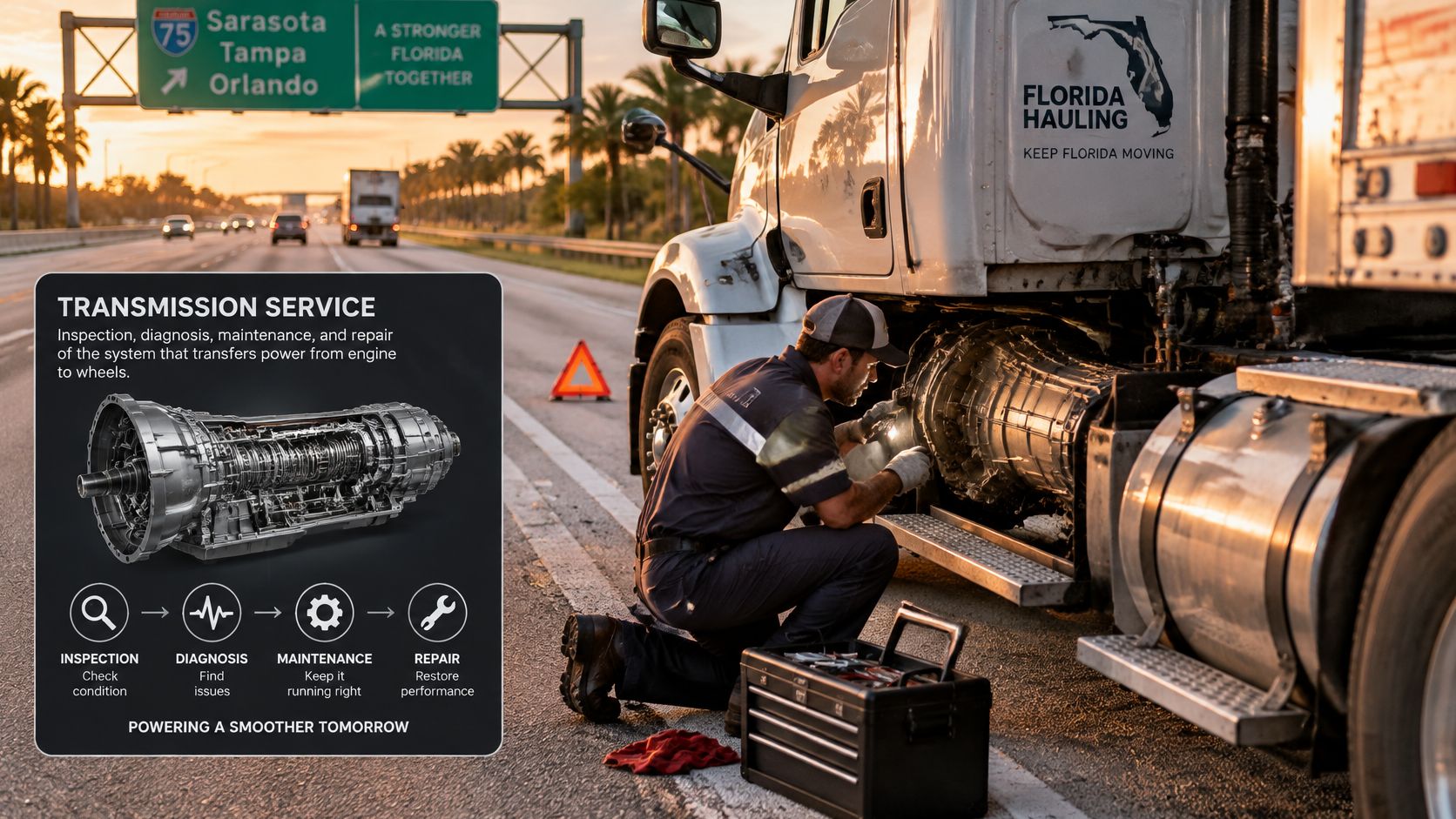
Transmission service on a heavy truck means inspection, diagnosis, maintenance, and repair of the system that transfers engine torque toward the wheels. Fluid work is one step inside a wider check of the model, lubricant, leaks, controls, and shift behavior.
Why One Symptom Can Have Different Causes
A heavy-duty diesel may use a manual gearbox or an electronically controlled automatic. Those designs fail in different ways. Slipping, delayed engagement, harsh shifts, abnormal noise, loss of drive, overheating, or a warning lamp can point to a mechanical problem inside the unit, a hydraulic problem with pressure or fluid condition, or an electronic problem with a sensor, wiring, actuator, or control module.
That overlap is where confusion starts. A lamp is evidence of a reported fault, not proof of gear damage. A hard shift is evidence of poor shift quality, not proof of worn fluid. The technician has to separate evidence from guesses before anyone quotes a rebuild, a replacement, or a simple service.
Fluid does two jobs at once. It forms the oil film that keeps gears and bearings from direct contact. On many automatics, it is also the hydraulic pressure that applies clutches and makes shifts happen. Low, degraded, or incorrect fluid can hurt wear protection and shift quality, while fresh fluid cannot repair a broken actuator or a damaged gear.
What Routine Service Covers
Routine scope follows a logical order at the truck:
- Identify the unit: Confirm the transmission model and the approved lubricant before opening anything.
- Check the level: Read the level by the method that model requires.
- Inspect for leaks: Look at seals, gaskets, housings, coolers, and breathers for the source of any loss.
- Inspect filtration where fitted: Check a filter or screen only if that design uses one.
- Read the evidence: Note metallic debris, abnormal darkening, or a burnt odor without treating any one sign as a final diagnosis.
- Record shift quality: Write down how the truck engages and shifts before and after any work.
A planned service and a complaint visit aren't the same job, even when both involve fluid.
A planned interval service occurs because miles or hours indicate it is due, and the goal is prevention. A complaint visit happens because the driver reported a symptom, and the goal is diagnosis first. Mixing those two up is expensive. Draining fluid on a truck with an electronic fault wastes time, while scanning codes on a truck that is due for maintenance adds work nobody needs.
The useful record is specific: model, lubricant spec, leak location, fluid condition, codes or lamp status, and shift behavior before and after the visit. With that record, fluid service, clutch work, diagnosis, or replacement can be matched to the unit and its duty cycle instead of treated as a universal drain and fill.
Service Intervals That Follow the Duty Cycle
The first instruction for any fleet desk is simple. Identify the transmission model and the operating environment before quoting fluid work. Mileage alone doesn't establish the correct interval, and it doesn't establish the correct lubricant either. A model number, a fluid specification, and a duty cycle do.
The figures below are manufacturer examples, not a universal schedule for every brand. The Eaton Fuller heavy-duty transmissions service manual shows a heavy-duty highway application using approved synthetic transmission fluid with fluid-level and leak checks every 10,000 miles and fluid replacement at 250,000 miles, while normal off-highway use may use 1,000-hour replacement intervals and severe off-highway contamination can reduce replacement to 500 operating hours. Other brands and other models need their own published schedule, applied as written.
Example Heavy-Duty Fluid Checks by Duty Cycle
| Duty cycle | Level and leak check | Fluid replacement | What changes the interval |
|---|---|---|---|
| Heavy-duty highway with approved synthetic | About every 10,000 miles | About 250,000 miles | Highway schedule and approved synthetic fluid |
| Normal off-highway | Use the model hour schedule | About 1,000 operating hours | Off-highway load and exposure |
| Severe off-highway contamination | Use the model hour schedule | About 500 operating hours | Dirt and contamination |
| Mid-range or another transmission model | Use that model's published mile or hour check | Use that model's published replacement interval | That model's own maintenance schedule |
Those rows teach a clear lesson. Highway miles and off-highway hours aren't interchangeable measures, and neither one transfers to a mid-range model by guesswork. Where the table says to use the model's own schedule, the honest answer is to look it up rather than invent a number.
Why Level and Fluid Choice Matter
A low level does physical harm in a predictable way. It thins the lubricant film protecting gears, bearings, and synchronizing components, so parts that should ride on oil start to approach direct contact. Wear speeds up, heat builds, and shift quality suffers. The driver may feel hard shifting or hear noise long before anyone sees the cause underneath.
The wrong fluid or contamination creates a similar chain. Dirt and degraded lubricant raise operating temperature and can produce shifting faults that look like internal damage. That's why a technician checks the specification on the container against the model requirement every time. Close enough isn't a specification, and a fluid that's correct for one unit can be wrong for the next truck in the yard.
Practical rule: A level check without a leak inspection is an incomplete check, because topping off a leaking unit only resets the clock on the next failure.
Fleets can turn these intervals into planned work instead of roadside surprises. Tracking model, lubricant type, miles or engine hours, leak findings, and duty cycle in one file tells the maintenance desk when the next check falls due and which trucks run severe conditions. A highway tractor counting miles and an off-highway unit counting operating hours can sit in the same file, because each row carries its own measure and its own due point. That record also helps a dispatcher answer a technician's first questions without searching through old invoices.
A structured semi truck maintenance schedule gives those entries a consistent home across the fleet. The record stands as proof of what was checked, what was found, and what decision followed, so the next visit starts from evidence rather than memory.
Symptoms and Records to Capture Before Dispatch
A transmission complaint becomes far easier to solve when the driver writes it down in plain words before the truck moves again. Federal rules already require that habit. The FMCSA safety planner guidance on 49 CFR 396.11 states that drivers of non-passenger commercial motor vehicles inspect each vehicle and complete a signed post-trip report at the end of each workday, and if the report identifies a defect, the carrier must repair it or determine that repair is unnecessary before dispatching the vehicle again, then certify that decision on the original report.
That rule turns a vague phone call into a dispatch decision with a paper trail. The carrier can't treat a listed transmission defect as background noise. Someone has to repair it or formally decide repair isn't necessary, and that decision gets certified where the next driver and inspector can see it.
What the Driver Should Write Down
Plain language beats technical guesses. The useful entries describe what the truck did, not what part the driver thinks failed:
- The symptom itself: Slipping, delayed engagement, a gear that won't select, abnormal noise, visible fluid, a warning lamp, or loss of drive.
- When it happened: Cold start, idling, just after a highway run, loaded or empty, and whether it repeated.
- What was involved: The tractor alone or a specific tractor and trailer combination.
- The basics: Vehicle location, engine and transmission identity, and recent repairs.
- The safety call: Whether the truck can be moved safely or should stay where it is.
These details change the first questions a mobile technician asks. A slip that only happens hot points toward temperature and fluid condition. A gear that won't select after a recent clutch job points toward the recent work. Without that context, the technician starts from zero and the truck sits longer.
A Hypothetical Lakeland Example
Consider a clearly hypothetical case, not a customer story. A tractor near Lakeland won't select a range after a hot highway run. There's fluid on the frame rail, but nobody wrote down whether a fault code appeared. The driver tells dispatch only that the truck won't go.
Now add three records to that same hypothetical. A photo shows the leak path running from a cooler line area rather than the main housing. The last repair order shows a recent line replacement. The post-trip report notes the selection problem started only after the truck got hot. The technician's first checks now focus on fluid loss, the recent line work, and heat, instead of opening with fears of internal failure.
Photos of the leak path, the last repair note, and the driver report often save more time than any single tool on the truck.
One boundary stays firm regardless of how the story reads. A truck that can't be operated safely shouldn't be dispatched just because a temporary roadside adjustment might be possible. The carrier remains responsible for confirming the vehicle is safe before it returns to service, and a mobile visit doesn't transfer that responsibility to the technician.
Good records also protect the next shift. When symptom, timing, location, and recent work travel with the truck's file, a repeat complaint shows a pattern instead of looking like a brand new problem every week.
Checks That Separate Fluid Work From a Fault
A technically correct transmission service is a documented diagnostic decision, matched to the transmission model and the duty cycle the truck runs. The job is to separate a lubrication problem from a mechanical, clutch, linkage, pneumatic, electrical, or control-system fault. Each check below either confirms that fluid work is appropriate or points the repair somewhere else.
A Seven Step Check Sequence
- Record the complaint in the driver's words. Note whether the tractor, the trailer, or the combination was involved, and keep the driver's phrasing instead of translating it into a parts guess.
- Identify the model and approved lubricant. Confirm miles or engine hours at the same time, because the correct fluid and interval both come from that identity.
- Check level and leaks together. Inspect seals, gaskets, housings, coolers, and breathers, because a low reading often means lubricant is leaving through one of those points.
- Read fluid condition as evidence. Metallic debris can indicate gear or bearing distress, while a burnt odor or abnormal darkening can indicate overheating or lubricant breakdown. Use the evidence to choose the next test.
- Inspect the shift controls that design uses. Linkage, clutch operation, or pneumatic shift controls can mimic internal faults when they're worn, misadjusted, or leaking air.
- Scan electronic units before blaming fluid. Fault codes, sensor data, wiring and connectors, and calibration or adaptation status can explain symptoms that fluid condition alone never will.
- Compare shift quality after any fluid work. Measure the post-service road behavior against the original complaint, then record whether each reported symptom changed.
Step three earns its pairing. Eaton's published service procedures repeatedly pair lubricant-level inspection with leak inspection, and refilling without locating the leak invites recurrence and a roadside repeat failure. A top-off that ignores a weeping seal only schedules the same breakdown for a worse location.
When the Fault Isn't Fluid at All
Electronic faults put a hard edge on what fluid work can accomplish. The 2025 NHTSA recall report describes certain commercial trucks equipped with Allison 1000 and 2000 transmissions where an improperly calibrated shift actuator could prevent the transmission from engaging reverse. A fault like that lives in the calibration file and the actuator hardware, and it stays there until someone scans, tests, and corrects it.
The scan result decides whether the truck needs a calibration update, a wiring repair, or a component. That sequence is the working logic behind methodical semi truck transmission diagnostics at the vehicle.
Every check should land in the fleet file before the truck leaves. Model, lubricant, hours or miles, leak findings, duty cycle, fault codes, and post-service shift behavior together support trend detection. They also carry the harder decision the sequence is built to reach: whether the truck stays a mobile job or whether removal and teardown at a suitable facility is the honest next step. A gearbox that has to come out needs a facility equipped to take it out, and the checklist exists partly to draw that line before time and fluid get spent on the wrong repair.
How Missed Service Affects Fuel Heat and Uptime
Transmission condition decides how much engine power reaches the wheels. A gearbox works like a chain between the engine and the tires: when fluid degrades, shift control drifts, or heat goes unresolved, the engine burns more fuel to hold the same road speed. The driver feels it first as lazy or harsh shifts. The fuel bill and the repair bill follow.
Published efficiency figures explain why preserving shift quality matters, as long as their scope stays honest. The U.S. Department of Energy article dated March 30, 2020 states that beginning with model year 2016, improved automatic transmissions became more fuel-efficient on average than manuals through added gears that kept engines operating in more efficient speed ranges, and identifies dual-clutch six- and seven-speed transmissions as capable of reducing fuel use by approximately 3% to 9%, partly because they eliminate torque-converter losses.

What Those Figures Do and Don't Mean
Both figures are light-duty technology estimates and apply to that class of vehicle. They describe what transmission engineering can achieve, and no service visit can promise them as payback for a specific Class 8 gearbox. What they do show is the direction of the engineering: designers chase efficiency through gear count, shift timing, and reduced losses, and poor maintenance hands some of that efficiency back.
The maintenance link needs no invented benchmarks. Degraded fluid raises friction and temperature. Wrong fluid or contamination raises temperature further and disturbs shift control. Unresolved overheating stresses clutches, gears, seals, and the cooler, so a truck that needed fluid attention can end up needing hard parts.
Each of those stages is a documented observation on a specific unit. That is why a hot shift complaint is a reason to inspect promptly and record the finding against the truck's model and duty cycle, not a reason to quote national fuel totals.
Efficiency built into the hardware only survives if fluid condition and shift control stay correct.
Uptime follows the same logic. A Tampa or Lakeland tractor that gets a timely diagnosis keeps a small, contained problem. The same tractor run for weeks with low fluid or an ignored warning lamp converts that problem into secondary damage and a longer stop, sometimes past the point where work at the vehicle is still the right call. The service record makes that boundary visible: fluid condition, fault codes, and shift behavior at each visit show whether the truck is trending toward a fluid correction or toward removal and internal work.
Mobile Scope Versus a Suitable External Facility
The legal duty sits with the carrier before any technician arrives. The FMCSA maintenance rule page requires each motor carrier to systematically inspect, repair, and maintain every commercial motor vehicle under its control, with parts and accessories kept in safe and proper operating condition. A mobile visit supports that duty within the limits of the site. The carrier's obligation covers every job, including the ones a shoulder cannot host.
Where a Transmission Job Can Reasonably Be Done
| Job | At the vehicle | External facility | What must be true first |
|---|---|---|---|
| Level, leak, and fluid-condition check | Often | Not usually required | Safe access and the correct model identified |
| Filter or pan service | Only if the site allows it | When access, level ground, or containment is unsafe | Parts, containment, and a safe work area |
| Code scan, wiring, and calibration check | Often | If the setup cannot be done safely on site | Scan tools and a stable electrical supply |
| Linkage, control, or clutch adjustment | Sometimes | If under-truck access is unsafe | Room to work without traffic exposure |
| Removal, internal rebuild, or unit replacement | No | Yes | Lifting equipment, workspace, and post-repair testing |
Read the middle rows carefully. A pan or filter service needs safe level access, fluid containment, and the correct parts on hand. On a highway shoulder those conditions rarely line up, so the same job moves to a level site or a facility. Code reading and calibration checks often work well at the vehicle with professional scan tools, though programming still depends on the specific job and a stable electrical supply. Clutch or shift adjustments depend on whether a technician can work under the truck without traffic exposure.
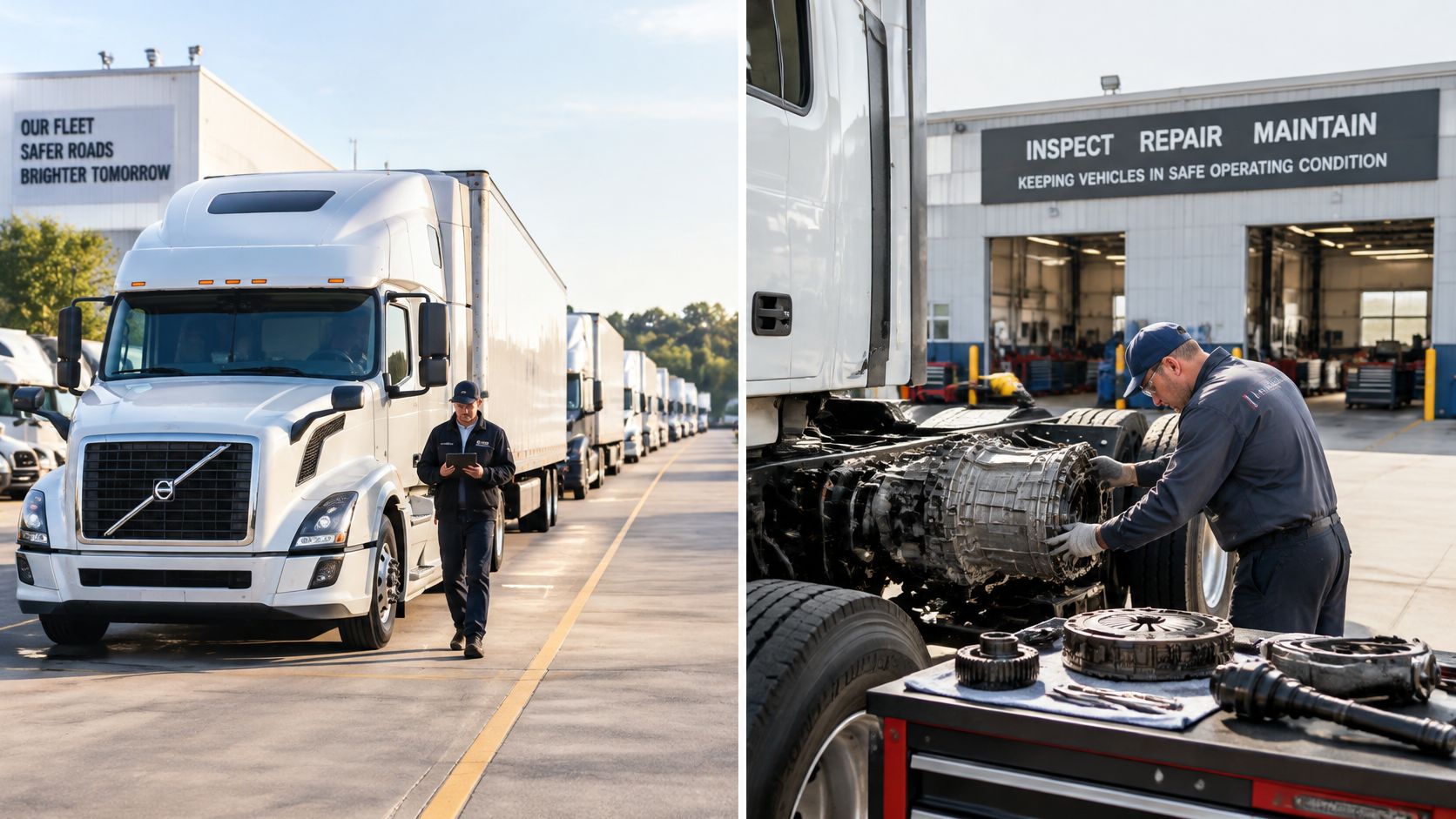
The last row is the hard stop. Transmission removal, internal rebuild, or full replacement needs controlled lifting equipment, workspace, parts handling, and post-repair testing that a constrained roadside usually can't provide. That work belongs at a suitable external facility, meaning an outside shop chosen for the job, and no towing service should be assumed or invented to get the truck there.
Manual and automatic units both follow this split, and the scope of semi truck transmission repair still gets judged job by job. The mobile model changes where the lighter work happens. The dividing line between light work and heavy work stays where it always was.
Roadside service is an assessment of what's safely possible at that truck, in that spot, with that access. Work that exceeds those conditions gets scheduled at a facility rather than attempted in place.
Feasibility gets assessed before work starts, using access, traffic exposure, vehicle condition, tooling, parts, and technician availability. SAAT Repairs Corp works as an independent mobile road services team at the vehicle's location, with no customer workshop, so every job begins with that on-site judgment call. When a job exceeds safe mobile scope, saying so early protects the driver, the technician, and the schedule far better than starting work that can't be finished safely.
Request a Conditional Mobile Assessment
A dispatcher who sends the right details gets a faster, more accurate answer than one who reports a vague "it slips." Send the truck's location in Tampa, Lakeland, or a nearby Florida corridor, the transmission model if known, the symptom in the driver's words, and whether the unit can be moved safely. Leak photos and the last repair note let the technician arrive with the right first questions.
SAAT Repairs Corp offers emergency road service 24 hours a day, 7 days a week, and the direct line for immediate assistance is +1 414 233 9746. Response targets run 45 to 60 minutes within the Tampa and Lakeland areas, depending on location and traffic conditions.
Arrival estimates stay conditional. Location, traffic, technician availability, and the job itself all shape the actual time.
The service is mobile only, so technicians come to the vehicle. There's no customer workshop, bay, or drop-off, and scope gets confirmed at the truck. Level checks, leak inspection, scans, and some adjustments may be possible where access is safe. Work beyond safe mobile scope gets referred to a suitable external facility for that job. A clear, documented mobile assessment is the request that gets a diesel fleet a straight answer.
For a heavy-duty truck with slipping, delayed engagement, a leak, or a warning lamp, operators can share the truck's location, transmission model, and the driver's symptom notes to start a conditional request. Visit SAAT Repairs Corp to send those details and request that assessment.