A transmission warning rarely arrives at a convenient place. It's more likely to appear under load on a Tampa or Lakeland corridor, with a delivery window tightening and a driver describing a symptom that sounds mechanical, electrical, or both. That's why semi truck transmission diagnostics has to start with a disciplined question: what does the stored code prove, and what still needs testing before anyone authorizes a repair, a tow, or another dispatch?
Table of Contents
- When the Transmission Light Comes On
- How Heavy-Duty Transmission Diagnostics Work
- What a Code Retrieval Session Actually Captures
- Why a Code Is Not the Same as a Failed Transmission
- What Can Be Safely Done at the Vehicle Location
- Reading Trends Before a Code Appears
- Information Worth Documenting Before the Next Event
- A Practical Standard for Transmission Service Decisions
When the Transmission Light Comes On
A driver reports that the truck won't take a gear, shifts late, or has dropped into a limited operating mode. The dispatcher hears a warning light, a flash code, or a vague description such as slipping, and has to choose between continuing, stopping safely, or requesting mobile service. That first decision matters because the symptom heard by phone isn't yet evidence.
What the first report can establish
The initial report can establish timing, load, gear behavior, and warning status. It can't establish whether the cause is a failed clutch pack, low voltage, a damaged harness, an air supply problem, a calibration fault, or an actuator that isn't reaching its commanded position. Treating those possibilities as interchangeable leads to the most expensive mistake in transmission work, which is replacing a major component because a code pointed in its general direction.
A code is a starting point for testing, not a parts order.
For an automated manual that won't shift, Eaton's driver instructions describe a controlled reset only after the truck is safely stopped, with the shift lever in neutral, the parking brake set, the ignition switched off, a 15-second wait, and then a restart, as set out in the Eaton heavy-duty transmission driver instructions. The same guidance notes that the service light stores diagnostic information in the transmission ECU and communicates faults through two-digit flash-code sequences. If the symptom persists after that reset, repeated ignition cycling doesn't become diagnosis. It destroys useful context.
Decisions for the first thirty minutes
Dispatchers and drivers can make the next step more useful by recording a few facts before a scanner arrives.
- Exact symptom: No engagement, failure to reach neutral, delayed shift, slipping, gear hunting, or a warning without a drivability change.
- Operating condition: Load, grade, speed range, temperature, and whether the fault appeared during a specific shift.
- Reset result: Whether the controlled reset changed anything, and which flash code or lamp remained.
- Safety status: Whether the truck can be moved to a safe location without forcing engagement.
That record separates code retrieval from root-cause confirmation. Retrieval tells the technician what the controller saw. Confirmation shows why it saw it, whether the fault is still present, and whether the truck can be returned to service safely.
How Heavy-Duty Transmission Diagnostics Work
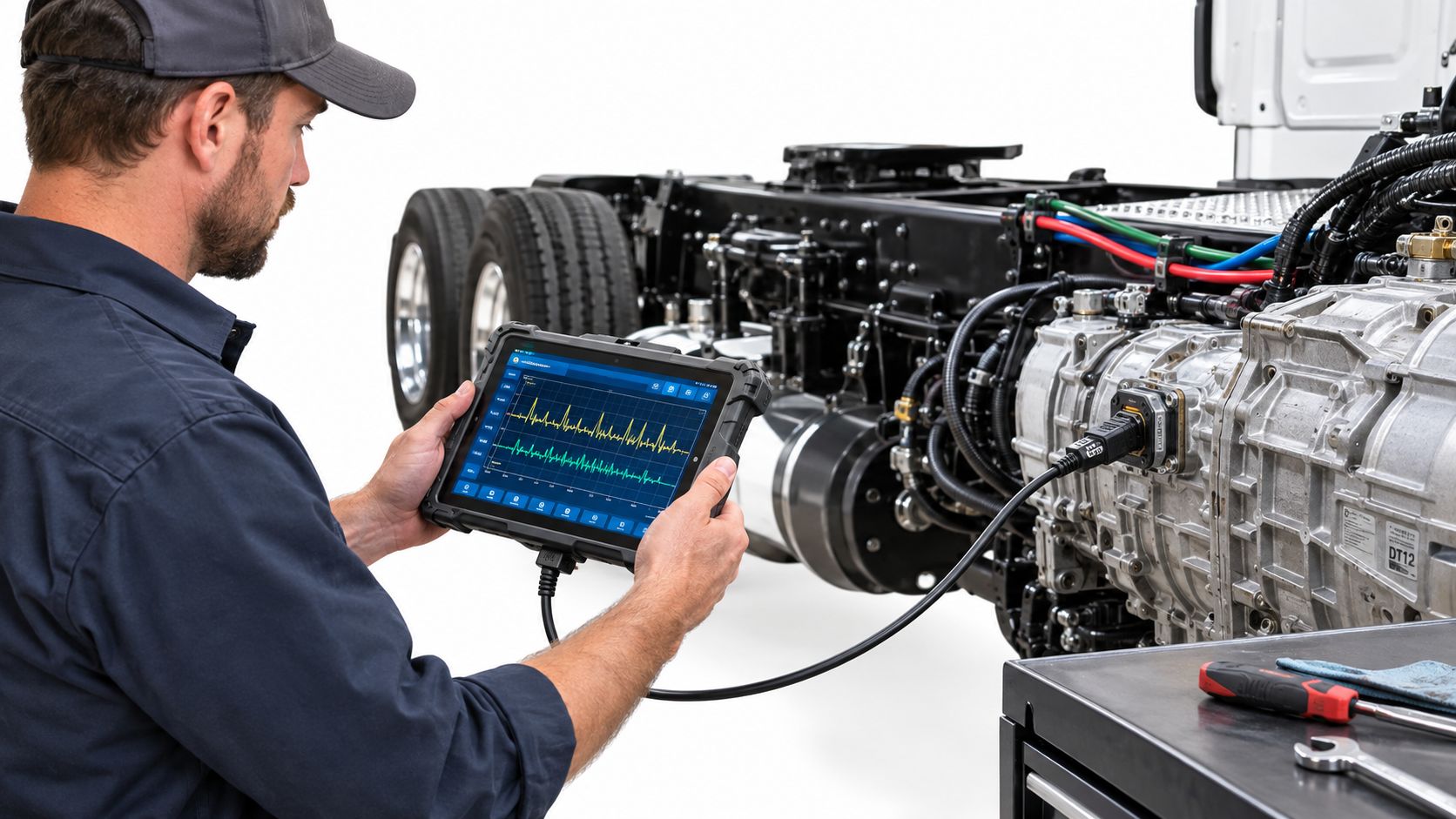
Modern transmission diagnosis depends on electronic communication before it depends on wrenches. The transmission control unit exchanges data with the engine, brakes, and other electronic control units, and the meaning of a code depends on the network carrying it. A technician who selects the wrong adapter or misreads the architecture can chase a communication problem as if it were a gearbox failure.
The hardware history explains why model year matters. Diagnostic connections moved from manufacturer-specific connectors used through 1995 to the 6-pin Deutsch connector standardized during 1996 to 2001, followed by the 9-pin Deutsch connector adopted by most manufacturers beginning in 2001. That chronology, along with the protocol shift described by Transport Canada's technical material on heavy-truck diagnostic connectors, shows why connector identification comes before fault interpretation.
A diagnostic connection at the truck provides access to controller data, not automatic proof of a failed component.
From J1587 and J1708 to J1939
SAE J1587, used with the J1708 data link, was developed for heavy and medium-duty vehicles built after 1985. SAE J1939 then introduced a CAN-based network connecting engine, transmission, brake, and other controllers. SAE published the initial J1939 specification set in 1998, and J1939 began replacing J1708 and J1587 on newer heavy trucks around 2001.
Older fleets may still require J1587 and J1708 support, while transitional trucks can carry both networks. Modern work commonly relies on J1939 parameter-group messages, controller fault codes, sensor values, and communication-status data rather than mechanical symptoms alone. If another module isn't reporting correctly, the transmission controller may react to missing or implausible torque, speed, or load information.
Why architecture comes before interpretation
The practical sequence is straightforward. The technician identifies the truck's model year, connector, and communication architecture, confirms that the scan tool can communicate with the relevant controllers, and then interprets the data in that context. Multi-protocol capability isn't an extra feature on a mixed-age fleet. It's a prerequisite for reliable fault isolation.
Practical rule: A transmission code only carries meaning when the controller, network, and operating condition that produced it are known.
That foundation also explains a common roadside limitation. A generic code list without live data, module status, and power and ground checks may identify the reporting controller, but it doesn't confirm the failed circuit or component.
What a Code Retrieval Session Actually Captures
A useful scan session isn't a quick read-and-clear. It's a documented capture of what the transmission controller recorded, what it's seeing now, and whether other modules agree with that picture. Clearing codes before that capture removes the evidence needed to tell an intermittent wiring fault from a persistent mechanical failure.
Evidence captured before codes are cleared
Active codes show faults the controller currently detects. Inactive or historical codes can show patterns that appear under load, heat, vibration, or a specific shift event. Freeze-frame and live data add context, including commanded and actual gear, shift timing, clutch or actuator position where available, input and output speeds, temperature, voltage, and engine torque signals.
The order matters. Power, grounds, connector condition, and J1939 communication should be verified before commanded actuation tests are used to judge a component. An actuator that doesn't move during a test hasn't failed conclusively if it's receiving low voltage, poor ground, inadequate air supply, or a corrupted command.
A structured diagnostic sequence
- Record codes and conditions: Save active and inactive codes, freeze-frame data, software and calibration status, and relevant live values.
- Check supplies and communication: Verify controller power and grounds, inspect connectors and harnesses, and confirm J1939 communication with related modules.
- Inspect fluid and external condition: Confirm fluid level and condition, look for leaks, and check mounts, airlines, fittings, and visible damage.
- Run commanded tests: Use OEM-supported actuation or calibration routines only after supply and communication faults have been addressed.
- Road test and rescan: Recreate the triggering condition when safe, capture live data, and confirm whether the code returns.
That workflow reflects the distinction between code retrieval and root-cause confirmation described in the commercial vehicle intelligent diagnostic tools market overview, which notes the expanding role of real-time transmission data, actuation tests, and post-repair verification. The important point for fleets isn't the tool category. It's the evidence standard.
A post-repair scan should follow the same discipline. A code that stays clear at idle hasn't been proven fixed if the original fault occurred during a loaded upshift, and a repeat scan under comparable conditions provides stronger confirmation.
Why a Code Is Not the Same as a Failed Transmission
Two manufacturer procedures show why a stored code should trigger testing rather than an immediate transmission verdict. Both begin with a symptom that could sound internal, yet both direct the technician toward controls, calibration, or circuit testing before major work is justified.
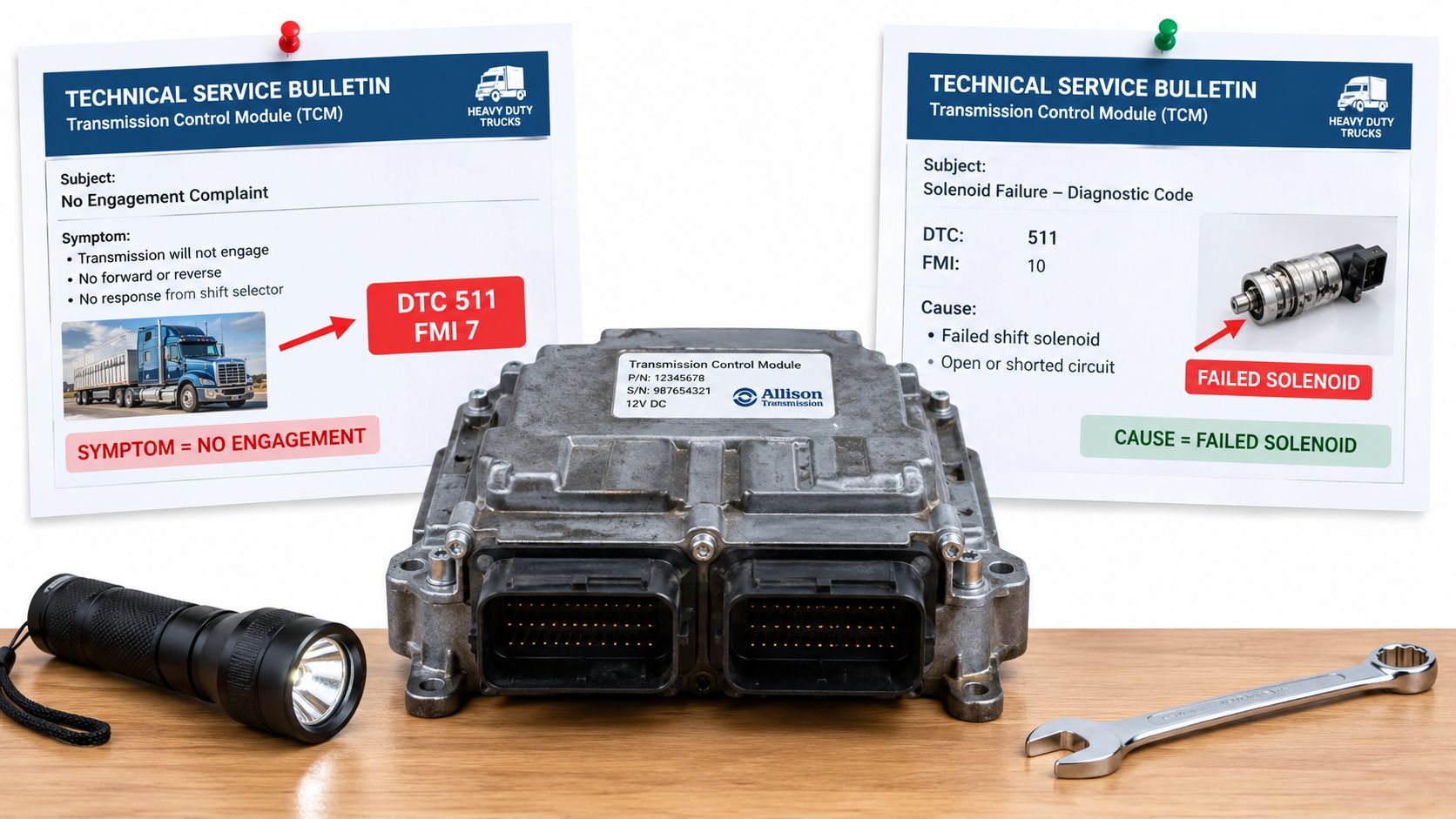
A control module removed for inspection illustrates the point that electronic control and mechanical condition must be evaluated together.
No engagement can start at the actuator
For an Eaton Endurant no-engagement or failure-to-select-neutral complaint, the documented procedure confirms DTC 511 FMI 7 or 10 and requires verification that transmission software and shift calibrations are current, according to the NHTSA-published Eaton Endurant diagnostic bulletin. The code indicates that the linear clutch actuator cannot achieve the commanded clutch position. Inadequate actuator travel leads to incomplete clutch release, which can block gear engagement or prevent neutral.
That chain changes the roadside plan. The technician captures active and inactive codes, records software and calibration status, verifies air and electrical supply to the actuator, and corrects the mechanical fault before calibration. For an in-chassis actuator replacement, the procedure specifies clutch calibration but not rail calibration, followed by a road test and renewed fault inspection. It allocates approximately 2.5 labor hours for diagnosis, code handling, actuator replacement, recalibration, and test drive.
Clearing that code without calibration can leave the controller's learned clutch position inconsistent with actual actuator travel. The truck may move again, then repeat the failure on the next dispatch. Electrical supply faults can produce similar confusion, which is why wiring and connector testing belongs in the same evidence chain as the procedures covered under semi-truck electrical repair.
The video below provides additional visual context for how diagnostic information is reviewed before a repair decision is made.
Incorrect ratio still requires pressure evidence
Incorrect-ratio codes require the same restraint. A manufacturer bulletin for P0733, P1DA8, or P1D92 directs technicians to pressure-check the specified D-clutch circuit before advancing toward transmission removal, as documented in the NHTSA-published incorrect-ratio diagnostic bulletin. Only a failed pressure test moves the procedure in that direction.
That's sound logic because clutch slip can result from insufficient apply pressure, a leaking circuit, valve-body or solenoid control faults, contaminated or incorrect fluid, or internal friction-element damage. A pressure pass shifts suspicion toward speed sensing, wiring, software, or calibration. A pressure failure provides stronger evidence of an internal hydraulic or clutch problem.
What Can Be Safely Done at the Vehicle Location
Mobile transmission work is scope-limited by safety, access, equipment, weather, parts, and the tests required to prove the repair. A truck stopped on a shoulder near Tampa or Lakeland isn't interchangeable with a controlled external facility, even when the initial diagnosis can be completed at the vehicle. The correct question isn't whether a technician can reach the truck. It's whether the fault can be confirmed and corrected safely at that location.
Work that often fits a mobile visit
Code retrieval, live-data capture, connector and harness inspection, power and ground checks, fluid level and condition checks, and air and electrical supply verification are generally suited to on-site evaluation when access is safe. A documented controlled reset may also be appropriate for certain automated manual complaints. After a verified mechanical correction, an OEM clutch calibration and a suitable road test may be feasible, depending on the vehicle, location, and available equipment.
Those tasks can answer the dispatch question that matters most: is this a control, supply, sensor, or calibration fault that can be addressed at the vehicle, or is there evidence of internal failure? That distinction helps fleets avoid unnecessary towing without creating an unsupported promise that a major overhaul can be finished roadside.
Roadside feasibility for common transmission findings
| Diagnostic finding | Realistic setting | Evidence required |
|---|---|---|
| Stored code with normal current operation | Vehicle location, if access is safe | Active and inactive codes, freeze-frame data, communication check, and road-test result |
| Actuator travel or clutch-position fault | Vehicle location in suitable cases | Code confirmation, air and electrical supply checks, calibration status, and post-repair calibration |
| Harness, connector, power, or ground fault | Vehicle location in suitable cases | Voltage, ground, connector, and continuity evidence tied to the symptom |
| Incorrect-ratio code | Vehicle location for initial testing, external facility if pressure results require removal | Commanded versus actual gear data, fluid checks, and OEM circuit pressure result |
| Suspected internal clutch or gearbox damage | Suitable external facility | Pressure evidence, fluid or oil findings, and inspection results supporting disassembly |
Internal gearbox disassembly, major replacement, and some pressure testing under load generally need controlled lifting, cleanliness, tooling, and verification conditions. Routing that work to a suitable external facility is an external option, not an invitation to bring the truck to a mobile provider's workshop. SAAT Repairs Corp operates through mobile Road Services at the vehicle location, so feasibility still has to be assessed case by case before work begins.
Reading Trends Before a Code Appears
Some transmission problems send useful signals before a fault code becomes active. Repeated abnormal shift timing, rising temperature under comparable loads, unexplained gear hunting, and clutch-slip indicators can justify inspection at a planned stop. The limitation is that a trend isn't proof of imminent failure.
Load, terrain, ambient temperature, driver behavior, voltage irregularities, and engine-torque data can all change how a transmission behaves. A single harsh shift on a grade doesn't carry the same weight as the same complaint repeated across similar routes and loads. Dispatchers get better value from trend data when it's compared against comparable operating conditions rather than treated as an automatic emergency.
Predictive alerts as triage signals
Industry developments described in the commercial vehicle electronic service tools market analysis include a March 2025 predictive-maintenance capability designed to detect issues before fault codes trigger, using historical and real-time data from transmission, engine, brake, and exhaust systems. The same period included an announced plan to integrate Allison diagnostic trouble-code data into a connected monitoring platform beginning in the second quarter of 2025. Those tools can support earlier decisions, but they don't replace verification at the truck.
A predictive alert should start a human check of load, temperature, voltage, shift history, and driver complaint. It shouldn't be sold as certainty that a failure has been prevented.
A useful triage standard separates three responses. A repeated trend without a warning can be scheduled for inspection, fluid review, and scan-data comparison at the next planned stop, including the fluid checks discussed in guidance on semi-truck transmission fluid. An intermittent complaint with stored inactive codes needs evidence capture before the data ages out of usefulness. A sudden derate, loss of engagement, or persistent warning requires the truck to be stopped and evaluated rather than dispatched on hope.
That approach avoids two opposite errors. Fleets don't waste a roadside call on every cold alert, and they don't ignore a pattern until it becomes a no-shift event away from help.
Information Worth Documenting Before the Next Event
Good documentation turns a frustrating breakdown into usable evidence for the next technician, whether the next step is mobile repair or work at a suitable external facility. Eaton's troubleshooting procedure specifically calls for observing broken mounts, fittings, brackets, and airlines, and for questioning the operator about operating conditions, vehicle use, problem history, and changes in shifting characteristics, according to the Eaton heavy-duty transmissions troubleshooting guide. It also calls for maintenance, lubrication, prior-failure, mileage, and engine-hour records.
A roadside-ready record
- Last successful gear change: Gear, speed range, load, and whether the shift was manual, automated, loaded, or empty.
- Warning evidence: Lamp status, flash code, displayed message, and whether the code was active when the truck stopped.
- Recent work: Clutch, actuator, air-system, battery, harness, software, or calibration work completed before the complaint.
- Fluid and lubrication history: Service timing, visible leaks, fluid condition, and any oil sample retained if disassembly becomes necessary.
- Pattern: Whether the failure is constant, intermittent, heat-related, load-related, or tied to one gear change.
That record should use the driver's plain description alongside scan results. Phrases such as won't leave neutral after a stop or slips only during the same upshift under load often guide testing better than a work order that only says transmission fault. Mileage and engine hours also help distinguish wear-related suspicion from a sudden electrical or air-supply failure.
Documentation has a second function. If the truck requires an external facility, the receiving technician can start from captured codes, calibration status, pressure results, and operating conditions instead of repeating the first hour of diagnosis. That's where a disciplined mobile visit still creates value even when the final repair can't be completed at the vehicle location.
A Practical Standard for Transmission Service Decisions
The standard is simple: retrieve the code, prove the cause, then choose the setting. Mobile work fits when the fault can be confirmed safely, corrected with available equipment, calibrated where required, and verified under conditions resembling the original failure. Internal damage, failed circuit-pressure evidence, or a repair requiring controlled disassembly belongs at a suitable external facility.
That go or no-go logic also protects fleets from premature replacement decisions, including the broader questions raised in transmission rebuild versus replace guidance. A stored code starts the investigation. It doesn't finish it, and it shouldn't be allowed to condemn a transmission before supply, communication, calibration, fluid, and circuit evidence have been checked.
For mobile semi truck transmission diagnostics in Tampa, Lakeland, and nearby Florida areas served, SAAT Repairs Corp provides roadside evaluation at the vehicle location, subject to safe access, job requirements, equipment, and technician availability. Fleets and owner-operators can use the English contact section to describe the symptom, warning evidence, and truck location so the next step can be assessed before a technician is dispatched.