A truck goes dead on the Tampa-Lakeland run, the driver says it's slipping between gears, and dispatch needs a decision before the load window closes. That is the moment to stop thinking in terms of a cheap fix versus an expensive fix. The question to ask is whether the truck can be stabilized on site, whether the core is worth saving, and which option gets the unit back earning money with the least total downtime.
For a heavy-duty fleet, transmission rebuild vs replace is not a parts-store debate. It is a dispatch decision, a maintenance decision, and a documentation decision. SAAT Repairs Corp works as a mobile Road Services provider only, so the first move is always roadside triage at the vehicle location, not a promise of a full overhaul in the lane or a workshop handoff that doesn't exist.
| Decision Point | Rebuild Existing Unit | Replace With Remanufactured Exchange |
|---|---|---|
| Core condition | Best when the case and major hard parts still inspect well | Best when internal damage is broader or teardown risk is high |
| Downtime | Depends on teardown findings and parts availability | Usually faster if a correct unit is ready to go |
| Cost shape | Can be lower if the core is strong | Can be easier to budget because the unit is defined |
| Warranty | Varies widely by builder and terms | Often comes with a clearer time and mileage structure |
| Field feasibility | Limited to diagnosis and safe stabilization on site | Installation may require a controlled external facility |
Table of Contents
- A Truck Down on the Tampa–Lakeland Run
- What Rebuild and Replace Actually Mean
- Downtime-Adjusted Cost Beyond the Invoice
- Side-by-Side Comparison of the Two Paths
- Real-World Scenarios for Owner-Operators and Fleets
- What to Document Before a Decision
- Decision Checklist for Your Next Transmission Call
- Common Questions Dispatchers and Owners Ask Next
A Truck Down on the Tampa–Lakeland Run
When a driver reports delayed engagement, slipping, or a flare between shifts, the first hour matters more than the invoice. A roadside technician can document the symptoms, check for leaks, scan for codes, and decide whether the truck is safe enough to keep parked or move under its own power. That initial assessment helps the fleet avoid a bad call, like authorizing a rebuild before anyone knows whether the case, geartrain, or control system is the problem.
A transmission complaint does not automatically mean the whole unit is finished. It might be an electrical fault, a fluid issue, a clutch-control problem, or internal damage. The job of mobile service is to narrow that down without pretending the lane is a rebuild bay.
Practical rule: If the truck is still moving, the priority is to capture evidence before anyone clears the fault or resets the system.
SAAT's role in that moment is direct and limited. The technician attends the vehicle location, stabilizes what can be stabilized safely, and records what the truck is doing. If the situation calls for teardown, machining, or a controlled installation, that work belongs in an appropriate external facility, not as a roadside promise.
What Rebuild and Replace Actually Mean
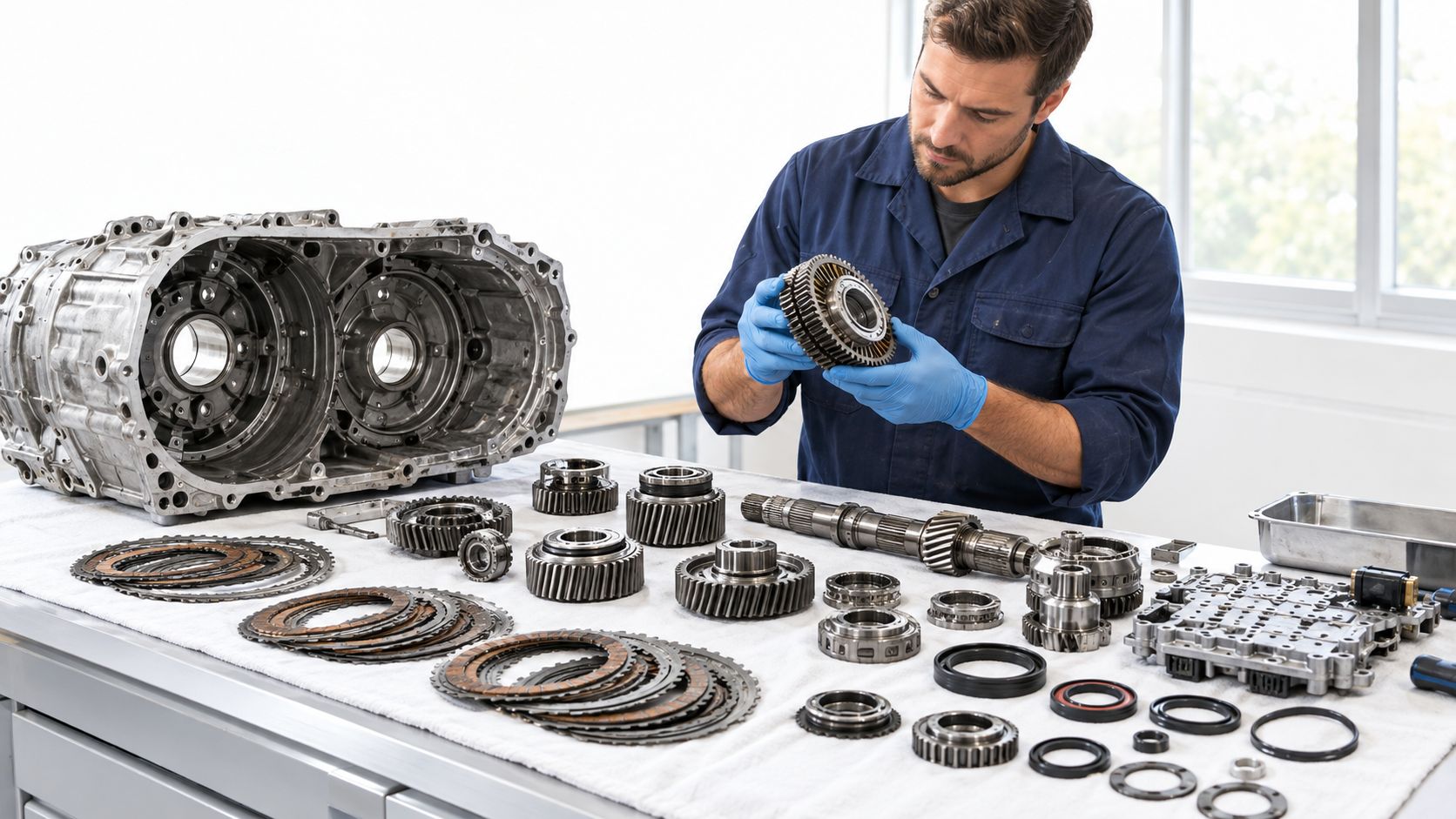
A rebuild keeps the existing transmission case and salvages the core if it passes inspection. The unit is removed, torn down, cleaned, measured, and fitted with the parts that failed, plus any other items that no longer meet spec. That means the outcome depends heavily on what the teardown reveals and how well the technician can verify wear, contamination, and hidden damage.
A replace decision usually means a professionally remanufactured exchange unit, not a brand-new factory transmission. The old unit comes out, the prepared exchange unit goes in, and the core is returned under the supplier's rules. The modern replacement market is heavily built around that model, not around factory-new inventory.
For a mobile technician, the boundary is straightforward. On site, it makes sense to confirm symptoms, inspect fluid, check wiring and connectors, and decide whether the truck can wait. A full internal rebuild, or a clean swap into a ready exchange unit, generally needs a controlled environment, proper lifting, cleaning, measurement, and verification equipment.
The key distinction is simple. Rebuild means you're betting on the existing core. Replace means you're buying speed and predictability from a prepared unit.
For a broader look at how that diagnosis starts in the field, the same logic applies to semi-truck transmission repair guidance. The roadside job is to verify the fault, not to invent a repair path before the truck has been inspected.
Downtime-Adjusted Cost Beyond the Invoice
Judge the transmission job by more than the estimate line. Compare the repair cost with revenue lost while the truck sits, towing risk if the failure gets worse, and the time needed to line up labor, parts, and programming. A cheaper invoice can still be the pricier decision if it keeps the truck out of service.
Maintenance and repair cost per mile rose by nearly 9% in 2025, while 64.4% of fleet repairs were completed in-house, according to industry reporting on fleet costs Fleet Maintenance on ATRI trucking costs. The point is simple. A truck that waits on parts or an open bay can wipe out the savings from a cheaper rebuild very fast.
For the broader maintenance rhythm that keeps these decisions rare, see our guide to truck fleet maintenance.
A fleet manager should weigh these points first:
- Downtime exposure: How many loads get missed if the unit stays down for diagnosis, teardown, or parts.
- Labor timing: Whether the repair starts now or waits for a controlled facility.
- Programming needs: Whether the replacement needs software setup or calibration to match the truck.
- Warranty administration: Whether the warranty is clear enough to save time if the unit comes back.
- Core handling: Whether the old transmission still has value as a returnable core.
A remanufactured unit with a clear path to installation can cost less in practice than a bargain rebuild that misses dispatch windows.
That is the economics that matter. The invoice matters, but the truck's earning window matters more.
Side-by-Side Comparison of the Two Paths
A clean comparison helps because shops use the same words for different jobs. One “replacement” may be a prepared exchange unit. One “rebuild” may be a full teardown of the original transmission. A fleet needs the actual path, not the label.
| Decision Criterion | Rebuild Existing Unit | Replace With Remanufactured Exchange |
|---|---|---|
| Reliability risk | Depends on what the teardown finds and whether worn hard parts are identified | More predictable because the unit is assembled and tested before installation |
| Turnaround | Can be fast or slow, depending on the core and parts | Often better when a correct unit is already available |
| Programming and calibration | May be simpler if the original configuration stays intact | Must match the truck's software, ratios, PTO needs, and torque rating |
| Warranty structure | Varies widely by builder | Usually clearer, with defined time and mileage coverage |
| Residual value | Preserves the original core if the housing and hard parts are good | Returns the truck to service sooner, but the original core leaves the vehicle |
| Sustainability | Can conserve resources when the core is sound | Still uses a remanufactured path, not a factory-new build |
Sustainability matters, but it does not settle the call by itself. A life-cycle study of a continuously variable transmission found the first remanufacturing cycle used about 70% of the energy required for a new unit, roughly a 30% energy reduction, and the remanufactured transmission was modeled at 75% of the cost of a new transmission OSTI life-cycle study. Those figures are useful benchmarks. They do not mean every heavy-duty truck transmission should be rebuilt.
The market also tells the story. A major East Coast supplier produced more than 8,000 heavy-duty transmissions annually, and over 95% of replacements were not new, which means fleets are usually choosing between the original core and a professionally remanufactured exchange unit Fleet Maintenance on heavy-duty replacements. That is the practical market fleets buy into.
Real-World Scenarios for Owner-Operators and Fleets
An owner-operator usually wants the truck earning again fast and still wants to keep the original core if it has real value. If the case, shafts, and gearsets are sound, a rebuild makes sense because it preserves more of the original unit and can fit the budget better. If the truck is down at a bad time and a confirmed exchange unit is on the shelf, replacement is the safer commercial call.
A fleet manager has a different priority. Dispatch pressure, CSA exposure, and route commitments make downtime predictability matter more than sentiment about the core. A replacement with a known configuration is often the better choice when the truck has to return to service on a schedule.
Environmental upside matters, but uptime wins when a truck is missing deliveries.
The energy and cost figures cited in the comparison above show why a sound core can be worth saving. The point is simple, save the core when it still deserves saving.
Late-model automated manuals and electronically controlled transmissions raise a separate risk, compatibility. A unit that looks right can still be wrong if the ratios, software, PTO provisions, or torque capacity do not match the truck's duty cycle. Dispatchers should treat configuration as part of the decision, not an afterthought. On a roadside call, SAAT's mobile model can stabilize obvious external issues and get a proper diagnosis started. Anything that depends on internal teardown, calibration, or hard-part inspection belongs in a controlled facility.
What to Document Before a Decision
Federal rules make this a maintenance record problem, not just a repair quote problem. Drivers have to report defects that could affect safe operation or cause a breakdown, and carriers must repair reported defects before dispatching the vehicle again while keeping the report and repair certification for three months FMCSA daily inspection rules. That means the first diagnostic pass should be written down, not held in someone's memory.
A strong transmission file should capture:
- Driver wording: Exact description of slipping, delayed engagement, or a failure to select a gear.
- Fault codes: Any stored codes before they're cleared.
- Fluid condition: Color, odor, level, and evidence of contamination.
- Leak details: Where the leak appears and how severe it is.
- Temperature behavior: Any abnormal heat pattern or overheating complaint.
- Shift behavior: Harsh shifts, missed shifts, or flare under load.
- Clutch or linkage clues: Evidence that the issue may be external rather than internal.
- Programming needs: Whether the truck may need software matching or calibration after repair.
For deeper transmission triage, the same documentation discipline is useful with the semi-truck transmission problems guide. The reason is simple. Good notes separate a wiring, control, or fluid issue from actual geartrain damage before anyone approves a rebuild or an exchange unit.
A carrier is still responsible for safe operation. Federal maintenance rules require systematic inspection, repair, and maintenance of every commercial motor vehicle under the carrier's control, with parts and accessories kept in safe and proper operating condition at all times FMCSA maintenance rule. If the truck is unsafe, it stays parked.
Decision Checklist for Your Next Transmission Call
Start with the truck's condition, not the repair preference. If the case and major hard parts are intact, a rebuild stays on the table. If there's contamination, widespread internal damage, or a failure pattern that points to more than one major component, replacement usually makes more sense.
Then weigh the truck's business pressure. A unit that can wait for teardown is different from a unit tied to a same-day load or a critical route. If an exchange transmission is available and the truck's configuration is well understood, replacement often wins on total downtime.
Use this checklist before authorizing anything:
- Confirm safe roadside status. If the truck can't be stabilized safely, stop there and plan for an external facility.
- Verify the exact fault. Don't guess from a dash light or a driver's summary alone.
- Check the core. Housing, shafts, gearsets, and major hard parts have to pass inspection if a rebuild is under consideration.
- Match the configuration. Ratios, PTO, software, and torque capacity must fit the truck.
- Compare downtime, not just price. The cheaper invoice can lose if the truck sits.
- Review warranty terms. Coverage has to be clear enough to matter if the unit comes back.
- Use mobile service for triage. Field work should focus on diagnosis, fluid checks, electrical checks, and safe stabilization.
SAAT's mobile model fits the first half of that checklist, not the whole overhaul. That's the right boundary. Roadside service can tell you whether the truck is worth saving on site or whether the next move is an external repair path.
Common Questions Dispatchers and Owners Ask Next
The next question is usually whether a mobile technician can fix the transmission on the shoulder. The honest answer is no, not as a default promise. Mobile service can diagnose, stabilize, and document, but a full internal rebuild or a complex replacement belongs in a controlled setting when lifting, contamination control, or programming demands make roadside work impractical.
Another common question is when a remanufactured exchange is the safer bet. It's the better call when the unit has broad internal damage, the truck has a hard delivery deadline, or a confirmed configuration match is available right away. It also helps when the fleet wants a more defined warranty path and less uncertainty around teardown findings.
Warranty terms deserve hard scrutiny. Commercial remanufactured powertrain coverage can be written in time and mileage, such as 18 months or 100,000 miles, and terms may also depend on core return, installation-date conditions, and geographic support Commercial warranty example. That means parts coverage, labor coverage, and return rules all need to be checked before approval.
A dispatcher also needs a defensible paper trail. Keep the driver's wording, the scan results, the fluid notes, and the repair certification in the file. That record is what supports the rebuild-or-replace call if the truck is reviewed later.
For roadside transmission triage, SAAT Repairs Corp handles mobile diagnostics, safe stabilization, and repair decisions at the truck's location across Tampa, Lakeland, and nearby Florida corridors. When the fault points to a rebuild or remanufactured exchange that needs a controlled facility, the right next step is to get the truck properly assessed and moved into the correct repair path. Visit SAAT Repairs Corp for direct contact with the English service team and get the transmission decision handled before the downtime gets worse.