Loaded onto the shoulder with a loaded trailer leaning and a hiss around the suspension, the right move is not to start naming parts. The right move is to keep people clear of traffic, decide whether the trailer is stable enough to touch, and figure out whether the fault is a leak, a ride-height issue, or a structural failure that needs a different plan. That first call matters because semi-trailer suspension repair can be a roadside job in some cases, and a tow or external facility in others.
Table of Contents
- A Shoulder Call on the Tampa-Lakeland Corridor
- Why Suspension Repair Is a Compliance Function, Not Just Maintenance
- The Functional Groups Inside a Trailer Suspension
- Symptom-to-Action Routing for Common Warning Signs
- Roadside Repair Versus External Facility: Where the Work Happens
- What a Service Visit Looks Like at the Vehicle Location
- Verification, Records, and Returning the Trailer to Service
A Shoulder Call on the Tampa-Lakeland Corridor
The trailer is angled on the shoulder near Lakeland, the driver says the rear end dropped on one side, and the noise is coming from the air-spring area. That is a triage problem before it's a repair problem. The first question is whether the unit is safe enough to approach, because a suspension issue can involve stored air energy, axle movement, and unexpected lowering.
First decide if the scene is safe
Keep the trailer where it sits unless traffic control, spacing, and ground conditions are under control. If the shoulder is soft, narrow, or exposed, the conversation shifts away from repair and toward containment. A technician should only be sent once the access question is answered clearly.
Practical rule: if the trailer is leaning hard, dropping, or shifting, treat it as a stabilization problem first and a wrench-turning problem second.
Then identify the system group
A driver's description should narrow the fault fast. Is it air loss, a spring pack issue, axle-positioning movement, or a mounting failure? That distinction is what decides whether a mobile response can diagnose the issue at all.
For a fleet manager, the useful questions are simple. Is the trailer still level enough to hold position? Is there an audible leak? Is a wheel tucked, cocked, or rubbing? If the answer points to collapse, displacement, or structural damage, the trailer is not a casual roadside candidate.
Then decide whether mobile work is appropriate
The best early decision is not “Can it be fixed?” It's “Can it be safely diagnosed here?” A safe call on the phone saves a lot of bad roadside heroics later. If the driver can describe a leak, a ride-height complaint, or a visible sag without any axle shift or hanger damage, a mobile inspection may make sense. If the trailer is visibly unstable, the location may not be suitable for on-site work.
For dispatchers, the first job is to document the basics, time, location, side affected, whether the leak is audible, and whether the trailer is level enough to support a safe response. A simple, disciplined report is better than a rushed repair order, especially when the next step may be an external option rather than a roadside fix. For related roadside decision-making, see commercial roadside service guidance.
Why Suspension Repair Is a Compliance Function, Not Just Maintenance
Federal rules do not treat trailer suspension as a cosmetic issue. Under 49 CFR 393.207, the system has to be structurally sound and in safe working order, and that covers axles, adjustable axles, leaf springs, coil springs, torsion bars, air suspensions, and air-suspension exhaust controls. Beyond swapping a broken spring, the rule asks whether the trailer is still legally and safely fit to roll.
What the rule changes for fleets
Once suspension defects show up in an inspection lane, the job turns into a compliance issue. FMCSA roadside guidance lists cracked, broken, loose, or missing axle-positioning parts, missing or separated spring leaves, defective suspension connecting rods or tracking components, deflated air suspensions, and air leaks of 3 PSI within 5 minutes as reportable conditions FMCSA safety planner guidance. Several of those conditions can be out-of-service failures, which means the trailer cannot legally keep operating until the defect is corrected.
That changes the fleet response. A suspension problem can mean immediate downtime, inspection paperwork, and dispatch disruption. The repair record matters as much as the wrench work.
What to record every time
Keep the description tight and factual. Note the side, the component group, the observed symptom, and the test result. A weak record like “suspension bad” helps nobody later.
Document the defect the way an inspector would read it, not the way a frustrated driver says it on the shoulder.
Write down whether the trailer leaned, whether the leak was audible, whether the axle looked shifted, and whether the vehicle was declared out of service. A clean record makes the next decision easier, especially when the trailer must be held, repaired, or routed to an external facility.
Why the compliance view protects uptime
Federal inspection procedures tie suspension maintenance into the broader commercial inspection system, including the requirement that every commercial vehicle receive a periodic inspection at least once every 12 months. That keeps suspension work in the same category as brakes and steering, not in a casual “we'll look at it next week” bucket. Once the defect is identified, the carrier has to treat correction and documentation as part of the service event.
The Functional Groups Inside a Trailer Suspension
"Suspension" gets used like it's one part, but it isn't. The fast way to miss the problem is to talk about the whole system when only one functional group is failing. Roadside diagnosis gets better the moment the fault is separated into the piece that holds position, the piece that carries load, the piece that feeds air, and the piece that keeps everything aligned.
The groups that matter at the shoulder
Axle positioning parts tell the trailer where the axle belongs. If they're cracked, loose, or missing, axle location can wander and tire tracking gets ugly fast.
Springs or air springs carry the load. A broken leaf pack or a flat air spring will show up as a sag, a lean, or obvious contact problems.
Air supply and ride-height controls manage the level. If the trailer won't hold height, the problem may be leakage, a valve issue, or a supply line problem rather than the bag itself.
Mounting hardware and bushings hold the assembly in place. Worn bushings or loose fasteners often show up as noise, play, or uneven stance.
Tracking or control arms keep the axle geometry in line. If these parts are damaged, the trailer can steer itself wrong without looking dramatic at first glance.
What each group sounds like on the road
A hissing corner points one way. A sideways lean points another. Tire rub points somewhere else again. The danger is assuming the visible symptom is the failed part.
Useful habit: describe what changed, not just what's broken. “Leans overnight,” “hisses at the right rear,” and “right tire is touching the liner” are better than “air suspension issue.”
That language helps a dispatcher or technician decide whether the unit can be diagnosed safely at the location. It also stops the common mistake of ordering the wrong part before the actual failure path is known.
For a broader air-system context, see the air system overview. The point is simple. A trailer that leans may have a bag problem, a line problem, a valve problem, or a structural issue, and each one pushes the work toward a different decision.
Symptom-to-Action Routing for Common Warning Signs
The smartest roadside call is the one that turns a symptom into a next action without drama. Dispatchers don't need a lecture when the driver says the trailer is sagging. They need a routing decision, a record point, and a hard stop when the symptom crosses the line into unsafe territory.
Route the symptom, not the guess
- Audible air leak. Most likely the air system, not the springs alone. First action, isolate the side and listen for the leak with the trailer secured. Route the work to mobile diagnosis only if the unit is stable and accessible.
- Soft or uneven ride height. Most likely the ride-height control, air supply, or an air spring. First action, note whether the trailer sits level and whether the condition changes after the system is checked. Route the work based on whether the trailer can be stabilized safely.
- Leaning trailer at rest. Most likely a bag, valve, or load-support problem, and it may also point to axle-positioning or mounting trouble. First action, stop the unit from moving and record the side that dropped. Route the work to mobile diagnosis only if the shoulder and trailer condition support safe access.
- Visible spring or hanger damage. Most likely a structural suspension issue. First action, don't keep probing the obvious break. Route the work to an external facility when the structure can't be safely serviced where it sits.
- Abnormal tire wear pattern. Most likely axle geometry, alignment, or ride-height drift. First action, photograph the wear pattern and note the affected axle. Route the work to diagnosis, not immediate part swapping.
- Post-curb-impact check. Most likely hidden damage to mounting points, bushings, or tracking components. First action, inspect for shifted hardware and note any change in stance after the impact. Route the work according to stability, not convenience.
What the dispatcher should capture
Write down the side, the time, the weather, whether the trailer was loaded, and whether the lean worsened after shutdown. Add photos if the location allows it. That way, the repair decision later is based on facts, not memory.
If the trailer is unsafe to walk around, it's unsafe to pretend a full roadside repair is the cheap option.
| Symptom observed | Most likely system group | First action | Route the work to |
|---|---|---|---|
| Audible air leak | Air supply or air spring | Isolate the side and confirm the leak | Mobile diagnosis if safe access exists |
| Soft or uneven ride height | Ride-height control or air spring | Record stance and level condition | Mobile diagnosis or external facility |
| Leaning trailer at rest | Load support or mounting issue | Stop movement and document the side | Mobile only if stable, otherwise external facility |
| Visible spring or hanger damage | Structural suspension member | Do not continue probing the break | External facility |
| Abnormal tire wear | Axle geometry or alignment | Photograph wear and note the axle | Diagnosis first, then repair path |
| Curb-impact aftermath | Mounting or tracking components | Check for shift, rub, or looseness | Case-by-case based on stability |
Roadside Repair Versus External Facility: Where the Work Happens
Mobile service does not automatically win. A shoulder is not a shop bay, and treating it like one puts the technician, driver, and nearby traffic at risk. The right call is the one that matches the repair to the working conditions in front of you.
What can be handled at the vehicle location
Pressure-leak diagnosis is often realistic when the trailer is stable and access is clear. Ride-height rechecks also belong in roadside work, because they show whether the problem sits in the bag, valve, or supply side. Airline or fitting work can be practical too, if the damaged section is reachable and the unit can be secured.
Single air-spring replacement can be done on-site only when the trailer is parked on a level surface, an axle remaining on the ground is chocked, suspension air is exhausted, parking brakes are released, and suitable supports are in place before the trailer is raised manufacturer procedure. Treat that sequence as mandatory. It separates controlled service from a bad lift.
What belongs somewhere else
Structural hanger damage, cross-member issues, axle re-alignment that needs a frame-level setup, and any job that demands heavy access equipment belong at an external facility. The same goes for a trailer that cannot be stabilized safely, or a repair that needs more room than the shoulder provides. On a busy Florida corridor, precision work belongs off the road when the scene is cramped or unstable.
If the work requires the trailer to be stable, level, supported, and easy to reach from both sides, roadside can be acceptable. If the work needs full structural access, controlled positioning, or repeated measurement, send it to an external facility.
Bottom line: the cheapest repair is the one that does not create a second incident on the shoulder.
Mobile repair should never mean everything here, right now. The service call starts with a safe-access decision, not a promise.
What a Service Visit Looks Like at the Vehicle Location
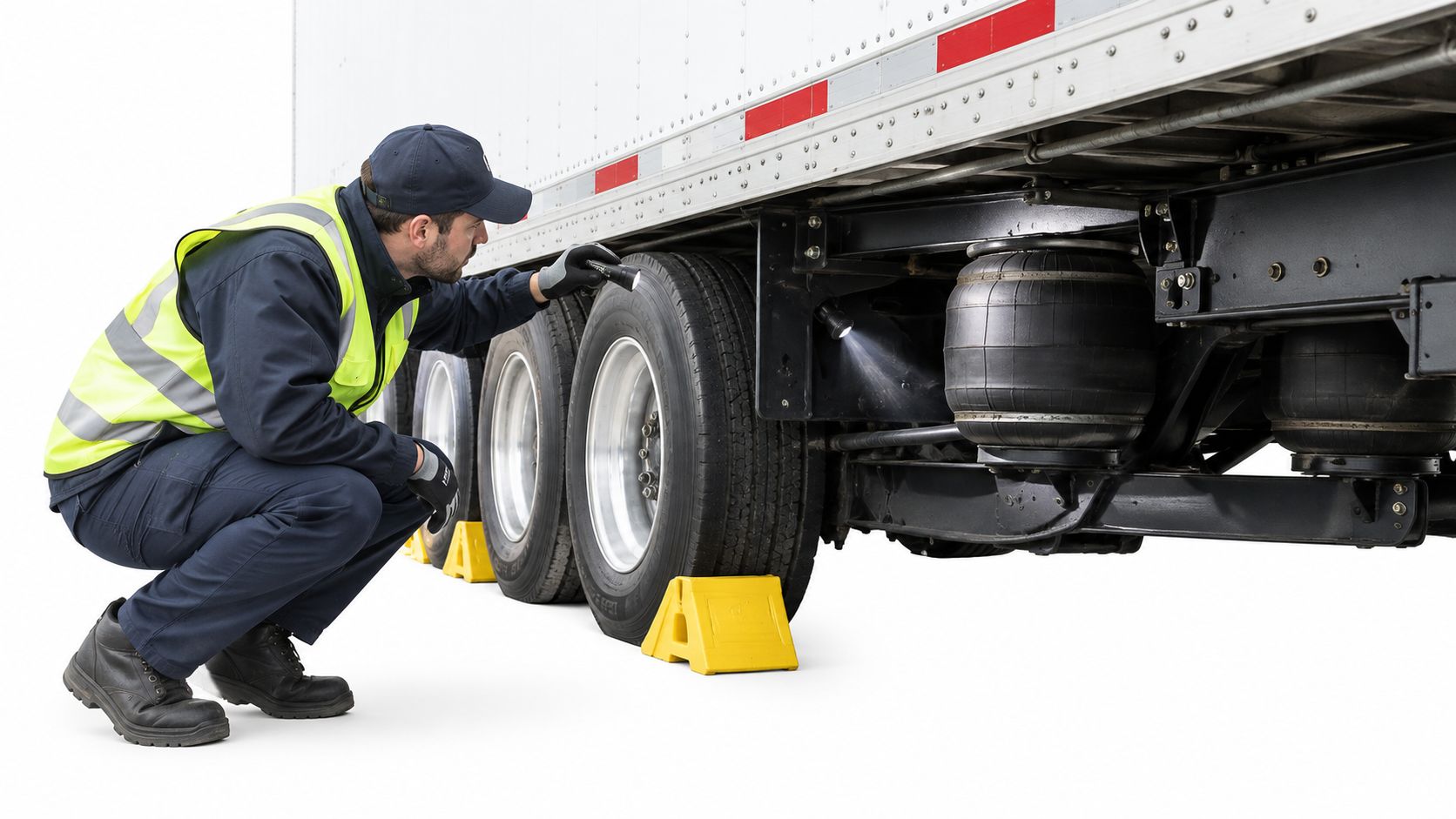
A mobile suspension call starts with the scene, not the wrench. On the shoulder, the technician checks whether the trailer can be stabilized, whether the ground will hold, and whether the load position leaves enough room to work without creating a second problem. If the setup is unsafe, the call ends there and the trailer goes to an external facility.
The sequence that separates real diagnosis from guessing
Once the trailer is secured, the technician checks system pressure, listens for leaks, and compares ride height on level ground when the setup allows it. That is the clean way to sort an air spring failure from a valve problem or a supply issue.
The inspection also has to cover the lines, fittings, and mounting points. Chafing, contamination, bent hardware, and disturbed fasteners change the repair decision fast. If a replacement part goes in, the job still is not finished until the suspension is put back into a supported condition and checked again.
A proper service note should read plainly:
- Safe-access check completed.
- Trailer stabilized and suspension depressurized.
- Ride height and side-to-side stance recorded.
- Leak isolated to a side, line, valve, or air spring.
- Repair completed only where the component was reachable and the job was safe.
- Recheck performed before the trailer is returned to service.
The record should also state what was left for later. Structural damage, a cramped shoulder, or any condition that makes the work unsafe belongs in that note, along with the handoff to an external facility.
Before the truck pulls away, the technician checks axle level, leak status, and adjacent components one more time. That recheck is what separates a polished mobile call from a rushed patch job.
Verification, Records, and Returning the Trailer to Service
Repair work isn't done when the last fastener is tight. It's done when the trailer passes a re-check and the carrier has the paper trail to prove it. A trailer that still leaks, still leans, or still shows damaged adjacent parts hasn't been returned to service, no matter how good the replacement looked on the shoulder.
The checks that should happen before dispatch
A proper post-repair review starts with a pressure-build retest and a ride-height compare. Then the technician checks the adjacent components, because the bad part often damaged something around it. Tire clearance matters too, along with a visual check of wheel-area hardware and any fasteners that could have shifted during the event.
For air systems, FMCSA inspection guidance says the vehicle should build air pressure from 85 to 100 psi within two minutes during the air-pressure build-up test CVSA inspection guidance. That kind of number gives a dispatcher something concrete to ask for, instead of a vague “looks fine” update.
What the carrier must keep
FMCSA guidance requires that when a vehicle is declared out of service the defect must be corrected before it operates again, the driver must provide the roadside inspection report to the motor carrier within 24 hours, the carrier must sign and return the completed report within 15 days, and the carrier must retain the original report, repair certification, and driver review certification for at least three months FMCSA roadside reporting guidance. That record cycle is part of the repair, not paperwork afterthought.
The carrier should require a note showing the failed symptom, the tested area, the repaired component, and whether the job stayed roadside or had to move to an external facility. If a mobile visit happens, it still has to end with the same question answered clearly, is the trailer safe to dispatch or not?
What to demand before the unit rolls
Ask for the retest result, the final stance of the trailer, and the note on adjacent hardware. If the answer is incomplete, the repair isn't finished. A good record protects the fleet when the same trailer is checked again later, and it protects dispatch from sending out a unit that still has an open defect.
When the trailer needs mobile diagnosis, safe on-site repair, or a clear handoff to an external option, SAAT Repairs Corp keeps the decision focused on access, safety, and uptime across Tampa, Lakeland, and the surrounding corridors. Visit SAAT Repairs Corp to contact the English service team and get a suspension issue evaluated the right way before the trailer moves again.