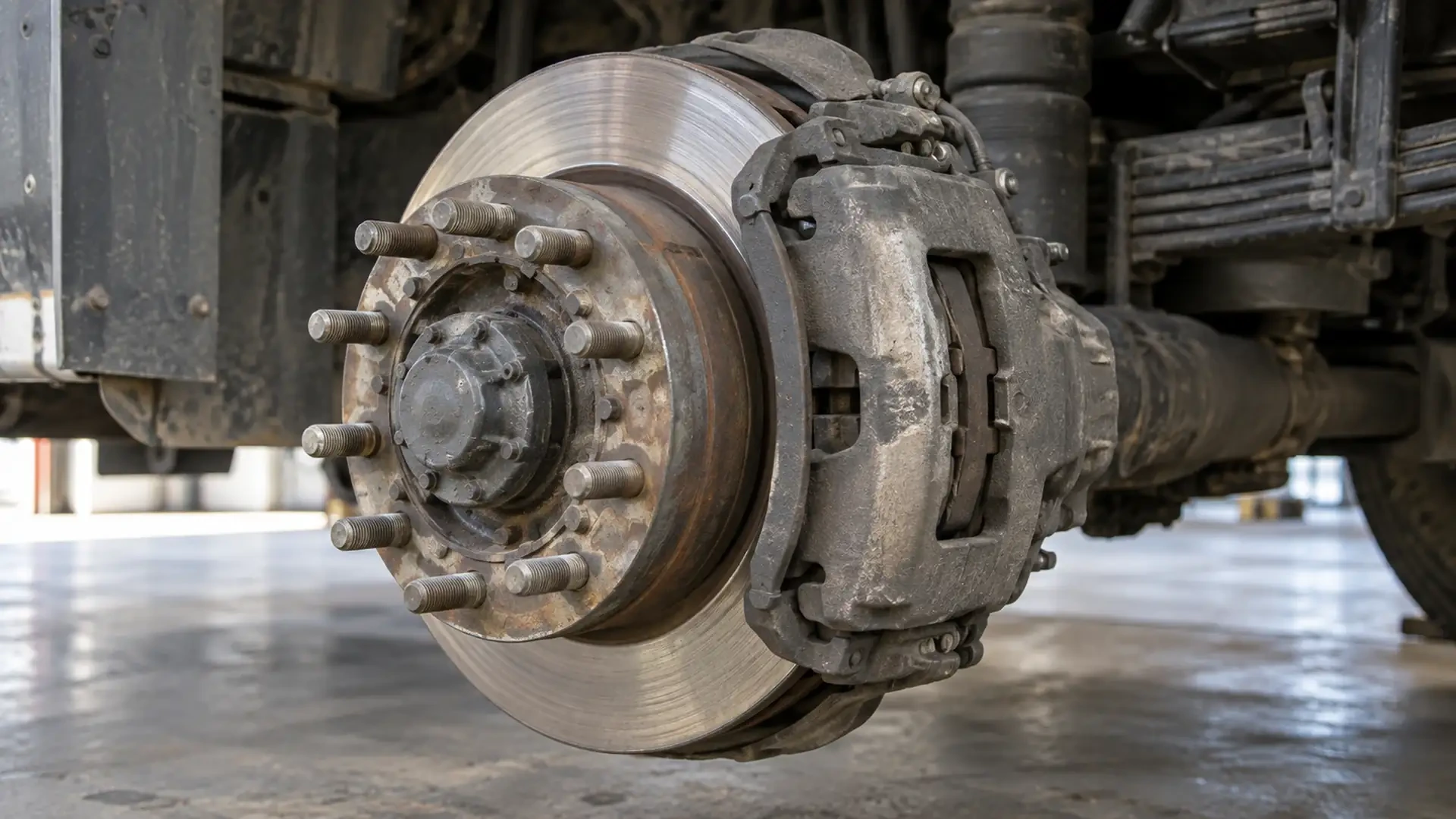
At 2 a.m., a tractor-trailer loses power on an interstate shoulder. The driver is safe, but the delivery clock keeps moving. A dispatcher is calling repair providers, the receiver is waiting for an updated arrival time, and every minute stopped on the road adds another complication to a route that was planned around a moving vehicle.
That is the economic reality behind commercial roadside service. For a heavy-duty fleet, roadside assistance isn't just a convenience for a stranded driver. It is part of the logistics operation, connecting dispatch, maintenance, recovery equipment, repair facilities, and delivery commitments when a truck can no longer perform its job.
Table of Contents
- Why Commercial Roadside Service Matters
- What Commercial Roadside Service Actually Covers
- Mobile Repair Versus Towing Choosing the Right Response
- The Economics of Downtime and Repair Costs
- Dispatch Expectations and Response Times
- Direct-to-Technician Service Models
- Building a Reliable Roadside Support Strategy
Why Commercial Roadside Service Matters
A loaded tractor-trailer loses power on an interstate shoulder, and the response cannot follow a passenger-car playbook. A light-duty tow truck may move a car to an ordinary service center. A commercial provider must account for tractors and trailers weighing up to 80,000 pounds, specialized recovery equipment, trained technicians, and round-the-clock dispatch coverage. Heavy Duty Journal's overview of heavy-duty truck roadside assistance explains why that equipment and expertise matter.
The roadside conditions add pressure. A technician may be working around air systems, electrical faults, a blown drive tire, a derated emissions system, or a trailer problem while traffic passes close by. If the recovery operator arrives without the right wrecker, tools, or vehicle information, a repair that should have ended the stop can require a second dispatch.

The breakdown is also a logistics event
The truck is only one affected asset. The driver remains assigned to the route, the trailer may hold time-sensitive freight, and the dispatcher must choose whether to notify the customer, arrange a relay, or wait for a mobile technician. Clear updates from the roadside provider give the fleet a better basis for that decision.
Commercial roadside service has become a logistics-support market because carriers need one coordinated process for tire replacement, jump-starts, diagnostics, minor repairs, towing, and coordinated escalation. Market forecasts reflect the scale of that demand. One estimate places the global vehicle roadside assistance market at USD 33.72 billion in 2025, with a projection of USD 67.48 billion by 2035. It identifies towing as roughly 27% of the 2025 market, while commercial vehicles are projected to grow from USD 13.95 billion to USD 28.31 billion, faster than the broader market. These figures come from the vehicle roadside assistance market estimate.
Practical rule: Treat a roadside call as a route-continuity decision, not just a repair order.
The right provider protects schedule capacity as well as the vehicle. It gives the fleet a realistic assessment of whether the truck can move, identifies the equipment required, and clarifies how quickly dispatch must make the next operational decision. That discipline limits idle time, prevents unsuitable recovery attempts, and keeps a breakdown from disrupting more of the route than necessary.
What Commercial Roadside Service Actually Covers
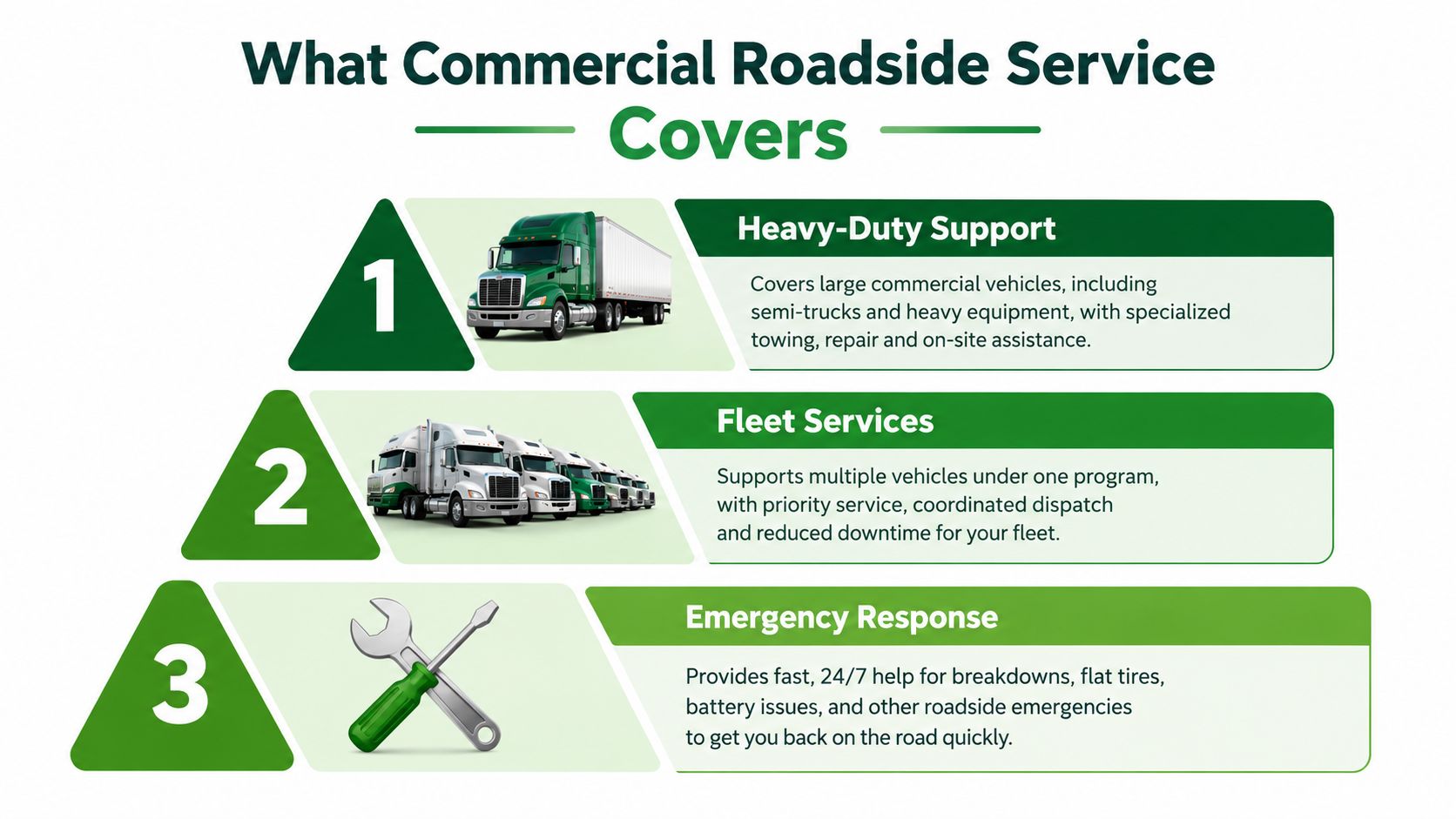
A roadside call can involve far more than a flat tire. A loaded tractor-trailer may need a technician who can identify an electrical fault, work around cargo and traffic, or arrange equipment capable of moving the vehicle safely. The service scope affects how quickly a fleet can restore the truck and how much route capacity remains available.
Commercial coverage usually combines three layers:
- Emergency assistance: Tire changes, battery or jump-start support, fuel delivery, and lockout response.
- Mobile repair: Electrical testing, fault diagnosis, minor mechanical work, air-system troubleshooting, and selected component replacement at the vehicle's location.
- Recovery and escalation: Heavy towing or specialized recovery when the truck cannot be repaired safely at the roadside or driven to a qualified facility.
Coverage limits matter as much as the service list
A contract can promise broad assistance while setting separate limits for labor, towing, parts, mileage, and after-hours work. Many commercial plans cap labor around $500 and towing around $5,000 to the nearest qualified repair facility. Confirm the exact terms before a breakdown, including the conditions described in this heavy-duty roadside assistance guide. A limit that covers a routine call may not cover a difficult recovery.
A fleet manager should verify:
- Whether the plan covers the truck, trailer, or both.
- Whether mobile diagnostics and programming are included or billed separately.
- How the provider handles parts, after-hours labor, and additional mileage.
- Whether towing is limited to the nearest qualified facility or can reach a fleet-selected shop.
- Which equipment classes the network can dispatch, including heavy wreckers and rotators.
Consumer assistance often assumes a simpler vehicle and a short move to a nearby shop. Commercial coverage must account for vehicle weight, cargo, roadside safety, route geography, and operational authorization. A plan suited to a pickup may leave a loaded combination vehicle waiting for a second provider, increasing idle time and recovery expense.
The strongest contract is the one whose exclusions, limits, dispatch rules, and escalation process match the fleet's routes and equipment. A long benefit list matters less than knowing what the provider will authorize at two in the morning.
Mobile Repair Versus Towing Choosing the Right Response
The first decision after a breakdown is often whether to send a mobile technician or a tow unit. Choosing incorrectly creates avoidable delay. A tow sent to a truck that could have been repaired at the shoulder may add handling, coordination, and shop time. A mobile technician sent to a truck with a failed transmission may lose valuable time before the fleet authorizes the recovery that was needed from the start.
Use mobile repair when the truck can be stabilized safely
Mobile repair makes sense when the failure is localized, the vehicle can remain safely positioned, and the technician can bring the likely tools or parts. Common examples include a failed alternator connection, a starter or sensor fault, a tire replacement, a minor air leak, or diagnostic work on a derate.
The dispatch call should include the truck's location, vehicle identification, symptoms, dashboard messages, trailer status, load condition, and any safety concern. A technician can make a better preparation decision when the dispatcher provides the actual fault description instead of just reporting “truck won't start.”
Authorize towing when movement creates risk
Towing is the better response when the truck can't be driven safely, the failure affects steering or braking, the vehicle is blocking a dangerous position, or the repair requires shop equipment and substantial parts. Transmission damage, major engine failure, severe frame or suspension damage, and some aftertreatment faults may fall into this category.
| Issue Type | Mobile Repair Suitable | Towing Required |
|---|---|---|
| Flat or damaged tire | Yes, if the truck is safely positioned and the correct tire is available | If wheel damage or unsafe positioning prevents roadside work |
| Battery, starter, or alternator fault | Often, after electrical testing | If the truck remains immobilized and the fault needs shop equipment |
| Minor air-system leak | Sometimes, if the leak can be isolated and repaired safely | If braking performance is compromised or the system can't be restored |
| Emissions derate | Diagnostics and selected resets may be suitable | If the fault prevents safe operation or needs deeper repair |
| Transmission or major engine failure | Rarely | Usually, because the truck needs controlled shop repair |
| Brake, steering, frame, or suspension damage | Not suitable for a roadside release | Yes, when safety or structural integrity is affected |
A provider should explain the decision, not just ask the fleet to approve the most expensive response. The technician's assessment should address whether the truck is safe to move, whether the repair is likely to hold, and what happens if the first intervention fails.
A fast wrong decision is still an expensive decision. Ask for a repair-versus-recovery recommendation based on safety, access, and the actual fault.
The Economics of Downtime and Repair Costs
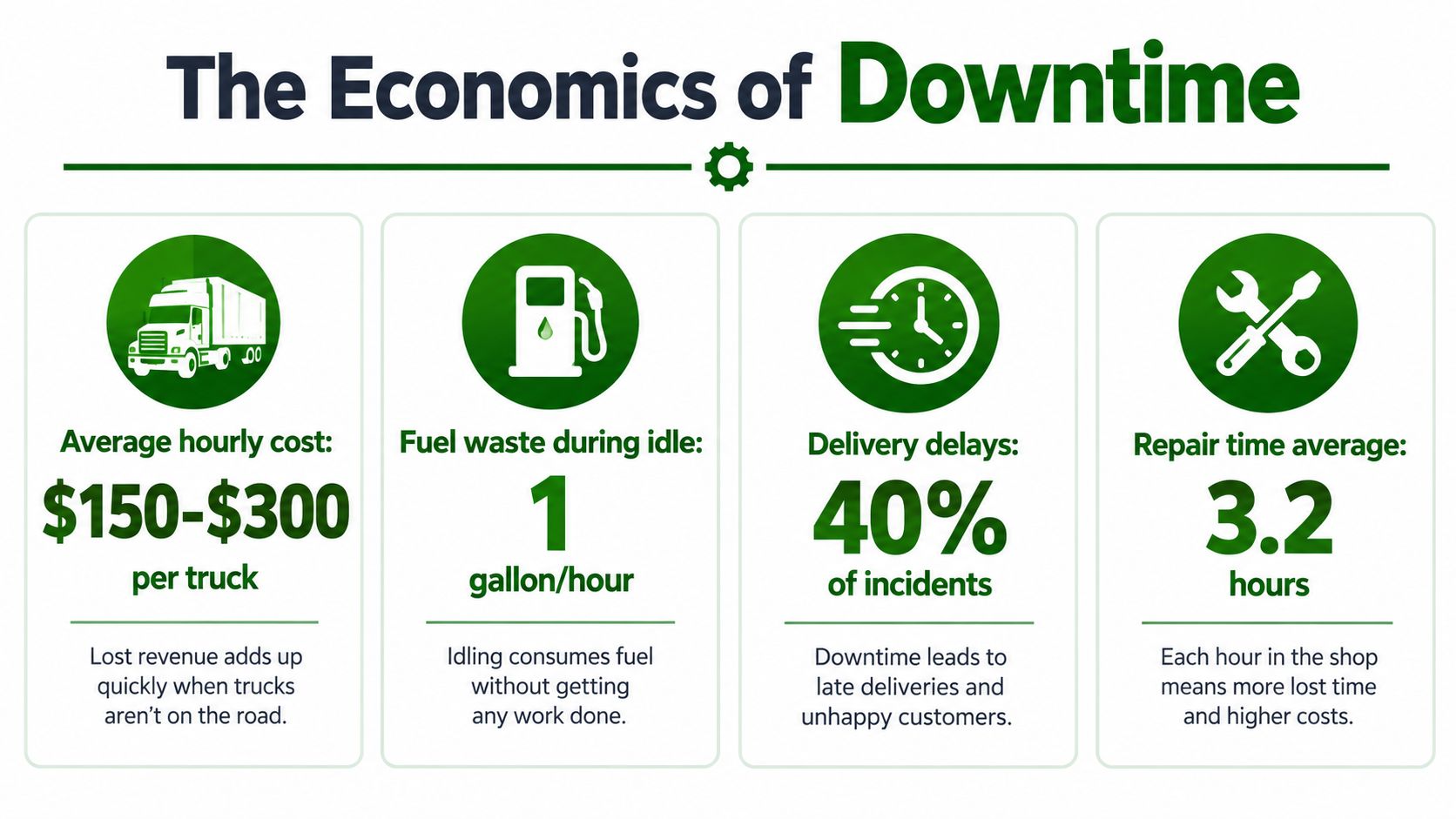
The repair invoice is visible. The larger cost often sits outside the invoice. While a truck is stopped, the driver remains assigned, the equipment is unavailable, the route may need to be rebuilt, and the customer may receive a late-arrival notice. A roadside program earns its value by controlling that total disruption, not merely by reducing the price of one repair.
The concentration of failures makes preparation especially useful. An industry summary citing ATA Technology & Maintenance Council benchmarking reported that five vehicle systems, led by tires, accounted for almost 70% of unscheduled roadside repairs. The same summary placed the average mechanical roadside repair cost at USD 491 in Q1 2020, which was 30% higher than a year earlier. The figures appear in Grand View Research's vehicle roadside assistance market analysis.
What the numbers mean for fleet decisions
Those figures don't mean every breakdown will cost the same amount. They show why a fleet should prioritize the systems most likely to generate an unscheduled event, maintain accurate tire and inspection records, and give dispatchers a reliable escalation path.
The same industry summary reported that fleets averaged 33,637 miles between breakdowns in Q1 2020. It also reported that commercial trucking repair and maintenance costs reached USD 0.202 per mile in 2023, compared with USD 0.148 per mile in 2013. That longer-term increase makes roadside response part of cost control, even when the provider doesn't perform the underlying preventive maintenance.
A useful review separates three costs:
- Direct repair cost: Labor, parts, diagnostic work, towing, and facility charges.
- Vehicle availability cost: The lost use of the tractor, trailer, and assigned driver.
- Network disruption cost: Missed delivery windows, replacement equipment, re-routing, and additional coordination.
A cheap provider that takes longer to dispatch may produce a higher total cost than a more capable provider with a higher call-out rate. Conversely, a premium response doesn't justify itself if the provider lacks the tools or parts to complete the repair. Fleet managers should compare first-time resolution, escalation quality, billing clarity, and response reliability, not just the initial service fee.
Dispatch Expectations and Response Times
A good dispatch call begins with accurate information. Give the provider the exact location, direction of travel, highway or exit, truck and trailer details, driver contact, visible hazards, cargo concerns, symptoms, dashboard warnings, and whether the vehicle is blocking a travel lane. The more precise the first call, the less likely the provider is to send an unsuitable unit.
Response time depends on geography and equipment class. In major metropolitan areas, roadside events may often be handled in approximately 45 to 120 minutes, while rural or remote events can take 2 to 4 hours or more, especially when a heavy wrecker or rotator is required. LogRock's discussion of commercial truck roadside service describes this geographic and equipment-based variability.
What to ask during the call
Don't accept “someone is on the way” as a complete update. Ask for the following:
- Dispatch confirmation: Has a specific provider accepted the call?
- Equipment match: Is the unit equipped for the truck's weight and reported failure?
- Estimated arrival: Is the estimate based on the provider's current location or a general service area?
- Technician contact: Can the driver speak directly with the responding technician?
- Escalation plan: What happens if the first unit can't repair or recover the truck?
Remote calls require more planning because the nearest qualified unit may be far away. A fleet can reduce uncertainty by selecting providers with strategically placed technicians, maintaining current route information, and documenting which facilities can accept heavy-duty repairs.
Dispatch discipline: Record the call time, acceptance time, estimated arrival, actual arrival, diagnosis, authorization, and release time. Those timestamps reveal whether the problem is provider capacity, incomplete information, or internal approval delay.
The cost of waiting isn't limited to the repair. A stopped truck continues to generate driver, equipment, and route-disruption costs, which is why response reliability matters more than a vague promise of coverage. The fleet should measure the entire event from the first call through a safe return to service.
Direct-to-Technician Service Models
Intermediary networks can provide reach, but they can also separate the person authorizing service from the person diagnosing the truck. That separation creates friction during complex calls. A dispatcher may record a generic complaint, send a technician without the needed equipment, and require several approval steps before the provider can change from roadside repair to towing.
A direct-to-technician model shortens that chain. The fleet manager or driver can describe the symptoms to someone who understands heavy-duty diesel systems, while the technician can ask focused questions about fault codes, derates, electrical behavior, air pressure, recent repairs, and vehicle configuration.
Better information at the first decision point
Direct communication is most useful when the fault isn't obvious. A modern diesel truck may need professional scan tools, smoke testing, wiring checks, emissions-system inspection, or software programming rather than a simple part replacement. A technician who can review the symptoms before dispatch can prepare for electrical diagnostics, sensor and harness faults, alternator or starter issues, DPF and EGR work, brake service, or ECU-related programming.
That doesn't eliminate uncertainty. It does make the uncertainty visible earlier. The fleet can receive a clearer estimate, understand whether a mobile repair is realistic, and decide sooner whether the truck should move to a shop.
A direct provider should also have a defined escalation path. Mobile service is valuable for a quick repair, but it isn't a substitute for a properly equipped shop when the fault requires deeper diagnostics or component replacement. The strongest model connects both options rather than forcing every incident into roadside work.
Where this model works best
Direct-to-technician service is particularly useful for regional fleets with repeat routes, familiar vehicle platforms, and dispatchers who need quick decisions. The provider can learn the fleet's approval process and understand that a repair decision may affect a delivery appointment, a driver handoff, or the availability of a replacement tractor.
Look for practical capabilities rather than a polished call center:
- Technical triage: The responder asks about symptoms and fault messages before assigning equipment.
- On-site diagnostics: The technician can test the system instead of guessing from a generic complaint.
- Shop escalation: The provider can continue the repair when the truck needs controlled facility work.
- Clear authorization: The fleet receives a direct quote or repair recommendation before avoidable work begins.
- Heavy-duty focus: The team understands commercial diesel platforms, trailer interfaces, and roadside safety.
A direct-to-technician arrangement won't solve every delay. It can, however, remove a communication layer at the point when accurate information has the greatest operational value.
Building a Reliable Roadside Support Strategy
A reliable roadside plan is built before a driver is stopped on the shoulder at midnight. Review the service agreement, mark its limits for labor and towing, and confirm that the provider can handle the truck and trailer combinations in your fleet. A service listed in a contract has little value if the network cannot reach the lanes your drivers run or lacks the equipment needed for a heavy recovery.
Build the operating process around decisions
Assign clear responsibility for approving mobile repair, towing, parts, and shop transfer. After securing the vehicle, drivers should know whom to call. Dispatchers should know which details the provider needs, including location, symptoms, fault messages, vehicle configuration, and delivery constraints. A written process prevents several people from having approval authority while nobody can release the repair.
Use a provider scorecard that reflects operating risk:
- Coverage fit: Does the network support heavy-duty equipment throughout the fleet's territory?
- Technical depth: Can technicians diagnose electrical, emissions, brake, and drivetrain faults?
- Recovery capacity: Is heavy towing available when roadside repair is unsafe or impractical?
- Communication: Does the provider give useful updates and maintain a clear escalation path?
- Billing control: Are labor, parts, mileage, and authorization records easy to audit?
- Performance history: Does the provider complete repairs, or often hand the event to another company?
Track the recurring causes of roadside calls. Frequent tire failures point to inspection and replacement planning. Repeated derates call for a review of emissions maintenance and diagnostic quality. Electrical faults that return after a roadside visit deserve a closer examination of whether the repair fixed the cause or only restored movement temporarily.
Industry forecasts indicate that roadside support is becoming a more established part of fleet infrastructure. The market forecast source supports that broader direction, but market growth does not confirm coverage where your trucks operate. Audit whether your provider covers Tampa, Lakeland, and nearby corridors, supports the required heavy-wrecker classes, and can escalate after hours. The economic question is simple: does the arrangement reduce dispatch disruption, missed appointments, and avoidable equipment repositioning?
Choose a provider that makes the first call useful, matches the response to the failure, and continues into shop repair when roadside work is insufficient. Test the process before a real breakdown exposes gaps in authority, coverage, or communication.
For heavy-duty trucks in Tampa, Lakeland, and nearby Florida corridors, SAAT Repairs Corp provides 24/7 roadside assistance, mobile diagnostics, mechanical repair, and in-shop support for individual operators and fleets. Contact the team to discuss a roadside response plan that matches your equipment, routes, and downtime priorities.
Published via Outrank