Professional heavy-duty DPF cleaning typically runs roughly $150–$500 per filter as a service benchmark, but the actual number includes diagnosis, removal labor, transport, downtime, and replacement risk. In practice, the cheapest quote is rarely the cheapest outcome.
Table of Contents
- When a DPF Cleaning Quote Actually Makes Sense
- What DPF Cleaning Actually Removes
- How a DPF Cleaning Bill Is Actually Built
- Cleaning Versus Replacement in Real Numbers
- What Mobile Roadside Technicians Can and Cannot Do
- Why Two Trucks Can Pay Very Different Prices
- Why DIY DPF Cleaning Rarely Pays
- A Practical Decision Checklist Before You Authorize the Work
When a DPF Cleaning Quote Actually Makes Sense
A driver usually reaches this point after one of three things happens: the DPF warning light comes on, the truck derates, or a scheduled service interval lands on the maintenance board. The question isn't whether cleaning is possible. It's whether cleaning is the right service for that truck right now.
For a fleet manager, that decision starts with how the truck is used. A tractor running steady highway miles behaves differently from a unit that idles, stops, and creeps through delivery routes. That's why a quote has to be read as a decision document, not just a price tag.
A fair estimate should separate roadside diagnosis from off-vehicle cleaning and show whether the truck can be handled on site or needs an external cleaning step. It should also show whether the issue looks like ash loading, a sensor fault, or a deeper aftertreatment problem that cleaning won't solve. A quoted price without that context can hide the true cost exposure.
Practical rule: If the invoice doesn't say what was tested before cleaning, what was removed, and what was reset after cleaning, the buyer doesn't yet have a complete quote.
For a mobile job in the Tampa-Lakeland corridor, the most useful first step is a case-specific roadside assessment. SAAT Repairs Corp's road-service guidance on DPF problems on the road and what to do next fits that workflow, because the truck can be checked where it sits instead of forcing a guess from the dispatch desk.
The anchor number is simple enough. Heavy-duty DPF cleaning usually benchmarks around $150–$500 per filter, but the final bill depends on diagnosis, access, transport, and whether the truck can stay productive during the work.
What DPF Cleaning Actually Removes
A cleaning service doesn't “reset” the filter in the way many drivers assume. It removes ash, not just soot. That distinction is the whole economics of the job.
EPA technical guidance separates regeneration, which burns combustible soot, from cleaning, which removes non-combustible ash left behind by oil and additives. Cleaning usually means the filter element comes out of the truck and goes into a purpose-built cleaning station. A parked regeneration or forced regen can help with soot loading, but it doesn't replace ash removal.
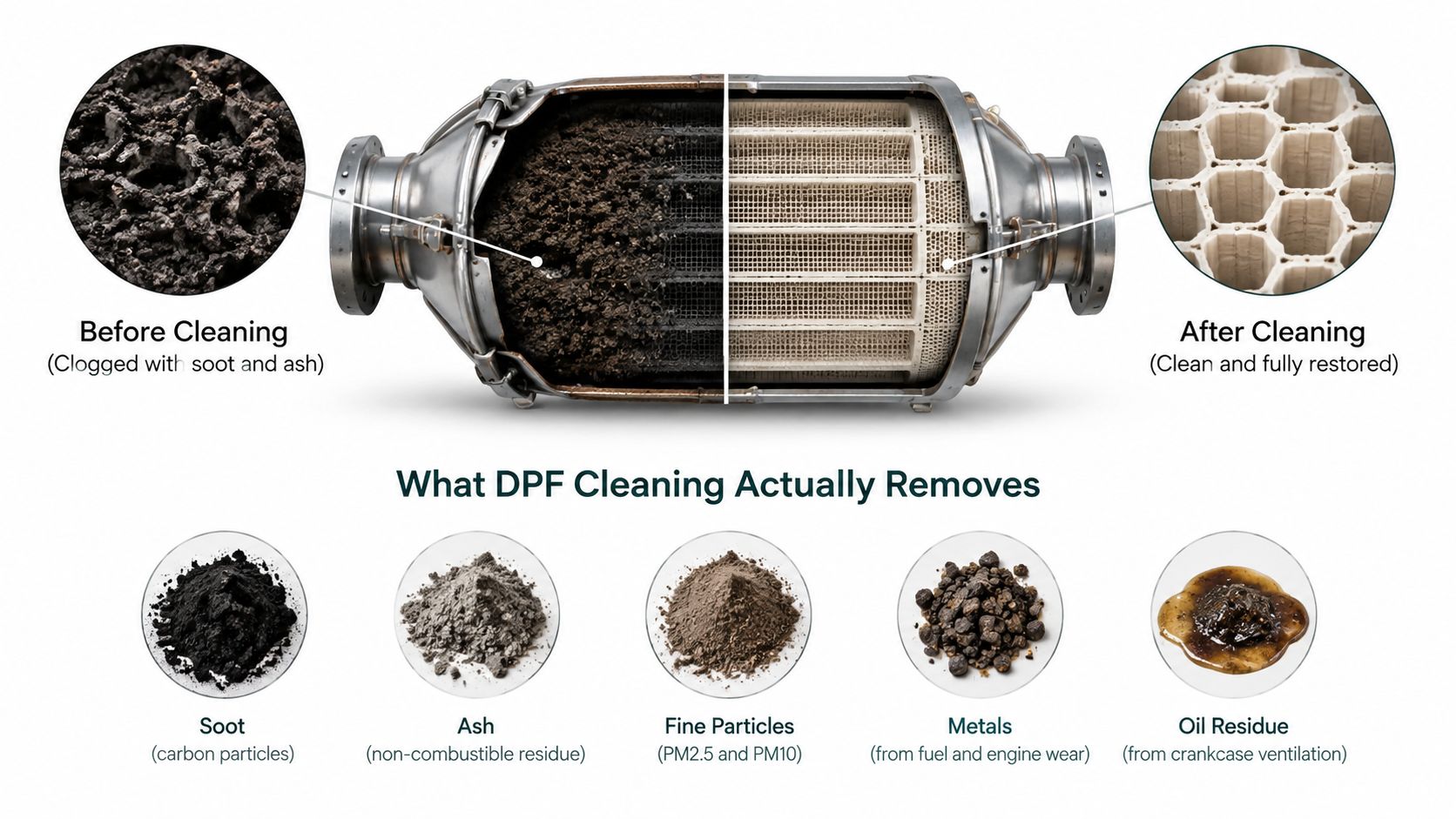
That matters because ash builds up even when the truck seems to be regenerating normally. Once ash occupies enough volume, the filter loads faster, regenerates more often, and the truck starts burning extra fuel just to stay out of trouble. If the root cause is excessive soot production, the cleaning interval shortens again.
Why soot and ash are priced differently
Soot is the softer problem. It's the material a hot regen is meant to oxidize. Ash is the stubborn residue that stays behind and has to be physically removed.
That's why a low-cost “cleaning” that only covers a burn cycle can disappoint operators. The truck may run better for a while, then the warning returns because the ash never left the substrate. In that case, the first invoice didn't buy real recovery, it bought time.
The EPA also notes that repeated loading can show a deeper issue in the engine or aftertreatment system. If the truck keeps producing abnormal soot, the cleaning interval gets shorter and the cost per mile climbs. That's why a proper DPF service begins with root-cause thinking, not with the cleaning machine alone.
How a DPF Cleaning Bill Is Actually Built
A fair DPF bill is a stack of separate labor events, and each one has a reason. A customer who only sees the cleaning machine charge is only seeing the smallest slice of the job.
The line items that should be on the quote
- Diagnosis and differential-pressure testing: Confirms whether the filter is restricted and whether a sensor, wiring issue, or engine fault is driving the warning.
- Parked or forced regeneration attempt: Useful when soot loading is the immediate problem and a safe on-site regen is possible.
- Removal labor: Takes time, tools, and access. Heavy-duty trucks can make this part of the job much larger than the cleaning itself.
- Transport or off-site handling: The filter may need to go to a specialized cleaning station instead of staying with the truck.
- Machine cleaning charge: The actual ash-removal process.
- Reinstallation and reset work: Includes software resets, fault clearing, and aftertreatment verification.
- Downtime exposure: The truck might be earning nothing while the work gets done.
Fleet Maintenance notes that cleaning needs are tied to mileage and duty cycle, not a universal calendar price, and that distinction explains why one fleet's invoice won't match another's. SAAT Repairs Corp's truck fleet maintenance guidance fits that same logic, because the maintenance record matters as much as the part itself.
A low headline price often covers only the off-vehicle cleaning cycle. That's not dishonest by itself, but it's incomplete if the quote leaves out removal, access, diagnosis, or reinstallation. The more immobilized the truck is, the more those “small” line items matter.
A truck that needs roadside triage, safe disassembly, transport, and reinstallation can cost more in labor than in machine cleaning. The invoice should say that plainly.
Cleaning Versus Replacement in Real Numbers
The decision becomes clearer when the price bands sit next to each other. Fleet Maintenance reports that replacement can run about $2,500 to $8,000 per vehicle before downtime is counted, while a separate market estimate places professional commercial-vehicle cleaning at about $150–$400 per service and replacement filters at about $800–$2,500. Those are broad market figures, not promises for any one truck. Fleet Maintenance
| Service Type | Published Range | Key Variables |
|---|---|---|
| Professional cleaning service | About $150–$400 | Filter size, ash loading, access, and whether the truck stays on site |
| Professional heavy-duty cleaning benchmark | About $350–$500 per filter | Removal labor, testing, and location-specific service conditions |
| Replacement filter | About $800–$2,500 | Substrate condition, design, and whether the part is new or exchange-based |
| Vehicle replacement exposure | About $2,500–$8,000 per vehicle | Installed cost, diagnosis, and downtime impact |
The table is only useful if the truck is still a candidate for cleaning. A cracked, melted, or chemically contaminated substrate changes the math immediately. So do stubborn pressure readings that stay high after cleaning.
The economic gap is why the first quote shouldn't be treated as a verdict. A truck that only needs ash removal can be a strong candidate for cleaning. A truck with substrate damage or a deeper engine fault may be better served by replacement or a different corrective path.
Video context can help dispatchers explain the stakes to drivers and planners, especially when a warning light turns into a scheduling problem.
The important comparison is total cost, not sticker price. A low cleaning invoice can still be the expensive choice if the truck returns to service with the same fault and fails again.
What Mobile Roadside Technicians Can and Cannot Do
A truck on the shoulder can still be assessed without guessing at the cause. The job starts with triage, not a promise of cleaning.
What can usually be handled on site
A mobile technician can read fault codes, check differential pressure, inspect wiring and sensors, and decide whether a parked or forced regeneration is feasible. If the fault sits in a sensor, injector, EGR component, or wiring defect, that root cause can often be identified before the filter is touched. That matters, because cleaning a DPF that will load up again is money spent in the wrong place.
What usually needs an external option
Filter removal, machine cleaning, and detailed substrate inspection usually require off-vehicle equipment. That is the part of the job that belongs in a shop or other fixed facility, not on the roadside. For SAAT Repairs Corp, the distinction is straightforward, because service is mobile only and the truck is attended at its location rather than brought in.
Any arrival estimate still depends on location, traffic, and technician availability. A dispatcher should not plan around a fixed promise when the unit is on the shoulder, on route, or buried in a yard with limited access.
In Tampa and Lakeland operations, the question is whether the truck can be stabilized where it sits long enough to make a smart decision. If the answer is yes, roadside diagnostics can prevent an unnecessary tow or an unnecessary cleaning, as covered in SAAT Repairs Corp's guidance on mobile fleet repair. If the answer is no, the quote should make clear that an external step is needed.

The boundary is simple. Mobile service triages the problem, off-vehicle equipment completes the ash-removal job.
Why Two Trucks Can Pay Very Different Prices
Two trucks can get the same warning and receive completely different invoices because the filter is reacting to the engine behind it. A long-haul tractor with a steady regeneration history is not dealing with the same load profile as a regional truck that idles in traffic and runs short hops around Tampa and Lakeland.
Fleet Maintenance says highway trucks often see preventive cleaning around 150,000–200,000 miles, then roughly every 100,000 miles, while severe-duty vehicles may need service much sooner, around 50,000–75,000 miles. The reason is duty cycle. Low-speed operation, frequent idling, and heavier particulate loading drive ash accumulation faster. Fleet Maintenance
The truck's operating pattern changes the invoice
A truck that spends its life on regional corridors may need more frequent intervention than a tractor with cleaner exhaust behavior. A recurring injector problem, EGR leak, turbo issue, or oil consumption problem changes the economics again, because the filter will load up after cleaning if the source of soot production stays active.
That's why an expensive quote is not always overpriced. It may be reflecting the actual labor needed to reach the filter and correct the condition that caused the loading in the first place. A cheap quote can be a bad deal if it ignores the reason the truck got there.
Useful rule of thumb: If the truck keeps making soot, the service interval shrinks. If the interval shrinks, cleaning stops looking like a one-time maintenance event and starts acting like a recurring expense.
For fleet budgeting, mileage records and fault history are what matter. The same cleaning method can be a preventive maintenance expense on one truck and a recurring repair on another. Those are different economic jobs, even if the filter hardware looks the same.
Why DIY DPF Cleaning Rarely Pays
DIY shortcuts are tempting because the filter looks like a part that should be easy to flush. That's usually how owners get into trouble.
California Air Resources Board guidance warns that ash removal has to follow manufacturer-approved procedures and cautions against improvised water sprays or compressed air outside an approved cleaning machine. EPA technical material also separates soot-burning from ash removal, which means a backyard rinse doesn't solve the actual job. A filter that's damaged during an improvised cleaning attempt can turn a recoverable issue into a replacement problem.
What usually goes wrong
A DIY attempt can drive contamination deeper into the substrate, leave residue behind, or crack the ceramic structure. Once that happens, the truck still needs proper removal, proper cleaning or replacement, and the labor bill doesn't disappear. It just gets larger.
That's the economic trap. A low-cost shortcut can multiply the original problem because the truck still has to come apart and the filter still has to be evaluated by a professional process. If the substrate is no longer usable, the owner pays twice, once for the failed attempt and again for the proper repair.
A professional cleaning quote looks higher for a reason. It includes the controlled process that protects the filter and the downstream diagnosis that decides whether cleaning is even worth doing. For heavy-duty equipment, that's usually the cheaper route.
Cleaning the wrong way doesn't save a DPF. It often turns a manageable ash problem into a replacement decision.
A Practical Decision Checklist Before You Authorize the Work
Before anyone approves the quote, the paperwork should answer six questions. If it doesn't, the estimate still isn't complete.
- Confirm the symptom: What exactly did the truck do, derate, warning light, failed regen, or repeated loading?
- Verify the code story: Which fault codes are present, and do they point to pressure, sensor, or engine-side causes?
- Require pressure readings: Get differential pressure before and after the service so the result can be measured, not assumed.
- Ask what's included: Does the price cover removal, transport, cleaning, reinstallation, and reset work, or only the machine cycle?
- Identify the cleaning location: Will the filter be cleaned on site, handled through an external facility, or only regenerated?
- Request the root-cause note: If the truck is making excess soot, what gets corrected so the same problem doesn't come back?
A quote that answers those questions is useful. A quote that skips them may still be cheap, but it isn't ready for approval. The goal is to spend once and get the truck back to work without guessing.
For Tampa, Lakeland, and nearby Florida corridors, a case-specific mobile assessment is the right next move when the truck is already down or the warning light is active. Arrival timing always depends on location, traffic, and technician availability, so dispatch should treat any window as conditional, not guaranteed.
SAAT Repairs Corp handles heavy-duty roadside diagnostics and mobile repair at the vehicle location across Tampa, Lakeland, and nearby Florida corridors, which makes it a practical fit when a DPF warning turns into a roadside decision. If the truck needs a case-specific assessment of cleaning, root-cause diagnosis, or whether off-vehicle handling makes more sense, visit SAAT Repairs Corp and use the English contact section to request help.