A truck loses power near the Tampa–Lakeland corridor, the dashboard shows an emissions warning, or a driver reports an air leak that makes continuing unsafe. The dispatcher has two choices, but neither should be automatic: send a technician to the vehicle or arrange controlled recovery to an external facility. The right decision depends on safety, access, diagnosis, equipment, and the likelihood that the first intervention will return the unit to service.
That distinction matters because downtime affects more than the repair invoice. ATRI's analysis of 2023 truck-driver detention found that annual detention across the U.S. trucking industry exceeded 135 million hours, with more than 72 million gallons of diesel fuel wasted while trucks idled. The reported combined burden was approximately $15.1 billion, although detention isn't identical to mechanical downtime. It still shows why a well-scoped mobile response can protect routes, driver hours, fuel, and customer commitments.
Table of Contents
- When a Truck Stops on the Corridor
- What Mobile Fleet Repair Covers
- Repair At Location Versus Tow To Shop
- Dispatch Workflow and Information to Send
- Service Level Expectations and Agreements
- Measuring Repair Quality After Return To Service
- Documentation Requirements For Florida Fleets
- Planning Mobile Road Services For Regional Fleets
When a Truck Stops on the Corridor
A regional truck doesn't need to be far from a terminal for a breakdown to disrupt the day. A tractor headed toward Lakeland may lose charging voltage near a busy interchange, or a trailer may develop an air-system problem while the driver is preparing for a delivery. The vehicle is already in the wrong place for a normal maintenance appointment, and the driver may be waiting in an exposed or restricted area.

A mobile technician changes the sequence. Instead of moving the truck first, the fleet can collect the vehicle location, symptoms, warning messages, and safety conditions, then determine whether diagnosis or a contained repair can happen where the truck sits. That can avoid unnecessary deadhead movement and preserve the driver's productive time, but only when the site and job are suitable.
Practical rule: The fastest response isn't always the fastest return to service. A rushed roadside attempt can create a second dispatch or leave a safety-critical fault unresolved.
Commercial brake condition illustrates the stakes. During CVSA's 2024 Brake Safety Week results, inspectors examined 16,725 commercial motor vehicles across North America and found 2,149 brake-related out-of-service violations, an out-of-service rate of 12.8%. In the United States, 14,692 inspections identified 1,900 brake-related out-of-service violations, equivalent to 12.9% of inspected vehicles. A vehicle placed out of service can't legally continue until the defect is corrected.
A service request should therefore describe the actual event rather than ask for “a truck repair.” The fleet breakdown response checklist helps dispatchers organize the information needed before roadside assistance is assigned. SAAT Repairs Corp provides mobile Road Services at the vehicle location, subject to safe access, equipment, technician availability, and job scope. It doesn't operate a customer-facing workshop, and major repairs may require an external facility.
What Mobile Fleet Repair Covers
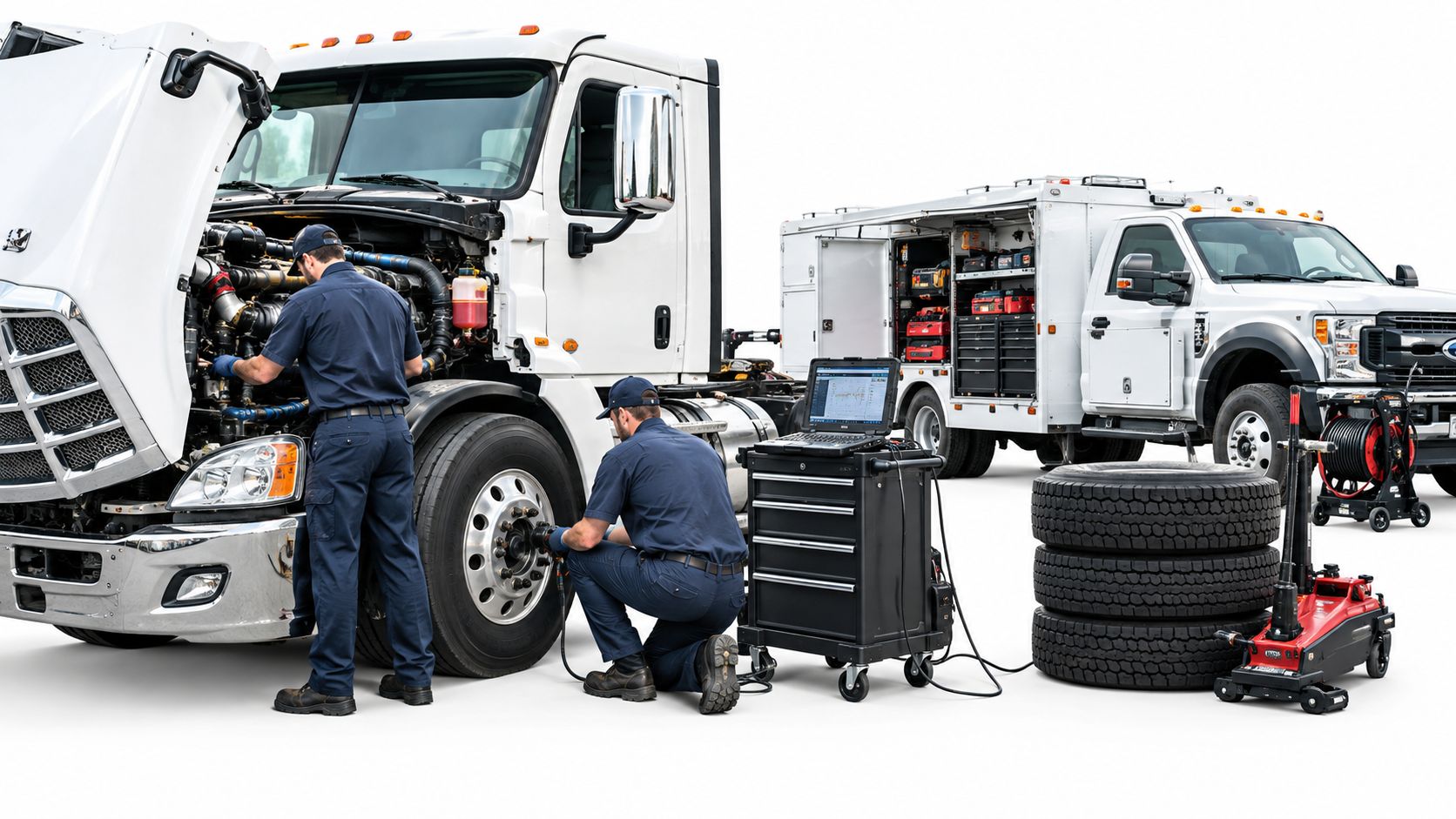
Mobile fleet repair works best when the problem is accessible, the probable repair is contained, and the technician can verify the result without a lift or extensive teardown. The service isn't defined by the presence of a scan tool. It depends on whether the entire diagnosis, repair, and safety check can be completed properly at the vehicle's location.
Diagnostics and electrical faults
A field technician may investigate no-start conditions, charging problems, wiring harness faults, sensor signals, communication issues, and intermittent electrical symptoms. Useful work can include voltage-drop testing, connector inspection, smoke testing for selected systems, scan-tool analysis, and step-by-step confirmation of the failed circuit.
Replacing the most obvious part isn't enough. A failed sensor may be the result of damaged wiring, unstable voltage, contamination, or a mechanical condition that caused the reading to change. The repair should include a test that supports the diagnosis and a verification that the original symptom has cleared.
Emissions and software systems
Late-model diesel platforms may need aftertreatment diagnosis, differential-pressure checks, DPF or EGR service, resets, calibrations, parameter changes, or compatible software programming. Some of these tasks can be performed at the vehicle location when the truck is safely positioned and the necessary equipment and stable power are available.
A fault code alone doesn't establish that a roadside repair is appropriate. If the issue requires extended testing, controlled regeneration, extensive disassembly, or repeated component substitution, an external facility may provide a safer and more reliable environment.
Brakes, air, suspension, and trailers
Commercial trailer brake, air, electrical, suspension, and structural repairs are confirmed service categories, but the work location remains case-specific. A technician may inspect air lines, locate leaks, assess brake components, perform certain adjustments, and replace accessible parts when the vehicle can be secured and the work can be verified.
The same caution applies to suspension, structural damage, wheel-end concerns, and extensive brake work. Traffic exposure, load status, ground conditions, lifting requirements, and the need for controlled testing can change the decision from mobile intervention to external-facility repair.
Preventive maintenance support
Planned inspections, service-interval work, fluid checks, battery testing, and documentation support can often be organized at a yard or other controlled vehicle location. Grouping suitable work around scheduled availability helps fleets identify developing conditions before a driver reports a roadside failure.
Mobile service doesn't replace a carrier's maintenance program. It gives the fleet another work environment, one that still requires a defined scope, safe access, complete records, and a return-to-service decision.
Repair At Location Versus Tow To Shop
The central question isn't whether mobile service sounds convenient. It's whether the vehicle can be repaired and verified safely where it sits, or whether moving it to a suitable external facility reduces the total risk and delay.
| Decision factor | Repair at the vehicle location may fit | External facility may fit better |
|---|---|---|
| Vehicle position | The truck is in a safe yard, wide shoulder, or controlled site | Traffic exposure, narrow shoulder, poor lighting, or unsafe ground limits access |
| Repair access | The failed component is reachable without lifting or major teardown | The work needs lifting, heavy component removal, or extensive disassembly |
| Diagnosis | The fault can be confirmed with portable testing | The issue is intermittent, system-wide, or requires extended controlled testing |
| Verification | The repair can be checked safely at the site | Brake, alignment, structural, load, or road testing requires facility equipment |
| Vehicle condition | Moving the truck could worsen the fault or create additional risk | The truck can be moved safely, or controlled recovery is required |
| Parts and tools | Required parts and equipment can be identified before dispatch | Unknown scope creates a high likelihood of an incomplete first visit |
A roadside electrical fault, accessible air leak, sensor problem, or limited aftertreatment procedure may be suitable for mobile work. A major engine, transmission, internal drivetrain, extensive suspension, frame, or structural repair generally needs a controlled environment. The same component can fall into either category depending on access, damage, weather, load, and the technician's ability to verify the completed work.
The safety gate
Before dispatch, the coordinator should confirm the truck's exact position, traffic exposure, shoulder width, weather, load status, wheel-chocking requirements, technician access, and whether the vehicle can be moved without worsening damage. If the location exposes the driver or technician to traffic, the repair decision should favor safety over convenience.
A useful escalation rule has three outcomes:
- Mobile intervention, when the job is contained, accessible, and verifiable.
- External-facility repair, when infrastructure, teardown, or controlled testing is necessary.
- Controlled recovery, when the vehicle or work area isn't safe for roadside repair.
The third option isn't a failure of mobile service. It's the correct result when an on-site attempt would merely relocate the problem, consume another dispatch, or leave a safety-critical defect insufficiently tested.
Dispatch Workflow and Information to Send
A strong dispatch request gives the technician a working diagnosis before arrival without pretending that the diagnosis is complete. The dispatcher should collect the vehicle identity, exact position, driver's description, warning messages, recent history, and current safety status.
Send the following information before a technician is assigned:
| Information | Why It Matters | Example |
|---|---|---|
| Vehicle identification number and unit number | Connects the call to the correct vehicle and service history | Tractor unit number, VIN, engine family |
| Exact roadside location | Determines access, traffic exposure, and travel conditions | Highway direction, mile marker, nearest cross street |
| Engine hours and mileage | Helps interpret maintenance timing and fault history | Current engine hours and odometer reading |
| Active and inactive diagnostic codes | Separates current faults from stored history | Code numbers, descriptions, and whether the warning is active |
| Recent repair history | Reveals repeat failures and recent component work | Battery replacement, aftertreatment service, wiring repair |
| Battery voltage | Helps identify power-supply and starting-system concerns | Reading with ignition off and during crank, if safe |
| Coolant temperature | Indicates overheating risk and whether continued operation is unsafe | Dashboard reading and recent overheating symptoms |
| Aftertreatment status | Helps assess derate, regeneration, or emissions-related limits | Derate message, regeneration status, warning lamps |
| Load and vehicle condition | Affects safe access and movement decisions | Loaded trailer, empty trailer, parked on shoulder |
| Driver's immediate observations | Adds context that codes alone can't provide | Loss of power, air-loss sound, smoke, fluid leak, no-start |
The mobile truck repair dispatch information guide is useful for standardizing that intake. The information supports equipment selection, including electrical test equipment, smoke-testing tools, pressure gauges, replacement components, and OEM-compatible programming capability.
What the dispatcher should avoid
A vague description such as “truck won't run” can lead to the wrong parts and tools. It may also hide a safety issue. Dispatchers should ask whether the driver sees smoke, smells fuel, hears an air leak, observes fluid loss, has a brake warning, or can safely remain outside the cab.
The technician also needs to know whether the truck is blocking a travel lane, parked on a narrow shoulder, exposed to weather, or carrying a load that affects movement. Those details influence the go/no-go decision before anyone begins work.
Service Level Expectations and Agreements
A useful service agreement for mobile Road Services should define decisions, communication, documentation, and escalation. It shouldn't promise that every fault will be repaired roadside or attach an unconditional arrival time to a job whose location and scope aren't yet known.
Arrival estimates must remain conditional on location, traffic, technician availability, and job requirements. A truck in a controlled yard may be easier to access than a disabled unit on a congested highway shoulder, even when both calls are within the same regional area. Dispatchers should receive updates when those conditions change.

What a workable agreement includes
A fleet should clarify how a provider handles the following:
- Initial triage: The intake process should capture location, vehicle identity, symptoms, safety conditions, codes, and recent repairs.
- Scope confirmation: The technician should explain what appears suitable for mobile work and what may require an external facility.
- Parts communication: The dispatcher should receive notice when parts availability could affect first-visit completion.
- Escalation: If the job exceeds safe roadside capability, the provider should document the reason rather than repeatedly attempting partial repairs.
- Work-order handoff: Findings, corrective actions, test results, and remaining limitations should reach the fleet's maintenance record.
- Return-to-service approval: The carrier should know what was verified and whether any follow-up inspection is required.
Response speed matters, but first-call accuracy matters more when a truck is exposed to traffic or a driver is waiting with a load. A mobile provider that identifies an unsuitable job early may protect more uptime than one that arrives quickly and leaves the vehicle needing another response.
SAAT Repairs Corp operates as mobile Road Services at the vehicle location, with direct technician coordination for diagnostics, mechanical systems, emissions components, and software programming. The fleet still needs its own approval rules, safety procedures, maintenance records, and external-facility options for work that can't be completed safely in the field.
Measuring Repair Quality After Return To Service
“Back in service” is a status, not proof that the repair solved the problem. A fleet should evaluate the quality of each mobile intervention by comparing the original complaint with the test results, corrective action, and later vehicle behavior.
The work order should record:
- Initial complaint: What the driver or inspection report identified.
- Fault information: Active and inactive codes, warning lamps, and operating conditions.
- Diagnostic evidence: Voltage readings, pressure readings, leak findings, temperature observations, and test results.
- Corrective action: Parts replaced, wiring repaired, software changed, adjustments made, and cleaning or reset procedures completed.
- Before-and-after condition: Readings or operating behavior that demonstrate the change.
- Derate status: Whether the truck remained derated, cleared the derate, or required additional work.
- Verification: Idle test, functional check, road test where safe, and technician sign-off.
- Follow-up interval: The next inspection, monitoring requirement, or planned external-facility assessment.
Measures that expose weak repairs
Fleets should track first-time-fix rate, repeat roadside events within 7 or 30 days, mean time from dispatch to safe release, towing avoided, and total downtime. The two repeat-event intervals are useful because a fault that returns shortly after release may indicate an incomplete diagnosis even if the truck appeared operational at departure.
Waiting for parts belongs in downtime. So does waiting for authorization, a second technician, or an external facility. Labor time alone can make a quick but incomplete repair look successful.
Connected-fleet maintenance guidance describes a condition-based approach that correlates telematics, maintenance records, fuel data, and diagnostic signals before a fault code appears. That information can help fleets benchmark events by vehicle, mileage, fault family, response time, first-visit completion, and repeat-failure rate.
Quality check: A cleared code isn't the same as a corrected cause. The record should show what was tested, what changed, and how the technician verified the result.
Documentation Requirements For Florida Fleets
Fast dispatch doesn't remove the carrier's maintenance obligations. Under 49 CFR 396.3 maintenance requirements, a carrier's file should identify each vehicle through information such as company number, make, serial number, model year, and tire size. It also needs a maintenance schedule showing the type and due date of required inspections and service, plus records identifying the date and nature of each inspection, repair, and maintenance action.
The carrier must maintain records for each vehicle it controls for 30 consecutive days, retain them for one year at the location where the vehicle is housed or maintained, and keep them for six months after the vehicle leaves the carrier's control. If FMCSA requests inspection and maintenance records, the carrier must make them available within two working days, as explained in FMCSA's record-retention guidance.
What should follow the service call
The work order should connect the technician's findings to the exact tractor or trailer, date, location, affected system, corrective action, parts, test results, and follow-up interval. If the technician only diagnoses the fault and the truck later moves to an external facility, the record should distinguish diagnosis, temporary status, and completed repair.
Brake and air-system calls deserve careful documentation. FMCSA inspection guidance identifies service brakes and trailer brake connections among the items drivers generally inspect at the end of each workday. The original driver vehicle inspection report, repair certification, and driver-review certification must be retained for three months, while periodic inspection reports must be retained for 14 months.
A quick dispatch that produces incomplete paperwork can create a second problem during maintenance review or an FMCSA request. Mobile-generated information supports the carrier's system, but it doesn't replace the carrier's recordkeeping responsibility. Fleets can use this commercial truck air-system repair verification checklist to make the handoff more consistent.
Planning Mobile Road Services For Regional Fleets
Regional fleets should treat mobile fleet repair as one part of a routing system, not as a universal substitute for an external facility. The best candidates are accessible faults that can be diagnosed, repaired, and verified at the vehicle location. The poor candidates are jobs where lifting, extensive teardown, controlled testing, or unsafe exposure makes an incomplete repair likely.
A practical operating standard has four parts:
- Prepare the call: Capture the vehicle identity, exact location, symptoms, codes, recent work, temperatures, voltage, aftertreatment status, load, and safety conditions.
- Make the routing decision: Choose mobile intervention, external-facility repair, or controlled recovery based on access, scope, risk, and verification requirements.
- Preserve the record: Connect the service information to the exact tractor or trailer and distinguish diagnosis from completed corrective work.
- Review the outcome: Track first-time completion, repeat events, parts delays, safe-release time, and total downtime.
For Tampa, Lakeland, and nearby Florida corridors, that discipline helps dispatchers protect routes without asking technicians to perform unsuitable work in unsafe locations. It also gives fleet managers evidence for deciding which repair categories belong in planned mobile service and which need controlled facility support.
SAAT Repairs Corp provides mobile Road Services at the vehicle location for heavy-duty trucks and fleets, including diagnostics, electrical work, emissions systems, programming, brake and air-system service, and preventive maintenance support when the job is safe and suitable for field completion. For a case-specific assessment in the Tampa or Lakeland area, contact SAAT Repairs Corp with the vehicle location, symptoms, fault information, and safety conditions.