The dispatcher has a truck loaded for a Tampa delivery, a driver reporting a warning light, and a preventive-maintenance date that's already approaching. Sending the unit onward may protect the schedule for today, but an unresolved brake, air, tire, electrical, or aftertreatment defect can turn a planned service stop into an unplanned roadside event.
A truck PM service should therefore be treated as a documented decision process, not a quick oil change. The technician inspects the vehicle, measures safety-critical systems, records defects, completes appropriate repairs, verifies the result, and decides whether the truck can safely remain at its current location or needs an external facility. For fleets operating between Tampa, Lakeland, and nearby Florida corridors, that distinction protects both compliance and dispatch reliability.
Table of Contents
- What a Heavy-Duty Truck PM Service Covers
- Federal Inspection Rules Every PM Service Builds On
- Risk-Based PM Checklist for Commercial Trucks
- Service Intervals by Vehicle Weight and Duty Cycle
- Air-Brake PM Procedure and Documentation
- Aftertreatment, Electrical and Software PM
- When Mobile PM Work Is and Is Not Appropriate
- Connecting PM Records to CSA Inspection Risk
- Work Order Fields, Retention and Roadside Safety Setup
- What to Expect From a Mobile PM Visit in Tampa and Lakeland
What a Heavy-Duty Truck PM Service Covers
A commercial truck PM visit starts with the vehicle's identity and operating history. The dispatcher or fleet manager should provide the VIN, current mileage or engine hours, reported symptoms, active fault codes, route demands, load status, and the truck's exact location. That information lets a mobile technician prepare for the actual job instead of arriving with a generic checklist.
The service itself combines the manufacturer's maintenance schedule with a systematic inspection of safety-related systems. Oil and filters may be due, but the visit also needs to address brakes, tires, steering, suspension, coupling devices, lighting, air systems, electrical components, exhaust, and aftertreatment. A visual finding becomes useful only when the record states what was found, what was measured, what was repaired, and whether the vehicle was released to service.
PM is a workflow, not a parts order
A sound visit follows a practical sequence:
- Confirm the service trigger. Check mileage, engine hours, manufacturer guidance, previous defects, daily condition reports, and the planned inspection date.
- Inspect by consequence. Give the most attention to systems where a defect can immediately affect safe operation or roadside inspection results.
- Separate findings from repairs. A fault code or worn component should generate a clear repair decision, not disappear through a reset.
- Verify before release. Confirm that the repair addressed the cause and record any work that still requires an external facility.
The purpose is straightforward. Preventive maintenance controls risk before the truck reaches a delivery route, while the record gives the fleet a defensible history of what happened at the vehicle location. SAAT's mobile Road Services model supports this type of on-site assessment, subject to safe access, equipment, technician availability, and the actual repair scope.
Federal Inspection Rules Every PM Service Builds On
The federal framework gives fleet managers a minimum compliance floor, but it doesn't create a complete PM schedule. Under FMCSA's periodic-inspection requirements, every commercial motor vehicle must receive a periodic inspection at least once every 12 months. The inspection must cover the minimum standards in 49 CFR Part 396, Appendix A, including brakes, steering, lighting, tires, wheels, suspension, coupling devices, and emergency equipment.
The carrier must retain the periodic-inspection report for 14 months, and proof of the latest inspection must remain on the vehicle. That paperwork isn't a substitute for maintenance. Carriers must systematically inspect, repair, and maintain every commercial vehicle under their control, keeping safety-related components in safe operating condition at all times.
The annual interval is only the legal minimum
A truck that passes its periodic inspection can still need service sooner. Mileage, engine hours, load, route type, climate, traffic exposure, idle time, and the manufacturer's maintenance schedule all change the practical interval. A regional delivery truck working stop-and-go routes may develop different wear patterns from a highway tractor covering long distances with consistent loads.
Drivers also contribute daily operating evidence. A driver generally completes and signs a vehicle-condition report at the end of each workday, documenting defects that could affect safe operation. The PM process should compare those reports with previous work orders. A recurring complaint about brake pull, air loss, steering play, warning lights, or regeneration behavior deserves investigation even if the truck is not yet due by mileage.
A useful explanation of how periodic inspections fit into Florida fleet operations appears in this guide to DOT inspections for commercial trucks in Tampa and Lakeland. The key operational point is that inspection scheduling, defect documentation, corrective repair, and record retention are connected activities. Missing one link weakens the evidence that the carrier is maintaining the vehicle systematically.
Risk-Based PM Checklist for Commercial Trucks
A flat checklist can make a technician busy without making the truck safer. A risk-based truck PM service starts with systems that can create an immediate operating or inspection problem, then moves into condition-based service and root-cause diagnosis.
FMCSA requires carriers to systematically inspect, repair, and maintain vehicles, including safety-related components such as frames, suspension, axles, wheels, rims, and steering. The FMCSA maintenance requirements also support the need for a periodic inspection and retained records. The work order should show how the technician applied those requirements to the specific truck.

Start with high-consequence systems
Brakes and air systems need measured checks, not a glance behind the wheel. Record pressure behavior, pushrod travel, lining or pad condition, drum or rotor condition, hoses, fittings, chambers, slack adjusters, and leakage findings.
Tires, wheels, steering, and suspension require condition evidence. Record visible damage, abnormal wear, wheel-end concerns, steering looseness, spring or air-suspension defects, frame concerns, and any condition that could make movement unsafe.
Lighting, electrical, exhaust, and aftertreatment need function and fault history. Check lamps and wiring, inspect harnesses and connectors, review active and stored codes, and document whether an emissions warning reflects a sensor issue, restriction, regeneration failure, or a deeper engine problem.
Coupling devices and trailer interfaces deserve their own line items. A secure connection, sound air connection, and functional electrical interface matter more than a generic “trailer checked” note.
The work order should include the VIN, mileage or engine hours, defect description, measurements, corrective action, parts installed, technician identity, and release-to-service decision. If a component is hidden and a measurement can't be taken, that limitation belongs in the record. A reset without a verified repair creates a cleaner dashboard, not necessarily a safer truck.
The visual inspection can introduce the process, but the record needs objective findings. A technician may use calibrated gauges, electrical test equipment, scan tools, pressure testing, and manufacturer specifications where the component requires them.
Service Intervals by Vehicle Weight and Duty Cycle
A single mileage rule is a weak PM strategy because vehicle weight and operating conditions change the work required. A public-sector fleet audit provides a useful contrast. For certain vehicles, oil and filter changes were paired with a 23-point inspection every 5,000 miles, or according to manufacturer guidance. For heavier gross-vehicle-weight equipment, the policy used oil and filter changes with a 162-point inspection every 12,000 miles or annually, again subject to manufacturer recommendations. The South Florida Water Management District fleet audit reviewed 364 preventive-maintenance work orders and 453 inspection work orders.
| Vehicle Class | Oil and Filter Interval | Inspection Points | On-Time Completion (1–60 days) |
|---|---|---|---|
| Certain vehicles | 5,000 miles or manufacturer recommendation | 23 points | 78% of PM work orders |
| Heavier gross-vehicle-weight equipment | 12,000 miles or annually, subject to manufacturer guidance | 162 points | 67% of inspection work orders |
The audit found that only 78% of PM work orders and 67% of inspection work orders were completed within 1–60 days after the organization's 40-day allowance. A further 9% of preventive-maintenance orders were completed more than 90 days after the planned date, compared with 22% of inspection orders, according to the same audit.
Dispatch determines whether the schedule works
The practical failure usually isn't a lack of a checklist. It's a missed handoff between maintenance, dispatch, and the driver. The due date should be tied to a planned location where safe mobile access is possible, or to an external facility when the job requires equipment or controlled working conditions.
A fleet manager should track:
- Next trigger: Mileage, engine hours, calendar date, manufacturer interval, or defect escalation.
- Operating context: Load, route, duty cycle, climate, and expected travel before service.
- Open findings: Defects that need repair before release, not just notes for later.
- Completion evidence: The date, measurements, corrective action, and technician identity.
- Schedule exception: The reason a PM moved beyond its planned window and the revised decision.
The audit's message is operational. An overdue inspection is a coordination problem with compliance consequences, especially when the fleet has no clear owner for rescheduling and follow-through.
Air-Brake PM Procedure and Documentation
A roadside air-brake PM can start with a simple complaint, poor brake feel, a slow pressure build, a driver report of air loss. What matters is turning that complaint into inspection evidence that matches the FMCSA North American Standard inspection procedure. That means checking system pressure at 90–100 psi, applying and holding the brakes, measuring and recording pushrod travel at each applicable wheel end, identifying chamber size and type, confirming lining-to-drum contact, and listening for leaks instead of writing “brakes checked” and moving on.
Some of that work fits a mobile stop. Some of it does not.
At the truck's current position, a technician can usually complete an applied-brake leak check, inspect hoses and fittings, verify pushrod travel where access is safe, and review compressor and governor behavior. The record should show each wheel end measured, the chamber information used, and any access limit that prevented a full reading. If a chamber, adjuster, or wheel-end component is obstructed, that is a documented limitation, not a pass.
The value is in separating the fault path before parts get changed. Excessive pushrod travel can point to adjustment. Poor lining contact, contamination, or cracking points to friction material. Scoring, heat damage, or surface defects point to drum or rotor work. Irregular slack adjuster movement or chamber operation changes the diagnosis. Air loss can come from hoses, fittings, valves, compressor output, governor control, or another pneumatic component.
That distinction also decides location. A mobile technician can verify, document, and in some cases correct accessible adjustment or leakage issues. Wheel-end teardown, drum or rotor replacement, and any repair that needs controlled lifting, heavier tooling, or a safer work surface should be moved to an external facility.
Before the truck returns to service, the file should read like a brake verification record, not a general note. A good air-system repair verification checklist for return to service shows the measured condition, the repair completed, and the post-repair brake result. The brake record is valuable because it preserves a baseline for the next service interval and supports the truck if the same items are checked during an inspection.
Aftertreatment, Electrical and Software PM
A truck shows up with an active derate, a driver who says a parked regen would not finish, and an inspection file that only says "code cleared." That record does not support a PM decision, and it does not help if the same truck gets stopped again. Aftertreatment PM needs to read like a compliance check with evidence attached. The technician has to tie the fault to the truck's operating pattern, confirm what was measured, and state whether the work was completed where the vehicle sat or deferred to a facility.
The benchmark matters. The EPA technical bulletin on diesel particulate filters notes that DPF regeneration may generally be needed once per day or shift, and regeneration can take two to eight hours depending on filter size, media, and system design. It also explains that poor regeneration or excessive particulate loading can force more frequent cleaning.
For a PM visit, I want a record that shows code status, regen history, differential-pressure readings, sensor response, wiring condition, exhaust leaks, and any fluid-system issue affecting aftertreatment. Then the file needs the action taken. Cleaning, repair, calibration, programming, or no repair authorized. Last, it needs a verification result under the right test conditions.
Location changes the decision. Reading codes, checking harness damage, inspecting connectors and grounds, measuring charging voltage, evaluating starter draw, and confirming sensor behavior can often be done on site. Forced regeneration, software updates, and parameter changes may also be possible if conditions are safe and stable. DPF removal, repeated failed regens with high restriction, heat-related exhaust faults, or work that needs extended run time, controlled ventilation, or shop support should be moved out.
A reset is an outcome of a verified repair, not the repair itself.
When Mobile PM Work Is and Is Not Appropriate
A truck parked on a narrow shoulder with a brake warning, a loaded trailer, and traffic pushing air past the work area is not just a maintenance call. It is a compliance decision. The PM question is simple. Can the inspection, service, and verification be completed where the vehicle sits, with records that would hold up if that truck is stopped again, or does the job need a controlled facility?
That decision affects downtime more than speed alone. A roadside PM visit works best when the technician can inspect, measure, document, and close the work order without unsafe access, long heat cycles, heavy lifting, or teardown that the location will not support. Analysts behind reported fleet maintenance survey findings found that almost half of surveyed equipment managers struggled to schedule maintenance, and 88% planned technology investments tied to maintenance cost, scheduling, or utilization. Dispatch pressure is real, but poor location choice creates repeat calls.
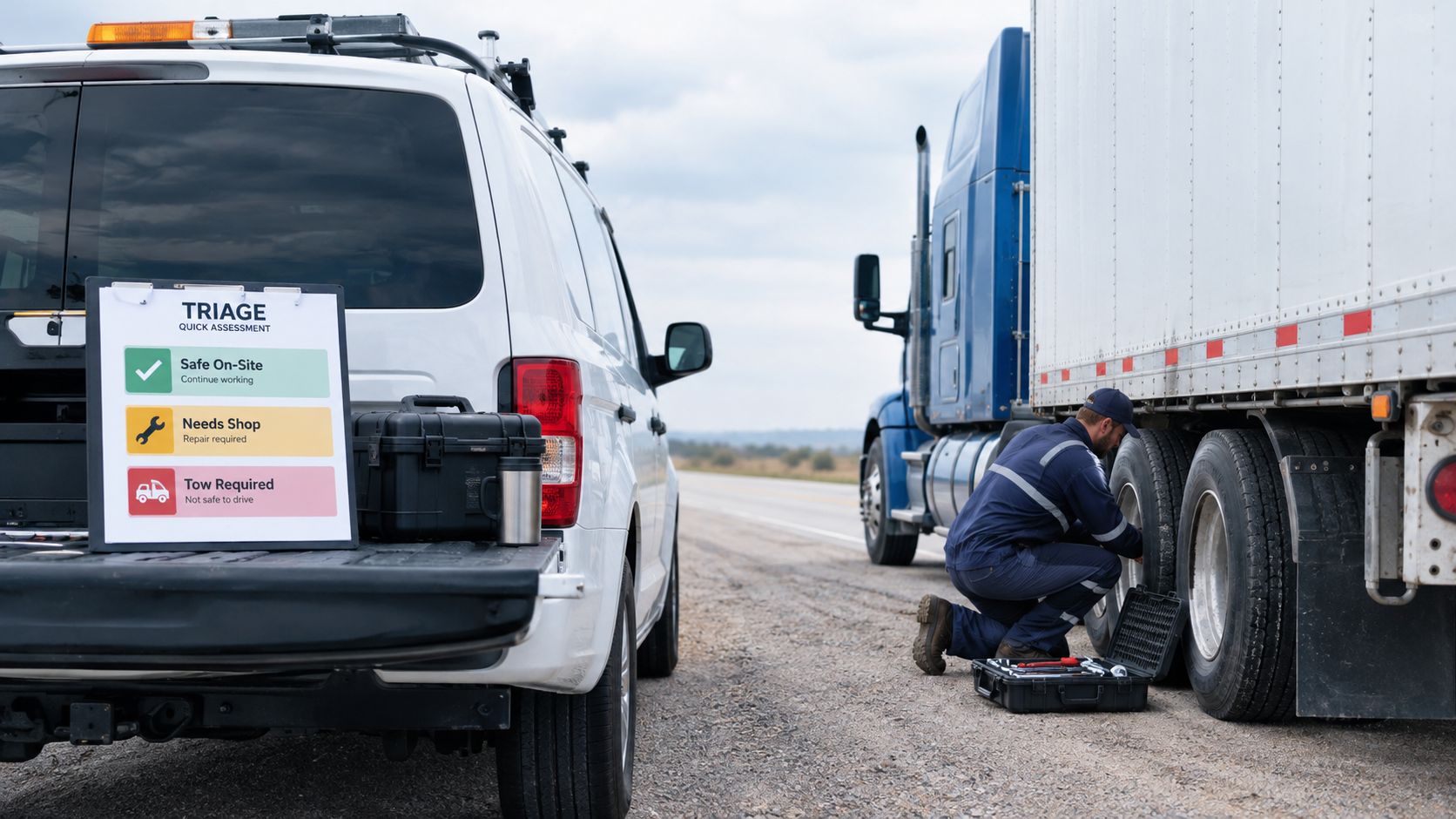
Start with the record, not the wrench. Document the driver complaint, warning lamps, active faults, current vehicle position, traffic exposure, ground condition, and whether the truck can be inspected safely where it stands. Then sort each PM item into one of two buckets. Work that can be completed and verified on site, or work that needs a facility because the location blocks safe access or proper confirmation.
On-site PM usually fits fluid checks, visible leak inspection, tire and wheel condition checks, battery and charging tests, lighting repairs, code retrieval, basic air-system checks, and other items that can be measured and signed off where the unit is parked.
Commercial trailer brake and air work, electrical repairs, suspension work, and structural repairs are confirmed case by case. SAAT operates exclusively as mobile Road Services and has no customer-facing workshop. If the job needs controlled access, lifting equipment, extensive teardown, or structural work, a suitable external facility may be necessary.
A mobile technician should commit only to the work the location allows, and document what was verified, what was deferred, and why.
Connecting PM Records to CSA Inspection Risk
A clean PM file matters most after the truck is stopped for inspection. If an officer finds a brake, tire, or lighting defect, the maintenance record needs to show what was checked, what was measured, who verified it, and whether that verification happened in a place where the work could be completed safely. That is the compliance value of PM. It creates inspection evidence, not just a service history.
The exposure is real. In the 2025 Roadcheck results, 7,289 of 30,060 Level 1 inspections placed vehicles out of service, a 24.2% vehicle failure rate. Brake violations accounted for 24.4% of vehicle out-of-service orders, tires accounted for 2,899 orders, and lighting accounted for 12.8%, according to The Trucker's report on the 2025 Roadcheck results.
That does not make every defect equal. A tire issue found in a yard may be corrected and rechecked on site. A brake issue may start with measurements at the truck's current position, then still need a bay if access, surface conditions, or confirmation steps are limited. Lighting falls somewhere in between. The record should show that decision.
Use the file to tie each finding to four practical questions: what system was affected, what evidence supports the finding or repair, whether the truck's location allowed full verification, and what trigger requires the next check.
For brakes, keep pushrod measurements and air-leak findings. For tires, record the wheel position, condition, and correction. For lighting, identify the failed lamp, circuit, connector, or component. The record should prove what changed and how the technician verified it, not merely show that a part was installed.
Work Order Fields, Retention and Roadside Safety Setup
A PM record should let a fleet manager reconstruct the visit without relying on memory. Start with the VIN, mileage or engine hours, date, vehicle location, driver's complaint, active fault codes, and planned service trigger. Then add the inspection results, measured values, defect descriptions, corrective actions, parts installed, technician identity, and release-to-service decision.
Keep the maintenance trail complete
A practical work order should answer these questions:
- What vehicle was inspected? VIN, unit identifier, mileage, or engine hours.
- What did the driver report? Use the driver's wording where possible, especially for intermittent symptoms.
- What did the technician measure? Record pressure, travel, voltage, differential pressure, clearances, or other relevant values.
- What was corrected? Identify the repair, adjustment, cleaning, programming, or component replacement.
- What remains open? State whether the truck is restricted, awaiting an external facility, or released.
- Who performed and approved the work? Include technician identity and the release decision.
The periodic-inspection report must be retained for 14 months, with proof of the latest inspection kept on the vehicle. For brake inspection work, FMCSA also requires the carrier to retain evidence of an inspector's qualification while the inspector is employed and for one year afterward, subject to the stated exception for a person who passed the applicable CDL air-brake knowledge and skills test.
Protect the roadside work zone
A commercial motor vehicle stopped on a highway or shoulder for a reason other than a necessary traffic stop must activate its hazard warning system and place external warning devices within 10 minutes. Under FMCSA roadside warning-device guidance, one device goes about 10 feet from the vehicle in the direction of approaching traffic, while two more go about 100 feet away, one in the approaching-traffic direction and one in the opposite direction.
The driver must reactivate the hazard lights while retrieving the devices. If traffic exposure, shoulder width, weather, visibility, or vehicle position makes work unsafe, the technician should stop and reassess. No PM schedule justifies placing a technician under avoidable traffic risk.
What to Expect From a Mobile PM Visit in Tampa and Lakeland
A mobile PM visit begins with direct dispatch coordination, not a promise that every job can be completed wherever the truck stopped. The fleet should provide the location, access conditions, VIN, mileage or engine hours, reported symptoms, fault codes, vehicle and trailer details, and the service needed. That information supports a more accurate feasibility assessment and helps the technician bring appropriate diagnostic and repair equipment.
SAAT's stated rapid response target is roughly 45–60 minutes within the core Tampa–Lakeland service area, but any arrival estimate remains conditional on location, traffic, technician availability, and the specific job. The technician assesses safe access and repair scope before work begins. Mobile diagnostics and repairs can address many on-site needs, but major drivetrain, structural, lifting, or controlled-work repairs may require a suitable external facility. SAAT has no customer-facing workshop, so an external facility is not a SAAT location.
For additional dispatch considerations, see what to know before calling for mobile truck repair in Tampa and Lakeland. A well-prepared PM visit gives the fleet a clear record, a safe release decision, and an honest answer when roadside work isn't the right option.
SAAT Repairs Corp provides mobile heavy-duty truck diagnostics, preventive maintenance, brake and air-system service, electrical and aftertreatment troubleshooting, and software support at the vehicle location in Tampa, Lakeland, and nearby Florida corridors. Fleet managers and dispatchers can share the truck's location, symptoms, fault codes, and PM requirements through SAAT Repairs Corp to coordinate a case-specific assessment.