The service brake is the primary braking system the driver applies through the normal brake pedal to slow or stop a truck, usually by using compressed air at the wheels.
If a truck still stops, does that prove every wheel end is braking properly? No, the remaining brakes can mask a weakened wheel end during a light stop. For operators and dispatchers around Tampa, Lakeland and nearby Florida, a useful brake report describes pressure, operating conditions and symptoms, not just whether the truck stopped.
Table of Contents
- What a Service Brake Is and Why It Matters
- How Air Pressure Turns Pedal Force Into Braking
- Service, Parking and Emergency Brakes Compared
- Pressure Thresholds Every Driver Should Know
- Symptoms That Point to the Service Brake
- When Roadside Brake Repair Is Feasible
- Document Symptoms and Act Before the Next Run
What a Service Brake Is and Why It Matters
The everyday comparison is the brake pedal in a passenger car. The driver uses it throughout a trip, while the parking brake holds the vehicle stationary and the emergency function addresses a failure.
On most heavy trucks, pneumatic means air-operated. Reservoirs store compressed air, control valves direct it, and brake chambers turn pressure into mechanical force at the wheels. A service-brake complaint can therefore involve much more than worn shoes or pads.
The 2025 edition of FMVSS No. 121, 49 CFR 571.121 addresses response, repeated applications, stopping distance and performance after specified failures. Those requirements judge a connected system, not a successful stop.
The 2009 final rule, discussed in a 2013 Federal Register rulemaking, reduced the maximum stopping distance for the vast majority of loaded heavy truck tractors braking from 60 mph from 355 feet to 250 feet, a reduction of 105 feet, approximately 29.6 percent.
Hypothetical scenario: A loaded tractor-trailer descends a grade with a weak wheel-end brake. The combination still slows, but the remaining brakes carry more of the braking demand, and the driver has less stopping margin.
A visual check can't establish response under load or reveal every pressure-delivery problem. Understanding what brake service includes helps operators connect a complaint to the air supply, controls, actuators or wheel-end components.
How Air Pressure Turns Pedal Force Into Braking
The air circuit and wheel-end mechanism perform different jobs. The illustration shows component inspection in a workshop setting, not a customer-facing SAAT location.
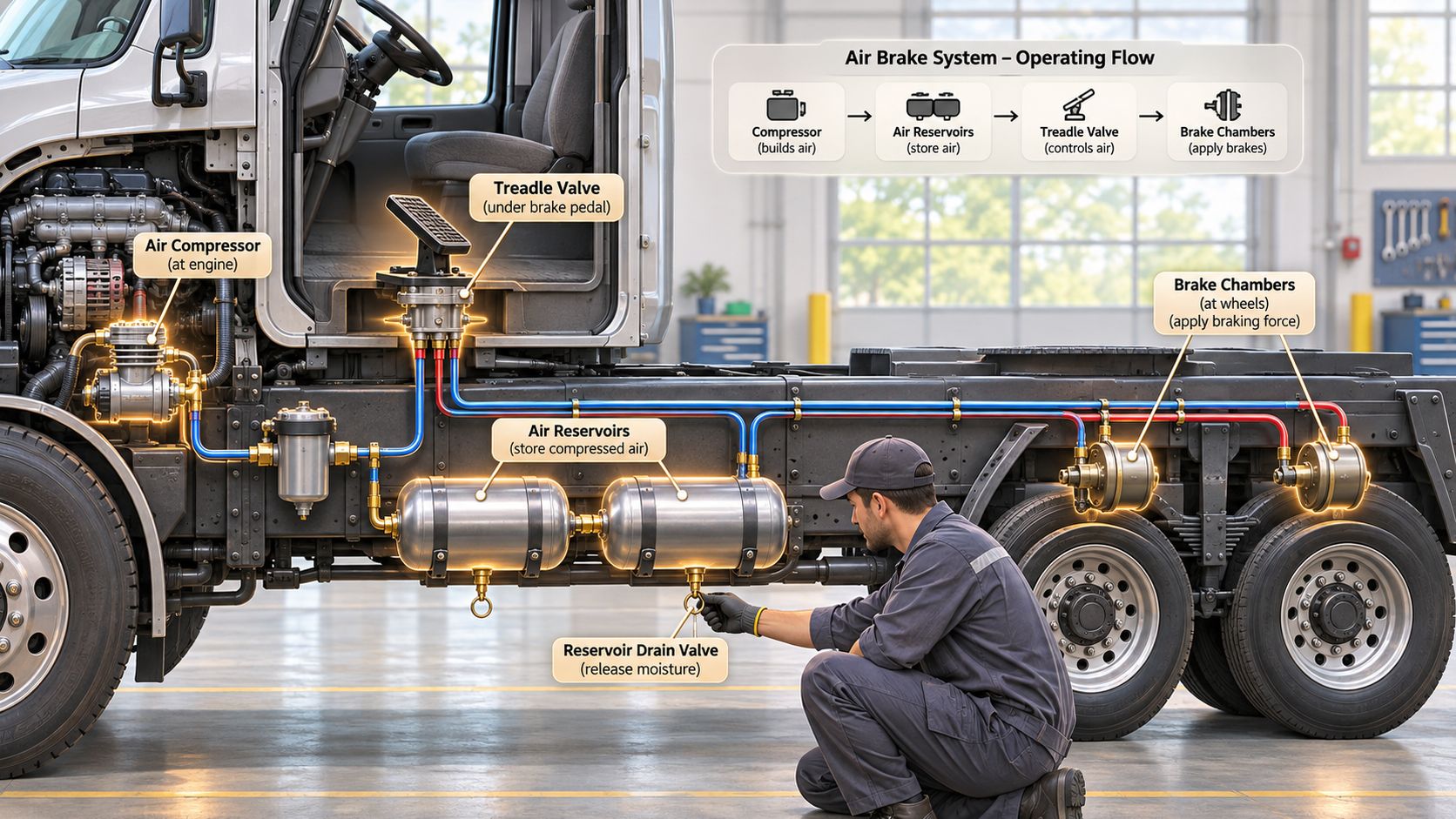
The FMCSA Commercial Driver's License Manual, July 2014 revision, Air Brakes section explains normal service-brake application and release, separately from parking and emergency functions. For a conventional air-operated drum brake, the sequence works like this:
- The compressor supplies the reservoirs. The tanks store the compressed air available for brake applications, so braking doesn't rely only on air being produced at that instant.
- The pedal operates the foot valve. A firmer application commands greater delivered pressure, allowing the driver to control braking effort.
- Air reaches the brake chambers. Pressure acts on the chamber diaphragm and moves the pushrod outward, converting air pressure into movement.
- The linkage applies the foundation brake. On an S-cam drum brake, the pushrod turns the slack adjuster and camshaft, spreading the shoes against the drum. An air-disc brake uses a different caliper mechanism to clamp pads against a rotor.
- Friction converts motion into heat. The shoes or pads resist wheel rotation, which explains why adjustment, friction condition and heat management matter.
Pushrod stroke isn't pedal travel. Excessive pushrod travel can leave a chamber with insufficient useful stroke to apply the brake effectively. A technician measures stroke and checks the adjustment mechanism rather than treating a pedal description as a diagnosis.
Under the federal air-brake definition, air transmits pressure or force from the driver control to the service brake, including air-over-hydraulic designs. The vehicle's actual brake configuration determines the inspection procedure.
What an operator should notice first
- Application timing: Whether the truck reacts promptly or seems delayed.
- Air noise: Whether hissing occurs during application, release or while stationary.
- Directional behavior: Whether the tractor or trailer pulls during braking.
- Dashboard indications: Which warning accompanies the change.
These observations guide inspection without requiring unsafe roadside experiments.
Service, Parking and Emergency Brakes Compared
| Brake Function | How It Is Applied | Main Job | If System Air Pressure Is Lost |
|---|---|---|---|
| Service brake | Normal brake pedal application while driving | Slows and stops the vehicle during ordinary operation | Available service-brake force can fall; warnings require immediate attention |
| Parking brake | Parking control releases air to apply spring-brake hardware | Holds a stationary vehicle | Springs provide holding force without air; actual holding ability still requires verification |
| Emergency brake | Spring-brake application as pressure falls | Provides fail-safe braking capability if service pressure is lost | Spring brakes apply; pressure ranges are described below |
The functions are distinct, but the hardware can overlap. A spring-brake chamber can contain separate service and parking sections, so identifying the function doesn't automatically identify a separate physical assembly.
The federal brake-system requirements in 49 CFR 393.40 distinguish service, parking and emergency braking capability. For a dispatcher, the useful question is which action produced the complaint: pressing the pedal, setting the parking control or experiencing a pressure loss.
Common descriptions that need clarification
- Soft brakes: The driver may mean weak service braking rather than an actual change in pedal travel. The report should preserve the driver's words and describe the stopping response separately.
- Rolling while parked: This points first toward parking-brake holding performance, not automatically toward the foot-operated service function.
- Low-air warning: This concerns the shared pneumatic system and can affect service-brake availability and spring-brake behavior.
Inspection records also distinguish service brakes, including trailer-brake connections, from the parking brake. If both functions are affected, both belong in the record.
Practical rule: The function named in the complaint determines which controls and components receive attention first. It doesn't establish the failed part.
Dispatchers shouldn't translate every complaint into a request for brake pads. A clear function description helps the technician prepare for pressure testing, actuator inspection or wheel-end checks instead.
Pressure Thresholds Every Driver Should Know
| Pressure Point | Value | Why It Matters |
|---|---|---|
| Service reservoir starting pressure in the federal response test | 100 psi, under the 2025 FMVSS No. 121 test procedure | Establishes the reference condition, not a universal operating target |
| Brake chamber pressure requirement | 60 psi within 0.45 seconds after control movement, under that response test | Measures how promptly pressure reaches the actuators |
| Low-air warning activation | Before pressure falls below 60 psi in either air system | Alerts the driver before further pressure loss |
| Spring brakes typically apply fully | Approximately 20–30 psi, within a broader 20–45 psi range | Falling pressure can activate the emergency function |
The reservoir and chamber values are laboratory response-test requirements in the 2025 federal standard, not instructions for a driver to time braking while traveling. The warning and spring-brake values come from the FMCSA Commercial Driver's License Manual, July 2010 revision, Air Brakes section.
Pressure readings need operating conditions. Slow reservoir build-up can indicate a supply problem or leakage; delayed chamber pressure can indicate a restriction, valve fault or leak. A dashboard gauge alone can't distinguish those causes.
A late warning, recurring buzzer or falling gauge reading belongs in the service report with the engine state and observation time. The air-brake leakage test guide explains why controlled test conditions matter when describing air loss.
A useful pressure record
Hypothetical scenario: A driver reports that the warning appeared on successive runs but can't identify when it began. Rather than guessing which component failed, dispatch records the available gauge readings, warning timing and whether pressure was rebuilding or falling.
- Engine state: Running or shut down when the reading was observed.
- Brake state: Pedal applied or released, with parking-control position noted.
- Pressure behavior: Which gauge changed and whether the compressor rebuilt pressure.
- Warning behavior: When the light or buzzer appeared.
These observations should be collected only under safe conditions. An unresolved low-air condition isn't a reason to keep operating while gathering more information.
Symptoms That Point to the Service Brake
| Symptom | Likely Area to Check | Record Before Calling |
|---|---|---|
| Low-air warning while driving | Compressor, air leaks, hoses and fittings | Pressure and time when the warning appears |
| Soft pedal or long pedal travel | Pedal control and brake response; technician checks pushrod stroke, slack adjuster and wheel-end adjustment | Exact pedal description and any known affected axle |
| Hissing at a wheel end or trailer | Brake chamber, hose or connection | Location, pedal position and whether the engine was off |
| Pulling or uneven stopping | Unequal brake contribution at wheel ends | Direction of pull and loaded or empty condition |
| Delayed braking response | Air-line restriction, valve or chamber | Observed delay without attempting a timed road test |
| Heat or burning smell after a downgrade | Dragging or overheated friction components | Route, grade and recent stopping pattern |
The checklist illustrates the difference between noticing a symptom and proving its cause.
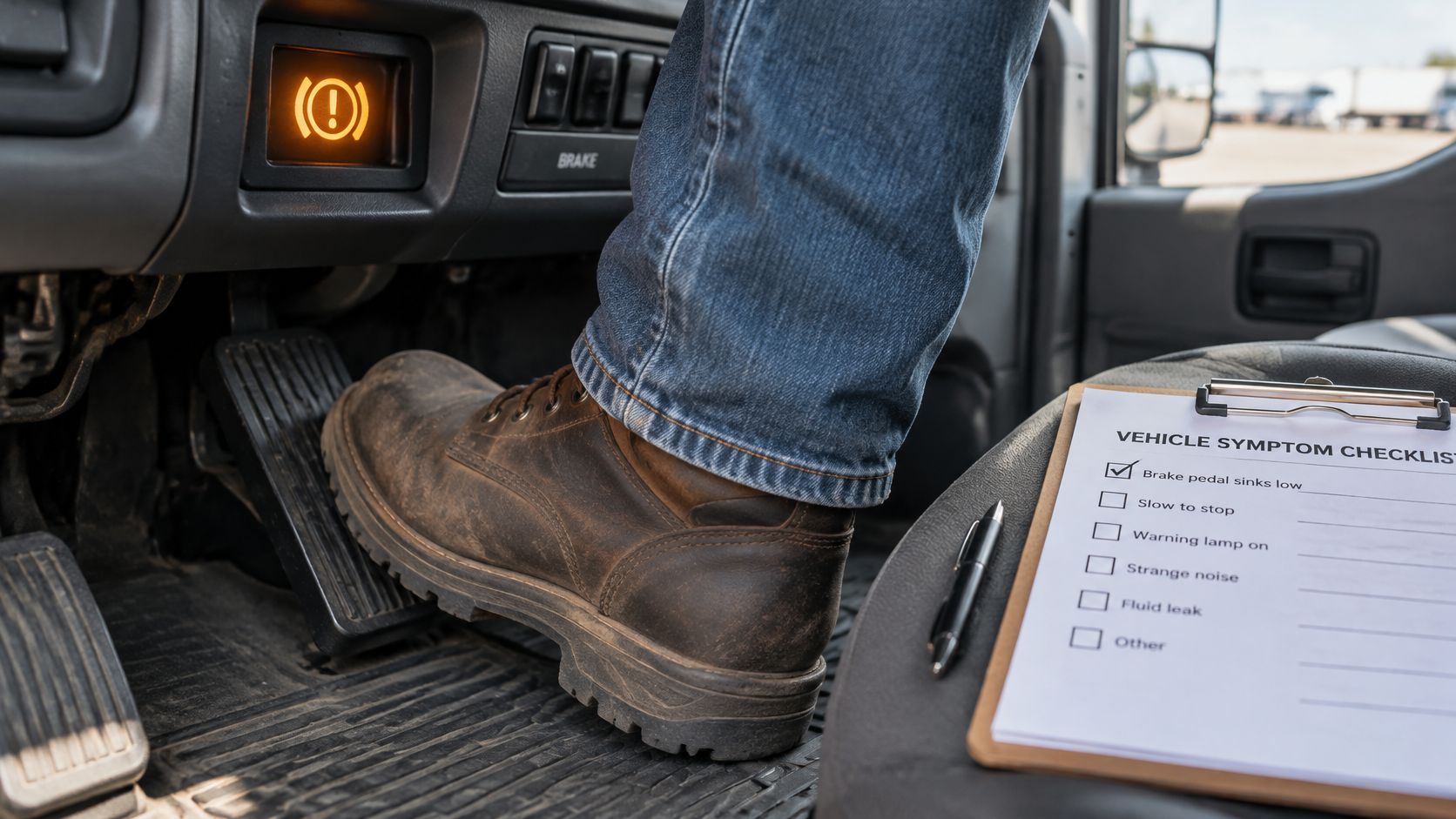
These are inspection leads, not diagnoses. An air-brake pedal doesn't behave like a hydraulic pedal, and excessive chamber stroke doesn't necessarily produce matching pedal travel. A technician must separate the driver's sensation from measured mechanical movement.
A weak wheel end may become noticeable only during harder stops, loaded operation or downhill braking. In CVSA's 2025 Brake Safety Week results, the most common out-of-service finding involved 20% or more defective service brakes, with 1,199 violations recorded in that category.
Preserve the driver's description
SAAT Repairs Corp uses diagnostic tools to identify truck issues. A report that includes the driver's words, operating conditions and warning indications helps prioritize leak checks, chamber testing and adjustment measurements at the vehicle location.
Dispatch should record observations, not assign a failed component. If pressure keeps dropping, a warning repeats or braking becomes abnormal, the vehicle should remain out of normal service until assessed.
A truck that can still move hasn't demonstrated that it can stop safely under the next load or traffic condition.
When Roadside Brake Repair Is Feasible
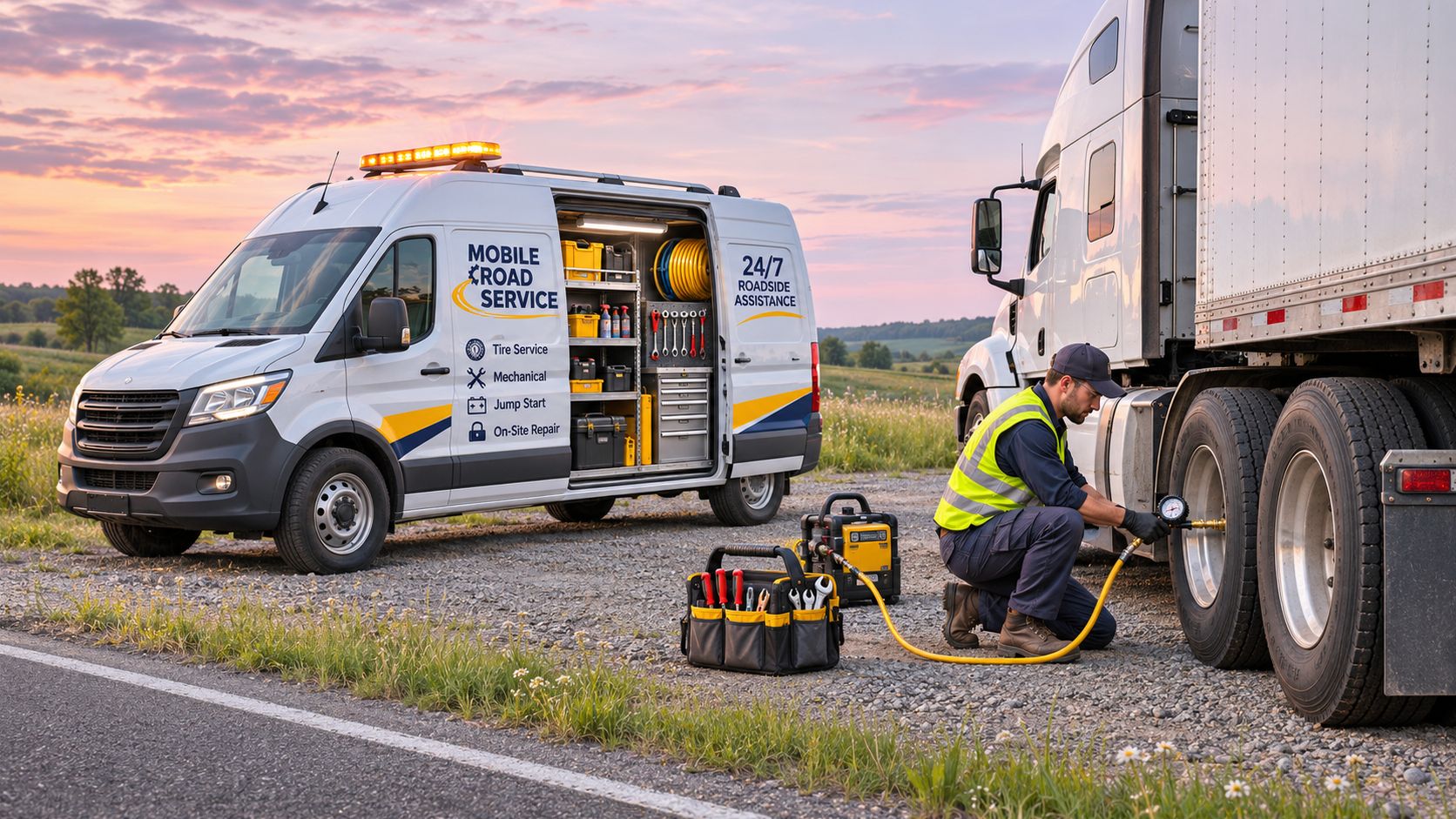
Mobile service doesn't mean every brake repair can be completed beside traffic. SAAT Repairs Corp operates exclusively as an independent mobile Road Services team, attends the vehicle location and has no customer-facing workshop.
The image illustrates mobile equipment used at a commercial vehicle.
Conditions that determine on-site feasibility
- Safe access: Traffic exposure, ground conditions and working clearance must permit inspection and repair.
- Equipment requirements: The necessary tools, support equipment and replacement components must be available.
- Vehicle condition: Damage can extend beyond the initially reported brake complaint.
- Repair scope: Commercial trailer brake and air repairs require case-specific assessment before work is promised.
The team's arrival target is 45–60 minutes in the Tampa and Lakeland areas, not a guaranteed arrival window. Any estimate remains conditional on location, traffic, technician availability and the job; operators outside the immediate area should confirm coverage.
Hypothetical scenario: A cracked axle component is discovered on a narrow shoulder beside moving traffic. The priority is to keep the vehicle stopped in the safest available position, avoid exposed inspection work and determine whether a suitable external facility is necessary.
The following video provides additional service context.
An external facility is an outside option, not a SAAT location. Operators reviewing air-pressure problems that may make continued travel unsafe should distinguish arranging an assessment from receiving clearance to move.
Document Symptoms and Act Before the Next Run
A useful brake record allows the next technician, dispatcher and fleet manager to understand what happened without relying on a verbal handoff. It should separate observed symptoms, measured findings and completed repairs.
- Tractor and trailer identifiers. Identify the complete combination, especially if trailers change between assignments.
- Inspection date and driver report. Preserve the symptom in the driver's words, then add objective observations.
- Air-pressure readings. Record warning activation, pressure behavior and whether pressure rebuilt normally.
- Leak-test findings. Include test conditions and the location of any confirmed leak.
- Affected axle or wheel end. Add measured stroke and adjustment observations when checked by a qualified person.
- Repair status. Separate parts replaced from parts only recommended, and identify unresolved findings.
- Vehicle disposition. State whether the vehicle was released or held and who made that determination.
Inspection requirements and release decisions
The FMCSA Safety Planner's inspection guidance identifies service brakes, including trailer-brake connections, among safety-affecting defects covered by post-trip reporting requirements and lists the parking brake separately. It also states that out-of-service defects must be corrected before operation resumes and that commercial vehicles require periodic inspection at least once every 12 months.
The guidance page doesn't provide a publication year, so it shouldn't be assigned an invented date. A periodic inspection also doesn't replace attention to a defect discovered between scheduled inspections.
SAAT Repairs Corp offers inspection, repair and maintenance of all brake-system components, with mobile work subject to safe access, equipment and scope. A completed service record should describe the work performed, rather than treating the requested service as completed automatically.
What happens after a new warning
- Stop and assess safely. A pressure drop, pull, warning or changed pedal response warrants attention before another run.
- Establish whether movement is safe. The ability to roll isn't clearance to relocate; uncertain braking requires qualified assessment.
- Request mobile diagnosis. Provide the vehicle location, combination identifiers and written symptom record so the technician can assess the job.
Driving slowly to a repair location with a weak brake isn't the default option. Unequal braking can lengthen stopping distance and affect control, so the vehicle should be held until assessed rather than moved on an assumption about low speed.
A diagnostic visit isn't permission to drive with an unresolved safety-affecting defect. Release requires a clear decision about the remaining findings and any applicable out-of-service status.
SAAT Repairs Corp offers mobile brake inspection, diagnosis, repair and maintenance at the vehicle location when the work can be performed safely. Operators can visit SAAT Repairs Corp and use the English contact section to provide pressure readings, symptoms and location, confirm coverage, and ask whether a mobile technician can assess the vehicle.