The usual advice to replace worn pads or shoes misses the main issue on a heavy-duty truck. Friction material can look serviceable while an air leak, excessive chamber stroke or seized hardware compromises braking. A complete service must evaluate how the system applies and releases, then leave a record showing what was measured, repaired and tested.
For operators and dispatchers around Tampa, Lakeland and nearby Florida corridors, the useful question isn't what does brake service include. It's whether the proposed work addresses the driver's complaint, covers the relevant air and wheel-end components, and establishes whether the truck can safely return to service.
Table of Contents
- What a Complete Truck Brake Service Covers
- Why Regulators Expect a Full-System Inspection
- What Brake Symptoms Justify a Service Call
- How Air Brake Adjustment and Stroke Checks Work
- Pads, Shoes, Drums and Rotors Across Brake Types
- Where Roadside Brake Work Stops and External Facilities Start
- What to Record and Confirm Before the Truck Returns
What a Complete Truck Brake Service Covers
A brake-service quote should distinguish inspection, diagnosis, repair and verification. A parts list alone doesn't establish that the technician checked the system supplying and applying those parts.
FMCSA's inspection, repair and maintenance guidance requires systematic commercial-vehicle maintenance and a periodic inspection at least once every 12 months, with braking components included in the inspection scope. A scheduled inspection doesn't replace attention to a defect that develops between maintenance visits.
Components checked in a complete truck brake service
| Component | What Technicians Check | Why It Matters |
|---|---|---|
| Air system | Pressure build, audible leaks, air-line chafing | Lost air pressure limits braking response |
| Chambers and pushrods | Pushrod stroke at each wheel end | Excess stroke means reduced clamp force |
| Slack adjusters | Movement and adjustment condition | Brakes out of adjustment are a recorded FMCSA violation category |
| Linings or pads | Thickness, contamination, cracks, loose friction material | Worn or contaminated friction material reduces stopping force |
| Drums or rotors | Cracks, heat damage, scoring | Damaged surfaces affect braking and can fail inspection |
| Air-disc hardware | Caliper, guide pins, boots, pad movement in the carrier | Stuck or damaged hardware causes uneven pad wear |
| Hoses and fittings | Chafing, kinks, secure clamps | Hose chafing is a significant brake-inspection concern |
| Wheel-end hardware | Loose, missing or damaged fasteners | Loose wheel-end parts can cause immediate failure |
| Brake function test | Application and release behavior after repair | Confirms the repair before the truck is dispatched |
This is a scope checklist, not a replacement schedule. Technicians replace components when defects or measurements justify replacement, rather than treating every inspected item as a required purchase.
SAAT Repairs Corp offers inspection, repair and maintenance of all brake-system components and uses diagnostic tools to identify truck issues. Its mobile Road Services scope is confirmed for each job according to safe access, available equipment and the defects found at the vehicle location.
Invoice check: A complete invoice should make clear what was inspected, what failed the applicable specification and what was done about it.
Fleet managers can incorporate that distinction into a heavy-duty truck preventive maintenance checklist. Keeping inspection tasks separate from replacement tasks helps maintenance coordinators compare quotes without confusing a lower parts count with a less thorough service.
Why Regulators Expect a Full-System Inspection
The FMCSA 2023 Pocket Guide (tables 2-4 and 2-11) reports 2022 data: 2,016,103 vehicle inspections and a 22.6% vehicle out-of-service rate, plus 56,190 brake-hose or tubing chafing or kinking violations, 55,798 inoperative or defective brake violations, 131,339 clamp- or roto-type brakes-out-of-adjustment violations, and 55,138 violations in the 20%-defective-brakes out-of-service category. These are historical nationwide inspection statistics, not 2026 figures or SAAT performance data. The 20% defective-service-brake criterion is one basis for an out-of-service decision, not the only one.
Each category in that count is a different failure. A chafed hose, an inoperative brake and a brake out of adjustment call for different repairs, so a technician who stops after the first obvious defect can clear one violation and leave two more on the same truck. The vehicle then returns to the road still carrying citable conditions, and every one of them lands in the carrier's inspection history.
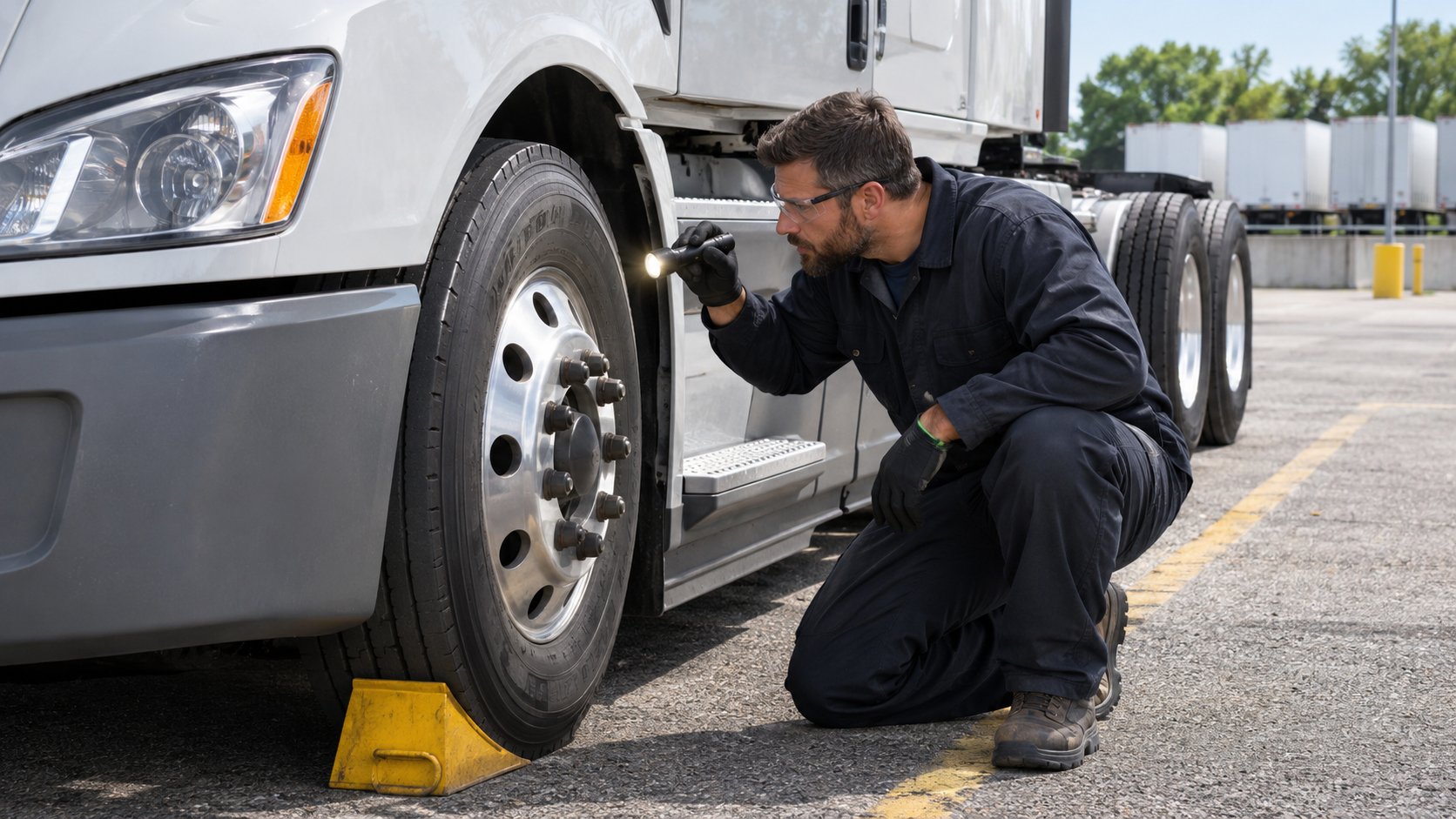
The illustration below shows a visual check beside a parked heavy-duty truck. SAAT Repairs Corp performs service at the vehicle location and does not operate a customer-facing workshop.
How a local fault affects the system
An air leak drains available pressure and alters response. A restricted or damaged hose interferes with delivery to a chamber, and excessive pushrod travel leaves the affected brake working outside its adjustment range. New friction material corrects none of those faults.
The brake system behaves like a chain: the weakest link determines the result. Sound drums and thick lining cannot compensate for a chamber that cannot apply correctly, which is why an inspection that checks only pad thickness misses the defects regulators cite.
Preventive brake service therefore supports three distinct goals:
Restore stopping performance. Diagnose the cause of weak, delayed or uneven application.
Avoid roadside immobilization. Correct accessible wear and defects before a breakdown forces an unplanned stop.
Reduce inspection exposure. Address the conditions inspectors evaluate instead of relying on a driver's impression that the truck still stops.
The 20% criterion is not a maintenance allowance or the only out-of-service condition. CVSA's 2026 Brake Safety Day results separately identify steering-axle, air-loss, hose or tubing, and other brake-related out-of-service violations. A qualifying defect can therefore require an out-of-service decision below 20%. Do not infer permission to move from a lower defect percentage; correct safety defects and complete the applicable evaluation before dispatch.
Mobile technicians can handle many inspections, leak checks, adjustments and component repairs at the vehicle. Safety, access, equipment and defect severity set the actual scope, and the delivery schedule does not change that.
What Brake Symptoms Justify a Service Call
A driver doesn't need to identify a failed component before reporting a brake problem. A precise description of when the truck behaves differently is more useful than a confident but untested diagnosis.
A pull under braking, for example, can involve adjustment, chamber operation, a restricted hose or contaminated lining. Ordering shoes immediately can waste time and leave the original fault untouched.
Describe the behavior before naming a part
Pulling to one side: Report whether the pull occurs only during application or continues after release. Unequal application and a dragging brake require different diagnostic paths.
Longer stopping distance: Note the load and operating conditions. A change from the truck's normal response deserves inspection before another dispatch.
Extra pedal or control travel: Describe what changed rather than assuming that travel proves a particular adjustment fault.
Hissing after shutdown: Identify the apparent location and whether the sound changes with brake application.
Low-air or brake warnings: Record the displayed warning and whether reservoir pressure builds normally.
Burning smell or smoke: Identify the affected wheel end from a safe position. Nobody should touch a suspected overheated assembly.
Grinding, scraping or pulsation: Note whether the noise or vibration occurs during application, release or ordinary rolling.
Uneven trailer braking: State whether the trailer seems delayed, unusually aggressive or inconsistent relative to the tractor.
Separate assessment from movement
A new noise, vibration or intermittent pull warrants a prompt mobile assessment and a dispatch hold while the condition is evaluated. Loss of air pressure that prevents a sustained brake application, smoke or a visible wheel-end failure requires the vehicle to be parked and secured, not driven around to reproduce the complaint.
Drivers shouldn't crawl beneath an unsecured truck or loosen air-system components to locate a noise. Stored air and spring-brake assemblies create hazards that require qualified handling.
A symptom identifies a diagnostic direction. It doesn't authorize a parts replacement.
The initial report should capture when the symptom occurs, speed and load conditions, whether it affects one side, and whether it appears to originate on the tractor or trailer. If the symptom disappears before the technician arrives, the complaint still belongs on the work order rather than being dismissed as resolved.
How Air Brake Adjustment and Stroke Checks Work
Pushrod stroke is the distance the chamber pushrod travels during brake application. On a drum-brake arrangement, that movement drives the shoes into the drum and develops braking force.
Excess travel consumes available chamber movement and reduces effective application. A slack adjuster that merely looks correctly positioned proves nothing on its own; the stroke has to be measured and recorded before anyone calls the brake adjusted.
The illustration shows a technician recording findings beside a parked commercial truck. Actual brake measurements and limits must come from the applicable inspection procedure.

Measure before making an adjustment
Keep the air-leak test separate from applied-stroke measurement. Follow the applicable procedure for vehicle securement, test pressure and timing. CVSA's Operation Airbrake procedure specifies 90–100 psi before checking brake adjustment; that is not a substitute for the conditions of a separate leakage test. The technician must identify the installed chamber and use its applicable stroke limit. The sequence below is an overview for qualified personnel, not a replacement for the complete procedure.
Confirm pressure build. Verify that reservoir pressure builds normally before interpreting application results.
Perform the air-leak check using its applicable pressure and timing, then establish the specified conditions for applied-stroke measurement.
Measure each chamber. Establish released and applied pushrod positions using the applicable procedure. Record the difference rather than estimating travel visually.
Compare each reading with the limit for the identified chamber size and stroke designation.
Check slack-adjuster operation. Excess stroke can indicate insufficient adjustment, worn friction material, mechanical wear or a malfunctioning automatic slack adjuster.
Correct adjustment where appropriate, or replace the defective component. Repeated manual adjustment isn't a substitute for diagnosing an automatic adjuster that won't maintain proper operation.
Record by axle and position. Recheck after corrective work so the record contains the final condition.
Maximum operating pushrod stroke by chamber size
The values below are the standard-stroke clamp-type chamber readjustment limits in 49 CFR 393.47(e). They must not be applied to long-stroke, rotochamber, Bendix DD-3 or other actuator types. Identify the chamber type and stroke designation before comparing a measurement with the applicable table or manufacturer marking.
| Chamber Size | Readjustment Limit (Standard-Stroke Clamp-Type Chambers) |
|---|---|
| Size 30 | 2 inches |
| Size 24 | 1¾ inches |
| Size 20 | 1¾ inches |
| Size 16 | 1¾ inches |
| Size 12 | 1⅜ inches |
| Long-stroke chambers | Use the applicable manufacturer's limit for the identified chamber |
An acceptable stroke measurement doesn't establish air-system integrity. A separate air-brake leakage test evaluates pressure loss that a pushrod measurement can't reveal.
Exceeding the applicable stroke limit can leave a brake out of adjustment and increase stopping distance. If safe access prevents the necessary chamber or adjuster repair, the technician should preserve the readings and identify the unfinished work instead of treating measurement alone as a completed repair.
Pads, Shoes, Drums and Rotors Across Brake Types
Drum and air-disc brakes don't need identical service checklists. Both require sound friction material and working air delivery, but their wear surfaces, moving hardware and failure patterns differ.
The 2026 spring maintenance guidance from brake-system manufacturer Bendix adds air-disc inspection points beyond friction measurement, including caliper hardware and rotor condition. For covered U.S. commercial motor vehicles, 49 CFR 393.47(d) sets a 1/8-inch (0.125-inch, 3.2 mm) minimum for air-disc friction material. This is a regulatory minimum, not a maintenance target or a universal limit for drum, hydraulic or electric brakes. Follow the applicable manufacturer's inspection and replacement criteria for the installed assembly as well.
Drum versus air-disc service checks
| Check Area | Drum Brakes | Air-Disc Brakes |
|---|---|---|
| Friction material | Shoe or lining thickness and contamination | Pad thickness against the model specification and free movement in the carrier |
| Wheel-end surface | Drum wear, cracks and heat damage | Rotor condition, including blocked cooling passages |
| Actuation | Chamber stroke and slack-adjuster function | Caliper actuation and sliding hardware |
| Corrosion and contamination | Lining contamination and drum surface | Corrosion at the caliper and protection of moving interfaces |
| Air components | Hoses, chambers and slack-adjuster movement | Hose condition plus the hardware checks in the earlier component table |
| Replacement limit | Set by the drum and lining specification | Set by the specific air-disc model, with no universal thickness |
On drum brakes, technicians need to evaluate shoe condition alongside the drum surface and operating mechanism. Installing shoes without investigating contamination or damaged mating surfaces can leave the replacement material exposed to the same underlying problem.
Air-disc service adds moving interfaces that drum hardware doesn't have. A pad can retain usable thickness and still bind in its carrier, and a failed seal lets contamination reach parts that must slide freely. Thickness alone doesn't clear the assembly.
Replace against the specification, not appearance alone
Replacement decisions should account for loose, contaminated, cracked or excessively worn friction material, cracked drums or rotors, and heat damage. Measurements must be compared with the specification for the installed components, not a rule borrowed from another truck.
Friction thickness answers one wear question; the assembly still needs its own check.
Mixed fleets need records that identify the brake design at each axle. A tractor's air-disc findings shouldn't be combined indiscriminately with drum-brake findings from its trailer.
Recording axle position, brake type, measurements and replaced parts helps maintenance managers distinguish recurring contamination from uneven wear or a hardware problem. It also explains why an air-disc invoice may include guide or caliper work that a previous drum-brake job didn't.
Where Roadside Brake Work Stops and External Facilities Start
Mobile service puts a technician at the vehicle. The site then decides how much of the repair can be finished there.
Traffic exposure, soft ground, restricted clearance and an inability to secure the vehicle can rule out work that would otherwise be mechanically straightforward.
FMCSA's vehicle-maintenance guidance requires carriers to keep safety-related systems in safe operating condition, including frames, suspension, axles and attaching parts, wheels and rims, and steering. A brake complaint can therefore uncover a separate wheel-end or supporting-system defect that changes the repair plan.
Roadside feasibility by brake job type
This table is general decision guidance. The technician makes the actual feasibility assessment at the vehicle location.
| Job Type | Roadside Feasibility | External Facility Trigger |
|---|---|---|
| Visual and operational inspection | Usually feasible when access is safe | Findings require lifting or structural access |
| Air-leak and pressure checks | Often feasible if the truck can be secured safely | Leak source requires bench or lift access |
| Pushrod stroke measurement and adjustment | Often feasible at a secured wheel end | Necessary chamber or slack-adjuster replacement requires controlled access |
| Pad or shoe replacement | Case-specific, according to wheel-end access and hardware condition | Seized hardware or damaged drums or rotors require equipment unavailable on site |
| Wheel-end structural, suspension or axle repair | Usually unsuitable for roadside conditions | Controlled access and specialized equipment are required |
| Commercial trailer brake and air repair | Case-specific, with scope confirmed before work | Access or equipment is insufficient for safe completion |
A protected parking area may permit work that an exposed highway shoulder doesn't. Even there, damaged fasteners, seized assemblies or unexpected wheel-end deterioration can expand the job beyond the original plan.
On-site brake, air and electrical repairs are confirmed case by case, subject to safe access and job requirements. Suspension and structural faults uncovered during that work go to an external facility equipped for controlled access and specialized tooling.
Preserve the diagnosis when the location must change
When on-site completion isn't appropriate, the next steps are to document the defect, restrict operation as necessary and identify a suitable external facility. That facility is a third-party repairer outside the mobile team's control.
The handoff should include:
Written findings: The failed components and the basis for the diagnosis.
Measurements: Stroke readings, wear measurements and air-test results already obtained.
Photos: Clear identification of damaged assemblies and their axle positions, where safely obtainable.
Open work: Unfinished repairs, required tests and any restrictions on movement.
A clear on-site truck repair assessment prevents dispatch from confusing attendance with repair completion. The person arranging any necessary movement should be named, and the maintenance record should remain open until the outstanding safety work is resolved.
What to Record and Confirm Before the Truck Returns
A useful brake-service record connects the complaint, the measurements, the repair and the final test. A note saying brakes checked doesn't give a maintenance manager enough information to make a dispatch decision or investigate a repeat complaint.
CVSA's 2026 Brake Safety Week inspection guidance identifies defects beyond friction wear, including loose or nonfunctioning components, audible leaks, over-stroked brakes, cracked drums or rotors and inoperative tractor-protection systems. An intake record should therefore identify the truck and trailer, exact location, driver's symptoms, warning lights, pressure-build behavior and suspected axle or wheel end.
Keep findings separate from completed work
The service record should carry:
Inspection findings: Affected wheel ends, defect count, air-loss results and chamber measurements by axle and position.
Completed repairs: Work performed at the vehicle location and parts replaced.
Verification: Post-repair application and release results, plus any repeat measurements.
Outstanding items: Recommendations, unresolved complaints and work requiring an external facility.
Personnel qualifications matter alongside documentation. FMCSA's brake-inspector qualification guidance accepts at least one year of brake-related training, experience or a combination as a qualification pathway and generally requires carriers to retain qualification evidence during employment and for one year afterward, subject to the guidance's stated exception.
Hypothetical example: A driver reports pulling under braking. The technician records the affected axle, measured stroke, leak-test result and repair performed, but cannot reproduce the original pull at the vehicle location. The repair can be marked complete while the original complaint remains open for further evaluation.
Use a final dispatch gate
Before release, the maintenance coordinator should confirm:
Scope matches execution. The written component list and stroke readings match the work performed.
Each defect is marked repaired at the vehicle location or open.
Testing is recorded. The brake-function result appears on the work order.
Any external-facility item is named, along with the person responsible for arranging movement.
The complaint is addressed. The record states whether the original symptom was resolved, reproduced or still requires investigation.
SAAT Repairs Corp offers fleet preventive maintenance, rapid response road service and emergency road service 24 hours a day, 7 days a week. Its Tampa and Lakeland arrival target is 45–60 minutes, conditional on location, traffic, technician availability and the job, not a guaranteed response time.
For truck and commercial trailer brake concerns, SAAT Repairs Corp provides mobile inspection, diagnosis and repair subject to safe on-site feasibility. Fleet managers and operators can visit SAAT Repairs Corp and use the English contact section to provide the vehicle location, symptoms and equipment details, and confirm the scope for brake, air, electrical, suspension or structural work.