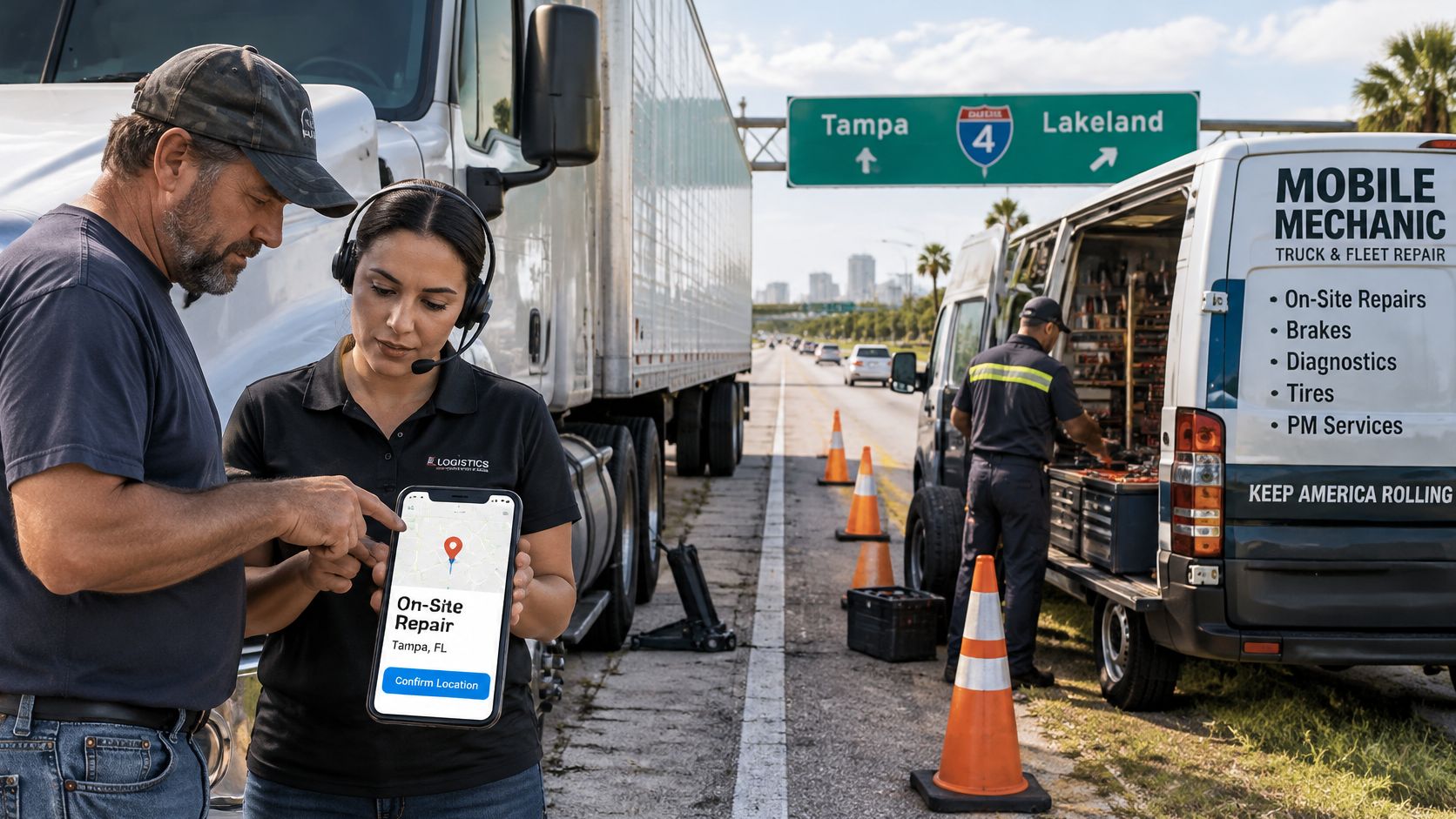
A loaded tractor-trailer has stopped on a Tampa-to-Lakeland route. The driver reports a warning light and a loss of power, while dispatch needs to decide whether the truck can be assessed where it sits or should be moved to a safer work location. The first decision isn't which part to replace. It's whether a technician can safely reach the truck and carry out useful checks at the scene.
On-site truck repair means diagnosing a vehicle and completing feasible work at its location, after safe access has been confirmed. SAAT Repairs Corp operates exclusively as a mobile Road Services team. It has no customer-facing workshop, so a shop drop-off or bay visit isn't part of its service model.
The business impact can extend well beyond the vehicle. In 2023, trucks carried about 13.1 billion tons of freight, or 65% of domestic freight by weight, and generated 2,483.9 billion ton-miles, or 45% of domestic freight travel by distance. The Federal Highway Administration's Our Nation's Highways 2026 freight figures also put the value of truck-carried freight at about $18.3 trillion in inflation-adjusted 2023 dollars, or 72% of domestic freight value. Around Tampa and Lakeland, a disabled unit can mean a missed delivery window, a fleet unit that never reaches its next assignment, and a contract that slips.
At the stop, the decision is whether the truck and its surroundings allow safe, useful assessment and repair where it is, or whether the operator must arrange another location before work can proceed.
Table of Contents
- Which Jobs Can Be Assessed Where the Truck Sits?
- What Should You Record Before Calling for a Technician?
- When Is the Shoulder the Wrong Place to Work?
- How Does SAAT Dispatch and On-Site Triage Work?
- What Should the Service Record Still Prove?
- How Do You Request SAAT Mobile Help?
Which Jobs Can Be Assessed Where the Truck Sits?
The table is a triage screen, not a service guarantee. A complaint may be diagnosed at the vehicle even when the repair can't safely or practically be finished there. Each outcome depends on the truck, the scene, the tools and parts available, and whether the work can be verified before the vehicle moves.
| Complaint | Mobile assessment | Roadside completion | External facility instead |
|---|---|---|---|
| Electrical, no-start, charging or lighting | Check codes, voltage, wiring, starter and alternator | Feasible when access, power and parts allow | Major harness work in live traffic or without safe power |
| Trailer or tractor brakes and air | Inspect leaks, pressure, warnings and affected axle | Case-specific pad, drum, air-line or leak work | An out-of-service defect, lifting need or unsafe shoulder |
| DPF or EGR derate | Review codes, differential pressure, leaks and regeneration history | Forced regeneration only when manufacturer safety conditions are met | Ash cleaning or restricted filter removal needing off-board equipment |
| Suspension or structural concern | Visually assess the affected area and immediate safety | Only when the site and repair scope are safe | Damage needing a protected bay or specialized fixtures |
| Transmission or clutch | Review fluid, codes and operating complaint | Limited service when major removal isn't required | Drivetrain removal or an unstable workspace |
| Software, ECU or calibration | Identify platform and fault context | Programming when power, tools and procedures allow | Work that can't be safely verified at the stop |
Read the symptom before naming the failed part
A no-start complaint can involve a battery, a starter circuit, a charging problem, or another electrical fault. Voltage checks, scan data, wiring inspection, and, where appropriate, smoke testing can help narrow the cause. A technician still needs safe access, stable power, and suitable parts before deciding that the repair can be completed on-site.
Brake and trailer-air symptoms call for careful triage, not a quick assumption. A warning, pulling, unusual heat, slow pressure build, or audible leak can point to different faults. FMCSA guidance says commercial vehicle brakes must remain operable and act on all wheels, subject to limited exceptions; it also says an out-of-service vehicle can't legally resume operation until cited defects are corrected. FMCSA brake guidance makes clear why an unresolved safety defect can require an external repair location instead of a roadside release.
Separate diagnosis from completion
A DPF or EGR-related derate may be assessed through fault codes, differential-pressure readings, exhaust checks, and regeneration history. The EPA explains that regeneration burns combustible particulate matter, while ash isn't combustible and requires a different cleaning process. A forced regeneration is only appropriate when the engine and aftertreatment system meet manufacturer safety conditions; EPA material on DPF regeneration supports treating a recurring restriction as a diagnostic problem, not automatically as a clean-or-replace decision.
The same boundary applies to larger mechanical jobs. A transmission or clutch complaint may be diagnosed at the vehicle, but removal that needs a protected workspace belongs at a suitable external facility, not a SAAT location. Software work also needs stable power, the correct service information, and a way to confirm the result. Before any wrench turns, the technician must judge traffic exposure, access, tools, parts, and whether the proposed work can be checked safely.
What Should You Record Before Calling for a Technician?
Dispatch can make a better decision when the driver reports observations rather than guessing at the failed part. A clear handoff helps identify the right diagnostic approach and whether the stop is even a candidate for on-site repair. The driver should report from the cab or another safe position, not walk into traffic to gather details.
Pin the location. Give the exact position, direction of travel, mile marker or cross street, and whether the truck is in a lane, on a shoulder, or in a yard. This helps dispatch assess access and route the technician to the correct spot.
Identify the vehicle. State whether the problem involves the tractor, trailer, or combination, and give the make, model, and engine family if known. Those details help narrow the diagnostic context and potential parts.
Use the driver's words. Report the actual symptom: no-start, air loss, pulling, noise, heat, derate, warning light, or an inspection defect. “Brakes” alone doesn't tell dispatch whether the concern is a warning, a leak, or a change in handling.
Note when it began. Record when the symptom started and whether the engine was cold, idling, or recently driven. Conditions at the time can help a technician interpret an intermittent fault.
List warnings and codes. Note visible warning lamps and any fault codes already retrieved. Don't translate a code into a failed part unless a qualified diagnostic process has confirmed the cause.
Describe the load and movement limits. Share only the load details needed to judge safety and access, and say whether the combination can be moved. This can affect whether a technician can safely reach the problem area.
Take photos only if safe. A dash photo, scene view, or image of the suspected area may help clarify the complaint. The driver shouldn't step into traffic or put themself at risk to take one.
Say what's already been tried. Report any restart, reset, connection check, or other action and what happened afterward. That prevents repeated steps from being mistaken for a completed repair.
Hypothetical scenario: A driver calls in “brakes.” That could mean a trailer air leak, a dashboard warning, or a pull under braking. Those are different complaints, and the location, symptoms, and affected axle or wheel can change the safe next step.
For a practical call handoff, use SAAT's fleet breakdown response checklist. A useful report gives dispatch enough to judge the scene and the diagnostic needs without turning a driver's first impression into a repair order.
When Is the Shoulder the Wrong Place to Work?
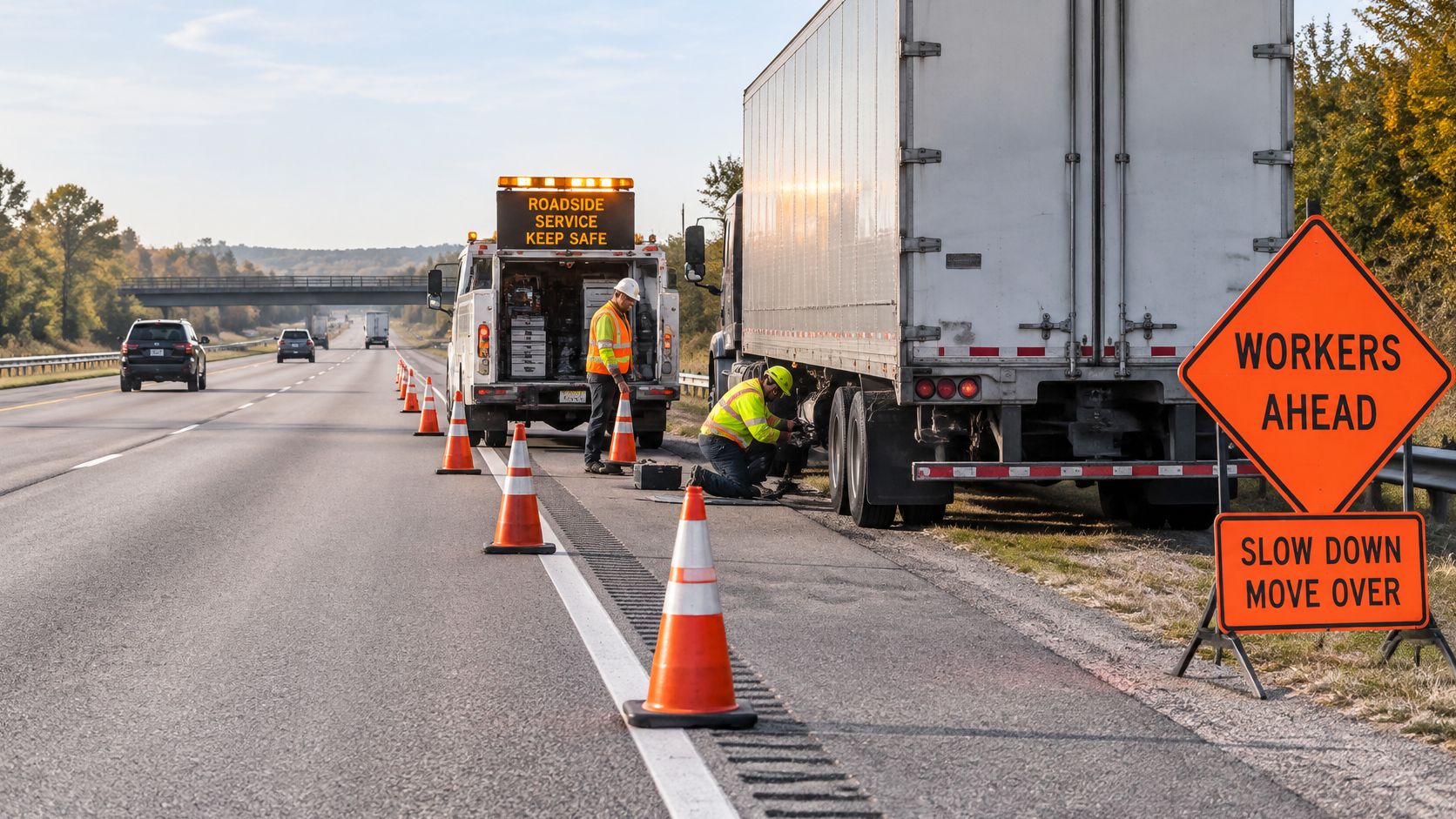
Before a repair begins, dispatch needs a clear picture of the scene: the truck's position, shoulder width, traffic direction, visibility, lighting, and whether movement to a safer location is the better option. Roadside work is a traffic-control problem as well as a mechanical task. A technician can't carry out a reliable inspection if approaching traffic makes it unsafe to reach or test the affected system.
The FHWA reported that, in 2024, large trucks or buses were involved in nearly one-third of fatal work-zone crashes, more than half of fatal work-zone crashes occurred at night, and rear-end collisions represented nearly one-quarter. These are scene-context statistics, not SAAT incident rates. The FHWA work-zone safety factsheet highlights why truck placement and protection matter to the work itself: an exposed, rushed inspection can increase the chance of missed checks or an incorrect reconnection.
Stop work when the scene can't support it
A truck shouldn't be operated in a condition likely to cause an accident or breakdown. Its brakes must remain operable and act on all wheels, subject to limited exceptions, and an out-of-service vehicle can't return to operation until cited defects are corrected. The FMCSA guidance on brake inspector qualifications also supports making sure brake inspections and service are handled by personnel who understand the required procedures, tools, and equipment.
Work should be postponed or moved when the shoulder is narrow or disappearing, the fault creates fire or fluid-spray risk, there's severe structural damage or a wheel-end failure, or the job requires major drivetrain removal. A task that puts a person between the truck and live traffic is also a reason to stop and reassess. At night, work lighting must make the area visible without blinding approaching drivers. The truck must be secured against movement, and warning devices and traffic controls must suit the road and site conditions.
Roadside rule: If there isn't enough separation from traffic to reach and inspect the failed area safely, the repair doesn't belong there.
SAAT Repairs Corp doesn't provide towing. If the scene isn't suitable, the operator must arrange movement to an appropriate external facility. A controlled work location gives the technician a better chance to complete checks carefully and leaves the fleet with a clearer record of what was inspected and verified. For a related air-system decision, see commercial truck air-pressure problems and when it may be unsafe to continue.
How Does SAAT Dispatch and On-Site Triage Work?
A roadside call needs enough detail to decide what can be assessed, where the truck is, and whether the location is safe to work in. SAAT Repairs Corp is an independent mobile Road Services team that provides service at the vehicle's location. It doesn't have a workshop open to customers.
The call starts with the driver or dispatcher reporting the location and recorded complaint. For a stop in Tampa, Lakeland, or a surrounding Florida area, coverage should be confirmed as part of the call. SAAT's stated arrival aim is conditional on location, traffic, technician availability, and the job; it isn't a guaranteed arrival time.
Triage comes before parts replacement
On arrival, the first task is to compare the reported symptom with the actual truck and its condition. That can include securing the scene, identifying the engine and platform, reading fault codes in context, and checking whether the reported system can be safely accessed. A code or warning is a lead for diagnosis, not proof that a particular component has failed.
The technician then assesses whether the work fits the location, tools, parts, and available procedures. Electrical, brake and air, emissions, or software work may be feasible at the vehicle, but the safe scope must be judged for that truck and scene. The SAAT guide to commercial roadside service describes the mobile-service context; the decision on a particular repair still comes from the on-site assessment.
The scope is assessed before work begins.
If ash cleaning, major mechanical removal, or an unsafe position prevents completion, the next step is an external option arranged by the operator. That isn't a SAAT workshop or an offer of towing. Fleets can also raise preventive-maintenance questions during a service call, but the immediate decision remains whether the reported fault can be assessed and addressed safely at the vehicle.
What Should the Service Record Still Prove?
A useful mobile-service report should show what the driver reported, what the technician tested, what changed, and what remains unresolved. That record helps distinguish an emergency repair that returns a truck to service from a completed repair that addresses the root cause. FMCSA's carrier-maintenance guidance describes the broader duty to systematically inspect, repair, and maintain vehicles, while drivers report defects and carriers address roadside inspection violations through the required process. See FMCSA guidance on inspection, repair, and maintenance.
| Job type | Fields to record | Keep the job open when |
|---|---|---|
| Brakes and trailer air | Axle or wheel, air or hydraulic side, leak behavior, corrective action | Any cited defect remains uncorrected |
| Emissions derate or DPF fault | Regeneration history, differential-pressure context, whether soot conditions were met, ash status | Ash cleaning or off-board work is unfinished |
| Intermittent electrical or software fault | Change since last normal operation, codes read, what wasn't reproduced | The fault is unverified or wasn't reproduced |
Record the test, not just the repair label
The full record should include the complaint and failure time, location, diagnostic codes, test results and measurements, parts and labor, who authorized the work, who performed it, what was verified, useful photographs, and any follow-up interval. A note that says only “brakes checked” doesn't tell the next maintenance person which axle or wheel was examined, whether the system was air or hydraulic, how a leak behaved, or what correction was made.
For a DPF complaint, keep the regeneration history and differential-pressure context, and note whether the filter condition pointed to soot or ash. EPA material explains that regeneration may be needed about once per day or shift in some duty cycles, while off-board regeneration can take roughly two to eight hours, depending on the filter and equipment. The EPA explanation of particulate-filter maintenance distinguishes soot, which regeneration can burn, from noncombustible ash, which requires physical cleaning. If that off-board work hasn't happened, the record should leave the job open.
An intermittent electrical or software fault needs a different kind of detail. Record the codes, what changed since normal operation, the checks performed, and what couldn't be reproduced. Otherwise, the next person may not know whether the fault was repaired, temporarily absent, or never confirmed.
Good records can help a fleet track recurring faults and support warranty or insurance discussions. Those are general industry benefits, not a promise of a particular claim outcome. They also give maintenance staff a sound basis for reviewing the repair and deciding whether follow-up is still needed.
How Do You Request SAAT Mobile Help?
Before calling, the driver or dispatcher should have the truck's location, complaint, warning details, and scene conditions ready. SAAT Repairs Corp provides mobile diagnostics and road service at the vehicle, not customer visits to a repair workshop. It offers emergency road service 24 hours a day, 7 days a week for heavy-duty diesel trucks; gasoline-powered commercial vehicle assistance should be confirmed with specific vehicle details.
For immediate assistance or to speak directly with a service representative, call +1 414 233 9746. Primary coverage is Tampa, Lakeland, and surrounding Florida areas; stops outside the immediate area should be confirmed on the call. Accepted payment includes cash, Visa, Mastercard, American Express, and fleet checks. The website is available in English and Spanish for mixed-language crews.
The technician assesses safe on-site feasibility, and a job requiring a protected workspace must go to an external facility arranged by the operator. Use the English contact section to start the request with the location and symptom details ready.
SAAT Repairs Corp provides mobile Road Services for heavy-duty trucks at the vehicle's location, with on-site work assessed for safety and feasibility. For a roadside fault in Tampa, Lakeland, or nearby Florida, visit SAAT Repairs Corp and contact the team with the truck's location and symptoms.