The most repeated advice about truck parts is simple: buy OEM when the part matters, aftermarket when it doesn't. It sounds prudent. On a late-model diesel truck it's the wrong way to decide, because the parts that matter most are usually the ones where a small electronic or emissions mismatch turns a cheap part into a two-visit repair, and the parts that matter least are often the ones an OEM-only channel can't deliver before the load leaves the yard.
The decision that holds up is risk-adjusted cost at the vehicle location: part price, plus diagnostic time, installation labor, programming or calibration, delivery delay, repeat-failure odds, warranty exposure and the cost of the truck sitting still. On a route truck, the last two usually decide the answer.
Fleets that get this right don't pick a side. They pick a part per failure, and they keep the paperwork that proves why.
Table of Contents
- Aftermarket vs OEM Diesel Parts Side by Side
- Why a Part That Fits May Still Fail
- Emissions Parts Depend on Documentation
- Brake and Air Parts Need Certification Checks
- Component Choices for Common Diesel Repairs
- Warranty and Total Cost After Downtime
- Mobile Limits and Your Next Step
Aftermarket vs OEM Diesel Parts Side by Side
A part number tells you what sits inside the box. Four other things decide whether it belongs on the engine: what the component does, how it sits in the electronic architecture, whether it carries an emissions or safety role, and what a day of downtime costs on that truck's route. The brand printed on the carton is not one of the four.
The independent channel has the scale to make aftermarket sourcing a real option rather than a budget shortcut. Industry analysis from AAPEX, drawing on Auto Care Association and MEMA Aftermarket Suppliers analysis put aftermarket parts sales at $204 billion in 2022, forecast to approach $214 billion in 2023, with the broader U.S. aftermarket including light-, medium- and heavy-duty vehicles projected at $534 billion for 2024, spread across more than 539,000 businesses.
Heavy-duty buyers see the same maturity inside their own segment. Growth Market Reports valued the global heavy-duty truck aftermarket at USD 124.6 billion in 2024, the figure that matters when the question is whether a replacement can be sourced today or has to be ordered.
Scale buys availability and price competition. Interchangeability is a separate question, settled component by component through specifications, warranty conditions, calibration requirements and safety-critical performance. Scale gets the part to the yard gate. Documentation decides whether it goes on the engine, and the paperwork differs by category: equivalence statements and test data for an emissions component, a certification mark for a brake chamber, a stated programming requirement for anything the controller has to recognize.
Reading the Comparison as a Screen
| Criterion | OEM parts | Aftermarket parts | Check before installing |
|---|---|---|---|
| Fit and connector match | Designed for the specific engine family and model year | Brand-dependent; must match connector, pinout and dimensions | Compare part number and connector drawing with the truck |
| Emissions compliance | Covered by the original engine or aftertreatment certification | Requires a reasonable basis that it will not adversely affect emissions | Request test data or equivalence documentation |
| Software and calibration | Aligned with the vehicle platform calibration | May need programming, calibration or parameter changes | Confirm the programming requirement before the visit |
| Warranty | Manufacturer or dealer network coverage under the OEM policy | Set by brand, part category and purchase channel | Keep invoice, part number, install date and mileage |
| Acquisition cost | Often higher in many categories | Often lower in high-volume, price-sensitive categories | Compare total repair cost, not part price alone |
| Availability | Through authorized distribution | Broader independent distribution | Check delivery time against the downtime cost of the route |
| Best-fit categories | Software-linked, warranty-linked and emissions-critical components | Mechanically simple parts with verified equivalent specifications | Decide per component, not per truck |
Use the table as a screen. Cross out any row that fails outright for the truck in front of you, then work the survivors in the order of what a wrong part would cost at the vehicle location. A sensor that needs a calibration flash adds diagnostic and programming time to the invoice. A brake chamber with thin certification paperwork adds risk to the next inspection. A part that arrives two days late adds a parked truck. None of that appears in the part price, and all of it belongs in the decision.
The difference in one line: a part that fits on paper still has to function on the truck, and only documentation closes that gap.
Why a Part That Fits May Still Fail
Hypothetical scenario: an aftermarket exhaust-gas temperature sensor threads into the bung without resistance, the connector clicks, and the scan tool shows a plausible reading. But the sensor reports a few degrees off across the operating range. The ECM doses against a number that isn't real, regeneration frequency climbs, fuel economy slips, and eventually the truck derates on the road. None of that is visible at installation.
Physical fit is the easiest check and the least sufficient one on a modern diesel. The part is not a mechanical object bolted to an engine; it's a node on a network that has to behave inside the controller's expectations.
EPA enforcement guidance on tampering is clear that OEM status does not by itself define legal or technical acceptability. Functional equivalence and evidence do. A nonoriginal-equipment replacement part may be used for maintenance or repair when there is a reasonable basis to know it won't adversely affect emissions performance, and for emissions-critical components the manufacturer should support that with engineering documentation or test results.
Practically, that means verifying connector and pinout compatibility, sensor calibration range, CAN/J1939 communication behavior, actuator response, fault-code thresholds and post-installation software requirements. An aftermarket sensor or actuator that shifts signal accuracy can produce false diagnostics, improper dosing, failed regeneration, reduced fuel economy or a derate.
Four Checks That Come Before the Part Number
- Record the vehicle identity. Pull the engine family, model year and emissions configuration from the data plate and prior repair orders. Two trucks that look identical can carry different calibrations, and the part has to match the one on the hood.
- Compare connectors and pinouts directly. Lay the connector drawing beside the harness. Count cavities, check the keyway, and trace wire colors against the pinout rather than trusting that a plug fits.
- Check the signal range against the controller specification. A sensor has to report inside the window the ECM expects, not merely report something. Temperature and pressure parts are where small offsets hide.
- Confirm the programming, calibration or parameter change the part needs, and decide who performs it at the vehicle location. Software programming and updates, ECU work and calibrations are part of SAAT Repairs Corp's mobile diagnostic scope, but the requirement has to be known before the part is ordered, not discovered after it's installed.
OEM parts generally reduce integration uncertainty because their calibration, software assumptions and validation history line up with the platform. A qualified aftermarket part can cut acquisition cost and improve availability, but only when its documentation covers the specific engine family, model year, emissions configuration and operating conditions.
Either way, the file needs the same three things before the truck leaves: the part number installed, the software version, and post-install fault-code status with a road test behind it.
Emissions Parts Depend on Documentation
Emissions components are where price comparison fails hardest, because the paperwork carries as much weight as the hardware. This is the area of the aftermarket vs OEM decision where a cheaper part can be more expensive inside a week.
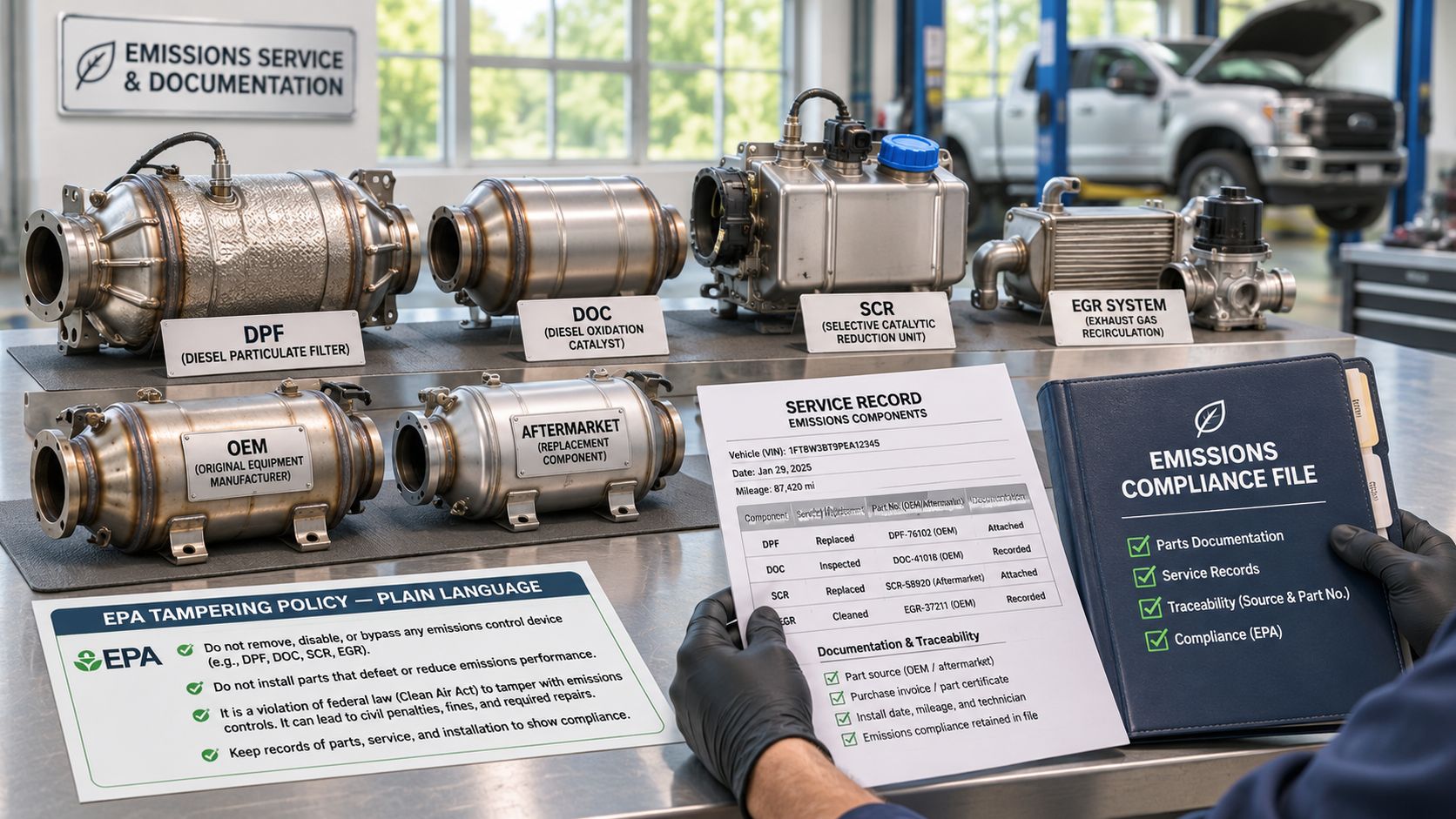
For diesel particulate filters, diesel oxidation catalysts, selective catalytic reduction systems and EGR-related parts, the benchmark is compliance evidence, not purchase price. Under EPA tampering policy, a replacement aftermarket part needs a reasonable basis for demonstrating that it won't adversely affect emissions performance. The EPA's aftermarket DDS and tampering factsheet from November 2021 sets out what that basis looks like.
What Counts as Reasonable Evidence
Two routes are acceptable. The first is proof that the part is identical in design and function to the replaced OEM component. The second is test results showing the modified vehicle or engine passes the same emissions tests used for original certification.
The guidance also carries a durability benchmark: an aftermarket aftertreatment system should be at least as effective as the original and durable for a period equal to at least half of the vehicle or engine's regulatory useful life. A part that passes a tailpipe test on day one and loads up by month three hasn't met that standard.
What belongs in a comparison, then, is not dimensional fit alone:
- Documented emissions test results for the same engine family and configuration
- Substrate and catalyst specifications, including precious-metal loading and washcoat
- Sensor compatibility, since an SCR system lives and dies on NOx sensor agreement
- Thermal operating range and backpressure characteristics against the original unit
- Regeneration behavior and expected service life
Where Cheap Emissions Parts Go Wrong
A fleet manager with a truck down and a load already booked signs off on a low-cost DPF. No compliance paperwork came with it, and none was requested. It fits. It runs. Two months later the differential pressure climbs early, the truck derates on a grade, and the same fault returns after a reset. The invoice showed a saving on the part; the actual cost arrives as repeat diagnostics, a second replacement and exposure at inspection, plus labor spent twice and revenue lost while the truck sits.
A low-cost part without traceable compliance documentation can create exactly those derates and repeat repairs, along with inspection exposure or an illegal tampering finding. A properly documented equivalent may be technically acceptable even when it isn't branded by the vehicle manufacturer.
The file behind the part is what settles the question: test results tied to the engine family, the durability statement, and a part number that traces back to a manufacturer willing to stand behind it. I would rather wait a day for that paperwork than fit a part without it, because a supplier who cannot produce it today will not produce it when a derate is on the dash.
DPF and EGR cleaning, repair, differential pressure checks and aftertreatment resets for emissions compliance are within SAAT Repairs Corp's mobile scope. The replacement part's documentation still has to be reviewed first, because cleaning a system around an unverified component just moves the failure downstream.
Diagnosis comes before parts. The video below covers that ground.
When a fault points at the EGR side rather than the filter, work through the EGR-related power loss checks before replacing emissions components so the part decision follows a confirmed cause.
Brake and Air Parts Need Certification Checks
A brake hose is cheap. A trailer parked for two days at a dock is not. That gap is where the certification argument gets settled, because a hose that fails a roadside inspection costs far more than the price difference between a documented part and an unbranded one.
Fleets default to an OEM-only channel whenever a brake or air part is involved. That habit costs money on components a certified independent part satisfies perfectly well, and the call usually gets made under time pressure at the yard rather than at a desk.
The NHTSA interpretation letter from February 2002 is the document to keep in view here. Replacement equipment covered by a Federal Motor Vehicle Safety Standard must be certified as meeting the applicable standard, whether it is installed on a new vehicle or sold in the aftermarket. The agency names brake hoses and brake hose assemblies under FMVSS No. 106, and brake fluid under FMVSS No. 116.
The question at the truck is whether the selected component carries the required certification and suits this vehicle, down to the fitting. Certification marking on the part or its packaging has to match the standard governing that category, and the paperwork needs to survive an inspection years later, when the invoice is long gone.
What to Verify Before the Box Goes On
Two things go wrong after the certification question is answered, and both are fitment errors rather than compliance errors.
- Fitting size and thread type measured against the failed component, not against a catalog description
- Hose length and routing compared with the original, since a hose that reaches but runs tight will chafe and fail again
- The reason for the failure, because a hose that burst from chafe needs the routing corrected, not just a replacement
Paying for the right routing clip is cheaper than paying twice for the same hose.
Brake inspection, pad and drum replacement, hydraulic and air system service and leak checks sit within the mobile road services scope. Whether a specific brake or air repair can be completed at the vehicle location depends on safe access, the equipment the job needs and the condition found on arrival. Commercial trailer brake and air work is confirmed case by case, and some jobs belong at a facility with a lift. Before a repaired truck goes back into service, run through what to verify after a commercial truck brake repair, and for a wider view of the work, see what brake service includes.
Component Choices for Common Diesel Repairs
Component families do not carry the same risk, and a single purchasing rule across a fleet hides the difference. The question is not whether the aftermarket part is cheaper on the invoice. It is what that part costs at the vehicle location when diagnostic time, programming, repeat-failure risk and downtime are counted.
| Component | Diagnostic confirmation before ordering | Aftermarket is defensible when | OEM is the lower-risk call when |
|---|---|---|---|
| Brake hoses and assemblies | Leak and pressure check after install; routing compared with the original | Fit and routing match the original and the assembly is rated for the system | Fit or rating cannot be confirmed |
| Brake fluid | System specification verified against the required fluid, not a catalog listing | Specification matches the system requirement | System specification is unclear or mixed |
| Diesel particulate filter | Backpressure and regeneration data reviewed; sensor compatibility confirmed | Documented equivalence to the original emissions configuration | Documentation is missing or covers a different engine family |
| EGR valve and cooler | Software control and actuator response checked before parts | Test results support equivalent performance on the same configuration | Actuation depends on calibration data the supplier does not provide |
| Sensors | Connector pinout and signal range checked against the controller | Signal range and connector match the controller specification | A signal shift could cause false diagnostics or derates |
| Alternators and starters | Charging control strategy and start circuit confirmed | Electrical ratings and warranty terms are verified in writing | Regulator communication or calibration data is platform-specific and not supplied |
| Transmission components | Fluid specification and programming requirement confirmed | Specifications are verified and warranty terms are documented | Programming or calibration is required and not confirmed for the part |
Electrical work is where ordering before diagnosis burns the most money. Wiring harness faults, sensor failures, alternator faults and starter failures all get diagnosed at the vehicle location, so confirm the fault before the part is ordered. A starter ordered on the symptom alone can leave the original no-crank unresolved and a new part on the invoice.
Starter and Alternator, Two Different Answers
A no-crank complaint on a 2016 day-cab tractor is the easy half of the electrical call. Start with voltage drop at the starter control circuit and the ground path. If that check finds a corroded cable end or a high-resistance ground, the starter was never the failed part. Correct the circuit and the original unit stays in service. When the circuit checks clean, a verified aftermarket starter with matching ratings and written warranty terms is a reasonable call, especially if the truck is on a schedule and the part is available locally that morning.
A charging complaint on the same tractor takes a different path. Check the commanded setpoint and the regulator communication the ECM expects as part of the diagnosis. A cheaper unit with different control logic can charge at the wrong setpoint or trip a fault, and the diagnosis starts over with a part already installed. That case leans OEM unless the supplier documentation covers the specific platform.
Transmission components follow the alternator logic more often than the starter one. Fluid specification, clutch and synchronizer specifications and any programming requirement decide the outcome. The mobile transmission scope covers repair, maintenance and replacement, so the specification conversation happens before the part is ordered.
Working rule: aftermarket is most defensible where the component is mechanical, the specification is documented and the warranty terms are written down.
Warranty and Total Cost After Downtime
The governing document is the warranty terms tied to the part number and the purchase channel, not the label on the box. Coverage changes by brand, part category and where the part was bought, so the invoice alone does not tell a fleet what happens if the replacement fails.
A Daimler Trucks North America warranty policy document states that certain Alliance and Mascot aftermarket parts carry coverage of one or two years depending on the part, with applicable parts, labor and reimbursement policies attached. That is an aftermarket part with written coverage behind it, which is a different object from the same part number bought through an unknown channel. Manufacturer terms can also tie eligibility to the qualifying distribution channel, so a correct part number from the wrong source can still produce a denied claim. Heavy-duty warranty exclusions commonly include failures tied to abuse, inadequate scheduled maintenance, worn components and normal wear.
What the Warranty Document Says
Read three things before the part goes on: the coverage period for that category, what is reimbursed (part only, or parts and labor), and what voids it. File the invoice, part number, installation date, mileage and maintenance records with the repair order. A claim can depend on part category, purchase channel, maintenance history and cause of failure rather than on whether the replacement was OEM or aftermarket.
Where the Cost Lands
| Cost factor | How it changes the comparison | Record to keep |
|---|---|---|
| Part price | The lowest line item, but not the total cost of the repair | Invoice, part number and purchase channel |
| Diagnostic time | A cheaper part that fails verification adds testing and visits | Fault codes, test results and technician notes |
| Labor | Installation difficulty varies by component and access | Labor hours and the repair order |
| Programming or calibration | A part that cannot be programmed or calibrated may not work at all | Software version before and after the repair |
| Shipping and delivery delay | A delayed part can cost more than the price saving | Order date, delivery date and route impact |
| Repeat-failure risk | A mismatch can trigger repeat visits and derates | Repair history and part identification |
| Downtime | A truck off route has a cost that the part invoice does not show | Route schedule, lost delivery time and dispatch notes |
A denied claim is the case that separates part price from repair cost. Say a fleet buys the correct part number through a reseller, installs it, and later faces a failure. The claim is rejected because the part did not come through a qualifying channel. The fleet pays for the replacement, the diagnostic time to prove the first part failed, and the downtime while the truck sits. None of those costs appear on the original invoice, and the cheaper purchase becomes the more expensive repair.
At the vehicle's location, that exposure grows. Diagnostic time is charged twice when a part must be proven bad, programming or calibration can fail on a unit with the wrong software relationship, and a repeat failure can pull the truck out of service again. The part price is only the first line. Risk-adjusted cost includes the labor to install it, the scan tool time to verify it, the chance of doing the job again and the route time lost while it is down.
For the bigger picture on how these line items roll up across a fleet, see the guidance on how to reduce total cost of ownership.
Mobile Limits and Your Next Step
A mobile road services team changes where the repair happens. The truck still needs the same diagnosis and the same correct part. SAAT Repairs Corp provides service at the vehicle's location, and that model fits failures where the truck cannot move: a derate on the shoulder, a brake chamber failure in a distribution yard, a no-start blocking a dock door. It also has limits, and knowing them before dispatch is what keeps a repair from becoming a recovery.
What Decides a Roadside Finish
Safe access comes first, followed by the job itself, the equipment the call requires and technician availability. A wheel-end repair in a lit yard with room to work is a different proposition from the same failure on a narrow shoulder with traffic passing close. The company has no customer-facing workshop, so that assessment happens at the truck, not later.
Some jobs need a suitable external facility rather than a roadside finish. Bench testing a component that is already off the truck, lift or press work, aftertreatment or calibration steps that require a controlled environment, and any job where on-site access is not safe all point to an external option. That facility is not a SAAT location, and arranging it is a separate step from the road call.
Before the call, gather what dispatch will be asked for:
- The driver's complaint in their own words, including when it started and what changed
- Active and stored fault codes, read rather than guessed at
- Part numbers for anything recently replaced on that system
- Brake or emissions certification paperwork for a part already installed
- Mileage, photos of the failure point, and the route deadline the truck is under
Arrival timing depends on location, traffic, technician availability and the job itself, so nobody can quote a firm number before the details are in hand. Coverage outside the immediate Tampa and Lakeland areas needs confirming before dispatch. A roadside diagnosis also separates a failed part from a programming or calibration problem, and that distinction changes the part choice before anyone orders.
Verdict by Situation
The decision turns on what the part controls and what documentation comes with it. Software-linked, warranty-linked and emissions-critical parts carry more risk without OEM support or proven equivalence. Mechanically simple parts with written warranty terms can justify aftermarket. For brake hose and brake fluid, check certification before choosing a brand.
When a truck is down in Tampa, Lakeland or the corridors between them, SAAT Repairs Corp brings heavy-duty diagnostics, emissions work, brake and air service, electrical repair and software programming to the vehicle's location, with feasibility assessed on arrival rather than assumed. If the OEM versus aftermarket decision is still open on a broken truck, the practical answer comes from inspecting the failure and reading the documentation together. Visit SAAT Repairs Corp to reach the contact section and start the dispatch conversation.