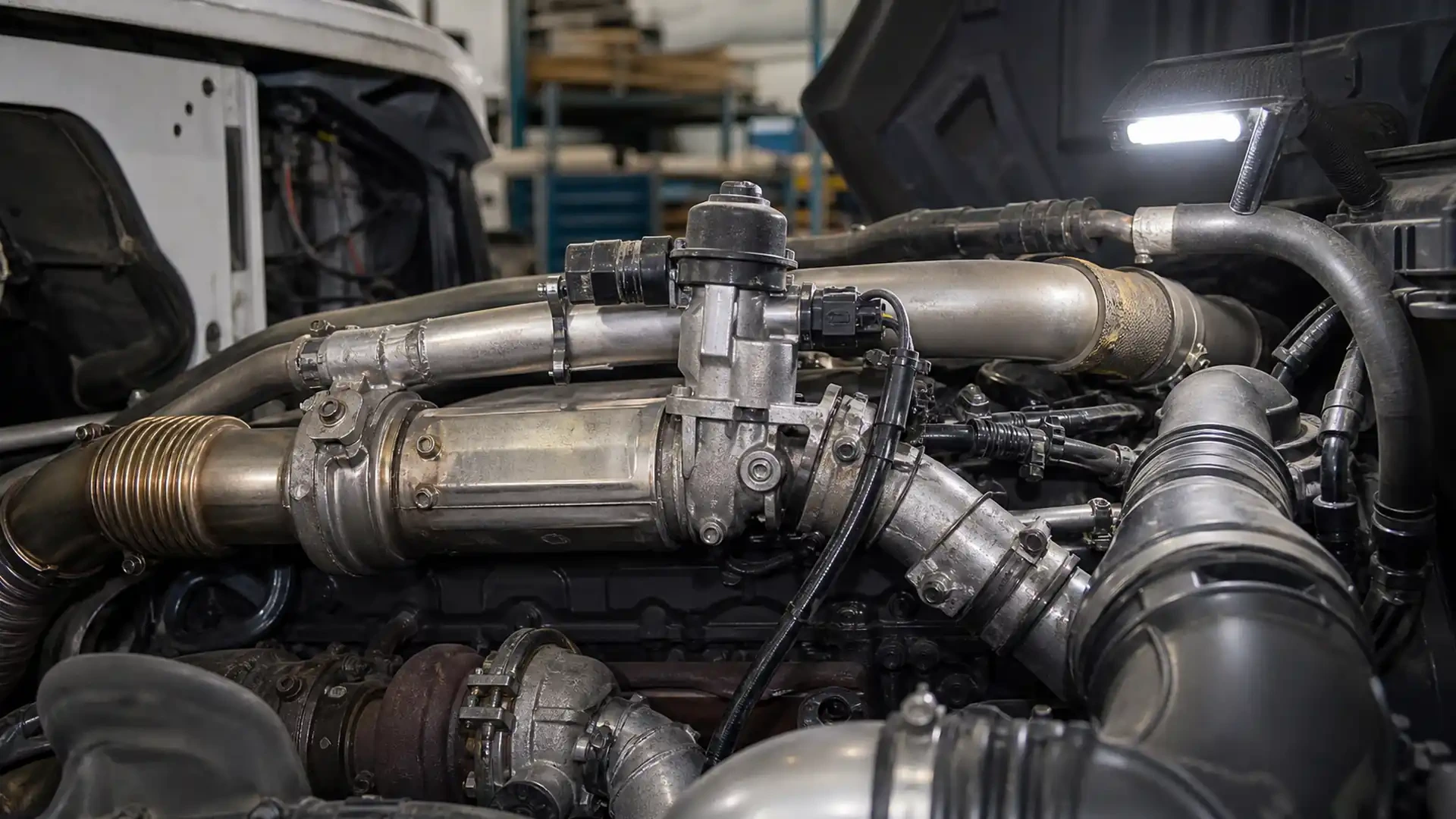
Power loss, smoke, warning lights, and derate can make an EGR component seem like the obvious cause. In a commercial diesel truck, however, the EGR system works alongside airflow, boost, exhaust, DPF, sensors, wiring, fuel delivery, and engine operation.
A code or short fault description may point the investigation toward EGR without confirming the part that needs replacement. Ask what the engine was doing, what other systems changed, and what evidence supports the next step—not only which component appears in the description.
SAAT Repairs Corp provides mobile truck repair, advanced diagnostics, and DPF/EGR support in Tampa, Lakeland, and nearby Florida areas. Service goes to the commercial truck's location when access and conditions are safe.
Why EGR-related symptoms overlap with other systems
The EGR system manages exhaust-gas flow as part of the engine and emissions strategy. Its operation depends on commands, position feedback, sensors, airflow, temperature, boost, exhaust conditions, electrical integrity, and the engine's current operating state.
Power loss can therefore appear with an EGR-related condition, but it can also involve:
Intake or charge-air leaks.
Turbo or boost behavior.
DPF restriction or regeneration problems.
Airflow or pressure sensor information.
Wiring, connectors, voltage, or grounds.
Fuel delivery or injector operation.
Mechanical engine conditions.
More than one active fault.
These areas should not all be repaired based on a list. They should be evaluated according to the codes, symptoms, service information, and operating data.
Patterns worth documenting
The pattern of the complaint can be as useful as the warning itself.
Power loss under load
Record whether the truck loses power only during acceleration, on a climb, with a loaded trailer, at highway speed, or after reaching operating temperature. Note whether reducing load changes the symptom.
A truck that idles normally but loses power under load presents a different pattern from one that runs rough at all times.
Smoke or changing exhaust behavior
Document smoke color, frequency, and the condition in which it appears without approaching the exhaust or placing anyone in danger. Also note unusual odor, excessive heat, or changes during a regeneration.
Smoke alone does not confirm EGR failure. It must be connected with codes, airflow, fuel, engine condition, and other evidence.
Warning lights, codes, and derate
Save the complete codes and messages before clearing them. Record whether the fault is active or intermittent, whether several codes appeared together, and whether the derate is stable or becoming more restrictive.
The order in which faults appeared may help separate an initiating condition from secondary effects.
A fault after recent maintenance
Recent work can provide an important timeline. Record repairs involving EGR, DPF, turbo, intake, exhaust, sensors, wiring, batteries, fuel system, injectors, software, or engine components.
This does not mean the previous repair caused the new complaint. It means the sequence should be considered during diagnosis.
What drivers and fleets should record
Prepare:
Complete dashboard messages and fault codes.
Whether the condition is active, intermittent, or no longer present.
Engine temperature and time in operation.
Speed, load, grade, and throttle condition when power changed.
Smoke, odor, heat, noise, or regeneration behavior.
Recent fuel, filter, electrical, EGR, DPF, turbo, or engine work.
Whether the truck starts, idles, and moves safely.
Unit number, repair history, and repeated complaints.
Clear descriptions help technicians and fleet teams avoid losing time to assumptions or incomplete handoffs.
What a diagnostic review may consider
The exact path depends on the engine, codes, operating data, and approved service procedure.
EGR command, position, and operating data
A review may compare commanded operation, reported position, engine conditions, and related fault information. One reading without load, temperature, or sequence may not explain an intermittent complaint.
Airflow, boost, intake, and exhaust conditions
EGR operation interacts with fresh-air flow and exhaust pressure. Intake restrictions, charge-air leaks, boost conditions, exhaust leaks, or related sensor information may need evaluation when supported by the evidence.
Sensors, wiring, voltage, and grounds
Sensor signals and actuator control rely on connectors, terminals, wiring, stable voltage, and reliable grounds. Heat, vibration, contamination, or previous repairs can contribute to intermittent conditions.
A connector can look secure and still require the correct electrical checks.
DPF loading and regeneration history
DPF restriction, repeated incomplete regenerations, or abnormal soot production can overlap with EGR-related warnings and power loss. Preserve the regeneration history and any DPF messages that appeared before or after the complaint.
Fuel and mechanical conditions
Fuel delivery, injector performance, compression, valve operation, or another mechanical condition can change combustion and emissions-system behavior. The diagnostic process should separate cause from consequence before components are authorized.
Why replacing one component may not solve the complaint
Replacing a valve, sensor, or emissions component from a short code description can leave the original cause in place. A new component may be installed while a wiring fault, airflow problem, exhaust leak, DPF condition, or engine issue continues to affect the system.
The goal is not to delay a necessary replacement. It is to support the decision with fault information, operating data, circuit checks, and the appropriate service process.
What not to do on the roadside
Avoid:
Clearing codes before recording them.
Disconnecting batteries only to remove a warning.
Applying power or ground to a circuit without correct information.
Forcing or blocking EGR or emissions components.
Replacing a valve or sensor from a short description alone.
Working near hot exhaust, moving, energized, or pressurized components without proper training.
Continuing to operate an unsafe truck to reproduce the fault.
Do not modify or bypass an emissions system. Diagnosis and repair should follow applicable requirements and approved procedures.
When to stop safely
Stop in a safe location and request assistance if the truck has severe or increasing power loss, a critical warning, heavy smoke, abnormal exhaust heat, overheating, low oil pressure, a burning odor, an active fluid leak, repeated shutdown, or any condition that makes continued operation unsafe.
The driver should follow fleet safety procedures and applicable roadside requirements.
Preparing for mobile diagnostics
Provide SAAT with:
Exact location and safe-access information.
Truck, engine, year, and unit details.
Complete codes and dashboard messages.
Description of the power-loss pattern.
Current derate and whether the truck can move safely.
Smoke, regeneration, temperature, or other related symptoms.
Recent EGR, DPF, turbo, electrical, fuel, software, or engine work.
Contact information for the driver, dispatcher, or maintenance manager.
Mobile diagnostics can help review fault information, visible conditions, electrical basics, and available operating data. The initial inspection determines the appropriate repair path and whether the work can be completed at the location.
Contact SAAT Repairs Corp
If your commercial truck has power loss, EGR-related codes, warning lights, smoke, or derate in Tampa, Lakeland, or a nearby area, contact SAAT Repairs Corp for mobile diagnostics and truck repair.
Call +1 414 233 9746 or email [email protected]. Share the complete codes, operating pattern, location, current condition, and recent repair history.
Power loss with an EGR or emissions warning? Contact SAAT Repairs Corp with the truck's location, complete codes, current derate, operating pattern, and recent maintenance so the next step can be evaluated with better evidence.