Ask three fleet managers how often a DPF needs cleaning and you'll get three confident answers that don't match. One quotes a mileage figure a dealer mentioned. One quotes a calendar. One just points at the ash-load monitor on the dash. Every one of them can be right about their own trucks and wrong about yours, because the question is being asked in a form the hardware doesn't answer.
The number that matters isn't a universal interval. It's the schedule the engine manufacturer publishes for your exact engine and aftertreatment model, checked against readings your truck already produces every shift. Everything else, including the calendar ranges most operators carry around in their heads, is a planning estimate that tells you when to start paying attention.
Table of Contents
- How Often Does a DPF Need Cleaning?
- Why Doesn't Regeneration Remove Ash?
- Which Operating Conditions Shorten or Extend the Interval?
- Which Warning Signs Mean Service Is Due Now?
- What Service Records Should a Fleet Keep?
- Which Diagnostic Checks Come First?
- What Should a Fleet Do Before the Next Run?
How Often Does a DPF Need Cleaning?
Which figure should go on your maintenance calendar? The honest answer is a set of planning ranges, and the widest split is between two services drivers routinely confuse. U.S. Environmental Protection Agency technical guidance describes regeneration as a soot-burning event that happens at minimum roughly once per day or once per operating shift, while ash cleaning, which removes the noncombustible fraction, runs on a far longer cycle, typically every 6 to 12 months or longer.
Use those ranges to schedule inspections and budget shop time. High particulate output, failed or incomplete regenerations, excessive idling, low-load operation and oil consumption all compress them, so a truck that reaches its ash window early is reporting something about how it runs. When two units on similar routes land months apart, the gap sits in those five variables.
Cummins 2024 X15 guidance shows how far a manufacturer schedule stretches when the engine tracks its own ash load: 250,000–400,000 miles for severe-duty operation, 400,000–600,000 miles for normal operation and 600,000–800,000 miles for light-duty operation. Put the published ranges side by side and the reason they disagree becomes visible. The EPA and Cummins figures in the table come from the documents linked above; the remaining rows are printed ranges from Cummins's quick-reference sheet and CARB's verification tables for listed diesel equipment.
| Service type or engine case | Planning range or trigger | What it depends on | Source and date |
|---|---|---|---|
| Regeneration (soot burn-off) | About once per day or shift, as a minimum | Duty cycle, engine-out particulate output, filter design | U.S. EPA technical guidance, linked above (undated) |
| Ash cleaning, generic planning range | About every 6 to 12 months, or longer | Backpressure readings and the manufacturer's maintenance strategy | U.S. EPA technical guidance, linked above (undated) |
| Cummins X15, severe duty | 250,000 to 400,000 miles | Ash-load monitoring and operating conditions | Cummins X15 guidance, linked above, 2024 |
| Cummins X15, normal operation | 400,000 to 600,000 miles | Ash-load monitoring and operating conditions | Cummins X15 guidance, linked above, 2024 |
| Cummins X15, light duty | 600,000 to 800,000 miles | Ash-load monitoring and operating conditions | Cummins X15 guidance, linked above, 2024 |
| Cummins quick reference, referenced engine family, DPF clean | 150,000 miles or 4,500 hours | Engine family and exact model | Cummins quick-reference maintenance table (undated) |
| Cummins quick reference, referenced engine family, DPF change | 200,000 miles or 6,500 hours | Engine family and exact model | Cummins quick-reference maintenance table (undated) |
| CARB verification table, diesel below 15 ppm sulfur | 2,000 operating hours before filter cleaning | A verification example for listed equipment, so applicability to a truck has to be confirmed | California Air Resources Board verification tables (undated) |
| CARB verification table, ultra-low-sulfur diesel below 15 ppm | 1,000 operating hours | A verification example for listed equipment, so applicability to a truck has to be confirmed | California Air Resources Board verification tables (undated) |
Why the rows disagree
Read the third column before the second. Engine model sets the ash capacity, duty cycle sets the soot production rate, oil consumption sets how fast noncombustible material accumulates, and fuel economy works as a rough proxy for how hard the engine works. A truck at 5.2 mpg on short regional runs and a truck at 7 mpg on interstate lanes can share an engine family and still land hundreds of thousands of miles apart.
A filter that reaches its ash window on schedule is maintenance. One that gets there early again is a symptom. Pull the regeneration history, idle hours and oil-consumption trend before booking the cleaning, because servicing a filter that is filling early leaves the cause in place and the lamp comes back.
Why Doesn't Regeneration Remove Ash?
A self-cleaning oven burns food residue to powder at high heat. The fine mineral dust left on the element stays there until someone wipes it out. The oven did exactly what it promised. What remained was a material it was never designed to burn.
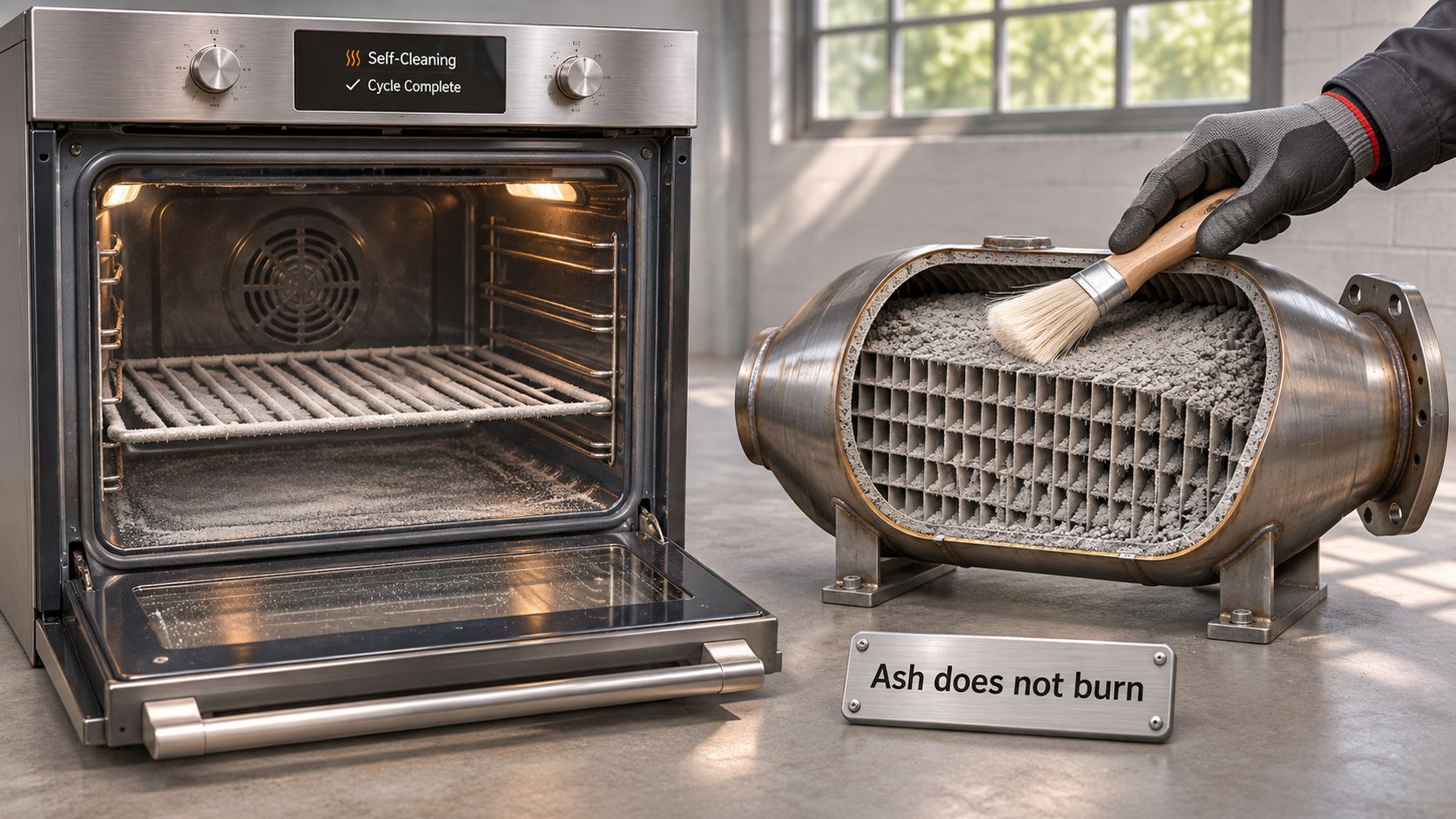
The filter in your exhaust works on the same principle. Soot burns. Ash doesn't.
What the engine control module is actually doing
Cummins training material describes active regeneration as an emissions-control process the engine control module starts when passive regeneration isn't keeping soot low enough. The system doses additional fuel into the exhaust stream, the diesel oxidation catalyst converts that fuel into heat, and the soot trapped in the filter burns. Light-duty patterns, extended idling and low-load routes often fail to reach the conditions passive cleaning needs, so the truck asks for a stationary or parked regeneration instead.
That mechanism is effective at what it targets. It has no effect on the mineral fraction.
Soot burns, ash stays
Ash is noncombustible material, produced mainly by lubricating oil consumption and fuel additives. It accumulates in the filter and stays there. No regeneration temperature removes it, no highway run clears it, and no amount of driving at 65 mph changes the arithmetic. Only physical removal does.
This is why a driver can report completing highway runs and still see the lamp return. The warning reflects one of three things, and each needs a different response. Soot loading responds to a completed regeneration. A sensor, exhaust-temperature, differential-pressure, dosing or software fault responds to diagnostics. Ash responds to cleaning, on the manufacturer's schedule.
A warning lamp is a message about loading, not a verdict about the filter. Reading which of the three conditions produced it is the whole job.
The steps for handling a lamp in the moment, from highway-speed driving to a completed parked regeneration, are set out in this guide to DPF regeneration. What matters for interval planning is the pattern afterward. A truck that warns once, regenerates and stays quiet for months is behaving normally. A truck that warns again within weeks is telling you something upstream is producing too much soot or too much ash, and the filter is only where it shows up.
Which Operating Conditions Shorten or Extend the Interval?
Take two tractors from the same fleet, same engine family, same oil drum in the shop. An illustrative pair like that can land 300,000 miles apart on cleaning. What separated them was how each truck worked, and six variables do most of that work:
- Duty cycle. Long highway runs at steady load give passive regeneration the exhaust temperatures it needs. Short routes and stop-and-go delivery work don't.
- Idle time. Idling produces soot and zero miles. It also cools the exhaust below the range passive regeneration wants.
- Load profile. A lightly loaded truck working a flat route runs cooler than a loaded one pulling grades.
- Oil consumption. Every litre burned carries ash into the filter. This is the single most controllable variable in the list.
- Oil specification. The wrong formulation, or one that doesn't match the engine maker's approval, changes the ash chemistry going in.
- Fuel composition. Blend and quality shift both the soot and the ash side of the equation.
Engine hours beat odometer readings
A regional tractor that idles four hours a day while covering 180 miles accumulates engine hours at nearly twice the rate of a linehaul unit running the same distance. Soot production tracks fuel burned and time at low load, so the hour meter often predicts loading better than the odometer does. Any unit doing PTO work, warehouse shunting, refrigeration duty or extended warm-up belongs on an hours-based review.
Fuel and oil, the controllable half
The fuel question deserves a straight answer. A 2025 MIT-hosted review reports that biodiesel testing produced an ash profile approximately twice as thick as conventional ultra-low-sulfur diesel at comparable aging, and increased pressure drop by 6.8% at 150,000 miles, concluding that biodiesel can require more frequent filter service because ash accumulates faster.
The effect depends on formulation, duty cycle, engine calibration and the ash-management strategy in place. Biodiesel on its own doesn't damage a filter, and switching back to conventional diesel won't fix a loading problem that a failing injector created.
| Condition | Reported effect | Source and date | Controllable by fleet? |
|---|---|---|---|
| Light-duty, extended idle or low-load routes | Passive cleaning may not occur, so stationary or parked regenerations are requested | Cummins training material (undated) | Partly, through route and idle planning |
| Biodiesel in test fuel | Ash profile about twice as thick as conventional ultra-low-sulfur diesel at comparable aging, plus a 6.8% pressure-drop increase at 150,000 miles | 2025 MIT-hosted review | Yes, through fuel specification |
| Lubricating oil consumption | Primary source of noncombustible ash alongside fuel additives | Engine manufacturer service literature | Yes, through oil specification and consumption monitoring |
| Normal or light-duty cycle with fuel economy above 5.5 mpg and an ash-load monitor | Can support a variable or longer cleaning interval | Cummins X15 maintenance guidance (undated) | Partly, through duty cycle and oil practices |
Read that last row twice. Cummins X15 maintenance guidance describes an ash-load monitor that determines when service is due instead of relying on a fixed number, and states that engines in normal or light-duty cycles with fuel economy above 5.5 mpg, together with reduced oil consumption, can support either a variable cleaning interval or a fixed interval of approximately 400,000 to 800,000 miles.
How to isolate a cause: list what changed in the ninety days before the interval shortened. A new fuel supplier, a switch in oil brand, a driver change on the route, a repaired injector or a new turbo all leave a signature.
Hypothetical: a regional tractor runs Tampa to Lakeland on stop-and-go routes with about four hours of daily idle. It may load soot faster than a highway unit covering identical mileage, even though both hit the same odometer reading at the same time. In that case the hour meter, the regeneration count and the pressure trend tell the story the odometer hides.
I'd separate what the fleet controls from what it doesn't before touching the schedule. Approved oil and fuel specifications, and abnormal oil consumption, sit in the controllable column. Compare regeneration frequency before and after any fuel or oil change, because the timing alone doesn't prove the change caused it. Building that comparison into a wider fleet maintenance scheduling routine keeps the interval honest without turning every blend change into a crisis.
Which Warning Signs Mean Service Is Due Now?
The lamp alone is the most common pattern and the least urgent. It means soot load is rising and regeneration is likely needed, not that the filter is finished. The reaction depends entirely on what else the dash is doing.
| Warning pattern | What it indicates | Required action |
|---|---|---|
| DPF lamp on alone | Soot load is rising and regeneration may be needed | Confirm the regeneration-inhibit switch is off, then drive at highway speed for about 20 to 30 minutes or perform a parked regeneration |
| DPF lamp flashing with check-engine or amber lamp | High soot load | Perform a parked regeneration immediately at a safe, controlled location |
| Repeated DPF warnings soon after cleaning | Unresolved fault, excessive particulate output, sensor or dosing problem | Root-cause diagnostics before another cleaning |
| Failed or interrupted parked regeneration | Possible filter damage, sensor fault or restriction | Mobile assessment first, then an external facility if safe roadside completion isn't feasible |
| Rising differential pressure at defined engine speeds | Ash or soot restriction trending upward | Compare with the baseline and schedule inspection when the trend is abnormal |
Cummins operator guidance matches that sequence: with the DPF lamp lit, the operator confirms the regeneration-inhibit switch isn't active and then drives at highway speed for approximately 20 to 30 minutes, or performs a parked regeneration. If the DPF lamp is flashing together with the check-engine or amber warning lamp, soot load is high and a parked regeneration is the immediate action.
The parked regeneration checklist
A parked regeneration needs three physical conditions before anyone presses a button. An appropriate location, the parking brake set, and the transmission in Park or Neutral. Start with the engine at operating temperature where possible, since that shortens the process. Duration varies by unit and ECM, so plan the stop generously rather than watching the clock.
Keep hot exhaust clear of people, cargo, vegetation and combustible material. A regeneration started beside a fuel island or over dry grass is a fire risk, not a maintenance procedure.
One-time or repeating: a lamp that clears after a completed regeneration is a monitoring item. A lamp that returns inside a few hundred miles, or a derate that persists after the cycle finishes, is a diagnostic item.
When a warning stops being routine
I'd push back on the instinct to clean again. Repeated warnings soon after a cleaning, backpressure climbing again quickly, a parked regeneration that fails twice, or a derate that survives the cycle all describe a fault the filter is reporting, not ash the filter is holding. Another cleaning without diagnostics just buys a shorter interval.
The dispatcher's first question is whether the truck can safely continue. The second is whether it can reach a controlled location on its own. The third is whether the pattern needs mobile diagnostics rather than another reset. A technician can evaluate the warning pattern and underlying faults on site, but a failed regeneration, damaged filter, sensor problem or severe derate may need an external facility when safe roadside completion isn't feasible.
What Service Records Should a Fleet Keep?
No single odometer number can set a reliable interval, and no single warning tells you whether you're looking at normal ash service or an unresolved fault. The record is what separates them. For each unit, capture:
- Engine and aftertreatment identity. Engine model, aftertreatment configuration and exact model year.
- Odometer and engine hours. Both, recorded together, every time the unit is in the shop.
- Regeneration events. Each one marked completed, failed or interrupted, with a date.
- Warning-lamp status. Which lamp appeared, whether it was steady or flashing, and what else was lit at the time.
- Differential-pressure baseline. Taken after installation or an approved cleaning, with the engine speed at which it was measured noted alongside.
- Fault codes and history. Active and stored, including anything cleared.
- Oil details. Brand, specification, oil-change interval and any consumption notes between services.
- Fuel source. Supplier or blend for each batch, especially when a contract changes mid-season.
- Prior cleaning dates and outcomes. Including who did the work and whether a flow test followed.
- Route and idle pattern. Typical run length, daily idle hours and seasonal variation.
How to use the record
Mileage alone lies. Trend differential pressure against engine hours rather than distance, and treat a repeat warning inside a short window as a root-cause signal instead of a scheduling nuisance. The trigger examples in the first section show how far cleaning schedules diverge between applications, and California Air Resources Board verification material carries one entry calling for inspection every 1,000 hours and cleaning only if needed. Equipment-specific triggers like that are what the unit record has to capture, because the format changes with the equipment.
The paired entries do the diagnostic work. A fuel-source change logged mid-season explains an ash-rate shift that would otherwise read as a fault. Oil consumption noted between services does the same for a pressure climb that outpaces the baseline. A dated run of failed regenerations between cleanings is a pattern, and a pattern sends a unit to diagnostics before it goes back to the cleaning bay.
The target: a one-page unit record a dispatcher can read in under a minute and answer three questions from. When was the last cleaning, what has the pressure trend done since, and how many regenerations failed.
Which Diagnostic Checks Come First?
Work the checks in the order below. Each one answers a question the previous check can't, and stopping early usually means cleaning a filter that will load again inside a month.
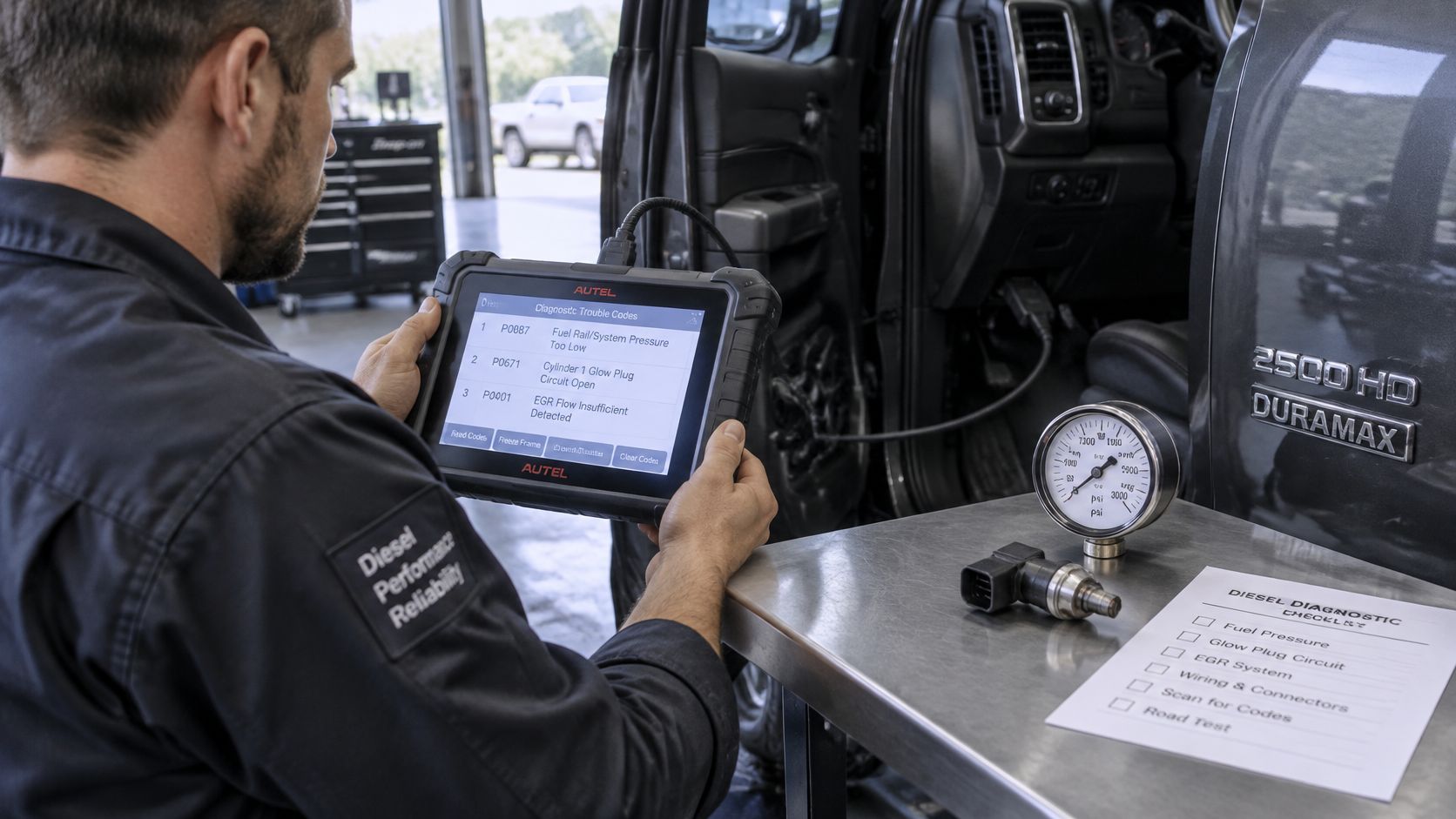
- Read active and stored fault codes. This determines whether the warning reflects genuine soot loading or a sensor, dosing or software fault reporting through the same lamp.
- Compare differential pressure with the recorded baseline at defined engine speeds. A number with no comparison is just a number.
- Review regeneration completion history. Frequent requests plus frequent failures point away from the filter and toward the conditions or components that make regeneration possible.
- Check exhaust-temperature sensing, dosing and visible exhaust leaks. A degraded oxidation catalyst that can't reach temperature will keep loading the filter no matter how often it's cleaned.
- Review oil consumption and the fuel source. Two controllable inputs that shift ash accumulation faster than most maintenance calendars expect.
- Assess whether the work is safe at this location. Access, traffic, weather, available equipment and the nature of the job decide that.
Manufacturer data sets the correct expectation here, and it sits beyond generic calendar advice. Cummins publishes clean and change milestones in miles and engine hours for each engine family, and those figures assume normal duty. The mechanism that decides when service is due on a working unit is ash-load monitoring and warning-lamp behaviour, so a warning that returns soon after a cleaning reads as an unresolved fault until the checks above prove otherwise. The baseline for that comparison is a pressure reading taken after installation or an approved cleaning.
Comparing a current reading against the baseline recorded at the last cleaning tells an advisor more than any single absolute number on the scan tool.
High idle time, short routes, stop-and-go work and interrupted parked regenerations all accelerate soot loading even at low mileage, so review engine hours, regeneration completion, fault history and backpressure together before approving any roadside intervention or replacement. The method for reading the pressure signal in detail is set out in this explanation of the DPF differential pressure sensor.
Where roadside work stops
Some of this work travels well. Mobile diagnostics at the vehicle location use professional scan tools and step-by-step test plans to identify truck issues, and DPF and EGR service for emissions compliance can run on-site where access and job requirements allow.
Ash cleaning and filter removal are a different category. Cummins guidance states that aftertreatment DPFs requiring ash service should go through an authorized repair location, and that unauthorized cleaning methods should not be used. Treat that as an external option, arranged with a suitable facility, rather than work performed at the roadside. The decision at the end of the checks is therefore one of three: continue with a monitored regeneration, carry out on-site diagnostics and repair, or arrange an external facility.
What Should a Fleet Do Before the Next Run?
A warning lamp on its own tells you very little. What turns it into a sound decision is a sequence of three actions, each one narrowing the choice between a normal ash service and an unresolved fault that cleaning will not fix.
- Pull the manufacturer schedule for the exact engine and aftertreatment model. Use it as the controlling reference for that unit, and replace whatever general figure is circulating in the shop with it.
- Start the unit record. Engine hours, regeneration outcomes, warning history and the baseline pressure reading give the next cleaning decision an evidence base instead of a guess.
- Request a diagnostic check when the pattern turns. A warning that repeats, a derate that persists or a pressure trend that climbs abnormally all justify a technician at the vehicle over another reset.
That last step is where the record earns its keep. Before the first diagnostic call, have four things in front of you: the manufacturer interval for that engine, engine hours since the last cleaning, the dates and count of recent warnings and forced regenerations, and the pressure readings that prompted them. A unit with steadily rising backpressure across ordinary duty reads as an ash service candidate. A unit that warns early and often reads as a fault to find first, because cleaning before that fault is named usually buys only a short stretch of quiet.
SAAT Repairs Corp takes DPF and EGR work to the vehicle through mobile Road Services, with no customer-facing workshop: diagnostics, differential pressure checks, aftertreatment resets and preventive maintenance support for fleets running the Tampa and Lakeland corridors. If a unit is warning repeatedly or a pressure trend has started climbing, that pattern is worth diagnosing before the next cleaning rather than after it. Visit SAAT Repairs Corp to start the conversation about what your records are showing.