“Replace the transmission” is premature advice for a truck that won't select a gear. A warning light, harsh shift, or loss of drive can begin with an air-supply problem, a clutch that isn't releasing, damaged wiring, or a control setting rather than broken gears.
For commercial diesel trucks working Tampa, Lakeland, and nearby Florida routes, learning how to repair transmission problems starts with identifying the failed system. The useful decision isn't repair versus replacement. It's whether testing supports an external correction at the vehicle, further diagnosis, or removal at a suitable external facility.
Table of Contents
- What the Complaint Points to Before a Rebuild
- How to Secure, Record, and Rule Out External Faults
- Clutch Measurements That Can Save a Wrong Repair
- What Repair Stages Follow a Confirmed Diagnosis
- When Roadside Work Should Stop
- How Do You Request Mobile Transmission Help in Tampa or Lakeland?
What the Complaint Points to Before a Rebuild
A transmission fault code identifies a reported condition, not automatically a failed gearbox. An automated manual transmission, or AMT, needs coordinated electrical, pneumatic, clutch, and mechanical operation. A fault in one supporting system can prevent shifting even when the gearset remains usable.
The heavy-duty gearbox diagnostic guidance supports checking fault information, air supply, electrical connections, clutch operation, and lubricant condition before condemning internal components. For an AMT, air-pressure checks and captured fault data should precede conclusions drawn from shift feel alone.
Transmission complaints and the first system to check
This table is an industry sorting aid. None of these complaints, by itself, authorizes a rebuild or guarantees roadside completion.
| Complaint | Check first | Rebuild only if | Typical first visit |
|---|---|---|---|
| Shift inhibit or limp mode | Active SPN/FMI, freeze-frame data, voltage, grounds, J1939 communication, and harness condition | External electrical and control checks pass, and further testing confirms internal damage | Scan and connector inspection; teardown not assumed |
| No gear with an air warning | Air supply to the transmission and airline condition | Air is adequate and persistent selection failure is traced inside the unit | External air check often possible; major air repairs are separate |
| Grinding or hard manual shift | Clutch release, linkage, mounts, and recent clutch work | Correct clutch measurements and further testing establish an internal selection fault | Measure and adjust when access is safe; replacement is separate |
| Leak or low fluid | Level, specification, metal, cooler lines where fitted, and leak path | Lubricant findings and component tests establish damage requiring removal | External leak inspection often possible; removal isn't assumed |
| Harsh shifts with a code | Clutch-wear or calibration values, temperature, and software state | Calibration and sensors are sound, and a mechanical fault is confirmed | Diagnostics and programming are case-specific |
| Slip or burning odor under load | Load, grade, stop-and-go history, and pedal use | Clutch and control testing identifies the failed component and supports internal repair | Diagnosis at the truck; clutch or transmission removal often needs another facility |
For shift inhibit, the technician needs the exact SPN and FMI, not just a dashboard description. The suspect parameter number identifies the reported parameter, while the failure mode identifier describes the reported failure condition. Whether the code is active matters, as does the freeze-frame record of conditions when it set.
A no-gear complaint accompanied by an air warning directs attention toward supply and leakage. Grinding during manual selection calls for clutch-release checks. Neither symptom proves that gears need replacement.
What operating information adds
Repeated harsh shifts require more context than a stored code. Live speed-sensor readings, clutch-wear values, temperature, and applicable pressure readings help a technician compare commanded operation with actual response. Telematics showing load, speed, temperature, and selected gear can help reconstruct the event.
A visible leak establishes a need to locate fluid loss, not an automatic need to remove the unit. Likewise, burning odor under load warrants clutch and operating-history checks before a transmission order.
The semi-truck transmission diagnostics guide provides additional context for organizing that first assessment. If the combination can't move safely, it should remain parked and out of service rather than being driven to reproduce the fault.
How to Secure, Record, and Rule Out External Faults
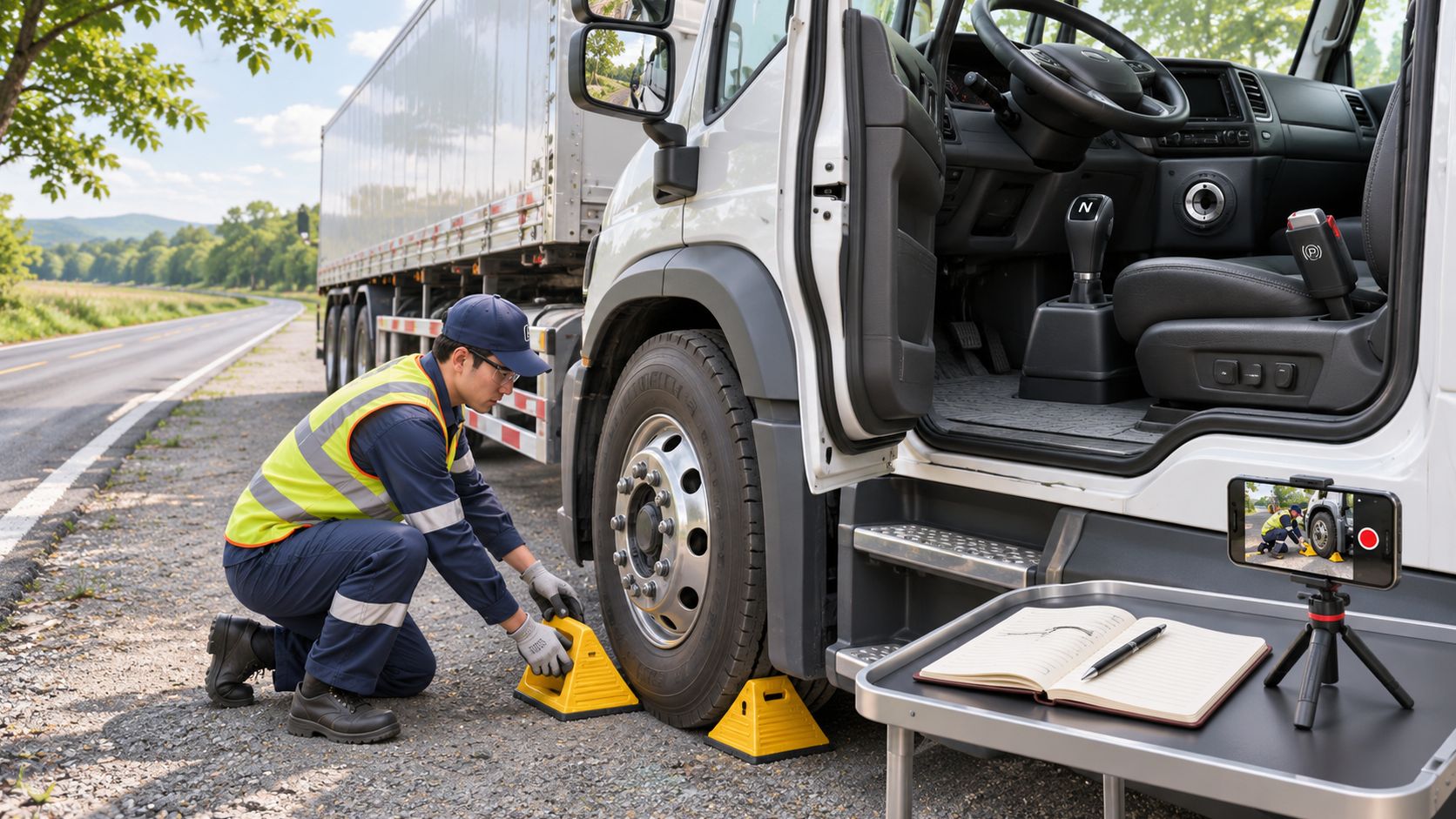
The first repair step is securing the truck. Do not operate the shifter again. A driver should move clear of traffic only if the truck can do so safely, select neutral when possible, apply the parking brakes, and shut off the ignition. A truck that refuses neutral should stay put, and the refusal itself should be reported to dispatch.
Safe immobilization must come before inspection around the vehicle. Every check that follows assumes the combination cannot roll, drift, or lurch.
Preserve the driver's account before testing
The dispatcher should capture what happened before anyone clears codes or changes settings. Repeated attempts to make the truck shift can obscure the original sequence and expose the vehicle to further damage. Each retry also overwrites the freshest evidence available: the conditions under which the fault first appeared.
The FMCSA vehicle-inspection instructor materials direct drivers to inspect vehicles and document deficiencies affecting safe operation or potentially causing mechanical breakdown so the carrier can address them before redispatch. A useful transmission report preserves the driver's words rather than substituting a diagnosis.
The report should include:
- Exact behavior: Grinding, missed or jumping gears, inability to select a gear, unusual noise, warnings, leakage, or loss of air.
- Vehicle status: Tractor, trailer, or full combination involved, current selected gear, and whether safe movement is possible.
- Operating conditions: Payload, hills, stop-and-go work, and whether the engine was cold, idling, or recently driven.
- Recent work: Clutch adjustment, lubricant service, transmission repair, wiring work, or software changes.
- Evidence: Dashboard photographs, captured codes, and leak-path photographs taken from a safe standing position.
No one should crawl beneath an unsecured truck to improve a photograph. A picture can show where fluid reached the ground, yet the leak itself may begin somewhere else entirely.
Follow an elimination sequence
The Eaton Fuller transmission service manual emphasizes diagnosis before repair, correction of the underlying failure cause, and performance verification afterward. Applicable procedures must match the installed transmission; a manual-transmission procedure does not substitute for the correct AMT service information.
A technician's sequence should progress from external evidence toward internal inspection:
- Interview the operator. Confirm the route, load, mileage, lubrication history, previous repairs, and exact sequence of symptoms.
- Inspect accessible supporting systems. Check mounts, brackets, airlines, connectors, wiring, leaks, clutch operation, and available air supply.
- Record electronic evidence where applicable. Save active and stored codes, freeze-frame information, and live speed-sensor readings before clearing anything.
- Evaluate lubricant. Follow the model-specific level-check procedure, confirm the approved specification, and assess contamination and metal. Preserve a sample if internal investigation may follow.
- Authorize disassembly only when supported. Internal inspection should investigate why parts failed, including incorrect, missing, or unsuitable components. Replacing visible damage alone leaves the cause in place.
A technician should record a measured air-pressure result or electrical test result; a note that the system "looked normal" carries no weight later. An intermittent connector fault may require testing under the conditions that produced the complaint.
The accompanying video provides additional visual context for transmission troubleshooting.
Evidence rule: Clearing a code isn't a repair, and a code that disappears after restarting doesn't establish that the truck is ready for dispatch.
The other common mistake is condemning the gearbox before excluding low air, a clutch-release problem, damaged wiring, a blocked breather, a loose mount, or a sensor fault. Each of these can imitate an internal failure: low supply pressure can block an air-assisted gear change, and a clutch that never fully releases makes every selection grind.
A Lakeland dispatcher takes a call like this mid-shift: the driver reports that the transmission stopped working after hill operation. The useful follow-up asks for the selected gear, any clutch slip or burning smell, and whether an air warning appeared. That packet supports triage; it doesn't certify the combination as safe.
Clutch Measurements That Can Save a Wrong Repair
Manual clutch checks before a transmission is condemned
For the applicable International procedure, the International service bulletin available through NHTSA's 2017 records specifies clutch-pedal free play of 0.4 to 0.6 inches, a release-bearing gap of 0.490 to 0.560 inches, and clutch-brake squeeze with the pedal approximately 1 inch from the floor.
| Measurement | Published range | If the reading is outside the range |
|---|---|---|
| Clutch-pedal free play | The applicable bulletin range stated above | Adjust linkage or follow the in-vehicle reset before replacing major parts |
| Release-bearing gap | The applicable bulletin range stated above | Correct the adjustment or setup, then measure again |
| Clutch-brake squeeze | The approximate pedal position stated above | Document pedal feel, engagement point, and recent work; follow the applicable adjustment procedure |
These values apply to one procedure on one platform. Other clutch designs and truck platforms carry their own service information, and a technician must identify the installed system before applying any measurement.
What an out-of-range reading shows
An out-of-range reading confirms that adjustment or setup needs attention. Whether the clutch assembly itself is worn or damaged is a separate question, and inspection answers it rather than a single number.
The technician corrects the relevant setting through the prescribed linkage adjustment or in-vehicle reset, then repeats the measurement and the operating check. If gear selection remains difficult, the remaining symptom becomes the basis for further testing.
Pedal feel adds context without replacing measurement. A driver should describe where engagement occurs, whether pedal behavior changed suddenly, which gears are difficult to select, and whether the complaint began after clutch work.
The semi-truck clutch-adjustment guide explains why an adjustment assessment belongs before a replacement decision. Work beneath the vehicle remains a technician task requiring secure support and safe access.
Separate heat history from component diagnosis
The West Virginia heavy-duty clutch-training document identifies excessive heat as a major cause of clutch failure and connects it with starting gear, shifting technique, overloading, riding the pedal, and holding a truck on a grade with a slipping clutch. Those operating details belong in the service report.
A useful report distinguishes among:
- Operating exposure: Heavy payload, hill starts, repeated stop-and-go operation, or prolonged clutch slipping.
- Observed symptoms: Burning odor, slip during acceleration, chatter, or difficulty engaging gears.
- Control behavior: Changed pedal travel, inconsistent release, or symptoms beginning immediately after adjustment.
A burning smell is evidence of a problem requiring investigation, and it cannot identify which part failed on its own. Hydraulic actuation, linkage, clutch condition, and transmission controls may each require a separate check.
Measurement rule: A reading inside the approved range removes adjustment from the suspect list. A reading outside it directs attention to setup and nothing more.
On-site measurement and adjustment may be practical at the vehicle. Replacement requires a separate assessment of access, lifting equipment, working space, and truck condition.
What Repair Stages Follow a Confirmed Diagnosis
The repair should match the proven fault, not the most expensive component associated with the symptom. A confirmed harness defect calls for an electrical repair. An established internal mechanical failure calls for a different work plan. Each stage below exists to answer one question: does the evidence justify going deeper?
Match the repair stage to the evidence
- External correction. An accessible air leak, blocked breather, loose connector, or damaged harness may be corrected at the vehicle when safe conditions and suitable equipment allow. The technician must confirm that the defect explains the complaint.
- Adjustment and resetting. Linkage or clutch settings should be restored using the applicable procedure. A reset can't substitute for inspecting worn or damaged parts.
- Calibration and programming. Software or calibration work should follow checks of sensors, power supply, grounds, and network communication. Programming won't repair a chafed wire or inadequate air supply.
- Component replacement. A failed clutch actuator or another component may require replacement after testing. Parts availability, access, support equipment, and removal requirements determine the workable location.
- Removal and internal repair. A transmission requiring case opening or removal belongs at a suitable external facility, where the assembly can be safely supported and inspected.
- Verification. The completed repair must be checked against the original complaint, with results recorded rather than assumed.
Stages can be skipped when the evidence supports it. A confirmed external fault may require no internal work, while clear internal damage may justify proceeding directly to a removal plan after supporting-system checks.
Define completion before returning the truck
The technician should establish pass criteria from the manufacturer's service information and the actual complaint. Verification may include a controlled operational check or road test when safe, followed by a review for returning faults, leakage, abnormal noise, and shift behavior.
The repair record should identify what failed, what changed, what passed testing, and what remains unresolved. A successful stationary gear selection doesn't automatically prove correct operation under the load and temperature conditions that triggered the original problem.
A truck that loses gear selection only after long runs on rough pavement tells a different story than one that fails cold. Tracing that pattern can lead to an air line rubbed thin at a bracket, feeding an intermittent connector that drops pressure under vibration. Securing and repairing the line closes the job at stage one, and the repair record shows why no deeper work was ever warranted.
When Roadside Work Should Stop
A technically sound diagnosis can still identify a job that shouldn't proceed at the current location. Traffic exposure, unstable ground, restricted access, or a loaded combination that can't be secured can make an otherwise straightforward repair unsuitable.
Compare mobile checks with removal work
| Work category | Potential on-site scope | Reason to stop or relocate the work |
|---|---|---|
| Electronic diagnosis | Capture stored information and test accessible circuits | Unsafe access, unsuitable equipment, or conditions preventing reliable testing |
| External inspection | Inspect accessible harnesses, airlines, fluid levels, and visible leaks | Inspection would require entering an unsecured area beneath the truck |
| Measurement and adjustment | Check applicable clutch settings and perform supported adjustments | Insufficient clearance, unstable support, or work beyond available equipment |
| Major mechanical work | Assess the fault and document removal requirements | Transmission removal, case opening, or clutch replacement requiring controlled lifting |
SAAT Repairs Corp is an independent mobile road-services team that attends the vehicle location and has no customer-facing workshop. Any facility used for removal or internal repair is an external option, not a SAAT location. A drop-off or shop-bay appointment isn't part of its operating model.
Stop-work boundary: A delivery deadline doesn't make an unsecured truck, exposed shoulder, or unsuitable lifting arrangement acceptable.
Make the maintenance record useful afterward
The carrier remains responsible for the out-of-service and redispatch decision. A diagnosis should state whether the truck can be operated safely, whether further investigation is required, and which conditions prevented completion.
FMCSA's maintenance-safety findings report that carriers targeted for intervention because of vehicle-maintenance violations had a crash rate 65% higher than the national average. That finding concerns maintenance-related carrier risk, not transmission-failure frequency, and it doesn't establish that every defect causes a crash.
For fleet managers, the practical response is systematic maintenance, not collecting emergency invoices. Records should retain lubricant condition, leak findings, shift quality, fault history, clutch or actuator behavior, and relevant operating conditions.
Useful follow-up includes:
- Vehicle history: Retain the original complaint alongside test results and completed work.
- Duty-cycle review: Compare repeat problems with payload, stop-and-go operation, heat exposure, and route demands.
- Repair verification: Record the operational check and any restrictions or unfinished work.
This article doesn't arrange towing or represent ownership of a heavy wrecker. If the truck can't move safely or the work requires relocation, the carrier must coordinate an appropriate recovery and external repair plan.
How Do You Request Mobile Transmission Help in Tampa or Lakeland?
I'm reviewing the "How Do You Request Mobile Transmission Help?" section. The closing line needs to be more actionable, specifying what a dispatcher should have ready before calling, rather than just echoing repair record guidance. I'll also ensure the link to mobile truck repair information appears exactly once and is correctly placed. I've confirmed there are no contradictions and the call to action is complete, while respecting the business facts provided.
I'm considering the structure of this section, noting that it shouldn't start with a list since the previous one ended with one. The current structure seems fine, but I'll focus on improving the closing sentence to be more actionable for dispatchers. I also need to ensure the unique angle about triage versus external repair is clearly reflected, especially regarding what information dispatch needs. I'll keep the H3 heading and aim to stay within the target word count.
The draft's opening sentence, "A useful service request begins with...", is functional but could be sharper. The quality of the request directly impacts triage efficiency, so I'll rephrase to emphasize that connection. The rest of the draft seems to align with the previous thoughts about actionable closing statements and the unique angle of dispatch triage versus external repair.
I'm reviewing the closing paragraph before the CTA. The current line, "The fleet's final record should preserve what changed, what was verified, and what remains open," is a bit generic. I need to replace it with a concrete next step for the dispatcher, focusing on whether the truck is drivable or needs to remain parked, as this dictates the mobile team's approach.
The previous section discussed records for lubricant condition, leak findings, and repair verification. The flagged line repeats that, so I'll replace it with a specific item a dispatcher should have ready before calling, like whether the truck can be moved to a safe spot. This detail shapes roadside attempts versus facility needs. I'll also add that precise symptom descriptions are helpful, as a "no drive" report could stem from various issues beyond internal transmission damage. This fits the article's angle of triage versus external repair. I'll check for banned words and ensure the link anchor and URL are correct.
I'm reviewing the "How Do You Request Mobile Transmission Help?" section. The draft's opening paragraph is good, but I need to ensure the response time claim is accurate and includes the necessary caveats. I'll also check that the paragraph lengths vary appropriately, starting with a short one.
I'm reviewing the draft's opening paragraph. The claim about SAAT Repairs Corp's 24/7 emergency road service needs to be presented clearly, along with the caveats that the 45-60 minute response time is an estimate dependent on traffic and location, not a guarantee. I'll also ensure the distinction between a diagnostic visit and the completion of internal repairs is maintained.
I'm reviewing the draft's final paragraph before the CTA. The current line, "The fleet's final record should preserve what changed, what was verified, and what remains open," is a bit generic. I need to replace it with a concrete next step for the dispatcher, focusing on whether the truck is drivable or needs to remain parked, as this dictates the mobile team's approach.
I'm reviewing the draft's final paragraph before the CTA. The current line, "The fleet's final record should preserve what changed, what was verified, and what remains open," is a bit generic. I need to replace it with a concrete next step for the dispatcher, focusing on whether the truck is drivable or needs to remain parked, as this dictates the mobile team's approach.
The draft's opening paragraph correctly links to the guide on requesting mobile truck repair and lists key information categories. However, it needs to clarify that the 45-60 minute response time is an estimate, not a guarantee, and is contingent on factors like traffic and technician availability. It also needs to explicitly state that callers outside the immediate service area should confirm coverage.
I'm reviewing the opening paragraph. It correctly states that SAAT Repairs Corp offers mobile transmission diagnostics, maintenance, and repair at the vehicle's location, provided access is safe and job requirements are met. It also directs users to the company's website for an initial assessment by submitting truck location, symptoms, codes, and operating status via the English contact section.