A driver parked near Tampa notices the air pressure falling while the truck is standing still. The dispatcher needs to know whether the loss is within the applicable limit, whether the source can be found at the vehicle's location, and whether the truck can safely move. A useful answer starts with a correctly performed air brake leakage test, not a quick glance at the gauge or a guess based on whether anyone hears hissing.
The result is only meaningful when the vehicle configuration, brake position, and test procedure are clear. Those details determine which limit applies and what the next decision should be.
Table of Contents
- What the Air Brake Leakage Test Actually Tells You
- Preparing the Truck for a Safe Leakage Test
- Running the Static and Applied Leakage Tests
- Pass and Fail Limits by Vehicle Configuration
- Finding the Source of a Leak When You Cannot Hear It
- Documenting Results for Compliance and Fleet Records
- When a Passing Test Is Not Enough to Return to Service
What the Air Brake Leakage Test Actually Tells You
A leakage test measures whether a charged air-brake system retains pressure with the engine off. It's a timed pressure-retention check, not a snapshot of a gauge. With the engine stopped, the compressor can't replace escaping air during the measurement and disguise the rate of loss.
Two conditions matter. A static test checks pressure loss with the service brakes released. An applied test checks the system while the service brakes are held down. A truck may behave differently under those conditions: a line or valve may hold pressure with the brakes released but leak when the service circuit is pressurized.
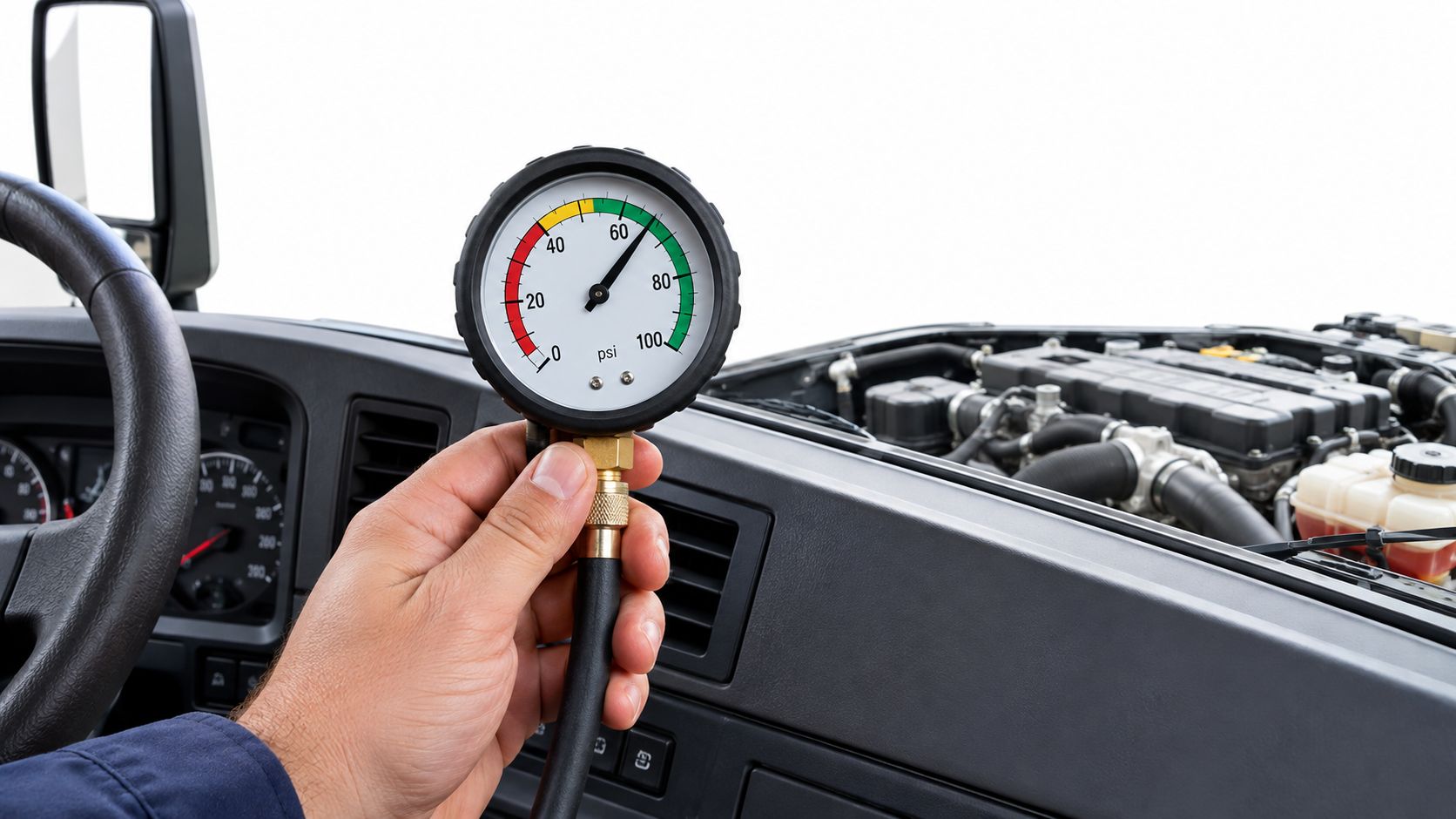
A passing pressure-loss reading does not prove that the brakes apply and release correctly, that the low-air warning works, or that every connection is leak-free. Those require separate checks. A leak can also be present even if it isn't audible, and a gauge result must be compared with the limit for the actual vehicle and test condition.
For a driver who finds pressure falling while parked, the useful starting point is to record the vehicle's condition and what was happening when the loss occurred. The guide to recording air pressure drops before mobile diagnostics can help organize those observations for the technician.
Practical rule: A gauge reading is evidence about pressure retention under one specific test condition. It isn't a complete brake-system inspection.
Preparing the Truck for a Safe Leakage Test
An invalid setup produces an unreliable result. Before starting a timer, secure the vehicle, confirm that the air system has reached normal operating pressure, and note what kind of vehicle is being tested. A straight truck and a tractor-trailer don't necessarily use the same limits.

Set up safely before timing
- Choose a safe, level location. Account for traffic exposure before anyone works around the truck. Chock the wheels so the vehicle can't roll, especially before releasing the parking brake for a test.
- Place the transmission in neutral and secure the vehicle. Record whether the test involves a single vehicle or a combination, including connected trailers. The configuration affects which inspection threshold is relevant.
- Build normal system pressure, then stop the engine. The Commercial Vehicle Safety Alliance procedure specifies building pressure to 90–100 psi before testing with the engine off (CVSA Operation Airbrake inspection procedure). Testing while the compressor is running can mask loss by replacing escaping air.
- Record the starting gauge readings. Note the stabilized pressure on each available circuit gauge, the parking-brake position, whether the service brakes are released or applied, and the time the measurement begins.
Keep the ignition position and other controls consistent with the inspection procedure being followed. Don't mix conditions from different procedures and then treat the result as a single standardized test. If a roadside location isn't safe for the technician to work around the vehicle, the test should wait until the vehicle can be secured appropriately.
Running the Static and Applied Leakage Tests
A roadside call usually goes wrong in the first thirty seconds: the pedal goes down, the needle falls, and someone calls it a leak before the application has settled. Treat that first needle movement as application fill, not timed loss. Start the clock only after the gauge holds steady, then write down start and finish values for the exact brake condition being tested.
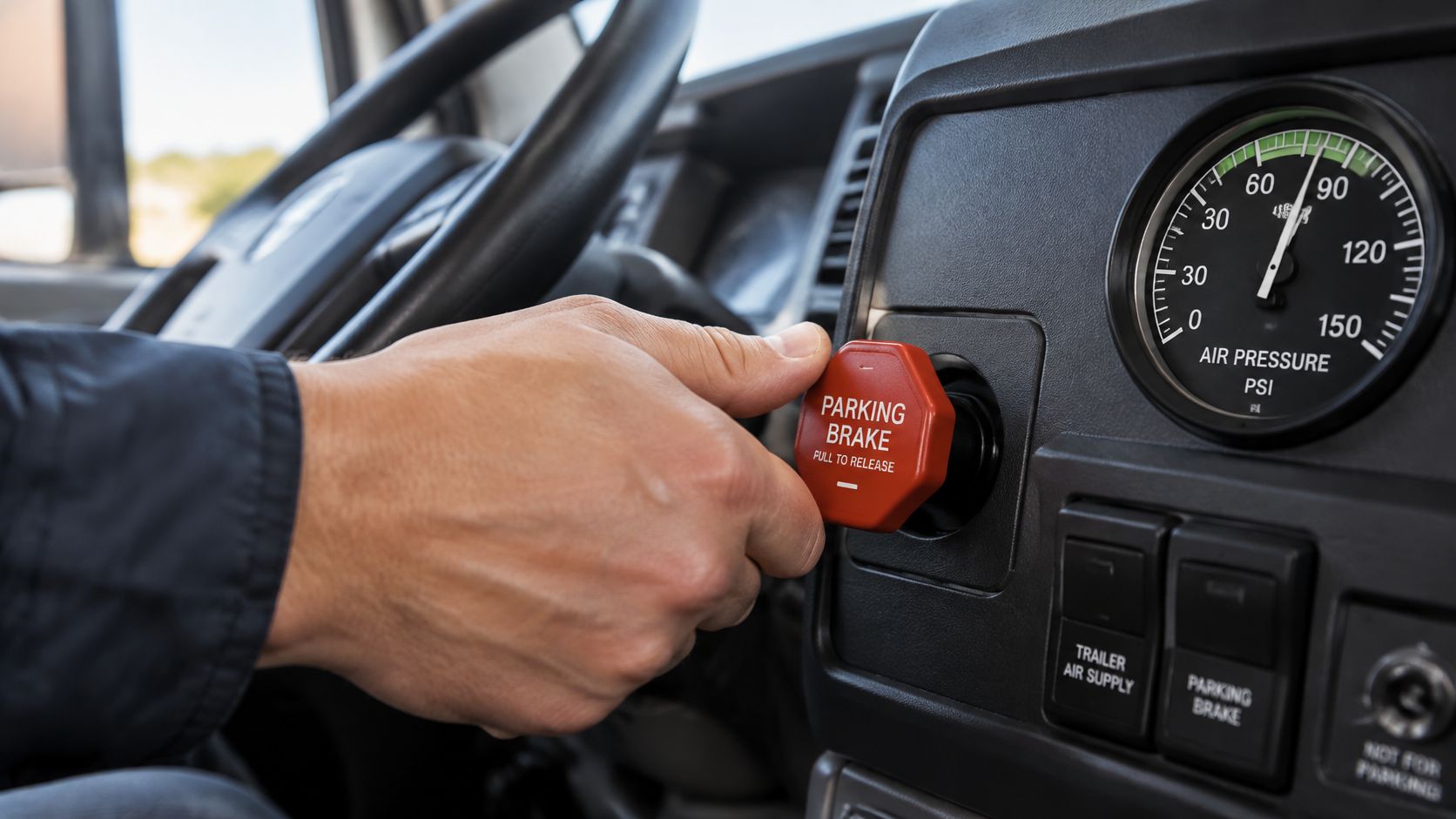
Check pressure with the service brakes released
With the truck secured and the compressor no longer replacing lost air, run the static check under the conditions set by the governing procedure. FMCSA inspection training describes a practical sequence that measures pressure loss for one minute with the parking brake applied, then repeats for one minute with it released, with a maximum loss of 2 psi in each minute (FMCSA Vehicle Inspections Instructor Module).
Record each result separately. Do not average the two readings or mark the test “passed” without noting the parking-brake condition. If the released check loses more than the applied check, that spread is useful later when you are deciding whether to chase service gladhands, relay valves, or a tractor-only circuit.
Check pressure with the service brakes applied
Release the parking brake only for the service-brake measurement, then press the pedal firmly and hold it steady. Let the initial application drop settle before starting the timed minute. The same FMCSA training material describes an initial application drop of no more than 10 psi, followed by a maximum continuing loss of 3 psi in the next minute for that procedure.
If primary and secondary circuits have separate gauges, record them independently. A legal one-minute result can still leave a practical problem if one circuit keeps creeping after the clock stops, so note the trend as well as the endpoint. When the reading is borderline, repeat the same condition once rather than mixing released and applied numbers into a cleaner-looking result.
A separate FMCSA brake-safety check describes holding a full service-brake application for two minutes, with acceptable loss of less than 5 psi during that interval (FMCSA brake safety systems guidance). That is a distinct protocol, with its own benchmark, and it should stay separate from the one-minute readings above.
Pass and Fail Limits by Vehicle Configuration
The most common mistake is treating “the leakage limit” as one universal number. The applicable result depends on vehicle configuration, whether the service brakes are released or held, and which inspection procedure governs the test.
For the commonly applied U.S. one-minute limits, a single vehicle has a tighter allowance than a combination vehicle. The cited commercial-vehicle guidance distinguishes static and applied conditions, with the applied test allowing a higher rate of loss than the static test (commercial vehicle air-brake leakage limit overview).
| Vehicle Configuration | Static Test Limit | Applied Test Limit |
|---|---|---|
| Single vehicle, such as a straight truck or bus | 2 psi per minute | 3 psi per minute |
| Combination vehicle, such as a tractor-trailer | 3 psi per minute | 4 psi per minute |
These values apply to the described one-minute tests. They shouldn't be swapped for the separate two-minute full-application check, which uses its own procedure and benchmark. Nor should an operator assume that a tractor-only result settles the question for a connected combination. The test should reflect the configuration being evaluated.
Other jurisdictions can specify different category limits. Ontario's handbook, for example, lists a one-minute applied-test maximum of 3 psi for a straight truck, tractor, or bus, 4 psi for a tractor-trailer, and 6 psi for a tractor pulling two or more trailers (Ontario Official Air Brake Handbook inspection procedure). That's why a cross-border fleet should identify the applicable jurisdiction and test standard in its records instead of using a familiar figure by habit.
If the measured loss reaches or exceeds the relevant ceiling, don't call the truck acceptable based on a different configuration's allowance. Investigate the system and confirm the correct procedure before making a return-to-service decision.
Finding the Source of a Leak When You Cannot Hear It
No audible hiss doesn't mean the gauge result can be ignored. Some leaks are difficult to hear in roadside conditions, and some appear only when pressure is applied or a component moves. The useful response is to repeat the test under controlled conditions, compare static and applied results, and inspect systematically.
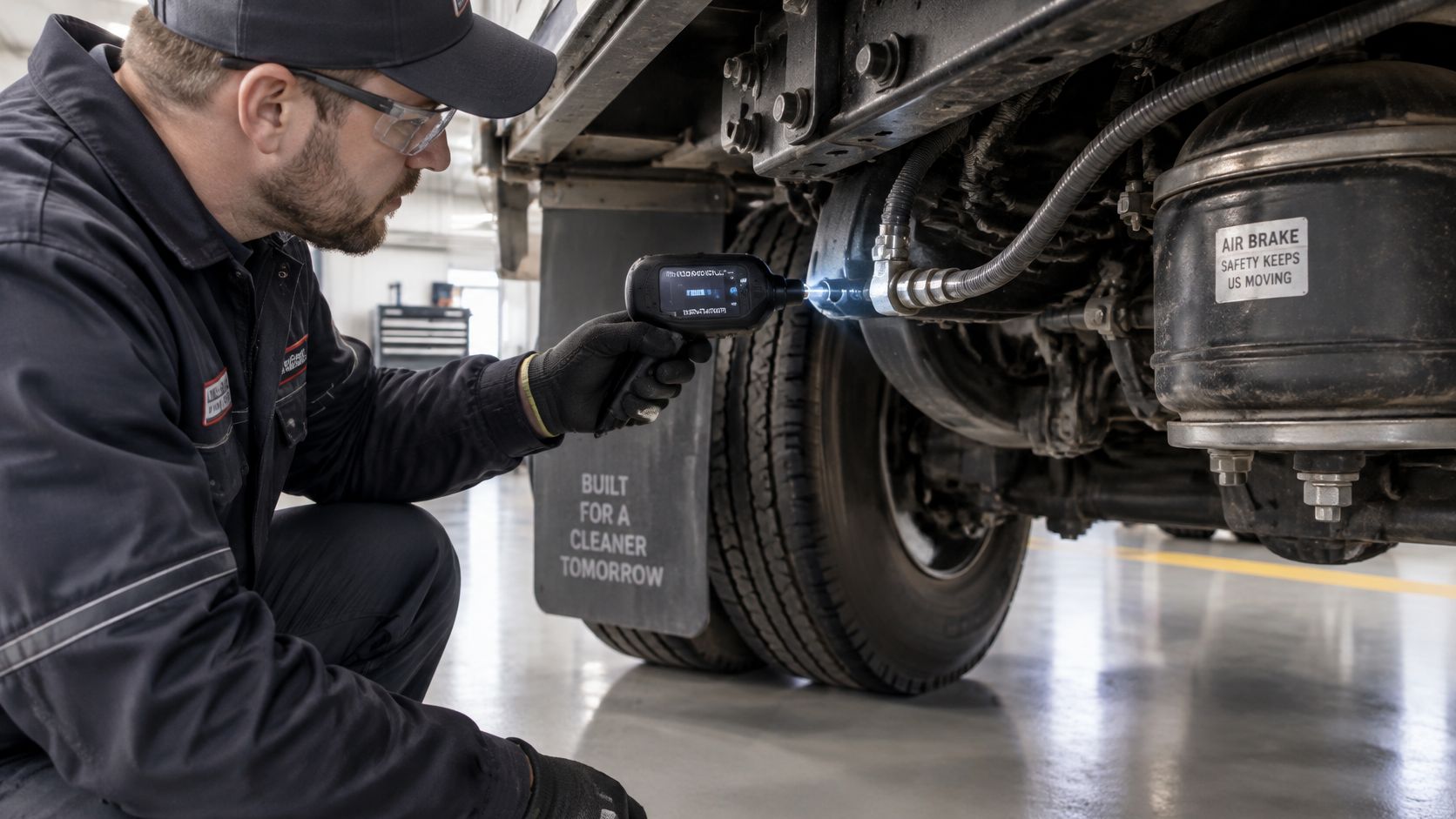
Start with the simplest comparison: did the loss occur with the service brakes released, with them applied, or under both conditions? Then check air lines and hose ends, glad-hand seals, fittings, relay valves, brake chambers, reservoirs, and visible connections. An approved leak-detection solution can reveal escaping air where it's safe and practical to apply it.
A combination vehicle should be evaluated with the trailers connected if that's the configuration in service. If the test points toward the trailer side, a technician may need to isolate circuits to narrow down the source. Intermittent loss can also require a careful repeat after relevant hoses or controls have been moved; a leak that appears with vibration or articulation may not show up during a still inspection.
A marginal gauge result without a visible source calls for diagnosis, not a confident pass.
Record what changed between tests, including the vehicle configuration, brake position, gauge readings, and any observed leak location. Those details help a mobile technician assess what can be inspected or repaired safely at the vehicle location. Commercial trailer brake and air work may be possible on site, but access, the specific fault, and safe working conditions determine feasibility. The guide to documenting tractor or trailer air-system problems can help dispatchers capture the information needed to coordinate the next step.
Documenting Results for Compliance and Fleet Records
A roadside technician called out at 2 a.m. will ask the same questions every time: what was the configuration, what was the starting pressure, how much did it drop, and under which limit does that reading fall. A record that answers those questions lets the next person repeat the test under comparable conditions instead of starting over. That matters for preventive maintenance, roadside decisions, and a defensible inspection history.
Record the vehicle configuration, including whether trailers were connected, and identify the governing inspection procedure. Then note whether the check was static or applied, which brake controls were set, the stabilized starting pressure, the elapsed time, the final pressure, the calculated loss, and the applicable limit.
If the test is part of a diagnostic visit, include the symptom that prompted it. Note whether pressure falls while parked, only during brake application, or after a trailer connection is moved. Photographs of gauge readings can support the written record, but they don't replace the conditions and measurements needed to interpret them.
A leakage test also isn't a reserve-capacity test. U.S. federal rules require reservoir capacity sufficient for a full service application without pressure dropping below 70% of the pre-application gauge indication for specified vehicles. That is a separate requirement described in the FMCSA brake safety systems guidance already cited above, and it shouldn't be treated as another way of calculating leakage.
A passing gauge rate doesn't erase a separate defect. Capture other observed problems in the record, especially warning-device operation and audible leaks, so the next decision rests on the whole condition rather than a single number detached from its test conditions.
When a Passing Test Is Not Enough to Return to Service
A tractor-trailer sits on a roadside pull-off with a one-minute gauge drop inside the legal limit, and the driver mentions the low-air buzzer never sounded during the morning check. The timed number says pass. The truck says otherwise.
A pressure-loss result answers a narrow question: how fast the system loses air under one set of conditions. Returning to service depends on the rest of the picture, including what the warning device does, where a leak sits, and whether the truck can move without creating a hazard.
FMCSA inspection guidance treats air-loss-rate failures, audible leaks at connections, and leaks at brake valves as distinct defects. A gauge reading inside the limit does not clear them. The low-air warning needs its own check. One FMCSA training procedure, cited earlier in this article, specifies that the warning must activate before pressure falls below 55 psi or the manufacturer's specified level. A separate FMCSA inspection record describes a low-pressure warning activating below 60 psi (FMCSA Safety Measurement System inspection record). Because wording and governing procedures differ, identify the applicable standard and follow it rather than blending thresholds.
Decide on movement from the whole condition
Whether a truck can roll after a failed or marginal test cannot be settled by the gauge. I weigh the warning device, parking-brake hold, service-brake response, leak location, and whether the site gives safe access off the traffic lane. A hissing brake chamber, hose, or fitting earns a repair call even when the timed loss looks acceptable.
When pressure loss is excessive but no leak announces itself, restabilize and repeat under the correct configuration. Compare released-brake against applied-brake results, work connections and valves with an approved detection solution, and treat silence as inconclusive rather than clean.
Common follow-up questions
Which limit applies to a tractor-trailer versus a single truck? Use the limit for the vehicle configuration and test condition specified by the governing procedure. The one-minute U.S. figures in the comparison table are not interchangeable with other inspection protocols.
Are static and applied tests interchangeable? No. The static test checks pressure retention with the service brakes released; the applied test measures loss while they are held. A result from one does not substitute for the other.
Does passing the leakage test verify the low-air warning? No. Warning activation must be checked separately under the applicable procedure. A pressure-retention pass does not prove the warning system works.
Can the truck be moved after a failed test? No blanket answer is safe. If warning operation, brake response, parking-brake behavior, or the leak location raises concern, a favorable reading from another test condition settles nothing. A qualified technician should assess the truck and whether on-site work is feasible before it moves.
Mobile brake service can handle air-system inspection and repair at the vehicle location when the job and site conditions allow. Some repairs require a suitable external facility, so the scope must be assessed rather than assumed. For the rest of the return-to-service checklist, see the brake repair verification steps for commercial trucks.
For a truck in Tampa, Lakeland, or a nearby Florida corridor with suspected air loss, SAAT Repairs Corp provides mobile roadside assistance and brake-system inspection at the vehicle location, subject to safe access and job feasibility. Contact SAAT Repairs Corp with the vehicle configuration, test readings, and leak symptoms to discuss the appropriate next step.