A commercial truck that loses air pressure while parked may restart with a warning, need more recovery time, or show a different gauge reading than the driver expects. The change can appear during a short delivery stop, after an overnight park, or only when the tractor is connected to a particular trailer.
The gauge movement confirms that the system's condition changed, but it does not identify where air escaped or which component needs repair. The useful next step is to document time, configuration, brake state, warnings, and any safely observable leak pattern.
Do not return the truck to the route only because pressure builds again after restart. The driver must follow manufacturer information, fleet procedures, and applicable requirements to determine whether the unit is safe.
SAAT Repairs Corp provides mobile truck repair and air-system diagnostics for commercial trucks in Tampa, Lakeland, and nearby Florida areas. Service goes to the truck's location when access and conditions are safe.
Why parked pressure loss deserves attention
Air-system behavior during parking can reveal a condition that is harder to notice while the engine and compressor are operating. A leak may be partially masked while air is being supplied, then become more obvious after shutdown or during a longer waiting period.
Parked pressure loss can affect:
The time needed to prepare the truck for operation.
Warning behavior after restart.
Brake and parking-system readiness.
Tractor-trailer troubleshooting.
Dispatch decisions and downtime.
The likelihood that an intermittent condition will be missed during a short inspection.
Not every change has the same severity or cause. The truck's design, configuration, parking duration, brake state, temperature, and service information all matter.
Why the gauge change alone does not locate the leak
A pressure change can involve many areas, including:
Air lines, hoses, fittings, or couplers.
Tanks, drains, or check valves.
Brake chambers or control valves.
Parking- or service-brake circuits.
Tractor protection or trailer supply components.
Suspension or accessory air circuits.
Pressure sensors, gauges, wiring, or displayed information.
More than one small leak in the combination vehicle.
The location may change with brake application, parking-brake state, trailer connection, temperature, or vehicle movement. That is why “it loses air overnight” should be followed by a structured description rather than an immediate parts order.
What to record before requesting service
Accurate documentation helps a technician reproduce the condition safely and choose the appropriate checks.
How long the truck was parked
Record whether the change appears after:
A few minutes at a delivery stop.
A meal or fuel stop.
Several hours.
An overnight park.
A weekend or longer period out of service.
If the fleet has an approved way to record initial and later gauge observations, include the time and conditions. Do not use a general blog article as a substitute for the vehicle's required inspection procedure.
Tractor, trailer, and brake state
Document the exact configuration:
Tractor and trailer unit numbers.
Whether a trailer was connected.
Whether the symptom follows one trailer.
Parking location and surface conditions.
Brake state according to the fleet's approved process.
Whether the truck had just completed a route, regeneration, repair, or wash.
Do not change connections or brake states only to test the system unless qualified personnel are following an approved procedure.
Where and when a leak can be heard
If a leak can be heard from a safe position, describe the approximate area without crawling under the vehicle or touching pressurized components.
Useful descriptions include:
Near the front, middle, or rear of the tractor.
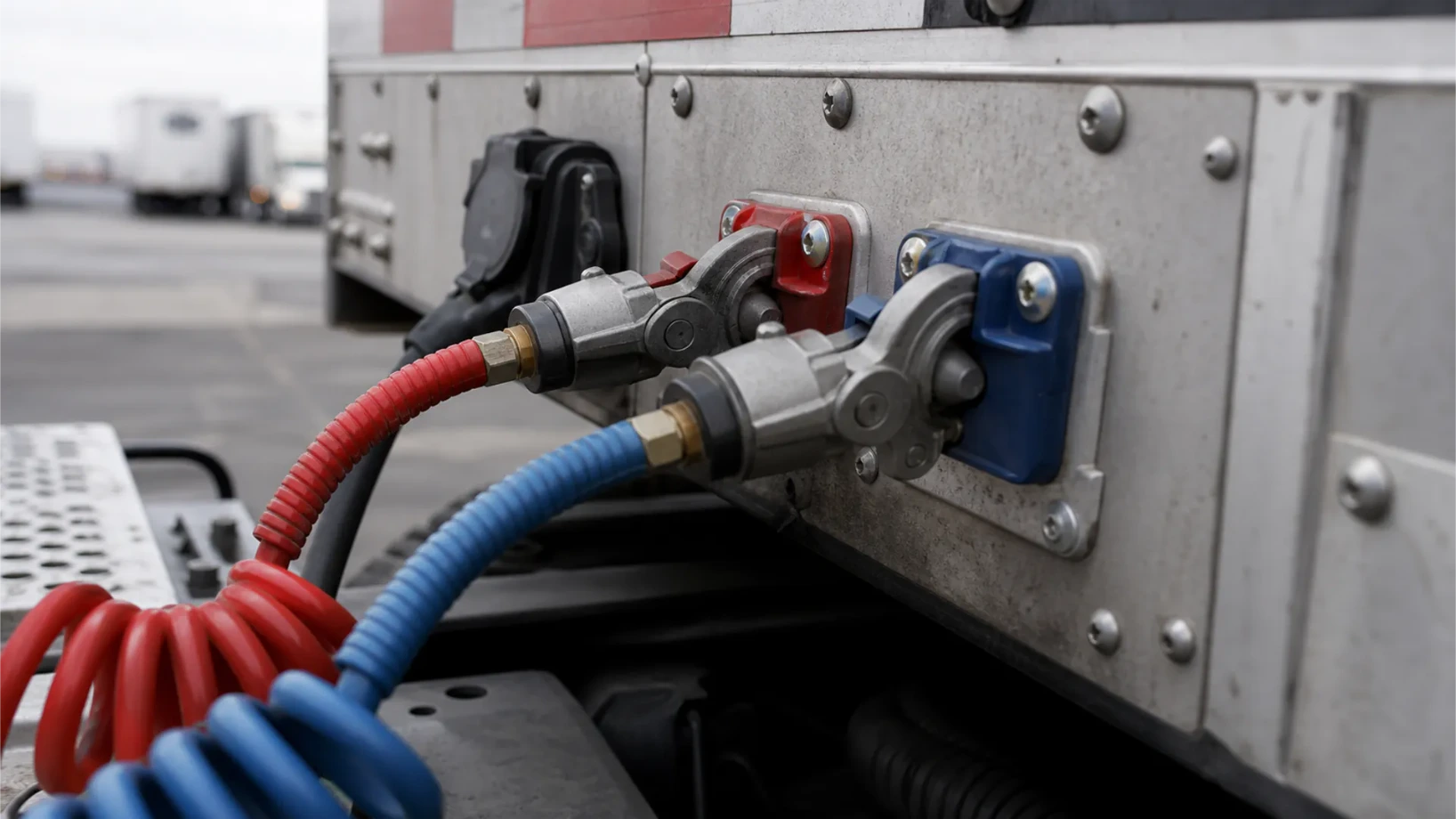
Near the trailer connection.
At a wheel-end area.
Near an accessible tank, line, or valve.
Constant, intermittent, or present only under a specific condition.
Louder when the system is cold, warm, wet, or recently operated.
Avoid using bare hands or improvised materials to search for a leak around moving, hot, sharp, or pressurized parts.
Warnings and behavior after restart
Record:
Gauge position before startup, if safely available.
Low-air warnings or dashboard messages.
How the unit behaves while pressure recovers.
Whether the warning clears and returns.
Whether buildup is also slower than normal.
Any change in braking, parking-brake, or trailer behavior.
Complete fault codes before they are cleared.
Parked pressure loss and slow buildup can occur together, but they are separate observations. Record both rather than combining them into one assumption.
Weather, recent work, and repeat history
Temperature, moisture, vibration, contamination, and recent service can affect when a leak appears. Note whether the complaint began after:
Air-line or fitting work.
Brake or wheel-end service.
Dryer, compressor, tank, or valve service.
Trailer repair or a trailer change.
Electrical or dashboard work.
Cold weather, rain, washing, or extended parking.
This timeline helps determine whether the condition is new, recurring, or connected to a specific configuration.
Conditions a diagnostic review may consider
The correct path depends on the truck, trailer, warnings, operating state, and manufacturer information.
Lines, fittings, tanks, and accessible connections
Visible damage, rubbing, loose mounting, contamination, or an accessible leaking connection may provide an initial direction. Other leaks may appear only under pressure or when a valve changes state.
The absence of an obvious sound does not confirm that the system is leak-free.
Valves, chambers, and brake applications
Some conditions change when service or parking circuits are applied or released. A technician may need to evaluate valves, chambers, connections, and related components using the approved procedure for that vehicle.
Drivers should not enter a crush zone or work beneath an unsupported vehicle to reproduce a leak.
Tractor protection and trailer-side conditions
The combination vehicle should be considered as a system. Trailer supply, protection components, hoses, couplers, and trailer brake equipment can influence pressure retention.
Record whether the condition appears with more than one trailer. Do not bypass or cap a circuit simply to keep the truck operating.
Sensors, gauges, and electrical information
If displayed pressure, warning behavior, and mechanical operation do not agree, the diagnostic review may need to compare sensors, wiring, grounds, voltage, and communication with the actual system condition.
A sensor name in a fault description does not automatically confirm that the sensor is defective.
How to distinguish a repeatable pattern from a one-time observation
A repeatable record can include:
Date and parking duration.
Tractor and trailer numbers.
Initial and later observations made under the fleet's approved process.
Brake and connection state.
Temperature or weather.
Warning messages.
Approximate leak area.
Recent repair history.
Two or three clearly documented events can reveal whether the same configuration and conditions produce the complaint. Do not keep operating an unsafe truck merely to collect more examples.
When the truck should remain stopped
Keep the vehicle safely parked and request qualified assistance when:
A low-air warning is active or returns.
The system cannot build or retain the condition required by manufacturer or fleet procedure.
Brake response or parking-brake behavior changes.
A major leak is audible or visible.
An air line, chamber, fitting, or related component is visibly damaged.
The tractor-trailer connection presents a concern.
The driver cannot confirm safe operating condition.
Federal guidance states that a driver must be satisfied the vehicle is in safe operating condition before driving. Consult current regulations, manufacturer information, and fleet policy; this article does not make an operating or compliance decision for a specific truck.
What not to do around a parked air system
Avoid:
Crawling under an unsupported truck or trailer.
Loosening pressurized fittings or components.
Bypassing alarms, valves, or protection functions.
Disconnecting or capping lines to hide the symptom.
Releasing or applying brakes outside an approved procedure.
Clearing fault codes before saving them.
Continuing the route because the system recovered once.
The driver should report the condition and protect the unit. Inspection and repair should be completed by qualified personnel.
Preparing for mobile diagnostics
Provide SAAT with:
Exact location and safe-access details.
Tractor, trailer, year, engine, and unit information.
Parking duration and when the pressure change was observed.
Gauge behavior, warnings, and complete fault codes.
Approximate leak area, if observable safely.
Brake and trailer configuration under the fleet's approved process.
Recent air-system, brake, trailer, or electrical work.
Whether slow buildup also occurs after restart.
Current condition and whether the truck is safely parked.
The initial review determines which checks are appropriate and whether the next step can be completed at the location or requires additional repair planning.
Contact SAAT Repairs Corp
If your commercial truck loses air pressure while parked in Tampa, Lakeland, or a nearby area, contact SAAT Repairs Corp for mobile air-system diagnostics and truck repair.
Call +1 414 233 9746 or email [email protected]. Share the truck's location, parking duration, warning information, tractor-trailer configuration, leak pattern, and recent repairs.
Truck losing air while parked? Keep the unit safely positioned and contact SAAT Repairs Corp with the parking duration, warning information, tractor-trailer details, leak pattern, and recent repair history.