A dispatcher gets the call while a truck is due for its next delivery: a Class 8 tractor near Lakeland has derated for an emissions fault. The truck gets diagnosed and returned to service, but a related warning brings it back off the road two weeks later. The first invoice records a repair. The fleet's records need to show whether the second event was a new failure, an unresolved root cause, or a separate problem that only looked similar.
That distinction changes how operators understand truck fleet maintenance costs. A cost-per-mile figure is useful, but it won't reveal repeated diagnosis, lost productive hours, or a missed delivery. The practical approach is to connect repair records, dispatch notes, and return-to-service time, while choosing on-site mobile work, in-house service, or an external facility according to the job's requirements and safety. SAAT Repairs Corp provides mobile Road Services at the vehicle location, not customer-facing workshop visits; work that can't be completed safely or suitably on site requires an external option.
Table of Contents
- Why a Single Repair Invoice Never Tells the Whole Story
- The Cost-per-Mile Baseline Worth Comparing Against
- What Your Repair Records Should Actually Capture
- On-Site Mobile Repairs, External Facilities, and In-House Work
- Turning the $448-per-Hour Downtime Figure Into a Real Number
- Where Repeat Repairs Hide in the Data
- Preventive Maintenance as a Spending Plan, Not a Calendar
- Putting It Together and Knowing When to Call
Why a Single Repair Invoice Never Tells the Whole Story
When a truck returns with a related fault, the invoice may show parts and labor without answering the question that matters to fleet operations: did the first repair address the cause, or only the symptom? A sensor code, for example, doesn't by itself establish whether the sensor failed, wiring caused an intermittent signal, or an aftertreatment issue triggered the warning. A second call can therefore represent a repeat repair, a distinct failure, or an incomplete record that makes the difference impossible to tell.
The invoice is only one part of the event. Dispatch records can capture when the truck stopped, where it was, what delivery or route was affected, and when it returned to service. The work order can record what the driver reported, what the technician found, what was repaired, and what verification was completed. Together, those details show whether the expense bought a durable repair or merely closed the first service call.
A useful test: If the next technician can't see the previous complaint, findings, and repair, the fleet may pay to diagnose the same symptom again.
A cost-per-mile baseline helps compare maintenance spending across vehicles with different mileage, but it doesn't include every consequence of a breakdown. The broader view in this guide treats maintenance spending as a set of linked records: scheduled work, unscheduled repairs, repeat symptoms, and downtime. That makes it possible to distinguish ordinary wear from avoidable repeat events without assuming that every recurrence was preventable.
Mobile roadside work can be appropriate for diagnostics and repairs that are safe and feasible at the vehicle's location. It isn't a promise that every major repair can be completed there. Some jobs need a suitable external facility, and fleets should plan for that possibility rather than assuming an on-site repair, workshop visit, or towing service is included.
The Cost-per-Mile Baseline Worth Comparing Against
A defensible comparison starts with a clearly defined numerator and denominator: the maintenance expenses included in the calculation, divided by the truck's miles over the same period. ATRI's operating-cost update reports average U.S. repair and maintenance costs of $0.198 per mile in 2024, down 2% from $0.202 per mile in 2023. The 2024 figure remained above the $0.196 per-mile average in 2022 and approximately $0.02 above the 2021 level, according to the ATRI 2025 operational-cost update.
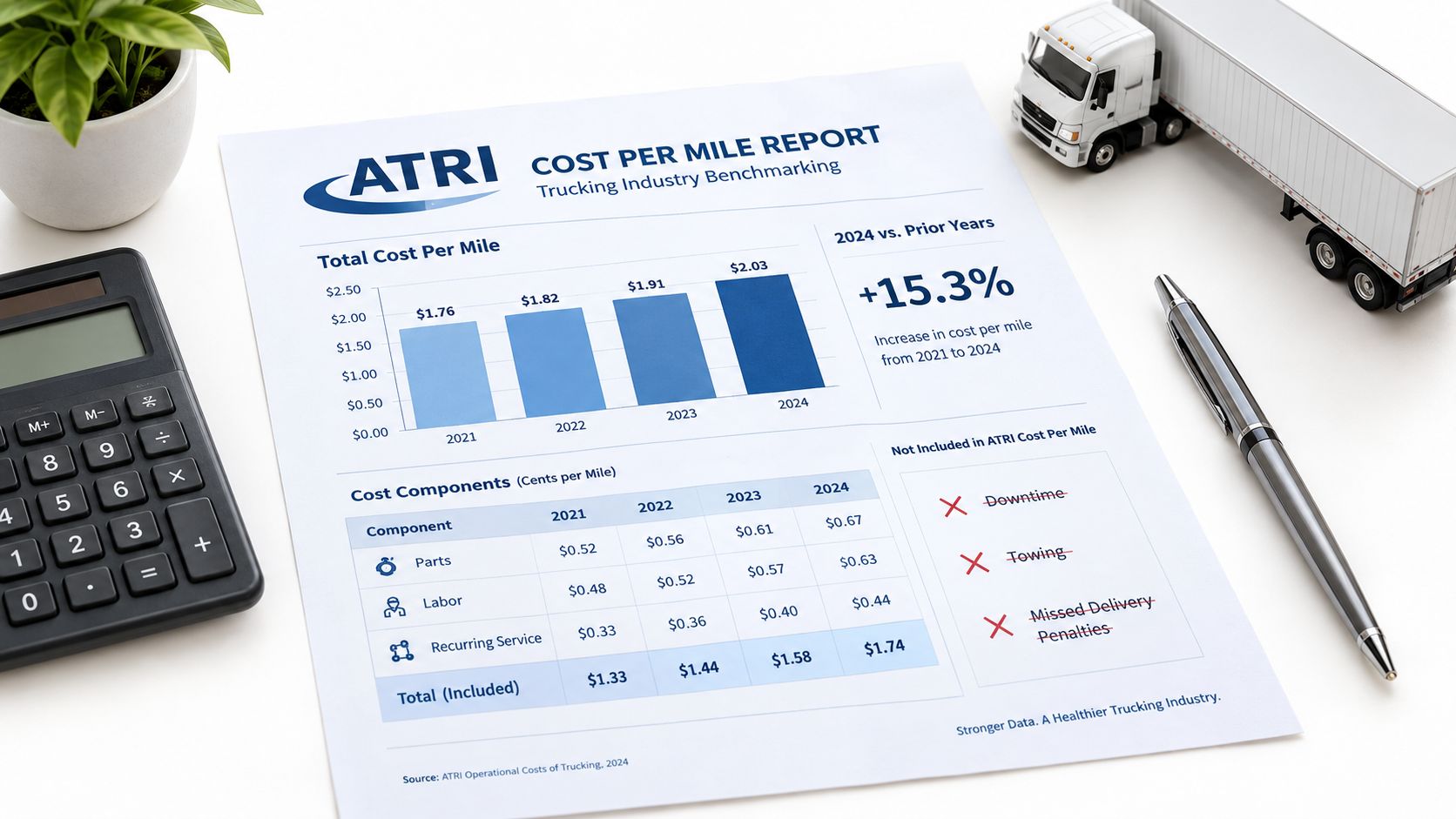
At that 2024 average, a truck traveling 100,000 miles would imply about $19,800 in repair and maintenance expense. The same ATRI update places less-than-truckload carriers at $0.222 per mile, or about $22,200 at that annual mileage. Those figures are useful reference points, not a price quote or a promise about what a specific Florida fleet should spend. Route, utilization, vehicle age, duty cycle, and powertrain all affect the comparison.
The benchmark describes repair and maintenance spending, not the full financial cost of a truck being unavailable. It doesn't add lost productivity, missed delivery penalties, or towing and substitute-vehicle costs to the maintenance line. For broader operating context, ATRI reported that total trucking costs averaged $2.260 per mile in 2024, with nonfuel marginal costs at $1.779 per mile in its operational-cost report. Keeping maintenance separate from fuel, wages, insurance, equipment payments, tires, and other operating expenses makes the fleet's calculation easier to audit.
A different heavy-duty benchmark puts maintenance and repair at approximately $0.215 per mile, about 8.9% of total operating cost and roughly $16,200 per truck annually at average utilization. It's an estimate, not a universal target, because mileage and duty cycle matter; see the heavy-duty maintenance cost-per-mile analysis. A Tampa-area stop-and-go route may place different demands on brakes, cooling, and electrical systems than steady highway work. The fleet's own cost per mile remains the more useful management figure. Operators reviewing DPF-related service can also consult SAAT's guide to DPF cleaning costs, while keeping any published cost discussion separate from an individual repair estimate.
What Your Repair Records Should Actually Capture
A repair record should let the next person answer three questions: what did the driver notice, what did the technician find, and what changed after the work? A broad invoice label such as “engine light” or “electrical repair” can't establish whether a return visit is related. Record the detail at the time of service, before the original complaint gets reduced to a short billing description.
Build a record around the event
For every repair, connect the work order to the vehicle and its operating context. Capture:
- Driver complaint: Preserve the driver's wording and note warning lights, derate behavior, noises, smells, or conditions when the symptom appears.
- Vehicle identification: Record the unit, engine or platform identification, mileage, and event date so records don't become detached from the asset.
- Diagnostic findings: List fault codes, tests performed, components inspected, and measurements or observations taken. A code is evidence to investigate, not automatically the failed part.
- Work completed: Identify what was adjusted, repaired, cleaned, programmed, or replaced, and distinguish confirmed findings from suspected causes.
- Verification and timeline: Note what was checked after the repair and document when the truck stopped, when work began, and when it returned to service.
The same discipline applies to dispatch notes. A location, route impact, and service status help the fleet separate repair time from time spent waiting for a decision, access, parts, or an external facility. If the truck cannot be repaired safely at the roadside, the record should show that limitation and the next planned step, rather than leaving the event marked “not fixed.”
Show symptom and cause separately
Suppose an ISX15 returns with an emissions-related warning. A useful record links the earlier complaint and diagnostic findings to the current fault, then states whether testing supports the same cause or identifies a new one. Apply the same method to a Paccar MX-13: compare the prior work order with current findings rather than assuming that a recurring symptom proves the earlier repair failed.
That record isn't paperwork for its own sake. It lets a maintenance coordinator spot a pattern, ask for a root-cause review, and decide whether the next action belongs in planned service or a roadside response.
On-Site Mobile Repairs, External Facilities, and In-House Work
The right repair channel depends on what the truck needs, what equipment the job requires, and whether the work can be done safely at its location. A lower labor rate doesn't automatically mean a lower total cost if the repair takes longer, requires another service event, or leaves the vehicle unavailable. Conversely, sending every fault to a facility can add transport and scheduling burdens when a qualified technician can diagnose or resolve the issue on site.
SAAT Repairs Corp's confirmed mobile Road Services include diagnostics and case-specific support for electrical, emissions, brake, transmission, and preventive-maintenance needs. Its mobile fleet repair information describes the mobile-service approach. The table below is a decision aid, not a guarantee that any category can be completed roadside.
| Repair category | Mobile feasibility | External facility | In-house fleet |
|---|---|---|---|
| Brake | Inspection, leak checks, or selected repairs may be feasible when access and conditions are safe. | Appropriate when the repair requires shop-only tooling, a lift, or work that can't be done safely at the roadside. | Suitable for routine inspections and repairs within technician capability and available equipment. |
| Electrical | Diagnostics and selected wiring, sensor, alternator, or starter work may be possible at the vehicle. | Consider when access, testing conditions, or the scope of repair requires a facility. | Useful for familiar faults when the fleet has the diagnostic capability and parts. |
| Aftertreatment | Mobile diagnostics and selected DPF or EGR service may be feasible, depending on findings and site conditions. | Consider when the repair requires facility equipment or the fault's scope makes roadside work unsuitable. | Appropriate for supported inspections and maintenance within staff capability. |
| Software | Some programming or calibration work may be possible on site if the platform, equipment, and conditions support it. | Use an external facility if the required tooling or procedure isn't available at the vehicle location. | Best limited to tasks the fleet can verify with its available access and expertise. |
| Transmission | Triage and some service or repair may be possible, but feasibility depends on the fault and safe access. | Often the practical option for major work requiring lifting, extensive disassembly, or specialized facilities. | Suitable for routine checks or work within fleet capacity. |
| Emergency breakdown | On-site diagnosis and feasible roadside repairs can help determine whether the truck can safely return to service. | Necessary when the truck can't be repaired safely or the job needs facility conditions. | Useful when the truck can be moved safely to fleet premises and the repair fits available capacity. |
Brake and trailer work needs particular care: the existence of mobile capability doesn't mean every repair is safe to perform at every roadside location. Commercial trailer brake, air, electrical, suspension, and structural repairs are case-specific. For transmissions, software faults, and aftertreatment concerns, diagnosis can clarify whether an on-site repair is suitable or whether the truck needs an external facility with the appropriate tools and working conditions.
Turning the $448-per-Hour Downtime Figure Into a Real Number
A truck drops on I-4 near Lakeland with a loaded trailer, a driver on the clock, and a delivery window three hours out. The repair itself might be a sensor and an hour of labor. The day it happened costs considerably more than that invoice.
One fleet-maintenance benchmark puts unplanned commercial-vehicle downtime at about $448 per hour, with its example fleets reporting 142 unplanned downtime hours and $63,616 in annual downtime cost per vehicle. Those are reference figures, not a forecast for your operation. The downtime benchmark and preventive-maintenance discussion provides the cited context.

Build your own event estimate with a consistent formula:
Total event cost = repair labor and parts + mobile-service or towing charges + lost productive hours + substitute-vehicle expense + contractual or delivery penalties.
For the lost-hours term, multiply the time the vehicle is unavailable by an internal revenue or contribution-margin figure. You supply those inputs, because a truck on a time-critical lane with no spare capacity does not carry the same interruption cost as one you can reassign without touching dispatch. A rental tractor, a missed appointment fee, a driver paid to sit. Each belongs on the record.
That math changes the decision. Price the on-site mobile call and the tow-to-facility path as two separate line items in the same event record rather than treating them as one blended repair bill. A premium roadside response can pay for itself inside a delivery window and look wasteful on a low-revenue day. The deciding factors are the actual service charge, the expected delay, whether the job is feasible at that location, and the hourly cost of leaving the truck down. Assume nothing about response time or outcome before the location, traffic, technician availability, and fault are assessed.
The following visual separates the components a fleet can enter into its own model.
A careful roadside diagnosis can also head off the wrong repair entirely. An emissions derate might trace to a sensor, a clogged filter, wiring, or a software or calibration issue, and confirming the cause keeps you out of unnecessary parts and repeat visits. When the required work does not belong at the vehicle location, the record should shift to an external facility and absorb the added delay and transport cost. Logging which lever was used, on-site or referred out, is what makes the next event cheaper to judge.
Where Repeat Repairs Hide in the Data
Repeat faults often disappear inside inconsistent descriptions. One work order says “check engine,” another says “low power,” and a third lists a component name. Grouping by the underlying fault family, component, and driver-reported symptom can reveal that those records may be related, even when the invoice labels differ.
Group events using more than one field
Start with the information the fleet already collects. Group records by fault-code family, component or part number, and complaint wording. For example, a DPF differential-pressure concern, recurring NOx sensor fault, electrical ground issue, brake-adjustment concern, or clutch-slip symptom can each be reviewed as a pattern. These are categories to investigate, not conclusions about cause.
For brake records, distinguish an adjustment concern from a damaged or worn component. In the 2013 North American Brake Safety Week campaign, inspectors checked 20,067 commercial vehicles and placed 2,714 out of service for brake violations, a 13.5% brake-related out-of-service rate. Adjustment violations accounted for 9.0% of inspected vehicles, while component violations accounted for 7.1%. The Brake Safety Week inspection results describe separate findings, which fleet records should preserve rather than compressing into a generic “brake issue.”
Record the finding, not just the category: Note the symptom, affected axle or wheel position when relevant, inspection result, and repair performed.
For current enforcement context, inspectors recorded 3,304 brake-system out-of-service violations during the 2025 International Roadcheck, or 24.4% of vehicle out-of-service violations. They also recorded 2,257 violations for 20% defective brakes. Together, those brake categories accounted for 5,561 violations, or 41.1% of vehicle out-of-service violations, according to the 2025 Roadcheck results from the Commercial Vehicle Safety Alliance. The practical point is to record the actual defect and corrective work, not to infer that every brake complaint has the same mechanical cause.
Review the pattern after scheduled service
After the fleet's next planned maintenance cycles, compare each vehicle's prior complaints, fault history, and repairs. Ask whether the same symptom returned, whether the same component was involved, and whether the earlier work included a recorded verification. Separate isolated failures from vehicles accumulating related events.
ATRI reported that trucks averaged approximately 37,700 miles between breakdowns or unscheduled repairs in its 2023 trucking cost research. That figure is a planning benchmark, not a guaranteed service interval. A fleet's own event history should drive its response: repeated symptoms deserve investigation even when the mileage comparison looks ordinary.
Preventive Maintenance as a Spending Plan, Not a Calendar
A truck that leaves the yard clean on Monday and rolls back Friday with the same derate is not short on calendar reminders. It is telling the fleet where to spend next. The PM plan should rank work by cost-per-mile trend, repeat faults, downtime exposure, and compliance risk, so a truck with recurring electrical faults gets a focused diagnostic review while another unit receives routine service.
The preventive-versus-reactive benchmark cited earlier is useful as a guardrail: keep the large majority of labor and parts on planned work, and keep breakdown response visibly separate. Calculate the fleet's actual mix from its own work orders instead of adopting a generic target. Relabeling reactive work as planned hides the failure, inflates the sense of control, and leaves the cause untouched.
Prioritize the work that changes the risk
Let the maintenance history choose the next dollar. A recurring code family, repeated component replacement, or brake-defect pattern can justify deeper inspection or a root-cause review before another part gets swapped. If the job needs a lift, alignment equipment, a press, or controlled conditions that roadside service cannot provide safely, send it to an appropriate external facility rather than letting mobile service become the default. For interval planning, fleets can use SAAT's semi-truck maintenance schedule guide as a reference while adapting timing to the vehicle, route, and work.
Fuel efficiency belongs in the same review, but it should not be folded into a maintenance savings claim without fleet data. Excessive idling, aftertreatment problems, tire condition, and brake drag can affect both operating performance and repair demand. Record the observed issue and the correction so the fleet can test whether those factors are moving its own cost per mile.
A practical cadence connects plan to outcome. At each review, compare PM completion against the schedule, sort unscheduled work by system and symptom, and check which vehicles keep generating calls. Put downtime hours and return-to-service notes beside the repair history. If a unit's costs are rising, find the recurring cause before raising its budget.
Putting It Together and Knowing When to Call
A useful maintenance review leaves the fleet with three working records: a current cost-per-mile calculation, a repeat-repair register grouped by fault and component, and a downtime-cost model expressed per hour of vehicle unavailability. Each answers a different question. The baseline shows what the fleet spends, the register shows where faults recur, and the downtime model shows what an event costs beyond the invoice.
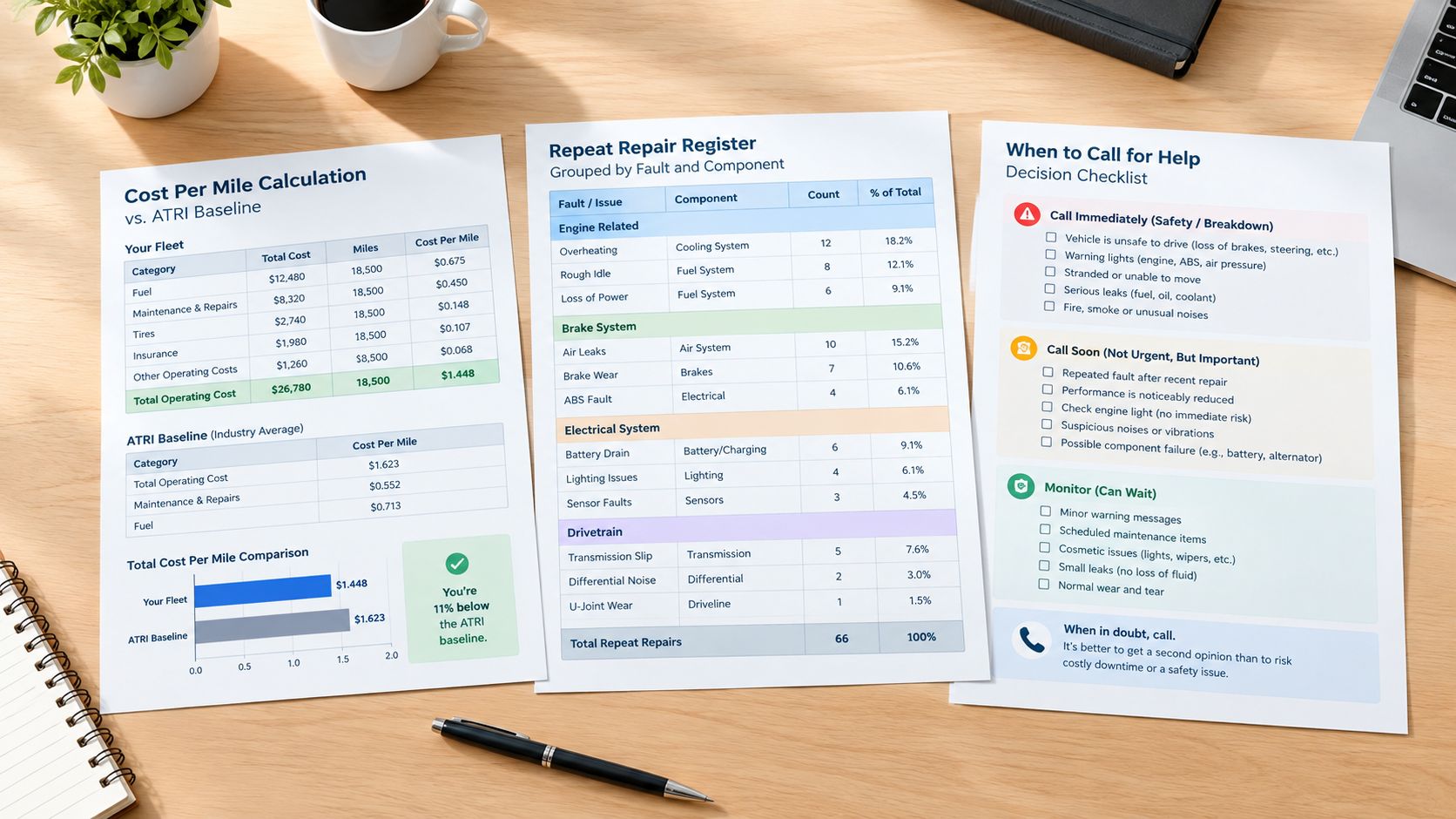
A focused review over the coming weeks can turn those records into decisions:
- Reconcile the baseline: Match repair and maintenance spending to vehicle mileage for the same period, and keep downtime losses separate.
- Review repeat events: Group recent work orders by symptom, fault family, and component. Flag uncertain causes for follow-up rather than treating every recurrence as confirmed repair failure.
- Complete the event-cost fields: Record lost productive time, substitute-vehicle use, transport charges when applicable, and delivery consequences alongside repair labor and parts.
- Set the service channel: Decide whether each open issue is suitable for in-house work, safe mobile service, or an external facility. Reassess if access, tooling, or the repair scope makes the initial choice unsuitable.
For a truck stopped in Tampa, Lakeland, or a nearby Florida corridor, mobile diagnostics and roadside service can help assess a fault at the vehicle location when conditions and job requirements permit. SAAT Repairs Corp has no customer-facing workshop; work requiring a suitable external facility or shop-only tooling must be handled through an external option rather than a promised workshop visit.
For a commercial truck stopped in the Tampa–Lakeland area, SAAT Repairs Corp offers mobile diagnostics and roadside repair at the vehicle location, subject to safe access, job feasibility, and technician availability. To discuss a truck fault or fleet maintenance need, visit SAAT Repairs Corp and contact the team about service options.