“Clean the EGR valve first” is common advice for a diesel truck with reduced power or recurring emissions codes. It's also an expensive guess when nobody has checked whether deposits caused the complaint. EGR cleaning benefits come from correcting a demonstrated restriction, not just removing visible soot.
For commercial trucks working Tampa, Lakeland, and nearby Florida corridors, the useful question is whether cleaning will restore a measurable function and whether the work can safely happen at the vehicle. A sound decision combines fault history, live readings, physical inspection, and a realistic assessment of mobile access.
Table of Contents
- Does EGR Cleaning Actually Improve Efficiency and Emissions?
- How Does EGR Work and Why Do Deposits Build Up?
- Which Symptoms Point to EGR Deposits?
- What Should a Dispatcher Document Before Requesting Service?
- How Do You Check EGR Condition Before and After Cleaning?
- Where Does Roadside EGR Cleaning Stop and When Is an External Option Needed?
- When Should Diagnosis Decide Whether to Clean?
Does EGR Cleaning Actually Improve Efficiency and Emissions?
Cleaning can restore heat transfer, airflow, and measurement accuracy when deposits are responsible for the problem. It doesn't automatically improve every truck's fuel economy or eliminate an emissions fault. The distinction matters because a dirty component and a failed component can produce similar complaints.
Deposits formed from soot, particulate matter, and hydrocarbons insulate cooler surfaces and narrow gas passages. Technicians therefore need to distinguish a heat-transfer problem, a flow restriction, and an inaccurate pressure signal before deciding what to clean.
Documented EGR cleaning benefits and their limits
The evidence below describes reasons to investigate fouling, not guaranteed results from a cleaning service. Publication dates aren't established for every document, so unidentified dates remain explicitly identified rather than guessed.
| Benefit | How deposits affect it | Source and date | Limit |
|---|---|---|---|
| Engine efficiency | Fouling insulates cooler surfaces and adds flow resistance. | The U.S. Department of Energy and Oak Ridge National Laboratory presentation, hosted in June 2016, describes approximately 20–30% heat-transfer degradation and more than a 1% loss in brake thermal efficiency from cooler fouling. | Brake thermal efficiency isn't a universal fuel-economy improvement that cleaning can promise. |
| NOx control | Restricted recirculation can prevent the system from operating as intended. | An EPA heavy-duty diesel evaluation described in the linked technical material reported approximately 50% NOx reduction on the tested engine; the evaluation's report date isn't established here. | That result concerns EGR operation, not a measured cleaning outcome. Cleaning guarantees no set NOx reduction. |
| Sensor and fault accuracy | Soot in sensing passages interferes with EGR-flow measurement. | Cummins technical bulletin archived by NHTSA in 2020; exact bulletin publication date isn't established here. | A clear passage doesn't establish that the valve, cooler, sensor, or wiring is healthy. |
| Drivability | Deposits can obstruct passages and interfere with valve movement. | Peer-reviewed EGR-deposit study in Fuel; publication date isn't established here. | Cleaning can't repair a cracked cooler, failed actuator, or wiring fault. |
What those benefits mean for a fleet
An efficiency benefit is credible when a technician identifies fouling that interferes with the engine's intended operating conditions. It isn't credible to turn a laboratory efficiency penalty into a promised percentage reduction in a carrier's fuel bill. Engine design, duty cycle, deposit severity, and related component condition affect the outcome.
Likewise, restoring EGR operation supports emissions control, but an EGR cleaning invoice isn't proof that the complete aftertreatment system functions correctly. Fleet managers should consider DPF cleaning intervals and maintenance planning alongside the truck's actual fault history.
Practical rule: Approve cleaning against a specific finding, such as a restricted passage or deposit-bound valve, and require a post-service check of that same finding.
The strongest benefit may be avoiding the wrong repair. Restoring a blocked measurement passage can give the technician a usable signal before a functioning component gets replaced.
How Does EGR Work and Why Do Deposits Build Up?
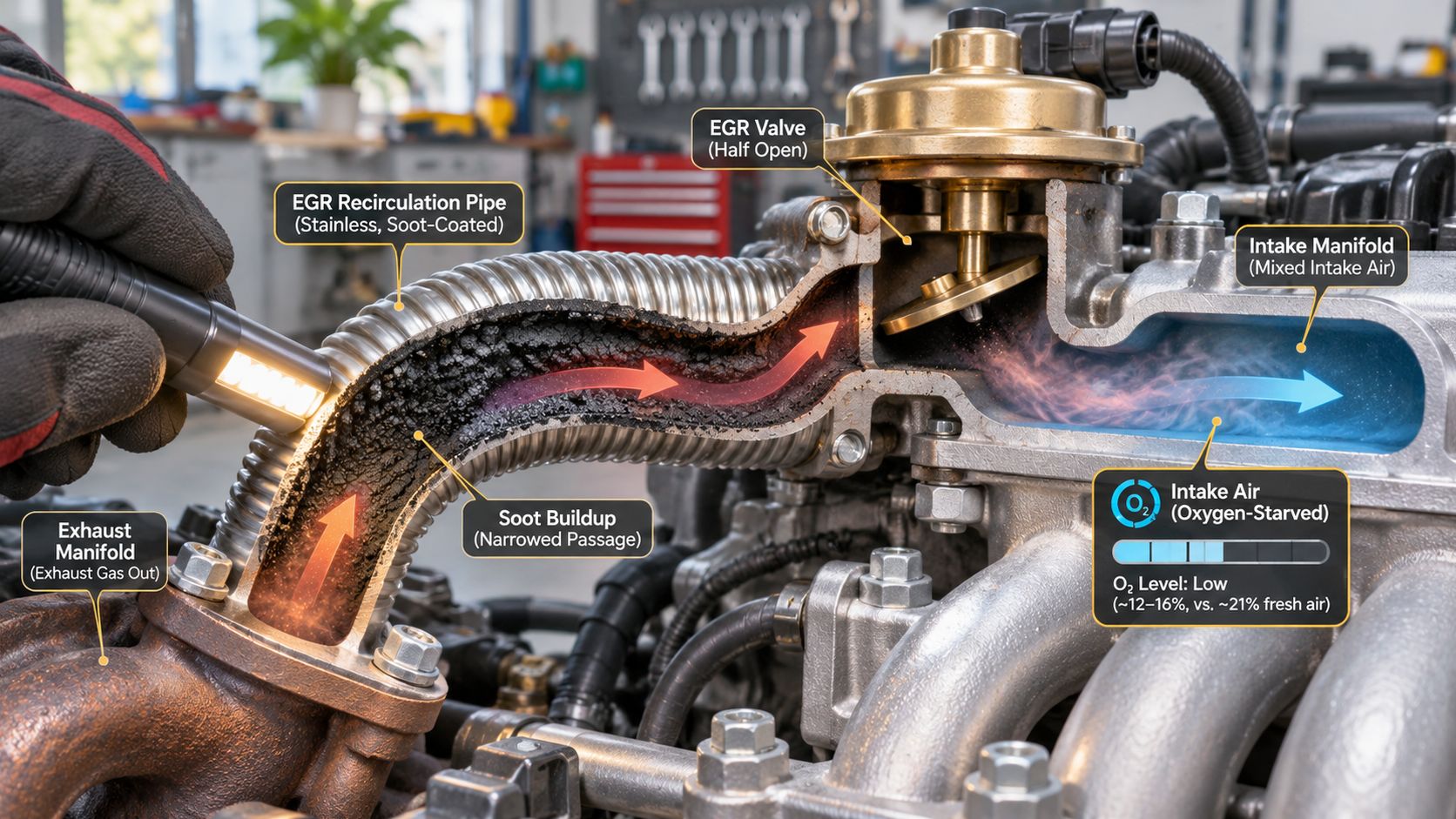
EGR routes a controlled portion of exhaust back toward the intake. The U.S. Environmental Protection Agency's explanation of EGR describes how recirculated exhaust displaces some incoming oxygen and lowers peak combustion temperature, which reduces nitrogen-oxide formation.
Deposits attack the system on two dimensions. Soot and oil residue narrow the flow passages gas travels through, and they coat cooler surfaces that must keep transferring heat. A passage can still look open while a thin layer inside the cooler degrades its heat rejection, so inspecting one accessible surface settles nothing about the rest of the path.
How buildup becomes an operating problem
A regional delivery tractor logging long idle periods between stops develops a recurring response complaint. Inspection finds layered contamination in the EGR path and abnormal oil contamination besides. Removing the deposits clears the accumulated material. Tracing the oil entry answers whether buildup will return on the same schedule.
Contamination does not settle only on the valve face. Cooler passages, connecting pipes, entrance ports, and pressure-measurement passages can all carry deposits, and cleaning the easiest visible surface can leave the actual restriction untouched.
A Society of Automotive Engineers technical paper published in 2022 connects EGR deposits with deterioration in emissions, fuel efficiency, performance, drivability, and reliability. That spread of effects is the reason to inspect the system as a connected path. A clean valve face tells you little if the cooler inlet or a measurement port is still plugged.
- Accumulated material: Inspection should establish where deposits restrict movement, flow, or measurement.
- Contamination source: Excessive soot or oil entry calls for investigation of combustion quality and related engine components.
- Operating pattern: Idle operation and duty cycle belong in the maintenance record, not just the current dashboard warning.
Cleaning removes contamination already present. If the same contamination source is still active, another cleaning will fail in the same place. The maintenance decision is whether to correct the condition producing the deposits, which may call for repair before a repeat cleaning pays off.
Which Symptoms Point to EGR Deposits?
Reduced response under load, rough operation, and recurring EGR codes justify investigation. None identifies deposits by itself. A dispatcher should treat these complaints as diagnostic clues, not permission to order a valve cleaning without testing.
A peer-reviewed study in Fuel examining EGR deposits, with publication date not established here, describes deposits in coolers, pipes, and valves causing increased thermal resistance, flow obstruction, and valve sticking. Those mechanisms explain why a deposit problem can affect more than the warning light.
Separate operating complaints from warning history
Drivers often describe what the truck couldn't do, while technicians need the conditions under which it happened. “Low power” becomes more useful when dispatch records whether it occurred during acceleration, on a grade, after idling, or throughout the trip.
- Power and response: Slow acceleration, reduced pulling ability, or a power-limited condition warrant a scan and airflow assessment. Turbocharger, intake, and fuel-system faults can overlap.
- Unstable operation: Rough idle or intermittent hesitation can justify checking valve control and movement. Injector problems or electrical interruptions can produce similar behavior.
- Warning history: An EGR code that returns after clearing deserves more attention than a verbal report that the light disappeared.
- Smoke and consumption: Unusual smoke or fuel use above the truck's normal route pattern should be documented, not automatically attributed to EGR deposits.
The operator's description should preserve uncertainty. “The truck lost response while loaded” is a useful observation; “the EGR valve is clogged” is a diagnosis that still needs evidence.
Decide when the complaint shouldn't wait
A derate, repeated returning codes, or smoke that appears under load warrants prompt evaluation. Dispatch should follow the vehicle's warnings and operating restrictions rather than asking the driver to continue until a convenient maintenance stop. A mobile visit still requires a safe place to inspect the vehicle.
A symptom can justify inspection without proving which part needs repair.
The guide to diesel EGR valve problems and symptoms helps organize driver observations before a service request. The useful handoff includes both the complaint and its limits: what happened, when it happened, and what remains unknown.
A truck that improves briefly after a code reset hasn't demonstrated a successful repair. The relevant question is whether it continues to operate normally under the conditions that originally produced the complaint.
What Should a Dispatcher Document Before Requesting Service?
A dispatch note that reads only "needs EGR cleaning" sends a technician out blind. A regional carrier reports that a loaded truck loses power and carries an inactive EGR code that returns after DPF regeneration; without the engine model, the exact code, or a workable location, that note assumes the repair before anyone has established the fault.
A better handoff records the sequence without interpreting it too aggressively. A code that returns after regeneration establishes a recurring pattern, but it doesn't prove that regeneration caused the fault or that a sensing passage is blocked.
Build a usable service record
Service information circulated as Cummins bulletin TSB190165 lists fault-code groups 1866, 3361, 3382, 3383, 3389, 4729, and 7233 in connection with soot affecting EGR-flow measurements. Those identifiers are useful only when matched to the applicable engine and its service information.
Dispatch should collect:
- Exact fault information: Record every displayed code and whether it's active or inactive before anything is cleared. Retain scan reports or dashboard photos when available.
- Vehicle identity: Include the engine model, truck identification, mileage, and engine hours if available.
- Recent aftertreatment activity: Note regeneration history, aborted attempts, and whether the complaint appeared before or afterward.
- Driver observations: Describe power reduction, operating load, smoke color, and when smoke appears.
- Fluid concerns: Report coolant loss or other recent fluid changes without assigning a cause.
- Location and access: Supply the precise vehicle position, parking surface, traffic exposure, and available working space.
- Previous work: Include recent component replacements, cleaning, wiring repairs, and the period of normal operation afterward.
Keep the conditions attached to the complaint
Requesting regeneration repeatedly without understanding the warning can bury the pattern the record is meant to capture. If a code keeps returning, the record should show how many times it returned and under what load, rather than presenting a dashboard that happened to be clear at departure.
Access information matters as much as fault information for mobile work. A truck parked inside a distribution yard presents different constraints from one sitting beside moving traffic, even when both show the same code. A precise location and a safe working area determine what can be attempted on site.
The dispatch record also decides whether an on-site diagnostic visit is reasonable and what equipment the technician needs to bring. It gives the fleet a fixed description of the original complaint, so the result can be judged against the conditions that produced it. That comparison is what separates a verified repair from a service call that only cleared a light.
How Do You Check EGR Condition Before and After Cleaning?
A useful inspection establishes a baseline before any deposits are disturbed. Without that baseline, a cleaner-looking component can be mistaken for a verified repair.
The following sequence describes technician work, not a roadside procedure for drivers. Engine-specific service information controls test conditions, allowable readings, component handling, and any required resets.
Establish the fault before disassembly
Retrieve active and inactive codes with available freeze-frame data. Record engine conditions so later testing addresses the original complaint rather than an unrelated operating state.
Compare commanded and actual EGR position where supported. A mismatch guides actuation testing, but position feedback alone doesn't establish correct gas flow.
Evaluate differential pressure using the applicable service procedure. Generic pressure targets aren't a substitute for the engine's specified conditions and limits.
Inspect the exhaust-gas entrance and sensing passages. Check the horizontal and vertical differential-pressure passages where applicable, rather than assuming an external pipe inspection is enough.
Check intake restriction and contamination. Oil or coolant in the path changes the repair plan and may justify additional testing before cleaning proceeds.
Assess cooler integrity and valve movement. Follow the manufacturer's procedure and avoid forcing an actuator or treating visible movement as proof of sealing.
Inspect wiring and sensor connections. Damaged terminals, harness routing problems, or electrical faults require their own repair.
The Cummins bulletin archived by NHTSA in 2020 addressing intake-air connections and EGR pressure ports directs passage cleaning and sensor inspection, and warns against excessive pressure that can damage sensor elements. That caution is especially important when attempting to clear a small passage near a sensitive measurement device.
Verify function after service
After cleaning and reassembly, the technician should repeat the relevant tests under comparable conditions. Any engine-specific adaptation or reset should follow service information, not replace functional testing.
- Compare readings: Record pre-service and post-service pressure behavior and commanded-versus-actual operation.
- Recheck fault status: Confirm whether faults return during the appropriate verification routine.
- Address the complaint: Where safe and appropriate, reproduce the load or operating condition associated with the original problem.
A cleared code immediately after a reset isn't enough. A successful result combines corrected readings, proper operation, and no recurrence during the applicable verification.
Verification standard: The repaired function should pass its test, not merely look cleaner.
If the relevant readings remain abnormal, the technician should stop treating cleaning as the answer and continue the diagnostic process.
Where Does Roadside EGR Cleaning Stop and When Is an External Option Needed?
Mobile versus external options by EGR case
| Situation | Mobile feasibility | External option |
|---|---|---|
| Soot in accessible entrance or pressure ports | Often assessed on site, subject to safe access and containment. | Not needed when inspection and cleaning can safely be completed at the vehicle. |
| Valve cleaning with safe access | Case-specific; access, tools, and removal requirements control the decision. | Needed when removal or handling exceeds safe on-site capability. |
| EGR cooler removal or leak repair | Assess disassembly requirements before starting. | A suitable external facility may be needed for controlled component work. |
| Cracked cooler or failed actuator | Diagnosis can establish the required component work. | A suitable external facility is appropriate when replacement can't safely be completed on site. |
| Wiring or sensor fault | Testing can begin at the vehicle; repair scope must be established. | Needed when access or deeper repair exceeds available mobile capability. |
| Several systems involved, including DPF, injectors, or turbocharger | Initial diagnosis can help define the combined job. | A suitable external facility may be necessary for major repair. |
A mobile service decision is a worksite assessment, not just a judgment about the component. Safe parking, technician access, hot surfaces, fluid containment, environmental conditions, and available equipment all affect whether work should proceed.
The distinction is especially important for assemblies buried behind other components. A valve may appear straightforward in a parts diagram while requiring extensive access work on the actual truck. Beginning disassembly without confirming how the job can be completed can leave the vehicle in a less manageable condition.
Evaluate the site before committing to removal
For trucks around Tampa and Lakeland, dispatch should describe whether the vehicle is in a yard, loading area, parking lot, or exposed roadside position. The technician must still assess the site on arrival. A location that permits scanning may not permit coolant handling or cooler removal.
- Accessible inspection: Fault retrieval and visual checks may be possible even when cleaning isn't.
- Controlled cleaning: Loose deposits, cleaning materials, and removed parts need appropriate containment.
- Major component work: Disassembly, leak testing, or difficult installation may require an external setting.
SAAT operates exclusively as mobile Road Services, with technicians attending the vehicle location and no customer-facing workshop. A suitable external facility is an external option, not a SAAT location, and this assessment doesn't assume towing arrangements.
No fixed arrival estimate should determine the repair decision. Timing remains conditional on location, traffic, technician availability, and the job.
When Should Diagnosis Decide Whether to Clean?
Diagnosis decides whether cleaning is worth doing. A fleet should authorize the work when a technician has identified deposit-related interference, with the finding documented before any hardware comes off the truck. Price or convenience alone can't supply that finding.
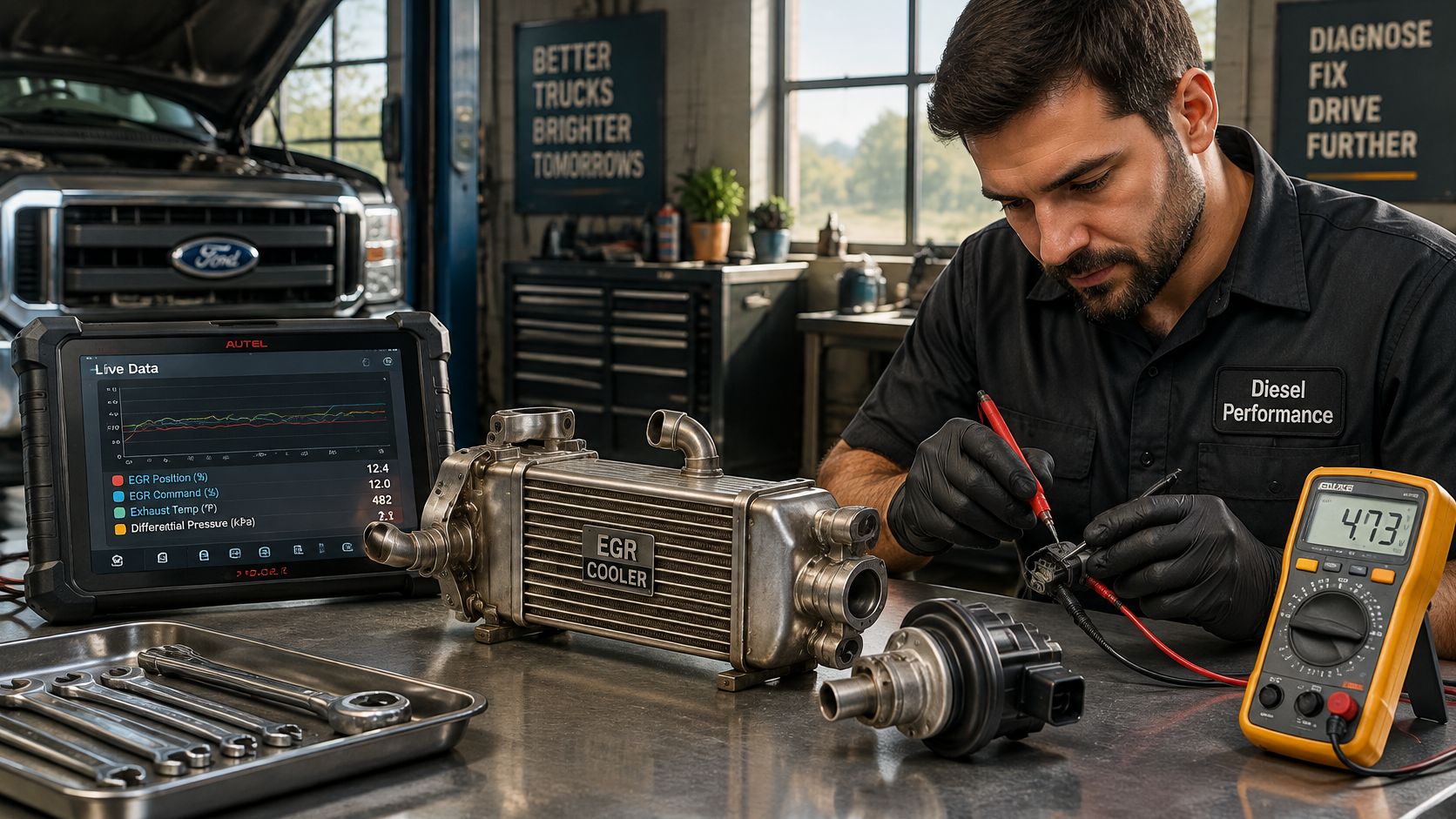
The image below shows component testing in a workshop setting. It doesn't depict a SAAT facility, and some pictured procedures suit an external shop better than roadside work.
Authorize the work that the finding supports
Consider two possible outcomes from the same complaint. In one hypothetical case, inspection confirms a blocked sensing passage and testing supports cleaning it. In another, the passage is open but the sensor signal fails an electrical test, so cleaning has no demonstrated target. The complaint is identical; the evidence is what scopes the work.
Calibration and system interaction also matter. EGR control involves a balance between emissions behavior and engine operation, and an emissions complaint doesn't license a technician to alter control settings indiscriminately. The correct objective is normal, specified operation.
The EGR-related power-loss checks before replacing emissions components walk through a test-first sequence that keeps parts off the truck until a fault is proven.
A short authorization path keeps the work focused:
- Document the complaint. Preserve symptoms, codes, and operating conditions.
- Identify the cause. Separate deposit restriction from component failure and electrical faults.
- Select the work location. Approve on-site work only when access and job requirements permit it.
- Verify the result. Compare functional tests and operating behavior with the original complaint.
The following video provides additional visual context for the topic.
Judge value by stable operation
When a fault returns after cleaning, the investigation restarts at root cause. Fleet records should distinguish a confirmed repair from temporary improvement and retain the readings that supported returning the vehicle to service.
Useful follow-up includes recurrence under the same load, another derate, changes in fuel consumption over comparable work, and the condition of related aftertreatment components. Those observations decide whether the initial restriction was the entire problem or only part of it. Across a fleet, they also build the trend data that turns one truck's cleaning into a service-interval decision for the rest.
SAAT Repairs Corp provides mobile diagnostics plus DPF and EGR system service for emissions compliance, with preventative maintenance and rapid response road service for fleets. Fleet managers and dispatchers can visit SAAT Repairs Corp and share the truck's location, engine details, fault codes, and operating symptoms before requesting service. Cleaning pays when a documented restriction is the confirmed cause; any other result sends the decision back to testing.