Replacing the EGR valve because a diesel truck runs rough or shows an EGR code is a parts gamble, not a diagnosis. Valve movement, exhaust flow and sensor feedback are different checks, and a replacement valve won't correct a leaking cooler, restricted passage or misleading pressure signal.
For operators and dispatchers around Tampa, Lakeland and nearby Florida corridors, the useful question is whether documented readings support an on-site repair or deeper testing at a suitable external facility. The decision starts with the symptom pattern, not the name of the component in the warning message.
Table of Contents
- What Do EGR Valve Symptoms Point To?
- Why an EGR Fault Escalates Into a Derate
- Stuck Open, Stuck Closed and Soot Faults Compared
- What to Document Before a Diagnostic Call
- Which Pressure and Flow Thresholds Matter?
- Should the Next Step Be Roadside Work or an External Facility?
What Do EGR Valve Symptoms Point To?
EGR symptoms, likely causes and first checks
| Symptom | Likely Cause | First Check |
|---|---|---|
| Rough or unstable idle | Valve stuck open or excessive EGR flow | Commanded versus actual valve position at idle |
| Hesitation and reduced acceleration | Soot friction slowing valve travel or stuck-open dilution | Position response during a loaded acceleration test |
| Excessive black smoke | Stuck-open valve or restricted intake airflow | Intake airflow change when EGR is commanded open |
| Lower fuel economy with more frequent DPF regenerations | Excessive EGR increasing soot loading | Regeneration interval and duty cycle over recent weeks |
| EGR fault code with engine lamp on | Valve stuck closed or position disagreement | Live data plus valve connector and harness inspection |
| Unexplained coolant loss or white smoke | EGR cooler leak rather than valve fault | Coolant level and cooler integrity check |
| Power derate | Valve, sensor, wiring or control fault | Active fault codes and freeze-frame conditions |
These are diagnostic starting points, not confirmed causes or automatic repair instructions. Turbocharger, fuel, intake, sensor and aftertreatment faults can produce similar complaints, especially when the truck behaves normally at idle but loses power under load.
The EPA heavy-duty technical document, whose publication date remains unconfirmed, identifies a stuck-open EGR condition as capable of causing driver-noticeable drivability problems and estimates its occurrence at approximately 0.2 percent in the heavy-duty on-road vehicle data cited. That narrow estimate isn't a failure rate for every engine family or a probability that a particular truck needs a valve.
Separate the coolant complaint first
Coolant loss deserves its own diagnostic path. A truck with white smoke and a falling coolant level needs a cooler-integrity investigation, not a valve-position test; the distinction is explained further in EGR cooler failure symptoms.
Drivers should report whether smoke appears during warm-up, acceleration or sustained loaded operation. Dispatchers should also record whether the truck can maintain safe road speed and whether any stop-engine warning is present.
Diagnostic limit: A warning lamp identifies a condition the controller detected. It doesn't prove that the component named in the code needs replacement.
A useful mobile assessment connects the complaint to active and inactive codes, engine identity, operating conditions and derate status. One warning light can represent several failure paths, so the next decision must come from observed valve response and verified flow.
Why an EGR Fault Escalates Into a Derate
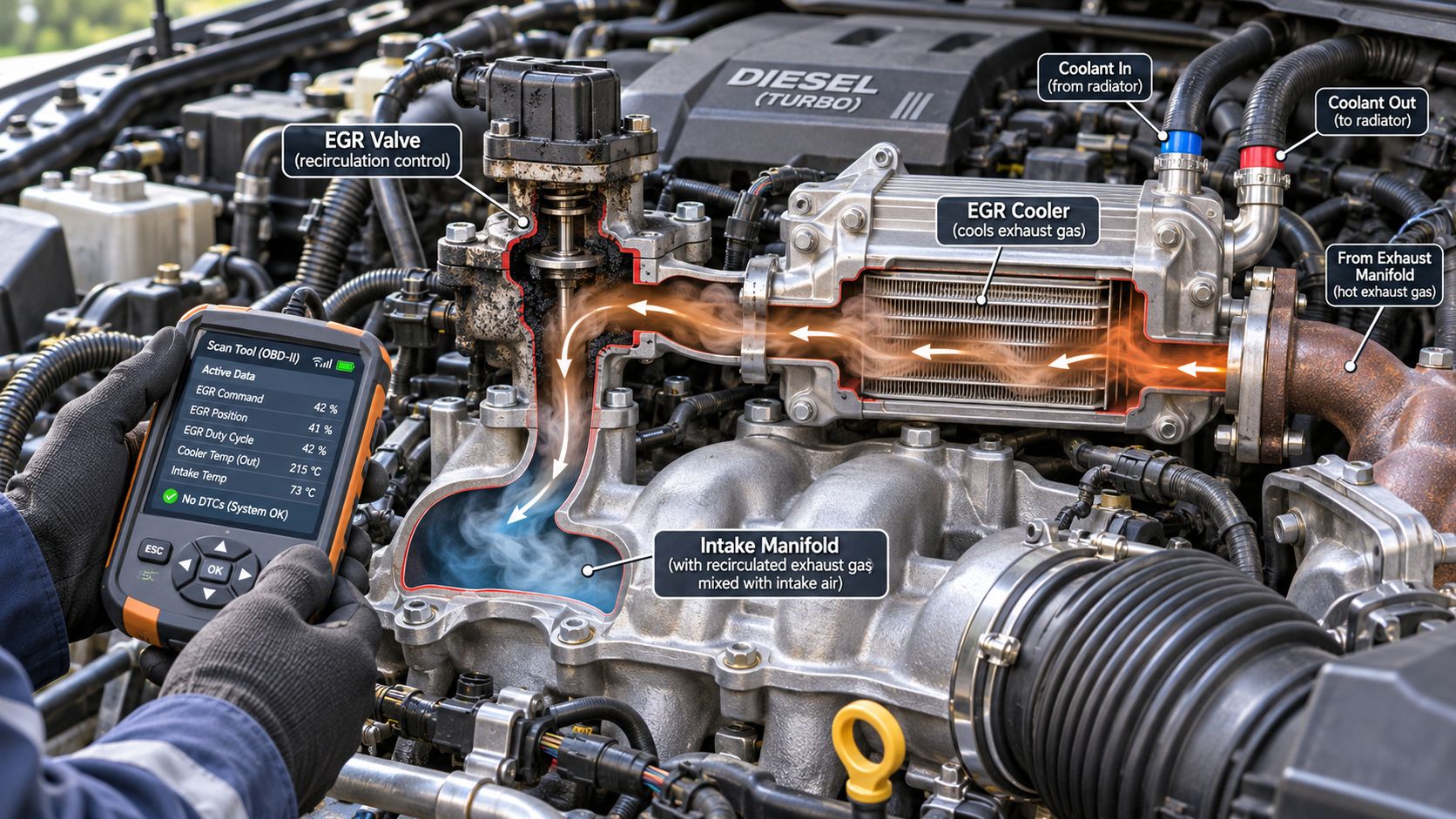
EGR meters exhaust back into the intake to reduce combustion temperature and nitrogen-oxide formation. The valve, cooler, actuator, sensors, wiring and control software operate together as a regulated emissions system, as described in the DieselNet heavy-duty emissions standards overview.
The engine behaves like a balanced air-handling system: changing recirculated exhaust without accounting for fresh air changes combustion. A scan-tool check helps establish whether the controller's command matches the engine's response.
How an unresolved warning becomes downtime
The operational progression can have distinct stages:
- Initial complaint: The driver notices hesitation, smoke or unstable operation, and the controller stores a fault.
- Power restriction: Depending on the fault and calibration, the controller limits available power through an emissions-related derate.
- Operational stop: The driver can no longer maintain safe progress or complete the route.
Excessive recirculation displaces fresh air and can worsen combustion and soot production. Insufficient recirculation leaves the engine outside its intended NOx-control strategy; the EPA alternative diesel control document from 2010 explains the emissions role of EGR and its relationship with particulate-control systems.
Hypothetical scenario: A regional delivery truck logs an EGR code on Monday, runs derated by Wednesday and stalls on a grade by Friday after someone clears the warning twice. This is an illustrative sequence, not a predicted failure timetable, and it doesn't establish that the valve caused the stall.
The lesson is operational: clearing a warning doesn't demonstrate restored function. Repeated derates warrant investigation before secondary DPF loading and unplanned downtime complicate the repair.
The accompanying video provides additional visual context.
Stuck Open, Stuck Closed and Soot Faults Compared
A valve stuck open and a valve that can't open enough require different evidence. Rough running alone can't distinguish them, and a position reading doesn't establish that exhaust passes through the entire EGR path.
Stuck open versus insufficient flow
A stuck-open valve can leave the engine receiving excessive exhaust when the controller expects less. The driver may report hesitation, smoke, unstable idle or stalling; the technician should examine whether actual position follows a closing command and whether fresh-air readings respond appropriately.
A stuck-closed valve or blocked passage produces an insufficient-flow problem. A useful distinction is whether the position signal remains closed despite an opening command, or whether position changes while flow feedback remains inadequate.
Inspection priorities differ:
- Apparent stuck-open condition: Check seating, position feedback and response to a controlled closing command.
- Apparent stuck-closed condition: Check actuator operation and the exhaust path rather than assuming the restriction sits inside the valve.
- Intermittent response: Look for sticking, connector movement, harness damage or control faults under the conditions that trigger the complaint.
Soot can slow travel before movement stops
Deposits increase friction between the valve blade and seat, delaying movement toward the requested position. The controller may detect slow response or disagreement before the valve stops moving altogether.
The manufacturer diagnostic bulletin hosted by NHTSA in 2024 associates this condition with bucking or jolting under load, rough running, reduced acceleration, warning-lamp illumination and EGR codes; on some covered platforms, its procedure calls for monitoring operation around 2,000 rpm for 3 to 5 minutes. That operating check belongs to the applicable service procedure, not a generic roadside instruction.
The physical inspection should include the valve connector and harness for corrosion, loose pins and damaged wiring. The cooler, bypass flap, pipes, temperature sensor and vacuum system, where fitted, also need attention for restriction or control problems.
A mechanically clean valve can still receive the wrong electrical or pneumatic control. Cleaning isn't proof that the system works.
Cleaning makes sense only when inspection supports deposits as the cause and the component remains serviceable. A failed actuator or unreliable feedback circuit requires a different repair path, followed by a repeat functional test.
What to Document Before a Diagnostic Call
A useful file lets the technician separate a sticking EGR valve from an EGR cooler restriction, sensor drift or airflow problem that produces the same complaint. The warning lamp proves the system detected a fault; it does not prove the valve caused it. Good records preserve the conditions around that decision.
Build a usable diagnostic record
Record the truck and engine identity. Include truck make, engine model, mileage and calibration information when available. The engine family and software determine which test procedure and thresholds apply.
Track DPF regeneration intervals and duty cycle over the last two weeks. Include idle-heavy operation, short delivery runs and sustained highway work. These records help the technician judge whether changed operating conditions accompany the complaint.
Photograph coolant, oil or smoke evidence with dates. Keep older photographs for comparison and identify where each image was taken. Coolant level should only be checked safely, and a hot pressurized cooling system must not be opened.
Keep the previous repair order. Note whether the earlier repair changed the symptom, briefly improved it or made no difference. A replaced part is not evidence that the original fault was correctly isolated.
List resets, code clears and parts already tried. Include programming changes and cleaning attempts when known. Clearing codes can remove useful context before the technician has an opportunity to preserve it.
What the handoff should contain
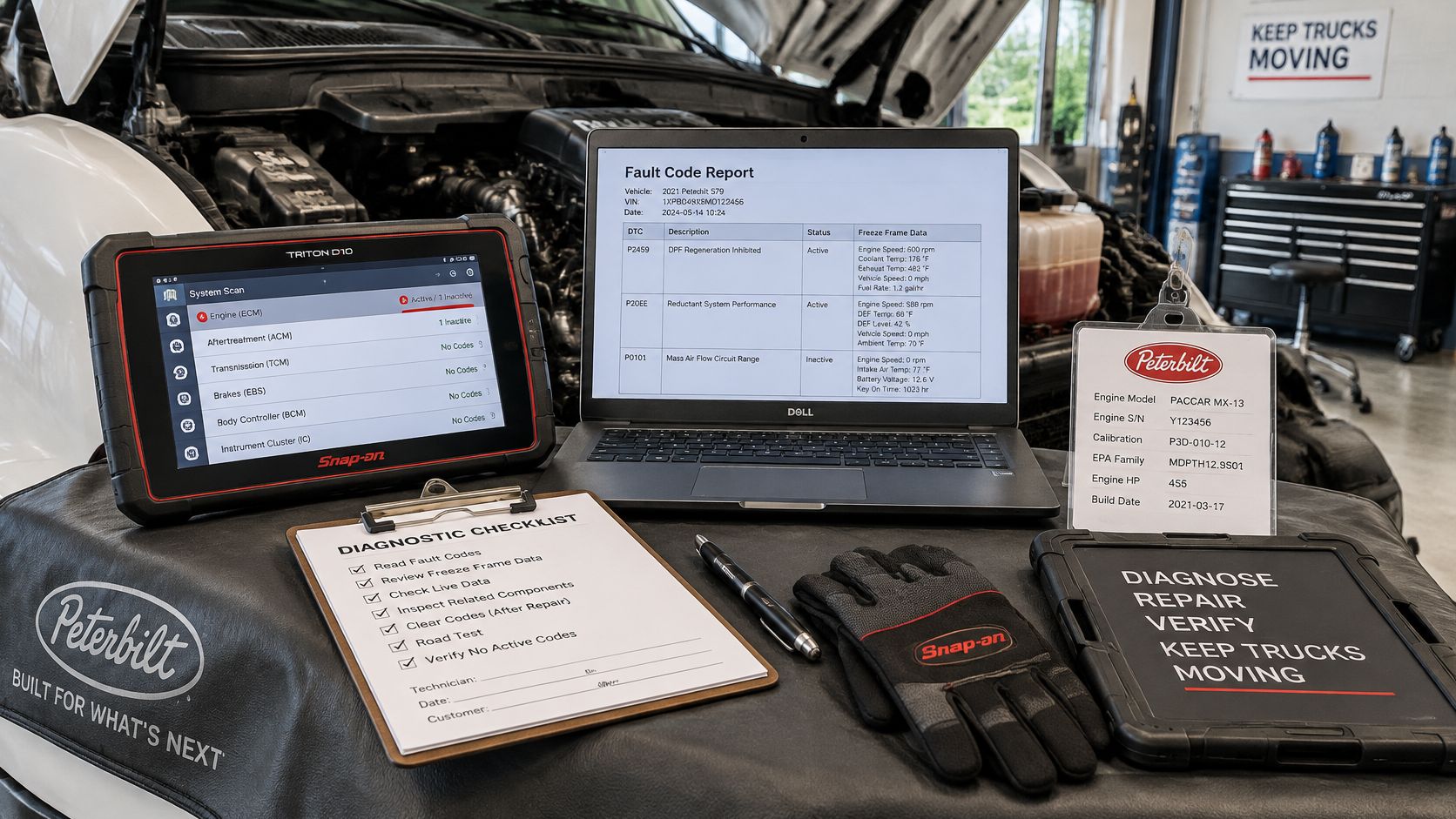
A complete handoff combines vehicle identification, the existing code export, dated symptom notes, regeneration history, photographs and prior repair information in a clearly labeled record. It also states the truck's exact location, whether it can be accessed safely and who can authorize testing.
The goal is to preserve enough evidence to confirm what failed and what changed after repair. A valve replaced on symptoms alone can leave the cooler, sensor or airflow fault in place, while a clear record gives the technician a baseline for live-data checks and the post-repair retest.
Which Pressure and Flow Thresholds Matter?
Every value below is platform-specific, not a universal valve-replacement limit. Match the engine, calibration, operating condition and test procedure before treating a reading as evidence.
Reference thresholds from diagnostic documents
| Source | Measurement | Reference Value | What It Suggests |
|---|---|---|---|
| NHTSA-hosted heavy-duty diagnostic bulletin | EGR differential pressure | Above 0.6 psi; approximately 0.2 psi (1.4 kPa) or less at full valve activation | The higher condition supports the failed-valve branch of that procedure; the low condition points toward a differential-pressure sensor or venturi problem |
| Same NHTSA-hosted diagnostic sequence | EGR differential pressure at full valve activation | Low or negative reading within that procedure | Probable sensor, venturi or plumbing issue before any valve condemnation |
| Cummins ISX12N service information, 2022 engine-model-year document | Estimated versus commanded EGR flow | 0.6 kg/min average difference over 10 seconds, with 0.2 kg/min tolerance | Estimated-EGR-flow-low fault for the covered engine and calibration |
| Cummins L9 service documentation | EGR control-circuit monitoring | Monitor timing and trip logic set by the L9 procedure | Timing controls when a monitored circuit fault activates the warning lamp |
What the readings establish
The higher differential-pressure condition belongs to one diagnostic sequence. A scan tool displaying the same unit on another truck does not import that threshold with it.
The low-pressure condition shifts attention to measurement quality. Reversed pressure-sensor hoses, obstructed sensing passages or a misleading sensor can make the controller report an EGR problem even when valve replacement would leave the cause untouched.
The Cummins flow example shows the useful pattern: the controller compares expected and estimated flow across a defined interval before it sets a fault. The L9 row concerns control-circuit monitoring logic. It gives no safe waiting period for a truck with worsening power or coolant loss.
Measurement rule: A plausible number isn't necessarily a valid measurement. Sensor plumbing, wiring and test conditions must be checked before the reading becomes a parts decision.
Position and flow must agree
Commanded position, actual position and flow have to line up. A valve can report full travel while a restricted EGR passage or cooler fault limits flow; faulty feedback can also make a mechanically sound valve look weak.
That is why leakage, clogging, sensor faults and actuator errors need separate isolation before parts approval. DPF pressure feedback is another distinct measurement path; the explanation of a DPF differential-pressure sensor helps distinguish it from EGR flow sensing.
The documented operating conditions and code history give these readings meaning. Without that context, comparing isolated pressure values risks replacing a sound component.
Should the Next Step Be Roadside Work or an External Facility?
Replacing the valve shouldn't be the default authorization. An EGR-system complaint may originate in the cooler, actuator, sensor, wiring or air-handling system, and the next step should match the confirmed fault.
The emissions fault-isolation guide distinguishes EGR complaints from DPF and related emissions problems. Its practical implication is straightforward: a sound valve won't correct an internal cooler leak, restricted passage, reversed sensing hoses or boost fault.
Match the work location to the diagnosis
Roadside feasibility by EGR fault type, hypothetical scope
| Fault Type | Roadside Feasibility | Next Step |
|---|---|---|
| Sensor, connector or wiring inspection | Often possible if access and safety allow | Mobile assessment at the vehicle location |
| Valve cleaning | Case-specific, subject to access and tools | Mobile assessment before any work is authorized |
| Cooler leak or coolant loss | Usually needs deeper testing | Suitable external facility option if required |
| Engine-internal or boost issue | Not assumed roadside | External facility option if required |
This comparison describes possible work scopes only. Safe access, available equipment, job requirements and technician availability determine feasibility after assessment.
SAAT Repairs Corp operates exclusively as mobile Road Services at the vehicle location and has no customer-facing workshop. Its on-site truck repair approach starts with assessing the vehicle and working conditions where it sits, since no customer brings a truck to a SAAT repair bay.
On site, that assessment is a sequence of checks. The technician compares commanded valve position against the position the feedback sensor reports, inspects the connector and harness for chafing or corrosion, and watches whether pressure and airflow signals respond the way the command predicts. Readings taken under the truck's real operating conditions then decide whether the job stays mobile.

The result is a scoped proposal rather than a blanket approval. When live readings support a valve or sensor fault, the technician outlines what can be cleaned, tested or replaced at the vehicle location. When coolant loss or an internal leak points toward the cooler, the proposal identifies the deeper testing that requires a suitable external facility, which is never a SAAT location. The company applies this process for the individual truck owners, fleet operators and transportation companies it serves, and each proposed repair is weighed against the actual site and job scope.
Authorize testing before replacement
A fleet truck reports a stuck-open valve signal, and an initial wiring inspection finds no visible defect. A technician assesses it on site, commands the valve and compares the response before deciding whether cleaning or another repair is practical.
A second case: coolant loss with suspected cooler leakage. After a safe coolant check and initial assessment, the repair may require deeper testing at a suitable external facility, which isn't a SAAT location.
Before authorizing a valve, the repair decision should establish:
- Movement: Does actual position follow the command under the relevant conditions?
- Flow: Do verified pressure and airflow signals support the expected response?
- Fault isolation: Have wiring, sensing plumbing, passages, cooler integrity and relevant boost concerns been evaluated?
Active derate, severe smoke, coolant loss or rapidly worsening power warrant priority assessment rather than repeated resets. The practical objective is a verified repair followed by a functional check; clearing the warning lamp alone settles nothing.
SAAT Repairs Corp offers mobile diagnostics and DPF/EGR service for diesel trucks in Tampa, Lakeland and nearby Florida. Visit SAAT Repairs Corp and use the English contact section to provide the truck's location, symptoms, fault codes and derate status so the team can assess the appropriate on-site next step.