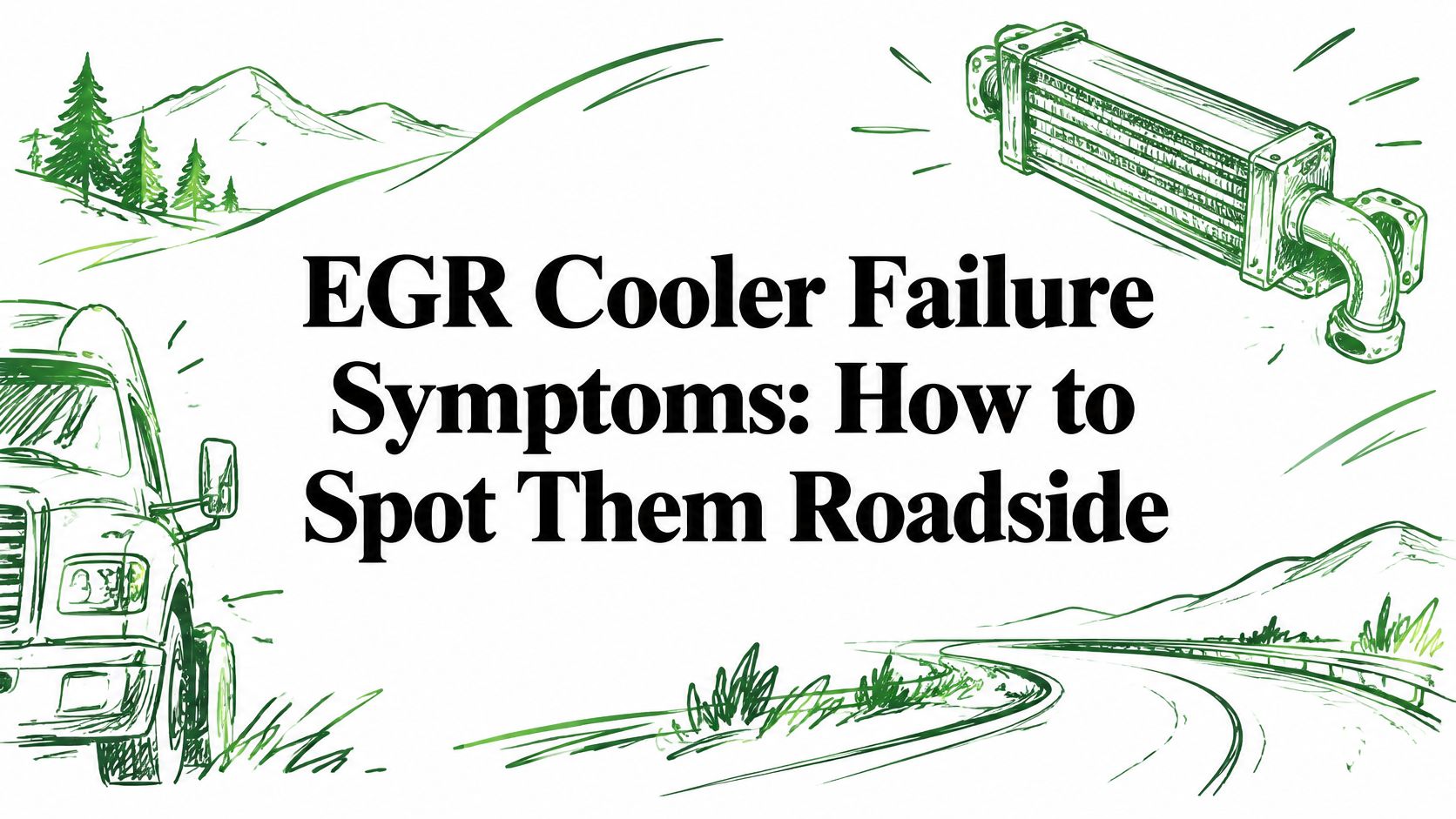
Example. A driver notices the coolant level is lower on successive cold checks and finds no puddle under the truck. When power drops and a derate appears, the driver calls dispatch from a safe location.
Falling coolant with no obvious external leak and reduced power can put an internal EGR cooler leak on the list. A cylinder-head fault, an external leak that only appears under pressure, or a separate air or emissions fault can produce overlapping symptoms.
The order of work matters more than the symptom list. Read the signs, confirm where the coolant is going, and only then decide whether a part gets ordered or the truck gets parked.
Table of Contents
- What Are the Warning Signs of a Failing EGR Cooler?
- Why Coolant Loss and White Smoke Point to the Cooler
- When Driving Must Stop Before Any Repair
- Documenting Symptoms Before a Pressure Test
- Which Look-Alike Faults Mimic an EGR Cooler Failure?
- Repair Tasks Mobile Crews Can and Cannot Finish
- Should You Request a Roadside EGR Cooler Diagnosis?
What Are the Warning Signs of a Failing EGR Cooler?
| Symptom | Where you notice it | Why it can point to the cooler |
|---|---|---|
| Unexplained coolant loss | Reservoir level drops with no visible external leak | An internal leak can send coolant into the intake or exhaust path |
| White exhaust vapor after warm-up | Steam-like exhaust persists at operating temperature | Coolant entering the exhaust can vaporize |
| Loss of cabin heat | Heater runs cold once the engine is warm | Low coolant can reduce heater performance; check the level and inspect for leaks |
| Reduced power or derate | Limp-mode behavior or power loss under load | An EGR flow or temperature problem can affect engine operation |
| Stored or active P0401 or P0402 codes | Fault code appears, sometimes with the malfunction lamp | The code indicates an EGR flow problem, not its cause |
| Sweet, burning or melted-plastic odor | Smell near the cab, exhaust or engine bay | Coolant or overheated material may be reaching the exhaust or intake |
| Intake whistling or abnormal engine noise | Whistle or unusual noise from the engine compartment | A leak in the intake plumbing or cooler may produce noise |
| Hard starting | Engine takes longer to start | Coolant entering the intake is one possible cause |
Persistent white exhaust vapor together with falling coolant warrants a check for an internal leak. The symptom pattern helps guide the inspection, but it cannot identify which part is leaking.
These signs vary in how specifically they point to a cooler. A cold heater, a P0401 code or engine-bay noise can each have other causes. Use the table to decide what to check next. Compare coolant level over time, note when vapor appears, and record any codes and changes in power.
What the pattern proves and what it doesn't
Repeated observations help a technician reproduce the conditions of a fault when it is safe to do so. White vapor that continues after warm-up alongside falling coolant raises suspicion of an internal leak. Confirm the leak path before ordering parts.
Why Coolant Loss and White Smoke Point to the Cooler
Repeated heating and cooling can fatigue the thin walls inside an EGR cooler until they crack. Exhaust and engine coolant then have a path between passages that should remain separate.
A leak can send coolant into the exhaust or allow exhaust pressure to push into the cooling system, displacing coolant from the reservoir. Either route can leave the level falling while the ground beneath the truck stays dry.
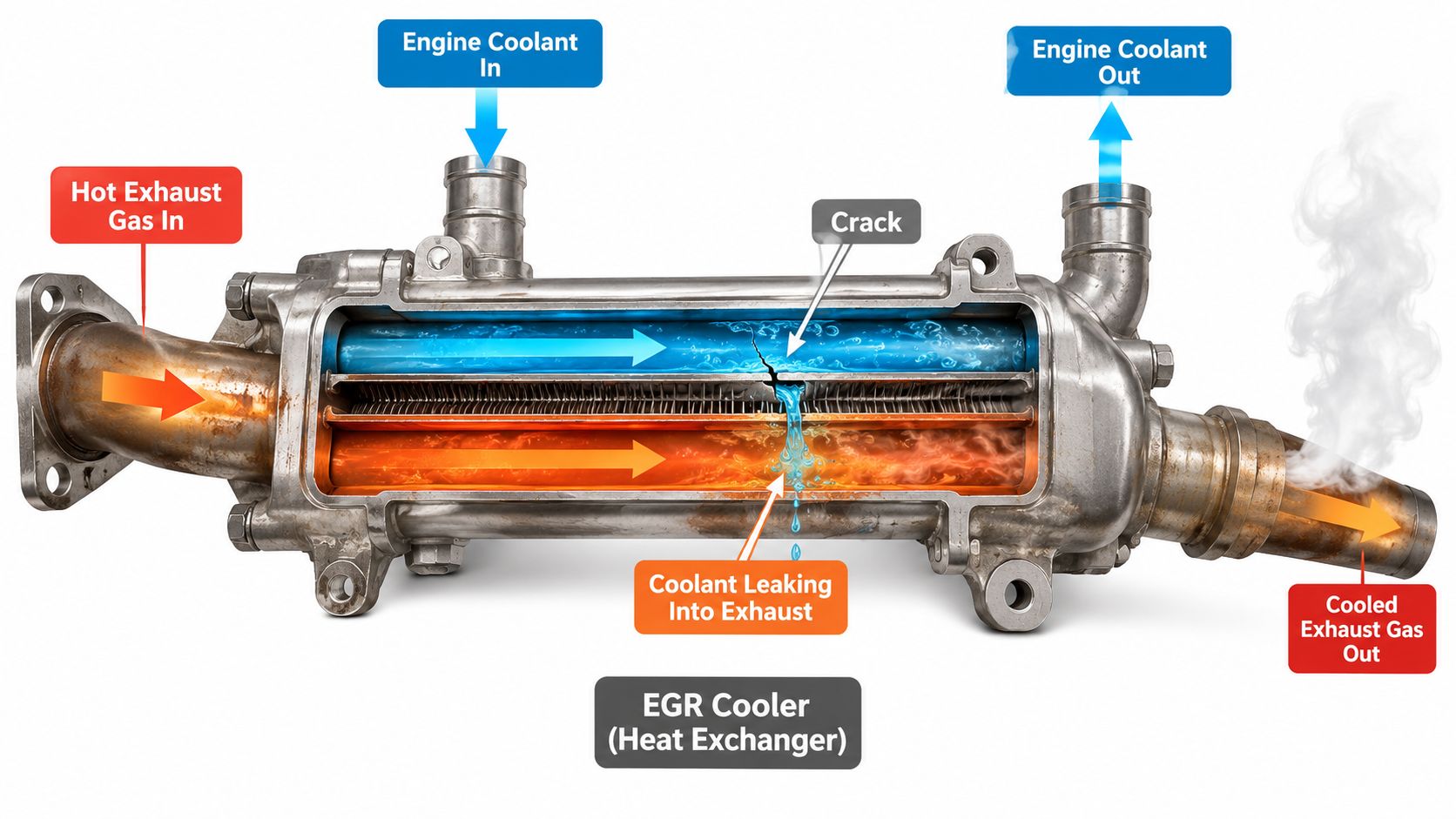
Two directions, one disappearing reservoir
The leak path affects what evidence remains. Coolant entering the exhaust may leave deposits or moisture in the exhaust tract. Depending on the engine design, a leak into the intake may leave residue or allow liquid to collect in a cylinder. Other faults can leave similar evidence, so the technician still needs to identify the source.
Thermal cycling, exhaust-pressure pulsation, localized boiling, soot buildup and coolant corrosion can all contribute to cooler damage. A roadside check can document coolant loss, visible exhaust evidence and fault codes, but confirming an internal leak may require inspection or testing at an external facility.
Example from a parked truck. A driver in Lakeland notices the cold coolant level is lower than on the previous check and sees dry pavement. The driver records the level and dashboard warnings. The technician traces possible external and internal leak paths before recommending parts.
A dry parking space narrows the search. It does not identify the failed part.
When Driving Must Stop Before Any Repair
If white vapor persists and coolant is falling, pull over as soon as it is safe and follow the truck manufacturer’s warning instructions. Once parked, share the location, dashboard warnings, and coolant observations with dispatch. Avoid driving farther to reproduce the symptom.
Heavy smoke, rapid coolant loss, overheating, a stop-engine warning, or abnormal cranking call for a safe stop and assistance. If liquid may have entered a cylinder, avoid restarting or repeatedly cranking the engine. Dispatch can arrange recovery if the truck cannot be operated safely.
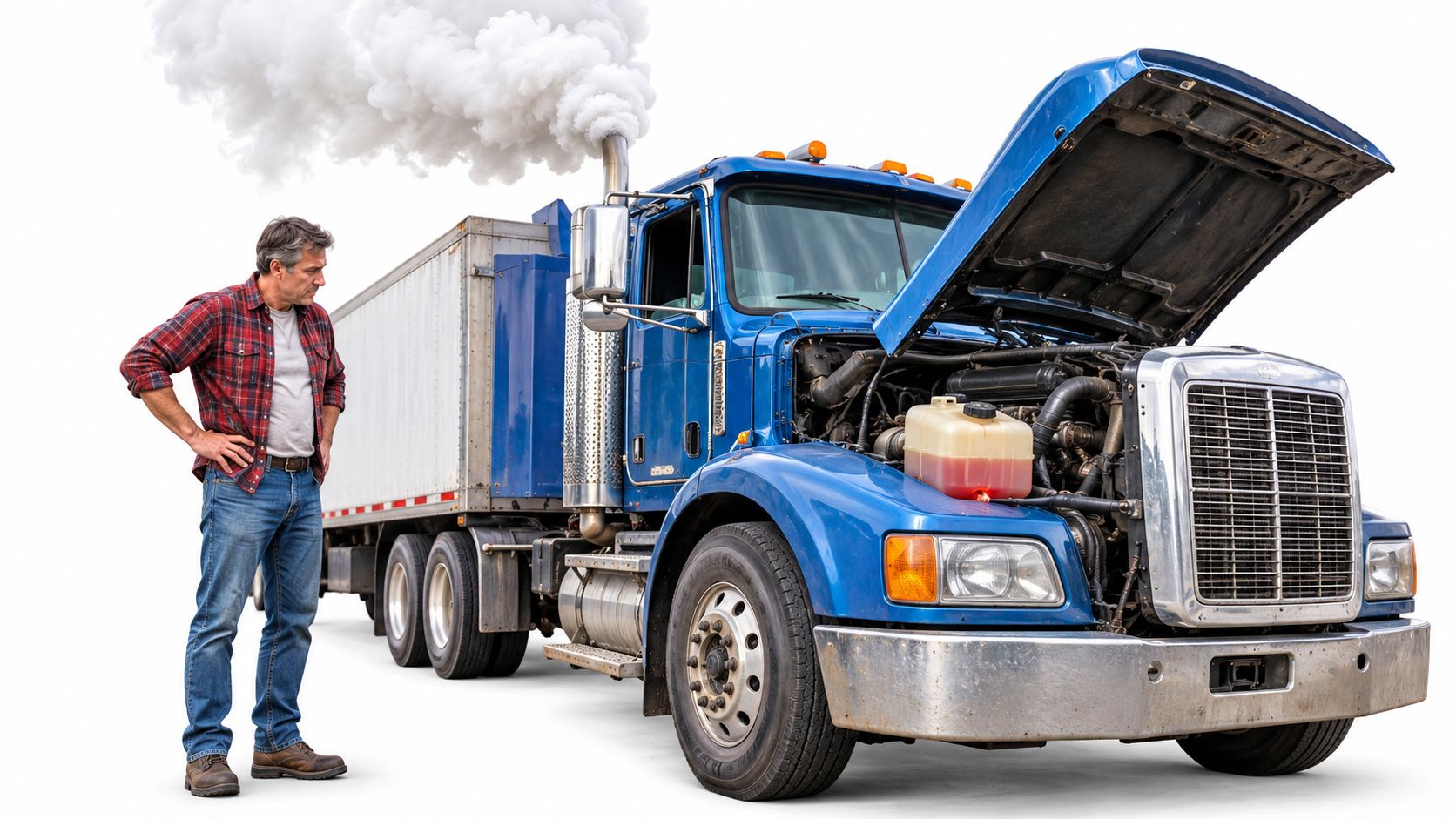
Stop rule: Shut the engine down as soon as it is safe when the manufacturer calls for a stop or the truck shows severe symptoms. Keep it parked while dispatch arranges the next step.
At the vehicle location, a technician can scan faults and inspect accessible plumbing when conditions allow. Confirming the leak or replacing the cooler may require equipment or access available only at an external facility.
Documenting Symptoms Before a Pressure Test
Moisture in an EGR crossover tube may be condensation. Cummins bulletin TSB150038 makes that distinction for the ISX12 G CM2180 EJ and ISL G CM2180. It describes a submerged test for applicable circular coolers on those engines. A technician should use the procedure and equipment specified for the engine and cooler installed.
Copy the fault code text exactly and note whether it's active or intermittent. P0401 and P0402 describe flow, not a crack, and a code that clears on its own tells a different story from one that returns every drive cycle.
Record when the symptom appears. Cold start, idle, acceleration, sustained load and full operating temperature each point at different causes, and "it smokes sometimes" wastes a diagnostic visit.
Share existing cold coolant readings. Compare them at similar temperatures and on level ground when practical. Read the reservoir marks from outside and never open a hot cooling system. Keep the truck parked if symptoms call for a stop. A qualified technician decides whether any later road test is safe and appropriate.
Record when white vapor appeared and how long it lasted. Use observations already made. Avoid idling or driving to recreate persistent vapor while coolant is falling or a stop warning is active.
Photograph visible leaks or wet areas when it is safe. Moisture or a clean patch can guide the inspection. Confirm the fluid and source before treating either as evidence of a failed part.
List recent cooling, fuel, electrical or emissions work. A recent thermostat, hose or software change reframes the whole complaint.
The confirmation step depends on the engine. A technician may need to isolate the cooler and compare its test results with the manufacturer’s limits. A cooling-system pressure test alone may leave the leak source unresolved.
Recording this properly is also the difference between a vague request and a useful one, and the same discipline applies to what to send when requesting mobile truck repair near Tampa or Lakeland: location, complaint and evidence travel together.
Write the final entry in the driver's own words. "Loses about a quart every two days, white steam for ten minutes after start, feels flat pulling the overpass" beats any generic description, and it keeps the complaint attached to the evidence.
Which Look-Alike Faults Mimic an EGR Cooler Failure?
Coolant loss, white vapor, reduced power, and intake whistling can point toward an EGR cooler, but each can also come from another fault. Match the symptom to a test before ordering parts.
| Symptom | Look-alike causes | Test that separates them |
|---|---|---|
| Coolant loss | External hose or clamp leak; head-gasket leak | Check for external leaks; test the cooling system for combustion gas; pressure-test the cooler |
| Reduced power or derate | Turbocharger, charge-air, DPF, sensor, or wiring fault | Scan active and stored codes; compare commanded and measured EGR behavior |
| White exhaust vapor | Cylinder-head or head-gasket fault; aftertreatment fault | Isolate and pressure-test the cooler; if it passes, inspect the head and gasket |
| Intake whistling | Loose charge-air coupling; cracked intake boot or clamp | Inspect couplings and clamps; pressure-test the intake plumbing |
A wet hose fitting gives the technician an external leak to investigate. Gas in the coolant can point to a leak path between a gas passage and the cooling circuit. It takes further checks to distinguish a head or gasket issue from other sources.
Use the manufacturer’s diagnostic sequence for the installed engine. Detroit Diesel’s DD Heavy Duty coolant-loss bulletin shows why the order depends on the platform and earlier findings. The procedure branches through external leak checks and cooling-system tests, with cooler inspection or testing where specified. If the cooler passes, continue with the next checks in that engine’s procedure.
For reduced power, check codes and compare commanded with measured EGR behavior before replacing components. EGR-related power-loss checks before replacing emissions components can help distinguish a mechanical problem from a sensor or wiring fault.
Whistling or an unusual odor gives the technician another observation to record. Inspect accessible charge-air and intake connections and compare the fault data with the engine procedure. Those symptoms can also come from plumbing or wiring faults.
Repair Tasks Mobile Crews Can and Cannot Finish
A roadside diagnosis can identify the likely fault, but access and job requirements determine whether repair can be completed where the truck is parked. Mobile work also depends on safe access, the equipment available and technician availability. The table shows common limits.
| Task | Often feasible at vehicle location? | When an external facility is needed |
|---|---|---|
| Visual leak check and possible cooler pressure test | Visual checks may be feasible. Pressure testing depends on the engine procedure, tools, and safe access. | The procedure requires removal or equipment unavailable at the vehicle location. |
| Scan-tool diagnosis and code review | Often, with suitable tools and safe access | Required tooling or programming is unavailable on site |
| EGR cleaning | Sometimes, depending on parts access and removal requirements | The assembly needs bench service |
| EGR cooler replacement | Sometimes, depending on access and equipment | The job requires major disassembly, a lift or shop tools |
| Intake or charge-air repair | Sometimes, depending on the damage and access | Parts need replacement or the repair requires facility equipment |
| Head-gasket or cylinder-head work | Generally not suitable for roadside completion | Major disassembly requires a suitable external facility |
A technician can inspect safely accessible parts at the vehicle location. Cooler pressure testing is feasible only when the engine procedure, equipment, and site allow it. Scan-tool readings can help narrow the fault before further testing.
Cooler replacement depends on engine layout, access and the equipment the job requires. If the cooler is buried beneath other components or the repair needs a lift and extensive disassembly, an outside facility may be the practical choice. Damaged intake parts also require repair or replacement based on their condition; cleaning alone will not correct physical damage.
SAAT Repairs Corp provides mobile diagnostics and repair at the vehicle location, with feasibility assessed for each job. The company has no workshop open to customers, so work requiring a suitable facility goes to an outside provider, and the operator must arrange transport. For an overview of how mobile truck repair works at the vehicle location, see the service details.
Get the feasibility decision before moving the truck, especially if the next step may require transport to an external facility.
Should You Request a Roadside EGR Cooler Diagnosis?
Request a roadside diagnosis when the symptom pattern suggests a cooler problem and the truck can be parked safely. The goal is to establish whether the evidence points to an EGR cooler or a look-alike fault before anyone orders parts.
Have the unit number, engine platform, and truck location ready, including a mile marker or gate access. For symptom records and fault-code details, use the documentation gathered before the call.
SAAT Repairs Corp provides mobile Road Services, not a customer-facing workshop. Its technicians use diagnostic tools to identify truck issues, with roadside checks guided by access, safety, equipment, and the job requirements. A technician can assess whether diagnosis or repair is feasible at the vehicle location; arrival timing depends on location, traffic, technician availability, and the job.
Before you call: Park in a safe location and have the unit number, engine platform, and precise location available.
A truck losing coolant without an obvious ground leak, especially alongside white vapor or an EGR derate, needs diagnosis before parts are ordered. Contact SAAT Repairs Corp to discuss a mobile assessment and whether the required checks can be completed where the truck is parked.