A driver calls from a loading yard near Tampa after the truck hesitates before engaging and begins making an unfamiliar noise during shifts. The transmission-fluid level may be low, but the same symptoms can also indicate a leak, contamination, clutch trouble, bearing wear, or internal gear damage. Authorizing a fluid change before gathering that information can turn a manageable roadside inspection into a more serious failure.
For semi-truck operators in Tampa, Lakeland, and nearby Florida corridors, the practical question isn't just when to change semi truck transmission fluid. The better question is whether the truck needs a safe top-off, a controlled fluid service, further diagnosis, or an external facility for internal transmission work.
Table of Contents
- Why Transmission Fluid Condition Dictates the Repair Path
- How the Shift to Automated Manuals Changed Fluid Requirements
- Matching OEM Approvals Instead of Just Viscosity Grades
- Adjusting Drain Intervals for Florida Regional Delivery Routes
- Reading Contamination Signs Before Authorizing a Fluid Change
- Preparing the Right Information for Mobile Service Dispatch
Why Transmission Fluid Condition Dictates the Repair Path
A delayed engagement doesn't identify the failed component by itself. A driver may report that the truck hesitates when selecting a gear, slips under load, grinds during a shift, or produces a new whining sound. Each symptom changes the inspection path, especially when the truck operates with a heavy load or has recently experienced a clutch event.
The first task is controlled information gathering. The driver should report when the symptom began, whether it appears in one gear or several, whether the transmission was hot, whether a warning appeared, and whether fluid is visible beneath the housing. The inspection should also account for recent repairs, route conditions, load, and any change in shifting behavior after a service event. Freightliner's heavy-duty maintenance documentation supports treating lubricant level and leaks as part of a broader maintenance assessment rather than assuming that every shifting complaint requires an automatic replacement.
Practical rule: A low fluid level is a finding, not a diagnosis.
When a top-off may be reasonable
A roadside top-off may be considered when the transmission model is confirmed, the correct approved lubricant is available, the leak source is understood well enough to prevent immediate loss, and the truck can be accessed safely. The technician still needs to check the level under the transmission maker's specified conditions. A top-off can restore the proper level temporarily, but it doesn't repair a failed seal, damaged bearing, worn synchronizer, or compromised housing.
Fluid appearance and odor add context. A normal-looking level with delayed engagement may point toward a control, clutch, or internal mechanical concern. A low level accompanied by fresh oil around a seal or case joint suggests a leak that requires follow-up rather than permission to continue indefinitely.
When fluid alone won't solve the problem
Burnt odor, metallic debris, abnormal temperature, grinding, repeated slipping, or failed engagement should raise the threshold for continued operation. A transmission that has lost lubricant may already have damage to gears, bearings, seals, or synchronizers. Adding fluid without investigating the loss can conceal the seriousness of the condition until the truck fails in traffic or under load.
Operators can also use the transmission and DPF or EGR care guide as part of a wider preventive-maintenance process. The key decision remains vehicle-specific: mobile technicians can inspect and perform suitable fluid work at the truck's location, but substantial disassembly, internal repair, or an unsafe work area may require coordination with a suitable external facility.
How the Shift to Automated Manuals Changed Fluid Requirements
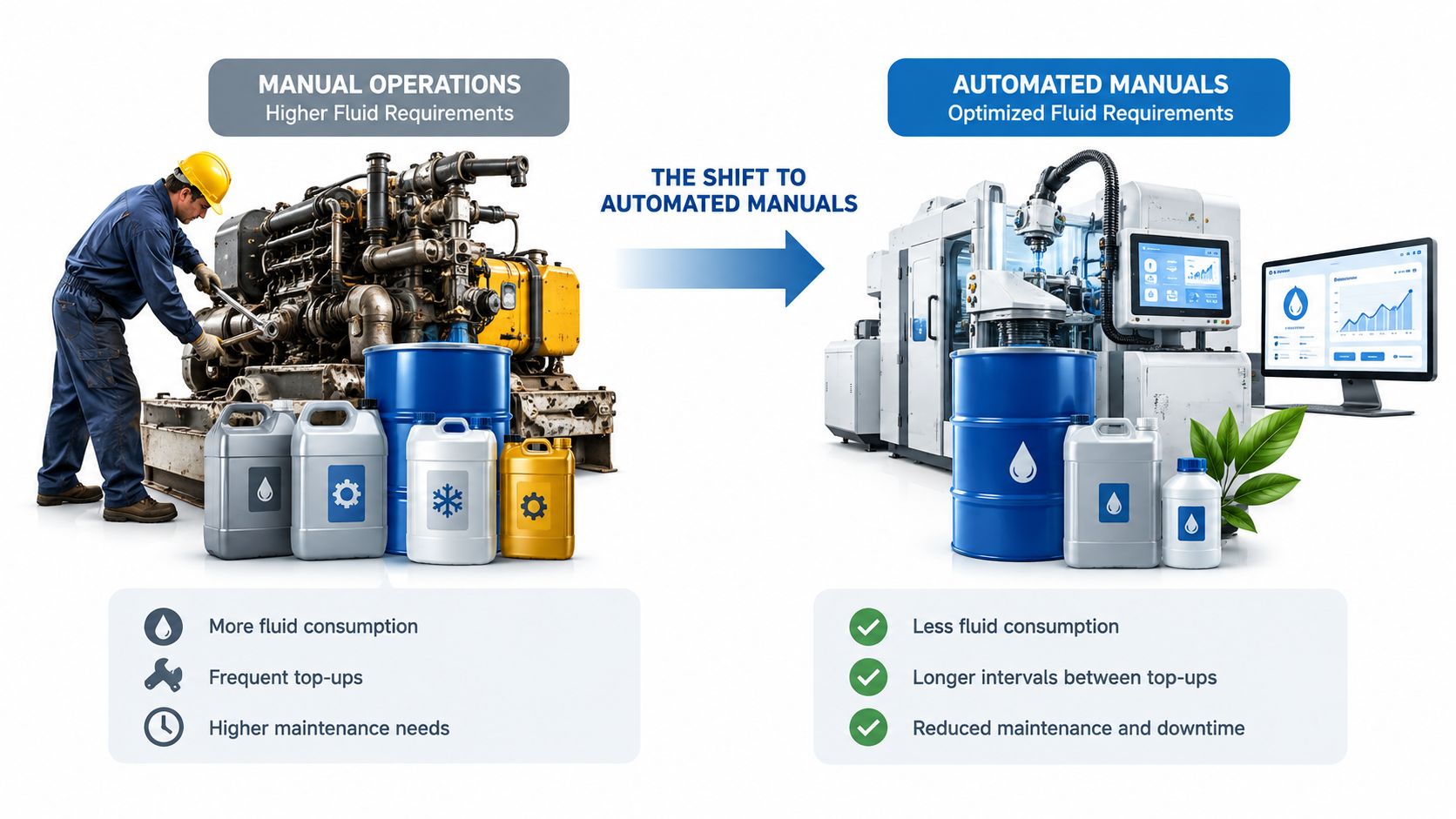
Manual, automated-manual, and fully automatic transmissions don't place the same demands on lubricant. An automated manual transmission retains a manual-style gear train but uses automated clutch and shifting controls. A conventional automatic uses a different hydraulic circuit and different friction-material requirements. That distinction affects fluid chemistry, heat management, shift behavior, and the consequences of using an incorrect product.
The market has moved strongly toward self-shifting equipment. In North America, self-shifting gearboxes represented about 30% of heavy-truck gearbox sales in 2013, while manuals represented approximately 70% at that time, according to industry coverage of automated-transmission adoption. By 2021, approximately 92% of new Volvo trucks were reportedly equipped with I-Shift AMTs, making exact lubricant approvals increasingly relevant to fleet uptime, as the same source reports.
Why AMTs change the maintenance conversation
An AMT's automated clutch operation can create a different thermal and friction environment from a conventional manual gearbox. Regional delivery routes add repeated starts, loading-yard maneuvering, traffic interruptions, and frequent gear changes. High ambient temperatures can make heat control and fluid condition more important, but heat alone doesn't authorize a longer or shorter interval without reference to the transmission specification and duty cycle.
A fleet that moved from manual units to AMTs may also carry forward old maintenance habits. A familiar gear-oil viscosity or a historical mileage interval may not suit a newer transmission. Electronic controls don't make the lubricant irrelevant. They make the relationship between lubricant friction behavior, clutch control, shift quality, and fault diagnosis more important.
The same principle applies to fully automatic transmissions. Allison requirements such as TES-389 and TES-295 apply to applicable automatic units, while other designs use different approvals. A fluid that appears suitable in a general category can still produce poor friction behavior or inadequate protection if the transmission maker hasn't approved it.
Efficiency isn't a license to improvise
Lower-viscosity products may support efficiency in a defined application, but the result isn't universal. Chevron technical documentation reports up to 2% fuel-economy improvement for a specified SAE 75W-90 heavy-duty AMT fluid compared with higher-viscosity SAE 50 full-synthetic transmission lubricants in the stated comparison, not across every truck or route. The technical product document should be read as an application-specific result.
A fleet testing a different fluid should compare similar routes, payload ranges, tire condition, idle policy, weather, and driver practices. It should also watch for hard engagement, synchronizer hesitation, gear rollover noise, leaks, abnormal temperature, or fault codes. A small efficiency gain isn't useful if an unapproved fluid creates shift complaints or downtime.
Matching OEM Approvals Instead of Just Viscosity Grades
SAE viscosity is only one part of fluid identification. The transmission model and its current lubricant approval carry more authority than a label that merely shows a familiar grade. Synchronizers, bearings, gear teeth, seals, and clutch-control components can respond differently to additive chemistry, even when two products appear similar on paper.
Eaton's lubrication specifications identify PS-386 as the recommended lubricant for its medium- and heavy-duty manual and automated-manual transmissions. The same documentation states that PS-164 Revision 7 was superseded by PS-386, which is why old fleet records and inherited service habits need review.
A practical approval check
Before draining or topping off a truck, the technician or maintenance coordinator should work through a defined sequence:
Identify the transmission. Record the model from the data plate, service record, or reliable vehicle documentation. Don't select fluid from the engine model, axle type, or truck brand alone.
Confirm the current approval. Match the transmission's required specification to the fluid container and current manufacturer documentation. An SAE grade without the required approval isn't enough.
Check the service history. Establish what was installed previously, whether the fluid was mixed, and whether the unit has an unknown maintenance history.
Assess the operating condition. A leak, burnt odor, metallic debris, abnormal shifting, or overheating can change the job from routine service to diagnosis.
Verify safe access. The vehicle needs stable positioning, sufficient clearance, spill containment, and a work area that protects the technician and surrounding traffic.
Approval matters more than familiarity. A commonly used heavy-duty oil can still be wrong for a particular transmission.
What can go wrong with an unapproved fluid
An apparently suitable viscosity can still alter synchronizer response, clutch engagement, seal compatibility, oxidation control, or shift quality. The result may be hard engagement, hesitation, noise, accelerated wear, or a warranty dispute. These risks are especially important for AMTs because automated controls depend on repeatable clutch and shift behavior.
Synthetic fluid can support longer drains in approved applications, but “synthetic” alone doesn't authorize an extended interval. The transmission manufacturer's specification, oil analysis, duty cycle, maintenance history, and warranty requirements still control the decision. Mobile service should therefore verify the approval before the drain plug is opened, not after the wrong lubricant has entered the case.
Adjusting Drain Intervals for Florida Regional Delivery Routes
A mileage number doesn't describe the whole duty cycle. A linehaul tractor that spends most of its time at steady highway speed has a different thermal and mechanical pattern from a regional truck that starts and stops repeatedly, maneuvers around loading yards, carries heavy payloads, and works in Florida heat.
Heavy-duty references cite conventional-fluid intervals of approximately 25,000 to 50,000 miles for applicable Allison automatic transmissions, while certain Eaton Fuller manual transmissions may specify roughly 100,000 to 500,000 miles, depending on model, lubricant, and operating conditions. Detroit DT12 automated manual transmissions are commonly cited at approximately 30,000 to 60,000 miles under standard conditions. These examples, documented in a heavy-duty transmission-fluid maintenance reference, demonstrate why no universal semi-truck interval is safe.
Standard and severe-duty triggers
| Operating Condition | Standard Linehaul | Severe Regional Delivery |
|---|---|---|
| Route pattern | Predominantly steady highway operation | Frequent stops, starts, traffic, and loading-yard maneuvering |
| Load profile | Consistent loads within the approved operating range | Repeated heavy payloads or operation near maximum GCW or GVW |
| Environment | Relatively clean, controlled road conditions | Dirty or wet access roads, construction areas, and water exposure |
| Heat production | Longer periods of stable operation | Repeated shifting, idling, low-speed work, and high ambient temperature |
| Maintenance response | Follow the exact model and lubricant schedule | Inspect condition, level, and leaks more often when duty conditions justify it |
Eaton's lubricant specification manual identifies operation near maximum GCW ratings and dirty environments as severe-duty conditions. It also states that fluid levels and leaks should be checked at intervals not exceeding 12,000 miles.
Build a schedule from evidence
A maintenance coordinator should record route type, payload pattern, exposure to water or dirt, idling, recurring heat complaints, leaks, and the transmission's service history. That record lets the fleet compare actual use with the manufacturer's schedule instead of applying a generic calculator that ignores regional work.
Current product documentation also gives examples ranging from 120,000 kilometers for certain Voith applications to 800,000 kilometers for specified Eaton on-highway manual and automated-manual transmissions, as summarized in the transmission-oil product brochure. Those figures aren't interchangeable. Severe service, contamination, towing, leaks, and unknown fluid history can change the safe decision.
For local operators, on-site truck repair in Florida can be considered when the truck is safely accessible and the required inspection or fluid work is feasible at the vehicle location. A larger repair may need an external facility.
Reading Contamination Signs Before Authorizing a Fluid Change
Fluid condition should be treated as physical evidence. A dark appearance, burnt odor, metallic particles, milky appearance, or unusual debris doesn't automatically identify one failed part, but each finding changes the risk assessment. The technician needs to connect the evidence with symptoms, leak location, temperature, service history, and the transmission design.
A burnt odor may indicate excessive heat or friction. Metallic debris can point toward wear in gears, bearings, synchronizers, or other internal components. A milky appearance may indicate water contamination, which is particularly relevant for trucks exposed to wet roads, flooded access areas, or pressure washing near seals and breathers.
The roadside decision tree
The inspection can follow four practical branches:
Level low, fluid clean, leak accessible: Confirm the approved lubricant, inspect the leak, restore the level if safe, and document the condition. Continued operation may still require a follow-up repair.
Level low with active loss: Identify whether the leak is from a seal, case joint, PTO area, or another location. A top-off without controlling the loss is not a reliable repair.
Contamination or metallic debris present: Stop treating the job as routine fluid maintenance. The transmission may need controlled draining, evidence capture, deeper diagnosis, and an external repair plan.
Grinding, failed engagement, severe noise, or internal damage suspected: Prioritize safe immobilization and next-step coordination. Fluid replacement won't rebuild a damaged transmission.
A fluid change restores lubricant. It doesn't restore damaged gears, bearings, seals, or synchronizers.
Where mobile work ends
Mobile technicians can often inspect the vehicle, verify the fluid requirement, check for leaks, assess the level, and perform suitable fluid work when access and containment are safe. The scope depends on the truck's position, traffic exposure, ground conditions, available equipment, and the extent of the failure.
A compromised housing, substantial disassembly, internal component damage, or a procedure requiring controlled shop access may make roadside completion inappropriate. In that situation, the responsible outcome is a documented diagnosis and coordination with a suitable external facility, not an improvised rebuild beside a highway.
Preparing the Right Information for Mobile Service Dispatch
A truck that is down on the road needs fast decisions, but the wrong details can send a technician out with the wrong fluid, the wrong containment plan, or no clear repair path. The dispatcher should collect the transmission model and current symptoms before authorizing a fluid service. If the model is unknown, say so directly instead of guessing from the truck's age or badge.
Information that should travel with the call
The fleet record should include:
Unit identification: Record the unit number, truck location, driver contact, and whether the vehicle is loaded.
Transmission data: Provide the transmission model and any available data-plate information.
Lubricant requirement: State the exact OEM lubricant specification, not only an SAE viscosity grade.
Current symptoms: Note delayed or failed engagement, slipping, hard shifting, grinding, unusual noise, overheating, warning messages, and when the problem began.
Fluid evidence: Report the visible level, leaks, odor, appearance, and any metallic debris found during a safe inspection.
Maintenance history: Give the last known service date, prior repair history, recent clutch events, and whether the fluid's identity is uncertain.
Site conditions: Explain whether the truck is on a level surface, exposed to traffic, blocked in a loading area, leaking heavily, or unsafe to access.
For a practical dispatch checklist, see what to send when requesting mobile truck repair near Tampa or Lakeland.
Eaton's heavy-duty transmission service manual calls for fleet records to include the unit number, transmission model, lubricant specification, odometer reading, leak findings, and date.
Decide the service path before dispatch
The call should point to one of three paths. A verified low level with safe access may justify an inspection and approved top-off. A scheduled drain, inspection, and refill may fit when the service history and transmission specification are clear. Suspected internal damage, severe contamination, an active major leak, or unsafe access calls for diagnosis first and possible coordination with an external facility.
SAAT Repairs Corp provides mobile Road Services at the vehicle location, including manual and automatic transmission repair and fluid service, subject to safe access, equipment, technician availability, and job requirements. The company has no customer-facing workshop, so dispatchers should send the fullest possible site and transmission details before the technician judges whether roadside service is workable.
Fleet managers and owner-operators with a shifting complaint, leak, or uncertain fluid requirement can visit SAAT Repairs Corp to request mobile roadside assistance in the Tampa, Lakeland, and nearby Florida service area. The technician can decide whether an approved fluid inspection or service is safe at the truck's location, or whether the condition calls for coordination with a suitable external facility.
Composed with Outrank tool