A dispatcher in Tampa or Lakeland opens the morning board to find three box trucks ready, one with a tire note from yesterday, and one showing a fault alert that nobody has classified. The route won't wait for a perfect maintenance file. It still needs a defensible decision about what can roll, what needs repair first, and what needs diagnosis before parts are ordered.
Good Box Truck Maintenance works as dispatch control, not as a repair list that sits apart from operations. Every check produces a record, every defect gets a decision, and every electronic alert gets tested alongside mechanical wear before the truck is released again.
Table of Contents
- How Often Is Each Box Truck Check Due?
- What Does a Complete Pre-Trip Walkaround Cover?
- What Body, Door and Refrigeration Work Can Be Done on Location?
- Why Do Tire Wear Patterns Point to Different Causes?
- How Do Driver Reports Become Dispatch Decisions?
- When Must a Truck Stop for Brake or Air Work?
- Which Electronic and Emissions Faults Can Be Fixed Roadside?
- What Should You Do With This Schedule Before the Next Route?
How Often Is Each Box Truck Check Due?
Every interval on this schedule is really a release decision. What a driver checks today, what a shop signs off once a year, and what a fault code triggers in between all feed the same question: does the truck roll on the next dispatch, or does it wait?
Stop-and-go delivery work, heavy curb exposure and open defects all argue for shorter intervals than the minimums shown. I treat the figures below as a floor that dispatch tightens when duty cycle demands it.
Box Truck Inspection and Service Intervals
| Check or service | Interval | Basis |
|---|---|---|
| Driver vehicle inspection | End of every workday | FMCSA Part 396 |
| Tire pressure, tread and damage check | At least monthly | NHTSA tire-maintenance guidance |
| Periodic commercial-vehicle inspection | At least every 12 months | FMCSA Part 396 |
| Inspection record retention | 14 months; latest proof stays with the vehicle | FMCSA Part 396 |
| DPF ash cleaning, retrofit systems | Typically every 6 to 12 months | Typical range; duty cycle and filter design decide placement |
| Off-board DPF cleaning, some applications | Around 100,000 to 200,000 miles | Typical range for some retrofit applications |
| Engine oil, filters, coolant and belts | Manufacturer's schedule | Vehicle service information |
The daily row carries the most weight on the board. Under FMCSA's Part 396 inspection, repair and maintenance rules, drivers must inspect each vehicle at the end of every workday and complete a written Driver Vehicle Inspection Report when applicable. Before the next dispatch, the carrier must repair each defect that could affect safe operation or certify that repair isn't necessary.
That makes the report the gate every release passes through. Writing the defect down starts the clock. It closes when someone with authority repairs it or formally records that repair isn't required.
Monthly, Annual and Manufacturer-Set Rows
The monthly tire row covers pressure, tread wear and damage, with rotation, balancing and alignment handled on recurring service. A visual glance doesn't satisfy the intent. Cold pressure, tread depth by position and sidewall condition give dispatch something comparable from month to month.
The periodic inspection is the annual anchor. Under FMCSA's inspection, repair and maintenance rules, every commercial vehicle needs a documented periodic inspection at least once every 12 months, the carrier retains the record for 14 months, and evidence of the latest inspection stays with the vehicle. Recurring checks between inspections should cover brakes, steering, suspension, wheels and rims, lighting, tires and frame components, so the annual visit confirms condition instead of surfacing surprises.
Aftertreatment follows a different logic. Ash loading depends on engine emissions, duty cycle and filter design, so a calendar promise fits poorly. An idle-heavy delivery route loads a filter differently than highway miles do. The practical habit is to log install date, mileage and last cleaning in the vehicle file, then schedule the next cleaning against the truck's actual duty cycle.
One more trigger ignores the calendar entirely: a fault code or warning lamp. Electronic and software faults queue the truck for diagnosis the same way a worn brake does, and the service file should record the code, the finding and the fix before the truck is released again.
Label every row honestly. Mark it as a regulatory minimum, a manufacturer setting, a typical range or a fleet judgment call. A judgment call can be tightened; a legal minimum cannot be stretched.
Engine oil, filters, coolant and belts stay on the manufacturer's schedule because no single interval fits every diesel platform, oil specification and duty cycle. Copying an interval from another truck creates false confidence. Attach the service information for that engine and model year to the vehicle file, then record each service against mileage so the next due date is a calculation instead of a guess.
What Does a Complete Pre-Trip Walkaround Cover?
A walkaround done in the same order every day catches change. A rushed walkaround done from memory usually catches only what's already obvious.
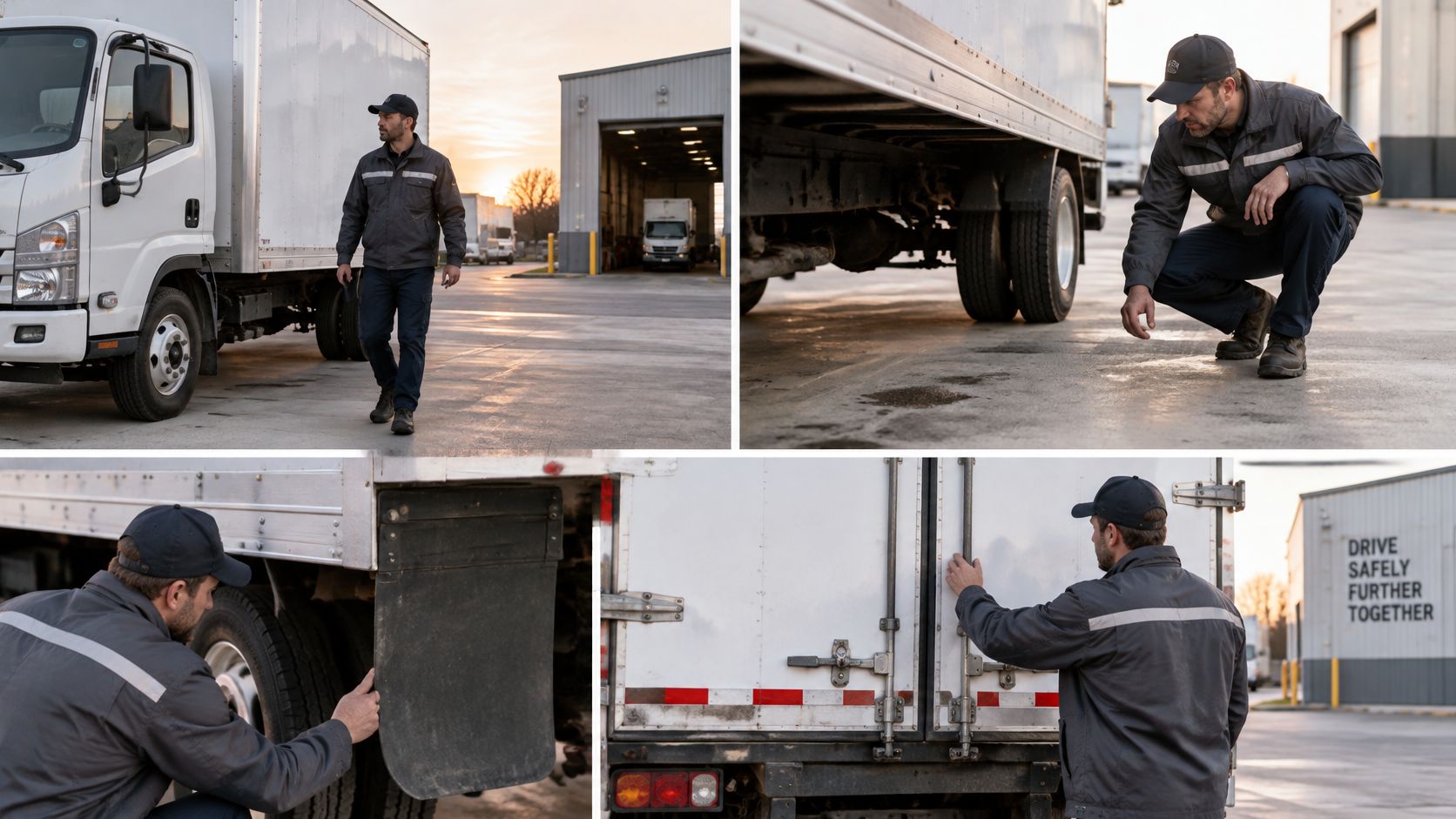
The driver starts outside the truck before engine start, following a consistent path around the vehicle.
Walkaround Steps in Order
- Ground and body check: Look for fluid under the chassis, fresh drips, damaged mud flaps or body panels, and any new gap or distortion near the frame. One drip deserves a location note, not a shrug, because leak source and rate decide urgency.
- Tires: Check visible damage, tread, sidewall cuts and valve caps, then measure pressure with a gauge. A tire just driven reads high, so record whether the reading is cold or warm.
- Wheels and rims: Look for loose or missing lug nuts, rust streaks from fastener movement, and rim damage. Rust trails often appear before a fastener backs off fully.
- Suspension and steering: Check for broken springs, cracked or missing bushings, loose linkage and bent components. Play at the tire or uneven ride height turns a visual note into a hold decision.
- Lights and visibility: Check lamps, reflectors, mirrors and the windshield. A cracked mirror or failed marker lamp matters more on early Florida routes in rain.
- Body doors and liftgate: Check latches, roller tracks, door seals and liftgate operation where equipped. Confirm each door locks and stays closed, not just that it moves.
- Refrigerated body: For refrigerated or climate-controlled units, check run status, set point and any alarm. Record the alarm code exactly as shown.
- Engine start: Watch air-pressure build-up, warning lamps and parking-brake function, and listen for air leaks. Slow build-up or rapid pressure loss shouldn't be carried into the first stop.
- Record defects: Write each defect on the driver vehicle inspection report with its location and whether it could affect safe operation. Vague notes such as "tire low" don't help a technician find the fault.
A more detailed breakdown is available in the pre-trip checklist of five checks that can help reduce downtime, which pairs well with a fleet-specific form.
What Good Looks Like at Shift End
The video below shows the walkaround rhythm drivers should repeat until sequence becomes habit.
A clean end-of-shift result has no new fluid on the ground, pressures recorded with a cold or warm note, doors latched, lamps working and no unexplained warning light. Comparing that baseline day to day exposes small changes early. The common failure is rushing the tire check because the truck "looks level." A gauge takes seconds and settles the argument.
What Body, Door and Refrigeration Work Can Be Done on Location?
Body defects strand deliveries even when the chassis runs well. A door that won't latch, a liftgate that stalls under load or a refrigeration alarm at the first stop can end the route as completely as an engine fault.
Feasible on Location When Access Is Safe
- Latch and roller adjustment: Often feasible where parts aren't bent and the door track is accessible.
- Seal, lamp and reflector replacement: Usually suited to work at the vehicle location.
- Leak location: A technician can trace fluid to a hose, fitting or component and decide whether repair can proceed there.
- Controller alarm reading: Run status, set point, defrost cycle, fuel level and alarm log can be reviewed on location.
Work That Often Needs an External Facility
Structural frame or floor repair, compressor or evaporator replacement, and repairs needing lifting equipment or a shop bay often belong at a suitable external facility. That facility is an external option, and feasibility stays case-specific. Structural and electrical repair scope is confirmed job by job after inspection.
Record each body or refrigeration defect with photos, exact location, alarm code or set point, and whether the door or unit can be used safely until repair. A photo of a torn seal means little without a note stating whether the door seals against rain. A refrigeration note means little without the set point and actual box temperature at the time of the alarm.
A body defect is a dispatch defect when cargo can't be secured, accessed or kept at temperature. Classify it that way, not as cosmetic damage.
Why Do Tire Wear Patterns Point to Different Causes?
A wear pattern is evidence. Replacing the tire without correcting the condition that shaped the tread usually buys a repeat failure on a new tire.
The NHTSA tire safety guidance recommends monthly tire-maintenance inspections that check inflation pressure, tread wear and damage, together with recurring rotation, balancing and alignment service. For commercial box trucks, the check should measure cold inflation pressure against the tire and vehicle specification, record tread depth by axle position, inspect sidewalls and valve hardware, and compare wear across steer, drive and lift axles.
Tire Wear Patterns, Likely Causes and Next Actions
| Observed wear or condition | Likely cause | Next action |
|---|---|---|
| Shoulder wear on one or both edges | Underinflation or an alignment problem | Check cold pressure first, then alignment |
| Center wear across the tread | Overinflation | Verify pressure against the tire and vehicle specification |
| Cupping or scalloped wear | Imbalance, suspension wear or a defective damper | Inspect suspension and damper before replacing the tire |
| Pressure loss that returns after inflation | Leak at the tire, valve, wheel or rim | Leak-test each component; don't rely on repeated inflation |
| Sidewall or tread damage | Impact, curb strike or penetration | Technician assesses repair or replacement; not a routine next-service item |
Hypothetical scenario: A box truck on a Lakeland route shows right-front shoulder wear after three weeks. Swapping the tire and releasing the truck wastes the clue. The first checks are cold pressure and then alignment, because either condition can chew the replacement the same way.
Trend records make that logic work. Log pressure loss and tread wear by vehicle, tire position, mileage and route. A tire losing pressure on the same corner after every inflation needs leak testing of the tire, valve, wheel and rim. Repeated inflation alone hides the fault while heat and rolling resistance build.
Guidance on removal thresholds is covered in the article on commercial truck tire replacement and when to remove a tire from service. High-mileage regional trucks, construction-zone routes and units with frequent curb impacts may justify pre-trip pressure checks and more frequent alignment or wheel-end inspections than the monthly minimum.
How Do Driver Reports Become Dispatch Decisions?
A driver report becomes useful when it enters a closed loop. Each defect gets classified by safety and drivability risk, assigned a repair decision, documented after corrective action, and verified before the truck dispatches again. That classification is the dispatch decision. An air-brake leak, loose wheel, steering fault, damaged tire or inoperative parking brake holds the truck until a technician clears it, while a squeaky step or cosmetic body damage can wait for a scheduled window.

Sorting Telematics Alerts
Connected trucks add alerts on top of driver notes. A 2025 U.S. Department of Transportation technology brief describes combining vehicle sensors with predictive algorithms and preventive-maintenance data, a shift from fixed intervals toward condition-based servicing.
The trap is treating every alert the same. A tire-pressure warning that fires on cold mornings and clears by midday calls for a logged pressure check, not a pulled wheel or a new sensor. Acting on the single event instead of the pattern turns telematics into noise.
Dispatch needs two alert buckets. Immediate diagnosis fits warnings tied to braking, steering, loss of power, derate risk or a no-start condition. Next service window fits stable, non-safety alerts where the truck operates normally and the code can be verified without risking the route.
Poorly interpreted fault codes lead to parts-swapping. A code names a system that saw an abnormal value, not always the failed part. Sensor, wiring, voltage supply and software causes must be tested before authorization.
Records That Close the Loop
- Driver complaint: The symptom in the driver's own words, with time and location.
- Photos and readings: Tire measurements, air-pressure readings, leak location and visible damage.
- Fault codes: Active and inactive codes captured before clearing.
- Repair verification: What was tested, repaired or replaced, and the result that justifies releasing the truck.
- Open defects: Anything deferred, with the reason, the holding condition and the next review point.
Never clear an intermittent fault silently. Clearing a code without a record erases the pattern a technician needs to find the cause on the next occurrence.
Intermittent faults deserve a date, mileage, operating condition and code history. "Light came on, then went off" becomes diagnosable when dispatch can show it happened three times under load after rain. That pattern points testing toward connectors, harness routing or voltage drop instead of random parts, and it gives dispatch a defensible reason the truck rolled or sat.
When Must a Truck Stop for Brake or Air Work?
A roadside brake adjustment doesn't close a brake defect. Verification and records close it.
The FMCSA brake requirements summary requires brake components, including actuators, slack adjusters, linings, pads, drums and rotors, to be installed and maintained so the vehicle can stop safely and reliably. Brakes must remain operable at all times and generally must act on all wheels, with limited exceptions for certain trailers, dollies and driveaway-towaway operations. For trucks towing air-braked vehicles, both manual and automatic means of activating trailer emergency brake features are required.
Stop and Assess Symptoms
- Air-pressure warning: Low pressure, slow build-up or rapid loss after shutdown.
- Uneven braking or pulling: The truck moves off line under brake application.
- Excessive pushrod travel: Adjustment alone may mask wear or a component fault.
- Failed trailer brake check: The trailer doesn't hold or respond as expected.
On-site inspection, leak checks and feasible component service may be possible at the vehicle location. Extensive brake, drum, structural or trailer work may require a suitable external facility instead. The air brake leakage test guide explains a structured way to document leakage before dispatch decides next steps.
Qualification matters as much as the wrench work. Under the FMCSA Part 396 brake inspector qualification rules, the carrier must ensure employees performing brake inspection, maintenance, service or repair meet minimum qualifications, which can include passage of the CDL air-brake test for applicable work. Carriers generally retain qualification evidence while the employee is employed and for one year afterward.
Close each brake job with components by position, measurements, adjustments, repairs, technician qualification evidence and open items. For brake questions, readers can use the English contact section at saatrepairscorp.com with the truck details and symptoms ready.
Which Electronic and Emissions Faults Can Be Fixed Roadside?
A diesel particulate filter handles soot through regeneration, raising filter temperature enough to combust accumulated particulate matter and convert it mainly into ash, carbon dioxide and water. Passive regeneration needs no added fuel or driver action when exhaust heat is sufficient. Active systems add heat or fuel.
Ash doesn't burn away. It accumulates and eventually requires physical removal, which is why a truck can complete regenerations and still develop a restriction problem over time.
The EPA DPF technical guidance states regeneration frequency is driven by particulate build-up and is generally about once per day or shift in the cited operating context. A regeneration event can take approximately two to eight hours depending on filter size, filter media and regeneration-system design. Those figures are not universal promises, because duty cycle, idle time, oil consumption and the specific aftertreatment system change the result.
Roadside Feasibility by Job Type
| Job | Roadside feasibility | When an external facility may be needed |
|---|---|---|
| Scan, sensor and derate diagnosis | Often feasible at the vehicle location if access is safe | When diagnosis points to bench testing or component removal |
| Regeneration fault and differential-pressure readings | Feasible when access and safety allow | When the filter must be removed or extended cleaning is needed |
| Ash-loaded DPF cleaning | Usually not a roadside job | Off-board cleaning of the removed filter |
| Software update or ECU programming | Case-specific; depends on equipment and access | When the job needs equipment or access not available at the vehicle location |
A mobile diagnostic visit can separate soot loading, ash loading, sensor failure and another emissions fault behind a derate. That distinction decides whether the next step is a sensor test, a regeneration attempt under proper conditions, or removed-filter cleaning at an external facility.
Software Faults Need Evidence Protection
Electronic symptoms don't always start with worn metal. The 2025 NHTSA safety recall report 25V436 described a vehicle-controller software problem where an incorrectly configured time counter could prevent engine control unit messages from reaching the chassis module at the intended frequency, with updated software as the remedy.
Before authorizing parts, record active and inactive codes before clearing, test battery voltage and network integrity, check recall and campaign status, and document software versions with post-update verification. Low voltage alone can create communication faults that look like module failure.
Not every software or calibration job can be completed roadside. Access, equipment, stable power and safety decide the location. A reset that erases codes without testing the cause can return the truck to service with the fault still present and the evidence gone.
What Should You Do With This Schedule Before the Next Route?
A schedule that cannot change a release decision is paperwork. Tie every line to the next dispatch: who cleared it, what evidence closed it, and where the repair has to happen.
- Assign one owner per interval row: Daily, monthly, yearly and manufacturer-set items each need a named person responsible for completion. Use fixed fields such as interval, owner, last done date or mileage, next due, evidence attached, and release status. Example: the monthly brake and air check stays “open” until the maintenance lead enters a completed inspection, not just a reminder in a notebook.
- Review open defects before release: Compare each open item against brake measurements, tire findings, driver reports, qualification evidence, fault-code history and software-version notes. Give the decision a pass or fail: “driver reports pull plus inside shoulder tire wear” stays failed until the cause and correction are recorded; “door open warning” stays failed until the switch or wiring result is entered.
- Mark each job roadside or external: Sort work by safe access, equipment needs, power requirements and whether a component must be removed. An accessible air leak or electrical fault may fit a mobile visit; a removed-filter cleaning or major transmission job may need an external option first. Dispatch then knows which truck can roll, which waits for a safe location, and which cannot be promised for roadside completion.
SAAT Repairs Corp works as an independent mobile Road Services team at the vehicle location in Tampa, Lakeland and nearby Florida corridors, with no customer-facing workshop or bay to book. Feasibility depends on access, equipment, technician availability and the repair itself; within the core Tampa-Lakeland area the stated arrival target is roughly 45-60 minutes, still subject to location and traffic. Outside the immediate area, coverage needs confirming before a route is built around it.
For Box Truck Maintenance decisions that can't wait for a routine service window, SAAT Repairs Corp offers mobile diagnostics, brake and air work, electrical testing, and emissions and software support at the vehicle location in Tampa, Lakeland and nearby Florida corridors. Send the truck's make, model, mileage, fault codes and open defect list through the English contact section so feasibility and coverage can be assessed before the next dispatch.