
A loaded tractor on a Tampa or Lakeland corridor does not always give a clean warning before it stops. Power fades, the engine surges, and the driver is suddenly managing traffic, a delivery window, and a truck that may not restart even after fuel arrives. Understanding what happens when you run out of diesel starts with separating an empty tank from trapped air, an emissions shutdown, and a deeper fuel-system fault.
Table of Contents
- What Happens When a Heavy Truck Runs Dry
- How Air in the Fuel System Stops a Restart
- Diesel Starvation Versus an Empty DEF Tank
- How to Restart Without Causing More Damage
- Protect the Stop and Record What Dispatch Needs
- When Mobile Road Service Can Finish the Job
- Keep the Next Run from Ending on the Shoulder
What Happens When a Heavy Truck Runs Dry
A loaded tractor on a Tampa–Lakeland run can lose power in traffic, then stop on the shoulder with freight still on board. The driver has to protect the stop while dispatch determines whether the engine ran out of diesel, air entered the fuel system, or an emissions shutdown is preventing a restart.
Running out of diesel interrupts the continuous, air-free fuel supply a diesel injection system needs. Refilling the tank leaves air in the filter housing, suction lines, and pump inlet, so fuel pressure stays low until those parts are filled. A truck may crank and sound close to starting, yet fail to fire. Repeated cranking can drain the batteries and turn a roadside fuel shortage into a more difficult no-start condition.
Three Questions Before Anyone Adds Fluid
Answer these questions to choose whether roadside priming is safe, whether the engine needs a platform-specific procedure, or whether the truck should be moved to a safer work area.
- Where is the truck stopped? Shoulder width and grade determine whether roadside work is safe.
- How did the engine stop? A power loss while driving points toward a different response than a shutdown followed by a failed restart.
- Which gauge is low? Low diesel, low DEF, or both point to different no-start paths.
Three Separate Outcomes Behind One Symptom
With true diesel starvation, the engine consumes its fuel supply and air enters the circuit. An empty DEF tank can trigger an emissions-related derate or restart restriction while diesel remains in the tank. A clogged filter, suction leak, pickup issue, pump fault, or electrical problem can also leave the engine unable to start, and priming alone will not fix those faults.
The correct roadside response depends on the engine platform. Trucks differ in tank layout, priming hardware, and the limits of their manufacturer-approved procedure. A hand primer, an electric pump cycle, or a scan-tool function may be required, and the driver should not assume that adding fuel and turning the key will clear trapped air. At the shoulder, some priming steps may be possible, while a deeper fault check or repair may need a service location.
For Tampa, Lakeland, and nearby Florida operators, the decision is practical: protect the stopped truck, identify which no-start path fits, and choose a response the specific engine permits. Record the symptom sequence and retain dash warnings for the next diagnostic step, rather than spending battery power on repeated starts.
How Air in the Fuel System Stops a Restart
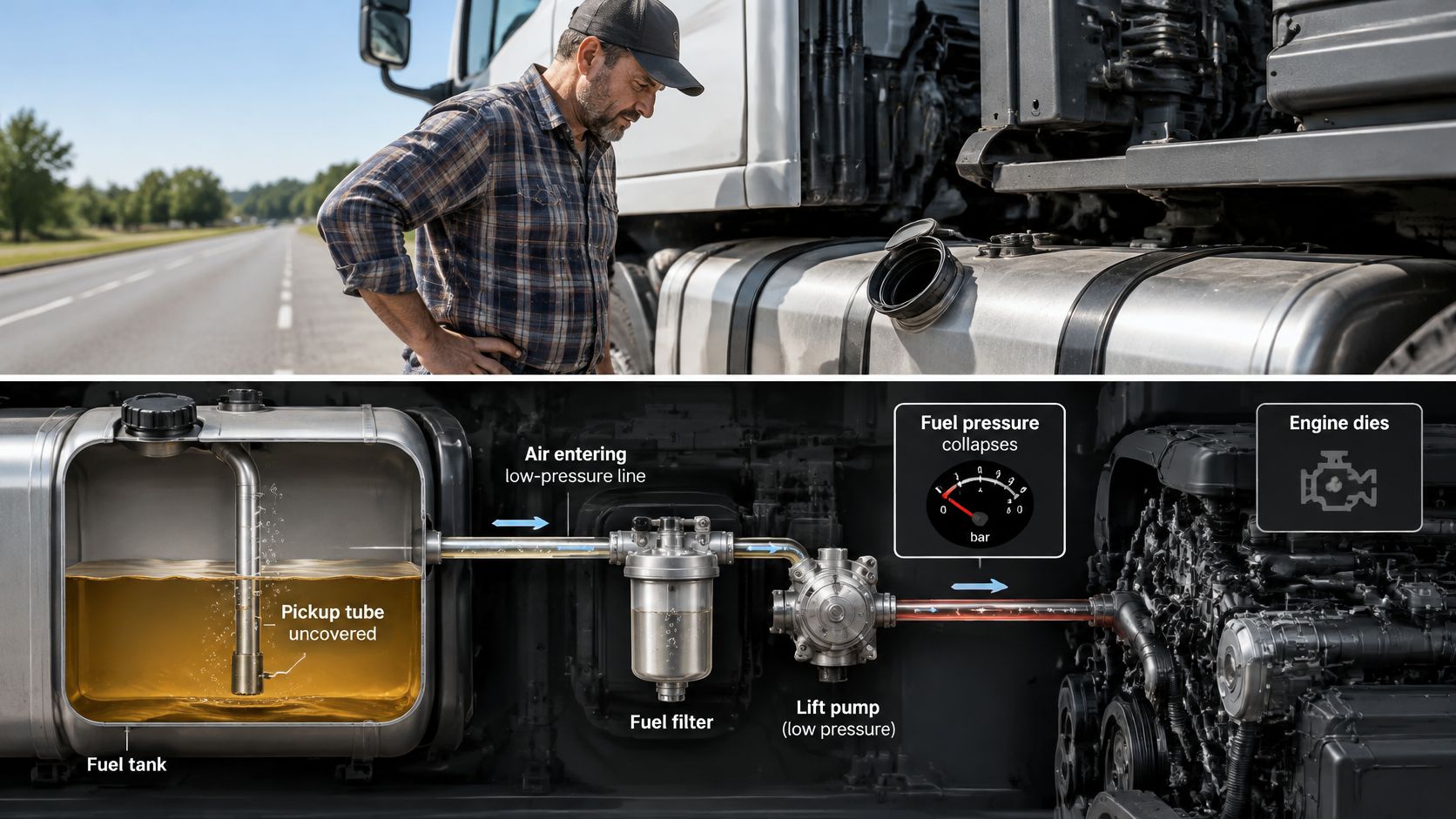
When a truck runs its tank dry, the pickup can draw air into the low-pressure supply circuit. Fuel pressure drops, and the engine shuts down without a steady supply. Manufacturer guidance for priming after air enters the fuel system describes refilling and de-aerating the supply side with a frame-mounted filter hand pump or an external priming pump.
Adding diesel does not refill every part of the circuit. Air may remain in the fuel filter, suction lines, and pump inlet, preventing a continuous fuel supply to the injectors during cranking. The result is a crank-no-start that can be mistaken for a battery or starter problem even when fuel delivery is the cause.
Why Priming Method Depends on the Engine
Priming equipment varies by engine. Some trucks have a hand primer at a frame-mounted filter; others use an electric lift-pump cycle controlled by the ignition or a manufacturer-defined priming function. Engine manufacturer guidance for priming after fuel exhaustion treats fuel exhaustion as a priming issue, so a no-start alone does not establish that the starter or batteries have failed.
At the roadside, use the procedure for that engine platform. A method that moves fuel on one truck may not prime another, and repeated guesses use battery capacity without confirming fuel delivery. The owner's manual or engine-specific instructions should set the limits for the attempt.
- Air in the filter: The housing may need to fill with liquid fuel before the pump can draw normally.
- Air in suction lines: A suction-side leak can draw air back into the circuit after priming.
- Air at the pump inlet: The supply pump cannot deliver steady fuel until liquid reaches its inlet.
What Turns a Prime Into Damage
Repeated cranking on an air-filled system wastes battery capacity before the pump can build pressure. Stop at the cranking limit in the engine manual. Loosening high-pressure injector lines is a separate hazard and is never a substitute for low-pressure bleeding.
A brief rough run or white smoke may occur as residual air clears after ignition. Continued rough running, another stall, or a primer that never builds supply suggests a fault beyond trapped air. Possible causes include a restricted filter, leaking seal, damaged pickup, closed valve, or suction-side leak. Those conditions may require diagnosis beyond a shoulder-side prime.
If low fuel pressure is suspected rather than an empty tank, guidance on checking PACCAR MX-13 fuel pressure before injector replacement reinforces the value of verifying supply before replacing injectors. A roadside technician can confirm what the accessible checks show, but unresolved pressure problems may need further testing at a repair facility.
Diesel Starvation Versus an Empty DEF Tank
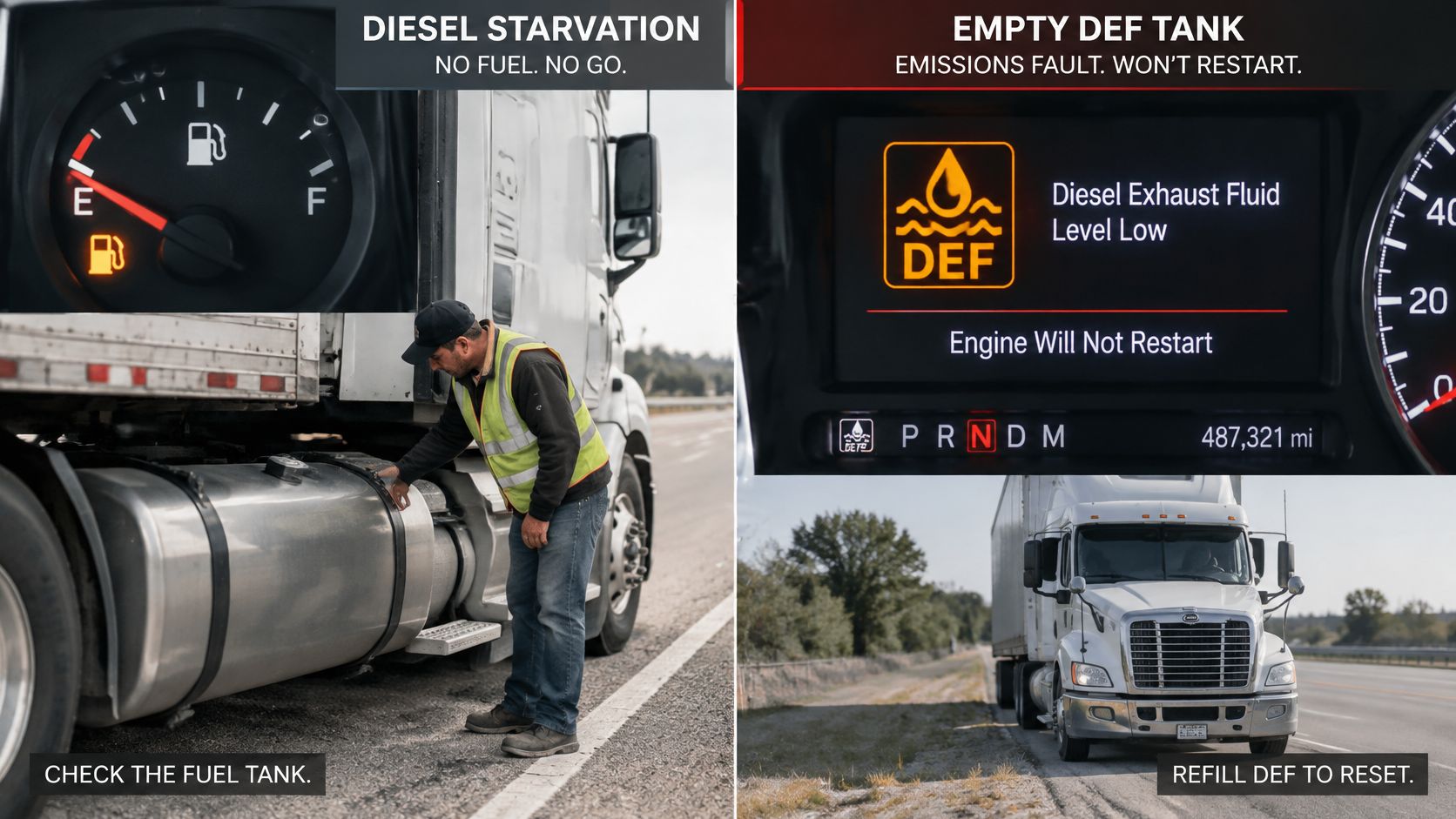
A truck that shuts down near a delivery entrance may still have diesel in the tank. An empty DEF tank creates a separate no-start path: SCR-equipped engines are designed to restrict normal operation when DEF runs out, and some trucks will not restart until it is replenished. The fuel system and emissions controls need different responses.
Adding diesel will not clear a DEF-related restriction. The truck may require diagnosis of the DEF system, correction of the fluid condition, or a manufacturer-specific reset. A roadside technician should confirm the truck's platform and fault messages before deciding whether the stop can be resolved roadside.
A Dash-Level Split for Dispatchers
The instrument cluster can help distinguish low diesel from a DEF-related shutdown. Take a clear photo before cycling the key or attempting a restart, since messages may disappear.
- Confirm the fluid: Record diesel and DEF readings separately. A gauge that looks empty does not identify which fluid is low.
- Photograph the dash: Save warning lamps, derate messages, countdown language, and visible fault information.
- Record the stop sequence: Note whether power faded while driving, a derate appeared first, or the truck shut down normally and then failed to restart.
- Preserve cranking behavior: Record whether the engine cranks strongly, cranks slowly, clicks, or does not crank.
A Hypothetical Example
A driver reports a shutdown at a delivery entrance and says the tank is empty. The dash photo shows diesel remaining, along with a DEF warning and active derate. Dispatch can avoid sending fuel as the first response and arrange emissions diagnosis instead.
In another case, the tractor loses power gradually on a grade, the diesel gauge is low, and there is no DEF warning. That evidence points dispatch toward safe placement and a fuel delivery, while the engine-specific priming procedure determines what can be completed at the stop.
A crank-no-start can begin with an empty diesel tank, air in the fuel system, or an emissions restriction. Dash messages and the stop sequence help identify which path to investigate.
A scan tool can help when fault codes or derate status do not match the apparent fluid levels. Without that evidence, a shoulder-side assessment may not establish the cause. Avoid repeated cranking while dispatch and the roadside technician decide whether the truck needs fuel-system service, DEF-system diagnosis, or further repair.
How to Restart Without Causing More Damage
A truck that runs dry may crank without starting because air has entered the fuel system. An empty DEF tank creates a different no-start path, so confirm that diesel starvation is the likely cause before adding fuel or attempting a prime. The truck also needs enough clean diesel to cover the pickup, a safe place to work, and the correct procedure for its engine and platform. On a slope, fuel may pool away from the pickup.
Published pickup manuals show why a single fleet-wide restart instruction can cause trouble. Fuel quantity, key cycles, crank limits, rest periods, and idle requirements vary. Heavy-duty engine procedures can differ as well, so dispatch should identify the truck and engine before giving the driver a priming sequence.
Published Priming Examples After Diesel Runs Out
| Source example | Fuel to add | Priming action | Crank or safety limit |
|---|---|---|---|
| Light-duty pickup example A | Approximately 4 to 5 gallons (15 to 19 liters), with more possibly needed on a steep grade | Switch the ignition on for 30 seconds, then off again, for six cycles before trying to start | Do not crank the starter for more than 10 seconds at a time |
| Heavy-duty pickup example B | Approximately 2 to 5 gallons (8 to 19 liters) after a run-dry event | Repeat three cycles with ignition in RUN for about 30 seconds and off for at least 30 seconds | Limit starter engagement to 15 seconds, pause two minutes between attempts, then idle for at least 30 seconds after starting |
| Published GM-platform example | At least 1 gallon on level ground and up to 5 gallons on a slope | Follow that platform's procedure for purging air instead of copying another vehicle's key cycle | Stop repeated attempts if the prescribed prime does not restore starting |
| Engine operating manual example, guidance on bleeding trapped air from low-pressure fittings | Add sufficient fuel for the application before priming | Activate the priming function for 30 seconds | Treat continued no-start behavior as a diagnosis issue rather than extending cranking |
Each row reflects one published manual, so the manual for the specific truck must govern the procedure. A dispatcher should confirm the vehicle, engine, and applicable manual before asking a driver to prime at the shoulder. The examples help identify differences, but they do not provide one procedure for every heavy truck.
Actions That Make the Job Worse
Stop cranking at the limit in the engine manual, since the starter and battery damage described in the air-in-fuel section applies here too. Starting aids such as ether are warned against because they can cause engine damage or fire. Opening the high-pressure fuel system while the engine is running can expose someone to fuel spray that causes serious injury or death, as stated in the heavy-duty pickup manual above.
- Keep fuel clean: Contaminated roadside fuel can turn a prime into a filter or injector problem.
- Control spills: Fuel handling beside traffic requires containment, lighting, and a position that keeps the driver clear of live lanes.
- Watch the first run: Brief roughness may clear as air exits. Persistent roughness or another stall calls for inspection.
If the prescribed prime fails, stop and diagnose rather than extending the procedure. Trapped air, a restricted filter, an electrical fault, a suction leak, or high-pressure fuel-system damage can produce the same symptom. Bleeding trapped air from low-pressure fittings may require professional diesel service, particularly when the procedure calls for work beyond what can be completed safely at the roadside.
Protect the Stop and Record What Dispatch Needs
A truck stopped in a lane or on a shoulder is first a roadside hazard, not a repair job. Traffic, visibility, and the driver's position determine whether anyone can safely approach the fuel system. Do not open the fuel system until the truck is out of the lane, the flashers are on, and the warning devices are placed.
Federal Motor Carrier Safety Regulations require drivers of stopped commercial vehicles to activate hazard flashers immediately. Under federal warning-device requirements in 49 CFR 392.22, warning devices must be placed as soon as possible and within 10 minutes. Keep the flashers on until the required devices are in place.
Protect People Before Touching the Fuel System
If the truck can be moved safely, get it to a safer position first. Secure it, activate the flashers, place warning devices, and keep the driver clear of live traffic. Give dispatch the exact location, direction of travel, nearest landmark or exit, lane or shoulder position, and traffic conditions.
- Secure the vehicle: Apply the parking brakes and prevent the truck from rolling on a grade.
- Make the stop visible: Place warning devices before opening tanks, hoods, or filter housings.
- Report access conditions: Tell dispatch whether a technician can work on the side of the truck away from traffic.
Build a Call Script That Changes the Decision
Dispatch needs a useful report, not just “out of fuel.” Record the details while the driver can still describe the sequence clearly.
- Vehicle position: Note whether the truck is on level ground or a grade, and which side faces traffic.
- Recent work: Report filter replacement, fuel-system service, battery work, or electrical repairs.
- Dash evidence: Send a photo of warning messages and gauges. Include any reduced-power or surging symptoms before the shutdown.
- Fuel added: State the amount and source of any diesel added, and whether it was clean.
Manufacturer bleeding guidance links fuel starvation with reduced power or surging. That symptom history can help distinguish a fuel-delivery problem from an abrupt electrical shutdown. It also helps the technician judge whether on-site priming is reasonable or whether a restriction or suction leak may prevent a restart.
Record what the driver observed, not a diagnosis. A location, dash photo, recent repair history, and clear account of symptoms and fuel added give dispatch grounds to choose the next step without asking the driver to keep experimenting.
When Mobile Road Service Can Finish the Job
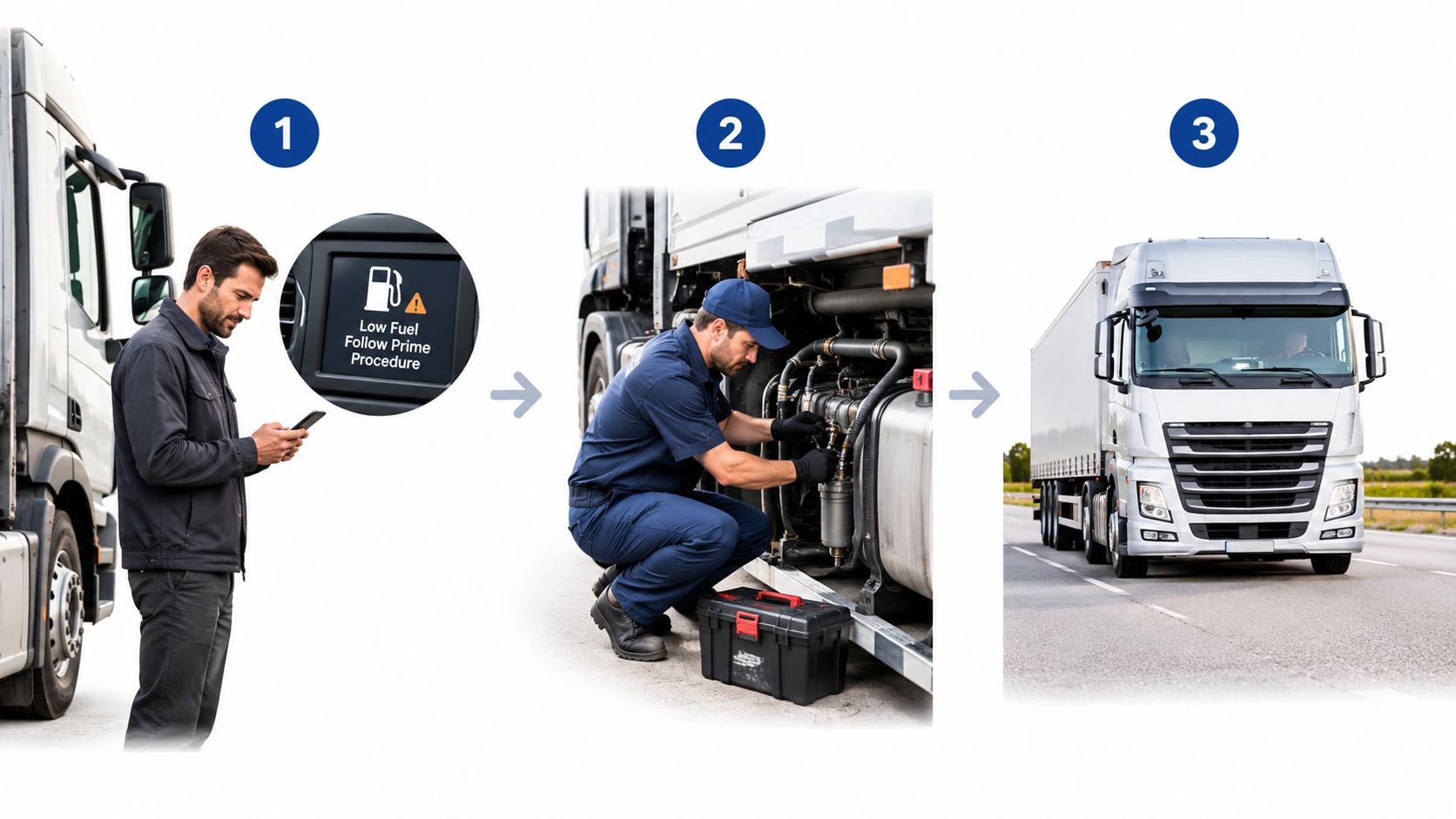
Three paths can follow a documented run-dry event. A driver may complete the truck's own prime after a confirmed diesel shortage. A mobile technician may assess and perform on-site priming and diagnosis at the vehicle location. A truck with unsafe access or a deeper fault may need work at a suitable external facility.
The first path fits the narrowest set of conditions. The dash evidence supports diesel starvation, the truck sits in a safe position, clean fuel is available, and the exact manufacturer procedure is in hand. If that controlled attempt fails, continuing to crank rarely improves the odds.
What Mobile Diagnosis Adds
A technician at the truck can check whether fuel is reaching the low-pressure side, inspect for suction leaks or filter problems, and read fault data that a dash photo can't provide. Electrical causes, starter and battery condition, fuel pressure, and emissions messages can be assessed as one connected no-start rather than separate guesses. That matters when what happens when you run out of diesel overlaps with a DEF inducement or an unrelated fault.
SAAT Repairs Corp operates as mobile Road Services for heavy-duty trucks at the vehicle location across Tampa, Lakeland, and nearby Florida. The company doesn't operate a customer-facing workshop, so the service decision starts with safe access at the truck rather than a drop-off or shop bay. Arrival and completion depend on location, traffic, technician availability, equipment needs, and the job itself.
Where Roadside Work Reaches Its Limit
Some jobs shouldn't be forced at the shoulder. Unsafe traffic exposure, lack of a protected work side, high-pressure fuel-system damage, complex emissions faults, or repairs needing equipment that can't be used safely at the location can move the job to an external facility. That facility is an external option, not a SAAT workshop, and the transfer method has to be arranged according to the truck's condition and location.
- On-site completion is plausible: Safe access, confirmed starvation, available priming method, and no evidence of deeper damage.
- On-site diagnosis is the value: Mixed dash messages, failed prime, suspected suction leak, weak cranking, or active fault codes.
- External facility may be necessary: Unsafe position, major fuel-system repair, extensive emissions work, or equipment needs beyond a mobile setup.
General insurance or warranty benefits should stay separate from what a mobile provider itself offers. Coverage terms come from the policy or warranty administrator, not from the technician at the truck. The service question remains feasibility and safety.
Fleets weighing response models can compare that decision with how commercial roadside service is structured for heavy trucks. The right outcome may be a successful prime, a confirmed diagnosis, or a clear finding that the truck needs a different work location.
Keep the Next Run from Ending on the Shoulder
A truck that runs out of diesel, draws air into the fuel system, or shuts down with an empty DEF tank has a different no-start path in each case. The next dispatch can reduce the chance of another stop by checking diesel level and DEF level before departure and at planned stops. Drivers should report each level separately so dispatch can respond to the actual warning rather than assume one fluid explains every shutdown.
Leave fuel margin for traffic, grades, and distance to the next stop. A nearly empty tank can let the pickup uncover before the gauge reaches empty, and another start attempt may worsen the situation if air has entered the system. Platform-specific priming limits matter: drivers should follow the procedure for that engine and stop if it cannot be completed safely at the shoulder.
Habits That Make a Future No-Start Easier to Read
- Keep the cab reference ready: Keep a current copy of each unit's manual in the cab, with the priming page marked, so the driver can find the applicable procedure without searching on the shoulder.
- Index fleet procedures: Store the priming page for each engine family in the fleet file, indexed by unit number.
- Track filter service: Record filter changes and fuel-system work so a restriction or sealing problem can be checked against the no-start.
- Document electrical repairs: Battery, starter, alternator, and harness history helps distinguish weak cranking from fuel starvation.
- Review low-fluid warnings: Dispatch should treat repeated low diesel or DEF reports as a planning failure and fix the route or fuel-stop schedule.
Current service records give a technician a useful baseline. Recent pickup, filter, seal, pump, or sensor work can be compared with the symptoms before anyone repeats a prime or replaces parts. A truck that cranks without starting may need more than fuel added, and shoulder conditions can limit what the technician can safely complete.
Dispatch rule: Record the last fuel stop, last filter change, and last warning message with each no-start report.
Fleet managers can connect those records to a practical view of truck fleet maintenance costs. Early reporting can help avoid a second failed start and provide a clearer basis for deciding whether the truck can be serviced where it stopped.
For a truck stopped in Tampa, Lakeland, or nearby Florida, send the dash information, separate diesel and DEF levels, exact location, and sequence of events when contacting SAAT Repairs Corp about mobile Road Services. The technician can assess the failure path and whether the work is feasible at the location. Major repairs may require another work site, but a sound assessment can help avoid the wrong fluid, an unsuitable prime, or an unnecessary repair.
When a heavy truck is stopped with trapped air, a suspected DEF shutdown, or a crank-no-start after refueling, SAAT Repairs Corp provides mobile diagnostics and Road Services at the vehicle location across Tampa, Lakeland, and nearby Florida, subject to safe access and job feasibility. Send the dash photo, fluid levels, exact location, and stop sequence so the response can match the actual failure path. Start that request through SAAT Repairs Corp.