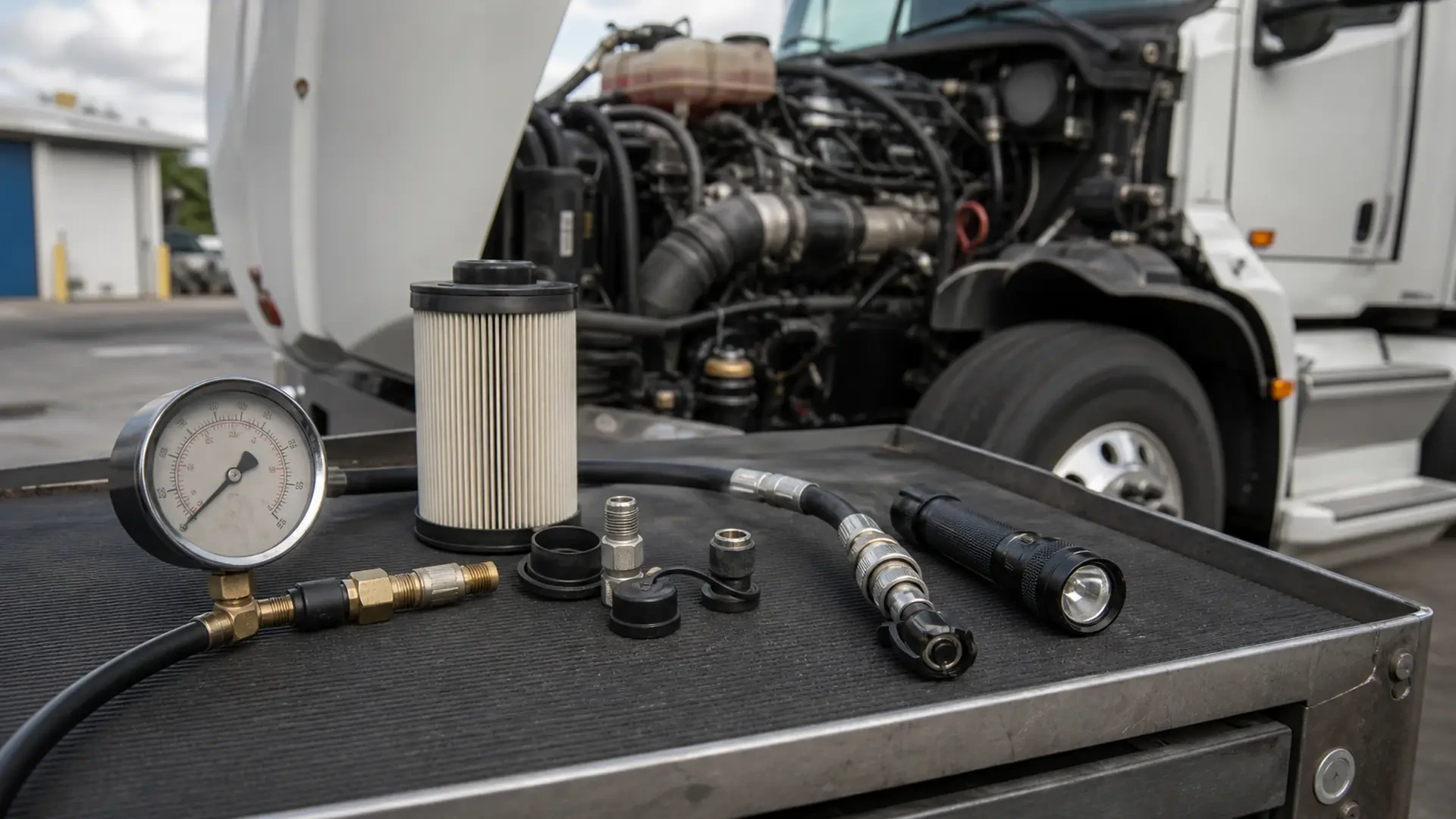
A Paccar MX-13 that is hard to start, loses power under load, runs unevenly, or shows an injector-related fault can quickly lead to one conclusion: replace the injector.
That conclusion may be correct in some cases, but the symptoms alone do not prove it. An injector depends on the rest of the fuel system, electrical control, operating conditions, and the engine's ability to receive the correct amount of air. If fuel delivery or pressure is unstable, the truck may behave as if an injector has failed even when the root cause is elsewhere.
The practical goal is not to guess the part. It is to document what the truck is doing, check the related systems, and use the evidence to decide the next step.
SAAT Repairs Corp provides mobile truck repair and diagnostics for commercial trucks in Tampa, Lakeland, and nearby Florida areas. Service is performed at the truck's location when access and conditions allow.
Why fuel pressure matters before injector replacement
A diesel engine needs fuel to arrive under the conditions required for stable combustion. The injectors are part of that process, but they do not create the entire fuel supply by themselves.
If the supply side is restricted, air enters the system, a filter is affected, pressure does not behave as expected, or an electrical control problem interrupts operation, the engine can show symptoms that overlap with injector failure.
That is why a responsible diagnostic path looks beyond the suspected injector. Replacing a component without checking the conditions that support it can add cost and downtime without correcting the original problem.
Symptoms that may appear when fuel delivery is unstable
The following symptoms justify inspection. None of them confirms a specific failed part by itself.
Hard starting or extended cranking
The engine may take longer to start when it is cold, after it has been parked, or after a short hot shutdown. The exact pattern matters.
Hard starting can involve fuel delivery or pressure, but it can also be influenced by battery condition, cranking speed, sensor information, electrical connections, or another engine condition. Record whether the symptom changes with temperature, parking time, or fuel level.
Power loss under load
A truck may feel normal at idle but lose power while accelerating, climbing, or pulling a load. That difference helps the technician understand when the system is being challenged.
Fuel supply and pressure are part of the diagnostic picture. Airflow, turbo performance, DPF/EGR conditions, electrical control, and mechanical health may also affect power under load.
Rough operation or hesitation
Uneven operation, hesitation, vibration, or a change in engine sound can point toward inconsistent combustion. The cause may involve an injector, but it can also involve fuel pressure, wiring, connectors, air delivery, or a cylinder-related condition.
Note whether the symptom is constant or intermittent and whether it becomes more noticeable at idle, during acceleration, or after the engine reaches operating temperature.
Warning lights, fault messages, or derate
Fault information helps define what must be investigated, but a code does not always identify the part that should be replaced.
A fault may describe pressure outside an expected range, a circuit condition, a contribution issue, or another operating problem. The useful question is: what evidence confirms the cause behind the message?
Why these symptoms do not confirm a failed injector
Several systems can produce similar complaints:
Fuel filters or supply restrictions.
Air entering the fuel system.
Fuel quality or contamination concerns.
Pressure that changes under specific operating conditions.
Wiring, connector, voltage, or ground problems.
Sensor information that does not match actual conditions.
Air intake, boost, turbo, DPF, or EGR problems.
Mechanical conditions affecting combustion.
A recent repair that changed a connector, line, component, or configuration.
The list is not a diagnosis. It explains why a symptom-based replacement can be risky. The correct checks depend on the truck, fault information, service history, and approved technical procedures.
What information helps narrow the problem
Good information can reduce guesswork before a technician reaches the truck.
When the symptom appears
Record whether the problem occurs:
During cold start.
After a hot shutdown.
At idle.
During acceleration.
Under load or on a grade.
During or after a regeneration.
After the truck has operated for a certain amount of time.
An intermittent problem is easier to investigate when the operating pattern is clear.
Fuel and filter history
Prepare the date or mileage of the last fuel-filter service when available. Report whether the symptom began after fueling, after a filter change, or after the truck ran very low on fuel.
Do not open pressurized fuel components or loosen lines on the roadside. These systems require proper procedures, training, and equipment.
Recent repairs
Tell the technician about recent work involving:
Injectors or the fuel system.
Filters or fuel lines.
Batteries, charging, or starting systems.
Sensors, wiring, or connectors.
Turbo, intake, DPF, or EGR components.
Engine disassembly or related repairs.
A clear repair history can reveal whether the complaint started before or after a change.
Dashboard messages and fault codes
Write down the complete message rather than a shortened description. If a code is visible, record it exactly and note whether it is active, intermittent, or accompanied by other warnings when that information is available.
Photos of the dashboard can help if they can be taken safely while the truck is stopped.
What a diagnostic path may consider
The exact procedure must follow the engine information, tools, and safety requirements appropriate to the truck. A diagnostic path may consider several areas.
Fuel supply and restrictions
The technician may review service history and inspect for conditions that could restrict supply or introduce air. Fuel quality, filters, lines, visible leaks, and the circumstances surrounding the complaint may all provide context.
Pressure behavior and operating data
Pressure information is more useful when it is evaluated under the conditions that produce the symptom. A value observed at idle may not explain a complaint that appears only under load.
The objective is to compare the commanded and observed behavior using the correct diagnostic process, not to judge one isolated reading without context.
Electrical and control conditions
Voltage, grounds, connectors, harness condition, and control signals can affect injector operation or create intermittent symptoms. Heat, vibration, moisture, or recent work may change how a connection behaves.
Air, turbo, and emissions systems
Fuel and air must work together. A restriction, leak, boost problem, DPF/EGR condition, or sensor issue can affect power, smoke, and response. Checking only the fuel side can leave the investigation incomplete.
What drivers should do before requesting mobile service
Prepare the following information:
Exact truck location and safe access details.
Truck, engine, and unit number when available.
Main symptom in plain language.
When the symptom started and when it becomes worse.
Dashboard messages, warning lights, and fault codes.
Whether the engine starts and whether the truck can move safely.
Fueling, filter, and recent repair history.
Photos or videos that can be collected without approaching hot, pressurized, or moving components.
This information does not replace inspection. It helps the technician arrive with a clearer picture of the complaint.
When to stop in a safe location
Stop in a safe location and request assistance if the truck has severe power loss, an active fuel leak, heavy or unusual smoke, abnormal mechanical noise, overheating, low oil pressure, or a derate that makes continued operation unsafe.
Do not continue driving only to reproduce a symptom if doing so could create a safety risk or additional damage.
Contact SAAT Repairs Corp
If a commercial truck with a Paccar MX-13 has hard starting, power loss, rough operation, warning messages, or a suspected fuel-pressure problem, contact SAAT Repairs Corp for mobile diagnostics and truck repair in Tampa, Lakeland, and nearby areas.
Have the location, unit information, symptoms, codes, fuel-service history, and recent repairs ready when you call.
If your Paccar MX-13 is losing power, is hard to start, or shows fuel-system warnings, contact SAAT Repairs Corp. Prepare the truck's location, fault information, operating pattern, and recent service history so the next step can be evaluated clearly.