A loaded trailer stops at a Tampa-area dock, a warning lamp stays on, and the next delivery is waiting. The dispatcher needs to know whether the fault can be assessed where the unit sits, whether the location is safe for a technician, and what information to send before anyone assumes the trailer can be driven elsewhere.
Trailer repair in Tampa is an on-location triage decision, not a shop drop-off. SAAT Repairs Corp provides mobile Road Services at the vehicle location and has no customer-facing workshop. The first useful step is to record the driver's complaint and the trailer's position, then assess whether safe access and the repair scope support mobile work.
Table of Contents
- When a Tampa Trailer Stops a Delivery
- What Mobile Trailer Repair Can and Cannot Do
- Symptoms to Check Before You Call
- How to Request On-Site Trailer Service
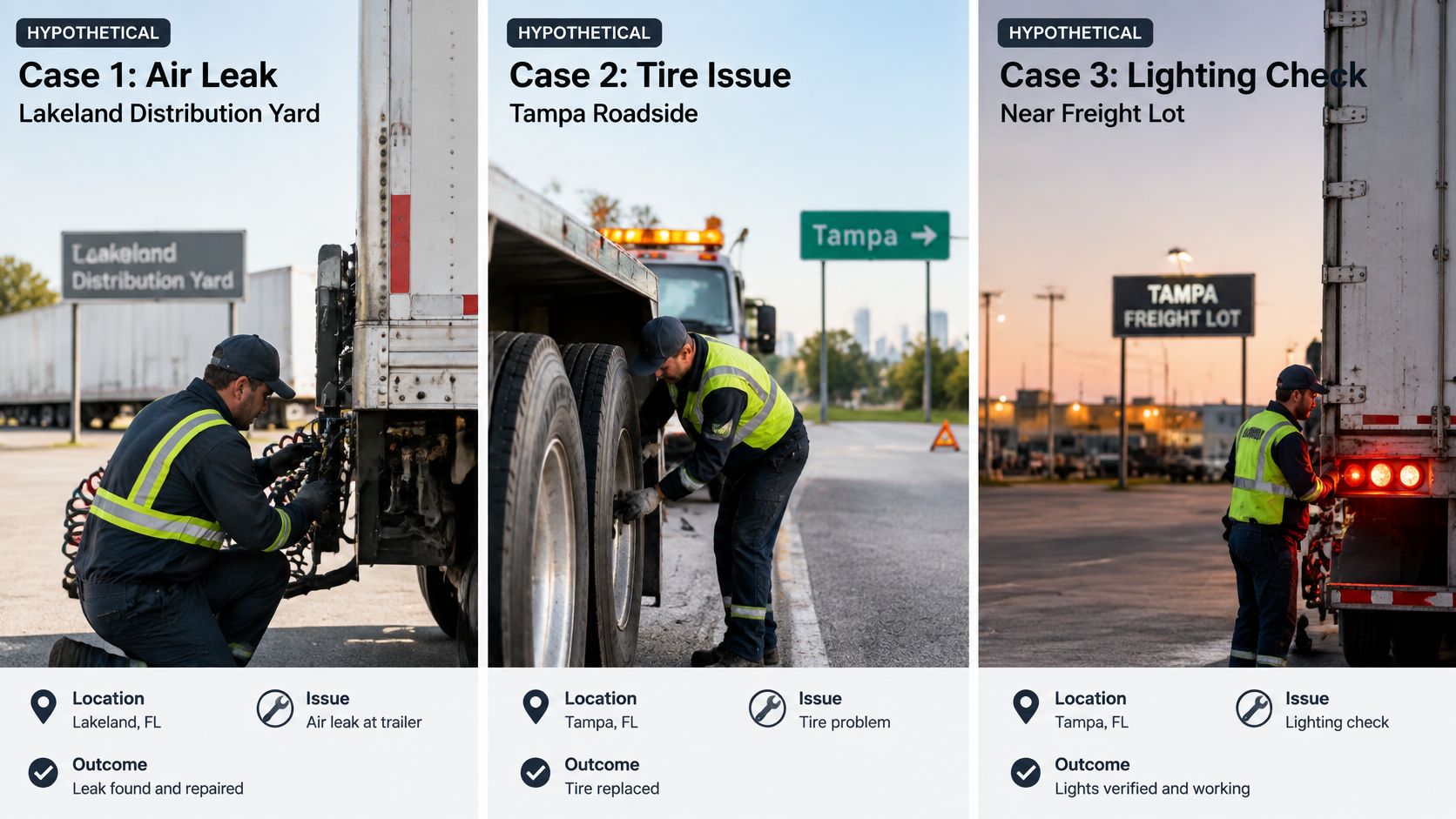
- Hypothetical Roadside Cases Around Tampa
- Work Zone Limits and Repair Records
- Choosing the Next Step for Your Trailer
When a Tampa Trailer Stops a Delivery
"The brakes feel soft." "A dash lamp won't clear." "The trailer is leaning on the driver side." Those are the calls a Tampa dispatcher hears when a dry van, reefer, or flatbed stops moving at a dock, in a yard, or on a shoulder toward Lakeland. A specific complaint gives dispatch a starting point. A report that the trailer is just "broken" does not, because it skips the information needed to judge whether the fault can be assessed where the unit sits.
The first record should capture the complaint in the driver's own words, when it appeared, where the tractor and trailer are positioned, and whether the unit is coupled and loaded. Photographs help only if the driver can take them from a safe position. A photo of a hose, warning lamp, or damaged component can sharpen the initial report, but it never substitutes for an on-site assessment.
Record the complaint before choosing a destination
Because SAAT Repairs Corp works at the vehicle's location rather than a customer-facing workshop, the access question comes before the repair question. A technician can only evaluate a brake, electrical, suspension, or structural complaint if the spot where the trailer sits allows safe access. Federal guidance requires commercial motor carriers to inspect, repair, and maintain the commercial vehicles under their control. The required scope includes trailer-brake connections, parking brakes, suspension, axles and attaching parts, wheels and rims, and frame assemblies; drivers must inspect before operating and be satisfied that the vehicle is safe to run. FMCSA's carrier maintenance guidance makes clear why a known defect should be documented and assessed before dispatch decides to move the unit.
That duty matters in a freight region where trailers move between Tampa, Lakeland, and connecting corridors. Florida's statewide FY2020 commercial-vehicle safety plan projected 98,532 inspections across the three principal inspection levels, according to Florida's commercial-vehicle inspection plan. Those figures are statewide projections rather than a Tampa-specific incident rate, but they reinforce the practical value of documented attention to inspection-sensitive systems such as brakes, lighting, coupling equipment, and suspension.
Dispatch note: Preserve what the driver observed. Keep diagnosis, repair scope, and permission to continue moving as separate decisions.
What Mobile Trailer Repair Can and Cannot Do
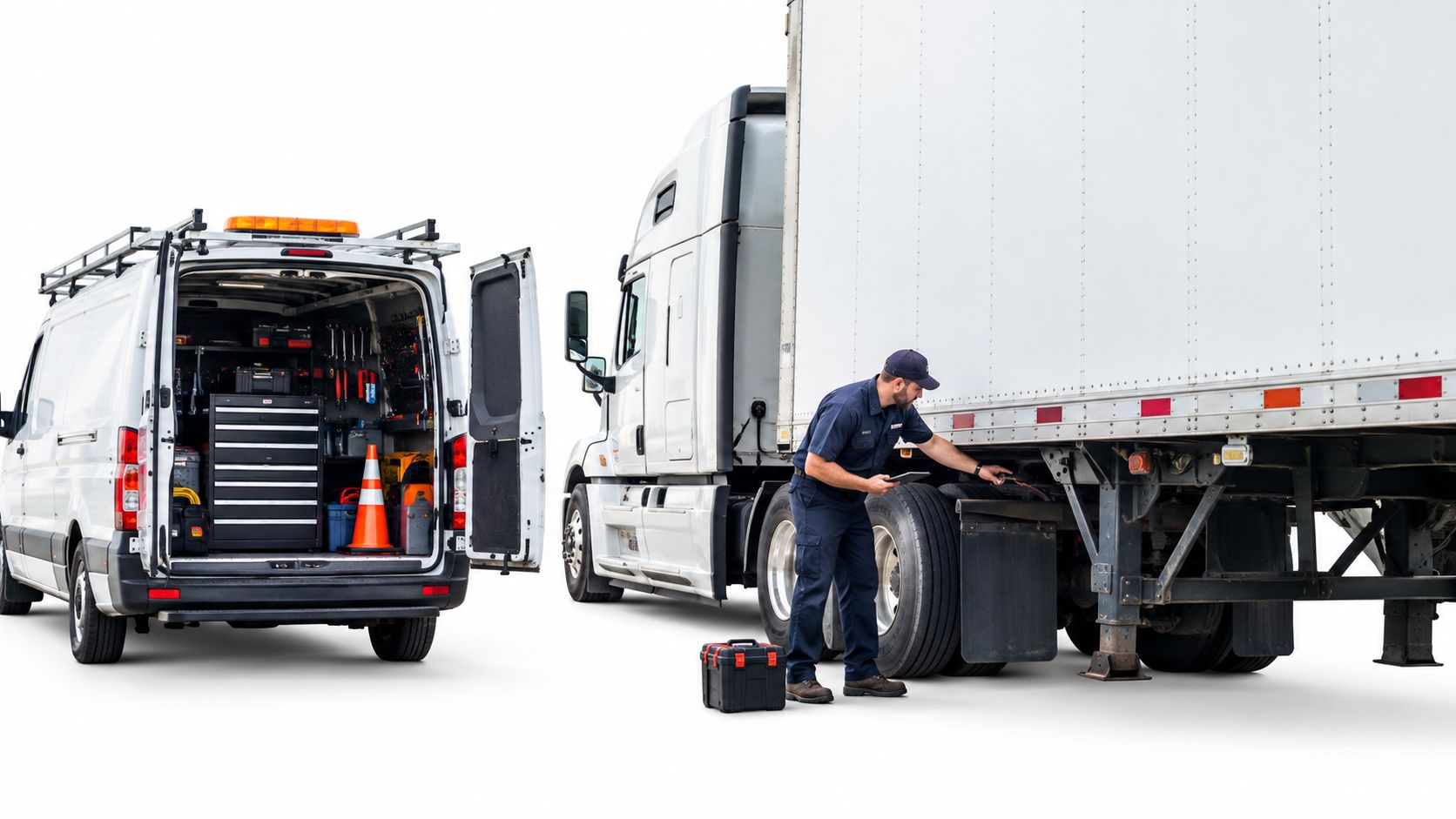
Mobile trailer repair means a technician comes to the vehicle. SAAT Repairs Corp operates exclusively as mobile Road Services and has no customer-facing workshop, so there's no SAAT bay to book and no vehicle to drop off. Whether a complaint can be worked on at the trailer's location depends on safe access, available equipment, and the actual job scope.
Start with the scene, not the parts list. Confirm whether the trailer is coupled or dropped, identify its type, and pin down the exact location: dock, yard, shoulder, or interchange. If a photo can be taken safely, send one that shows the defect and enough surrounding detail to understand access. A technician needs to know whether the unit is loaded, where it can be approached, and whether nearby traffic or yard activity limits the work area.
Decide on-site feasibility before the repair
Commercial trailer brake and air, electrical, suspension, and structural complaints can be assessed at the vehicle when the access conditions, equipment, and job requirements allow. That does not mean every axle, welding, or major structural job can be completed roadside. Work beside live traffic can be unsuitable even when the defect itself appears straightforward; a controlled work area may be needed instead.
The right escalation is a suitable external facility when the work cannot be done safely or appropriately where the trailer sits. That means an outside option, not a SAAT location, and it does not assume that SAAT provides towing. Dispatch should treat scene access and repair scope as open questions until a technician can assess them.
The regional context matters. The Florida Department of Transportation's Tampa Bay Regional Goods Movement Study covers an eight-county planning area and includes a strategic freight plan, network maps, investment strategies, and an interactive freight database for the region. The Tampa Bay freight study reflects how a breakdown can affect movement across neighboring counties, ports, warehouses, and routes toward Lakeland. The practical choice is therefore not just "repair or wait," but "is this location suitable for this repair?"
Symptoms to Check Before You Call
A brake complaint needs specific observations, not a guess at which part has failed. Federal inspection records identify recurring trailer defects such as audible leaks at brake chambers and connections, damaged or unsecured air hoses, ineffective automatic slack adjusters, and trailer ABS warning-lamp failures. An air leak can lower available system pressure and delay or weaken brake application; a slack adjuster that doesn't compensate for lining wear can increase pushrod travel and reduce braking effectiveness. Federal inspection records document these recurring defect types.
A controlled assessment can begin by securing the combination and noting reservoir pressure. A technician can listen and apply leak-detection solution at chambers, fittings, glad hands, and tubing, then check service- and emergency-brake response and observe pushrod and slack-adjuster movement. If the ABS lamp indicates a fault, the circuit can be tested; after repairs, pressure retention and a low-speed brake test in a controlled area help check the result. This is assessment logic, not a promise that the work can be performed at every roadside location.
Separate the symptom from the system
For an electrical complaint, record which lights or circuits fail, whether the fault changes when connections are moved, and what the ABS or other warning lamps do. For a door that won't latch, describe whether it is misaligned, damaged, or unable to secure, and note whether the surrounding structure appears affected. A suspension or structural concern should include the side and location of the visible damage, any sagging or contact with nearby components, and whether the trailer can remain in a stable, safely accessible position.
| System | What to document | Possible on-site path | When an external facility may be needed |
|---|---|---|---|
| Air brakes | Leak location, pressure behavior, warning-lamp status, and changes in braking response | Assess hoses, chambers, connections, slack-adjuster movement, and indicated ABS faults when safe access and scope permit | Access is unsafe, damage is extensive, or the required work needs a controlled repair area |
| Electrical and lighting | Which lights fail, connector condition, warning-lamp behavior, and whether the fault is intermittent | Trace the reported circuit and inspect accessible wiring or connections | Damage is extensive, access is restricted, or additional controlled work is required |
| Suspension | Side and component involved, visible sag, contact, and any change in trailer position | Inspect the reported area and assess whether the repair is suitable at the vehicle | The trailer is unstable, damage is substantial, or the work cannot be done safely at the location |
| Door and structure | Latch behavior, visible deformation, and affected area | Assess whether the problem is limited and safely accessible | Frame, axle, or major structural work exceeds safe mobile scope |
Tire or wheel issues may also arise during a driver's report, but those observations shouldn't be treated as confirmation that SAAT offers a particular tire service. For a suspension-specific discussion, see semi-trailer suspension repair. The table is a triage aid, not a diagnosis or a declaration that a trailer is safe to operate.
How to Request On-Site Trailer Service
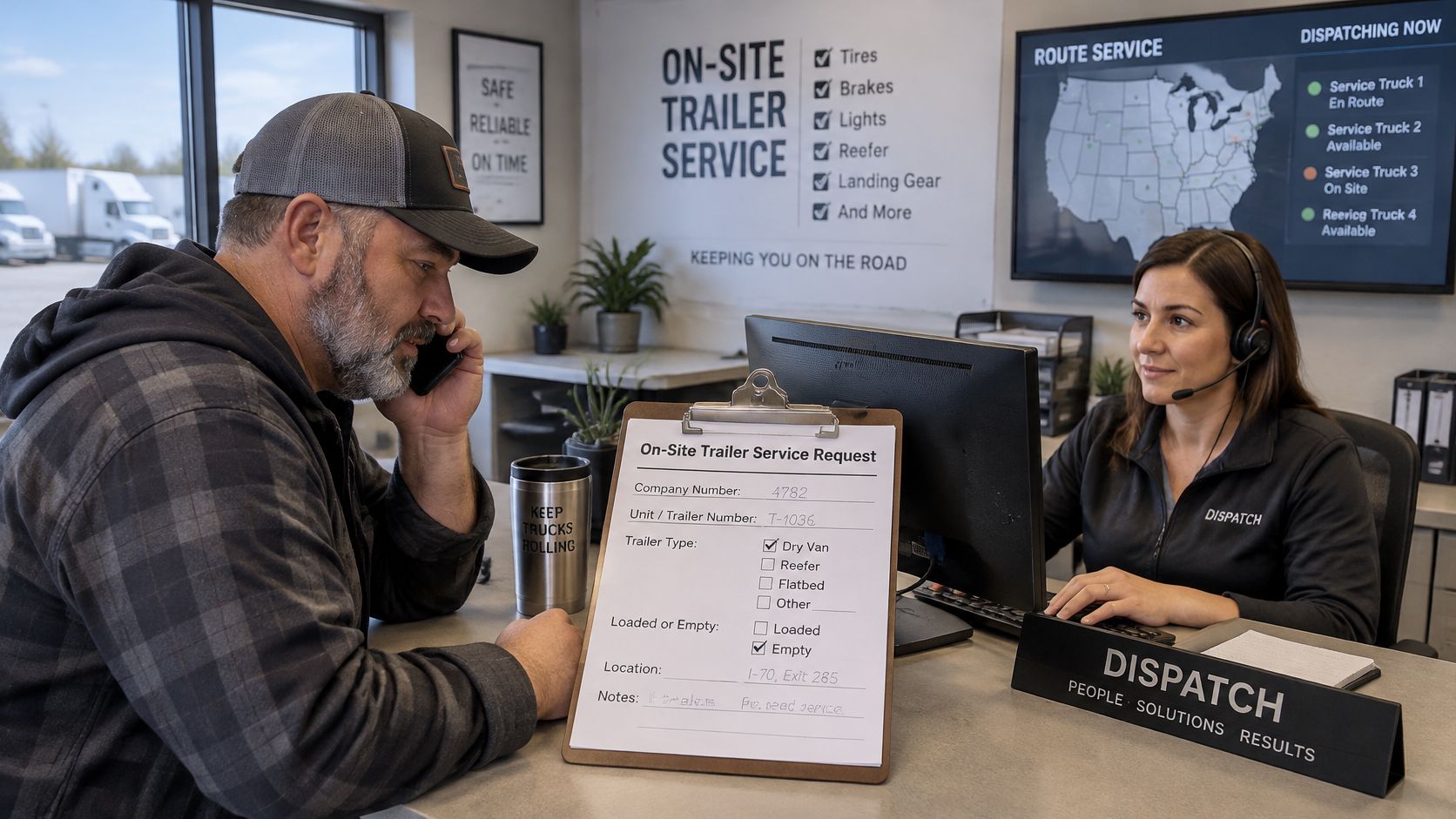
A clear request helps dispatch judge the location, access, and likely work before a technician is assigned. Start with the company and unit numbers, trailer type, whether it's loaded, and whether it's coupled or dropped. Then give the exact address or location pin, the safest approach, and the driver's complaint in the driver's own words.
Add photos if they can be taken safely. Include warning-lamp behavior, air-pressure observations, and whether a roadside inspection has already placed the vehicle out of service. A useful message separates what the driver observed from what remains unverified; “air escaping near the rear chamber” is more actionable than “brakes are bad.”
Compare the available choices
Continuing with a known defect isn't a neutral option. The carrier still needs to decide whether movement is lawful and safe, and a driver shouldn't treat a destination as a substitute for assessing an unresolved safety concern. A mobile assessment is a way to inspect the trailer where it sits, subject to safe access and job scope. Moving the unit should be considered only when that movement itself is lawful and safe.
SAAT uses a direct-to-technician Road Services model for Tampa, Lakeland, and nearby corridors, with dispatch coordination and assessment at the vehicle. Any arrival estimate remains conditional on location, traffic, technician availability, and the job; the stated target of roughly 45–60 minutes applies only within the core Tampa–Lakeland area and isn't a guaranteed window. Cash, major credit cards, and fleet checks are accepted, and the site is available in English and Spanish. For a practical handoff checklist, use what to send when requesting mobile truck repair near Tampa or Lakeland.
For a visual overview of the mobile service model, the following video can help crews understand what information to communicate before an assessment:
Before ending the call, confirm that dispatch has the unit, trailer type, load and coupling status, exact location, driver's complaint, available photos, warning or pressure observations, and inspection status. That gives the technician a usable handoff without promising that every repair will be completed roadside.
Hypothetical Roadside Cases Around Tampa
These hypothetical cases show why the same complaint can lead to different work decisions depending on the evidence and location. They aren't SAAT customer stories or reports of completed jobs. The point is to match the observed fault to a suitable work setting rather than assume that every trailer can be repaired wherever it stops.
A leak in a Lakeland distribution yard
A driver reports an air leak while the combination is parked on private property. Dispatch notes whether the trailer is coupled, records the pressure behavior, and sends a safe photo of the suspected area. With controlled access, a mobile technician can assess chambers, hoses, connections, and slack-adjuster movement, then determine whether the repair fits the equipment and conditions available on site. If the damage is beyond that scope, the next step is a suitable external facility.
A dark marker-light circuit at a Tampa dock
The trailer is coupled at a dock, and the driver reports a dark marker light. A precise report identifies which lamp is affected, whether other lights work, and whether the fault changes at the connector. That keeps the problem framed as an electrical complaint rather than a general trailer failure. Accessible wiring or connection work may be suitable for on-site assessment, while broader damage or restricted access could change the plan.
A door that won't latch after a warehouse pull-away
The driver reports that a door won't secure. Dispatch records what the latch does, whether the door appears displaced, and whether the surrounding trailer structure shows visible damage. If the issue is limited and safely accessible, a technician can assess it at the vehicle. If the door problem points to a larger structural concern, the trailer may need a controlled external repair setting before returning to the highway.
A suspension concern on an interstate shoulder
A driver reports a suspension or frame concern on a shoulder. Even if the damaged area can be identified, traffic exposure may make on-site work inappropriate. The technician's assessment must account for the vehicle's position and the available safe working space; when those conditions or the repair scope are unsuitable, the next step is an external facility. A roadside diagnosis doesn't, by itself, establish that the trailer can continue in service.
Work Zone Limits and Repair Records
A repairable defect isn't automatically a roadside job. As FMCSA's Florida work-zone safety material reports, Florida ranked eighth nationally for fatal crashes involving commercial motor vehicles in active work zones in 2019, more than 33 percent of fatal work-zone crashes involved commercial motor vehicles, and 47 percent of those commercial-vehicle crashes occurred on interstate highways.
That record supports a conservative read on where work can happen. Move the combination as far from live traffic as legally and safely possible, then judge warning procedures and visibility. Shoulder width, interchange geometry, lane position, weather, traffic speed, and the repair scope can each make a roadside job unsuitable. Because SAAT Repairs Corp runs no customer-facing workshop, every call is decided at the vehicle: if the scene can't support safe work, the trailer goes to an external facility rather than getting partial roadside attention. A technician may decline or limit work because of the site, even when the reported defect is clear.
Keep the inspection and repair trail together
If a roadside inspection places a vehicle out of service, the defect must be corrected before operation. The report must reach the carrier within 24 hours, the carrier must certify correction within 15 days, and the report must be retained for 12 months, as described in FMCSA's out-of-service record guidance.
A useful repair note records the original complaint, the systems or components assessed and addressed, how the work was checked, and what remains open. Keep it with the inspection paperwork so dispatch and maintenance staff can separate a reported symptom from completed work and any unresolved issue. For air-system complaints, what to document before mobile air-system diagnostics covers the handoff details. A repair note documents the work; it isn't a safety certification or permission to operate while a defect remains open.
Choosing the Next Step for Your Trailer
A sound next step starts with triage: the reported defect, the trailer's exact position, and whether a technician can reach it with enough room to work. I would not treat a clear complaint as clearance by itself. A loaded van on a narrow shoulder, a coupled unit near an interchange ramp, and a parked trailer on firm level ground can share the same symptom and still lead to different decisions.
If the location supports safe access and the job looks mobile in scope, contact SAAT Repairs Corp through its English contact section and request service at the vehicle. Give dispatch the address or marker, trailer type, load and coupling status, the symptom already documented, and any brake, air, electrical, suspension, or structural signs the driver observed. Timing still depends on technician availability, traffic, site control, and what the assessment verifies.
Some work belongs in a controlled facility. SAAT does not run a customer workshop, bay booking, or drop-off lane; a major structural repair, poor access, or an unsafe scene points to an external facility.
SAAT Repairs Corp provides mobile Road Services for commercial trailer brake and air, electrical, suspension, and structural complaints in Tampa, Lakeland, and nearby Florida corridors, subject to safe access and job scope. Contact SAAT Repairs Corp with the trailer's location, coupling status, type, and documented symptom to request an on-site assessment.