Commercial truck tire replacement: when to remove a tire from service
Specialized Truck Services
Commercial truck tire replacement: when to remove a tire from service
A commercial truck tire should not stay in service simply because it still holds some air or has visible tread. Damage, separation, exposed material, active leakage, loading, inflation, application, and wheel condition can matter as much as the tread measurement.
The first decision is safety: can the unit remain where it is, or must the driver stop and request assistance? The second is technical: does the tire require replacement, qualified repair evaluation, or correction of another condition that caused the wear?
SAAT Repairs Corp provides mobile truck repair and roadside support in Tampa, Lakeland, and nearby Florida areas. Work at the truck's location depends on safe access, traffic exposure, truck condition, required equipment, available parts, and the confirmed scope.
Tread depth is only one part of the decision
Federal requirements for commercial motor vehicles set a minimum tread depth of 4/32 inch on front tires of a bus, truck, or truck tractor and 2/32 inch on other tires, measured in a major tread groove as specified in 49 CFR 393.75.
Those numbers are legal minimums, not a complete maintenance strategy. A tire can require removal before reaching the minimum because of damage, air loss, separation, improper loading, or another unsafe condition. Fleets may also set earlier pull points based on operation, weather, retread plans, and tire-manufacturer guidance.
Do not measure at tread-wear indicators, tie bars, humps, or fillets when the regulation excludes those locations. If the condition is uncertain, a qualified tire professional should inspect it.
Conditions that can require immediate removal from service
Exposed material, separation, bulges, or severe cuts
Federal rules prohibit operation on a tire with exposed body ply or belt material, tread or sidewall separation, or a cut that exposes the ply or belt. A bulge, distortion, missing tread, or separation pattern can signal structural damage even when the tire is not flat.
Do not probe, strike, or continue loading a visibly damaged assembly. Keep people away from the trajectory area and wait for qualified service.
Flat tire or audible air leak
A flat tire or audible leak is also prohibited under 49 CFR 393.75. Continued operation can increase tire, wheel, and casing damage and can affect the paired tire in a dual assembly.
Record the pressure only when it can be checked safely and with appropriate equipment. Never attempt to repair, inflate, or handle a damaged commercial tire assembly without the training and restraints required for the task.
Tread below the applicable minimum
Check several major grooves and document the lowest valid measurement. The axle position matters because the front-tire minimum differs from other positions.
Tread readings should be stored with the unit, axle, position, date, mileage, and inspector. A single fleet note such as “tires OK” does not show where or how the tire was evaluated.
Why irregular wear should trigger a cause review
Replacing a worn tire without documenting the wear pattern can allow the new tire to develop the same problem. Irregular or rapid wear may justify checking:
Inflation history.
Load and application.
Alignment and axle condition.
Suspension or steering components.
Wheel and rim condition.
Dual matching and spacing.
Braking or wheel-end conditions.
Road-hazard or impact history.
These are inspection areas, not conclusions. The actual pattern and truck condition should guide the next step.
What to confirm before selecting a replacement tire
Position, size, load, and application
The replacement must fit the approved wheel and the vehicle's operating requirements. Confirm the tire size, service description, load capacity, speed restrictions, axle position, application, and manufacturer guidance.
Do not choose a tire from appearance alone. The sidewall information and vehicle specifications must agree with the intended use.
Dual matching and wheel condition
In a dual position, outside diameter, inflation, load sharing, and pairing condition matter. A new tire installed beside a substantially different tire can create unequal loading or wear.
The wheel, rim, fasteners, valve, and related hardware also require inspection. Replacing rubber does not correct a damaged wheel or a leaking valve assembly.
Repair history and casing condition
Provide prior puncture, repair, retread, run-flat, low-pressure, and impact history when known. A qualified professional should determine whether a casing is suitable for repair, retread consideration, or removal from service.
The U.S. Tire Manufacturers Association explains that truck-tire service life cannot be predicted from calendar age alone because use, load, inflation, speed, impacts, storage, temperature, and other conditions vary. Follow any product-specific replacement recommendation from the tire or vehicle manufacturer.
What to document before mobile tire service
Send:
Exact location and whether the truck is in traffic, on a shoulder, in a yard, or at a dock.
Tractor, trailer, unit, and VIN information as applicable.
Axle and tire position.
Tire size and clear sidewall photos.
Tread measurements and where they were taken.
Current pressure only if obtained safely.
Photos of cuts, bulges, separation, exposed material, or irregular wear.
Whether the tire is flat, leaking, hot, smoking, or has lost tread.
Load condition and whether the unit can be accessed safely.
Condition of the paired tire in a dual assembly.
Wheel, rim, valve, and fastener observations.
Recent impact, curb, pothole, brake, suspension, or alignment events.
This information helps prepare the correct tire, equipment, and service plan. It does not replace an on-site inspection.
Roadside safety comes before the tire job
Do not attempt tire service in an exposed traffic lane or unstable location. Activate warning devices and follow company, roadway, and emergency procedures. If the unit cannot be positioned safely, the service plan may require traffic control, relocation, recovery, or another response before tire work begins.
Commercial tire assemblies can contain dangerous stored energy. Mounting, demounting, seating beads, and inflation require trained personnel and appropriate equipment. Drivers should not improvise these procedures at roadside.
Contact SAAT Repairs Corp
If a commercial truck or trailer has tire damage, air loss, insufficient tread, or an uncertain roadside condition, contact SAAT Repairs Corp with the exact location, axle position, tire size, photos, load condition, and safe-access details.
SAAT provides mobile truck repair and roadside support 24/7 in Tampa, Lakeland, and nearby areas. The confirmed condition, location, safety controls, equipment, tire availability, and repair scope determine the next step.
Need help with a commercial truck tire condition? Contact SAAT Repairs Corp with the truck's location, tire size, axle position, damage photos, and load status so the mobile-service team can prepare the safest next step.
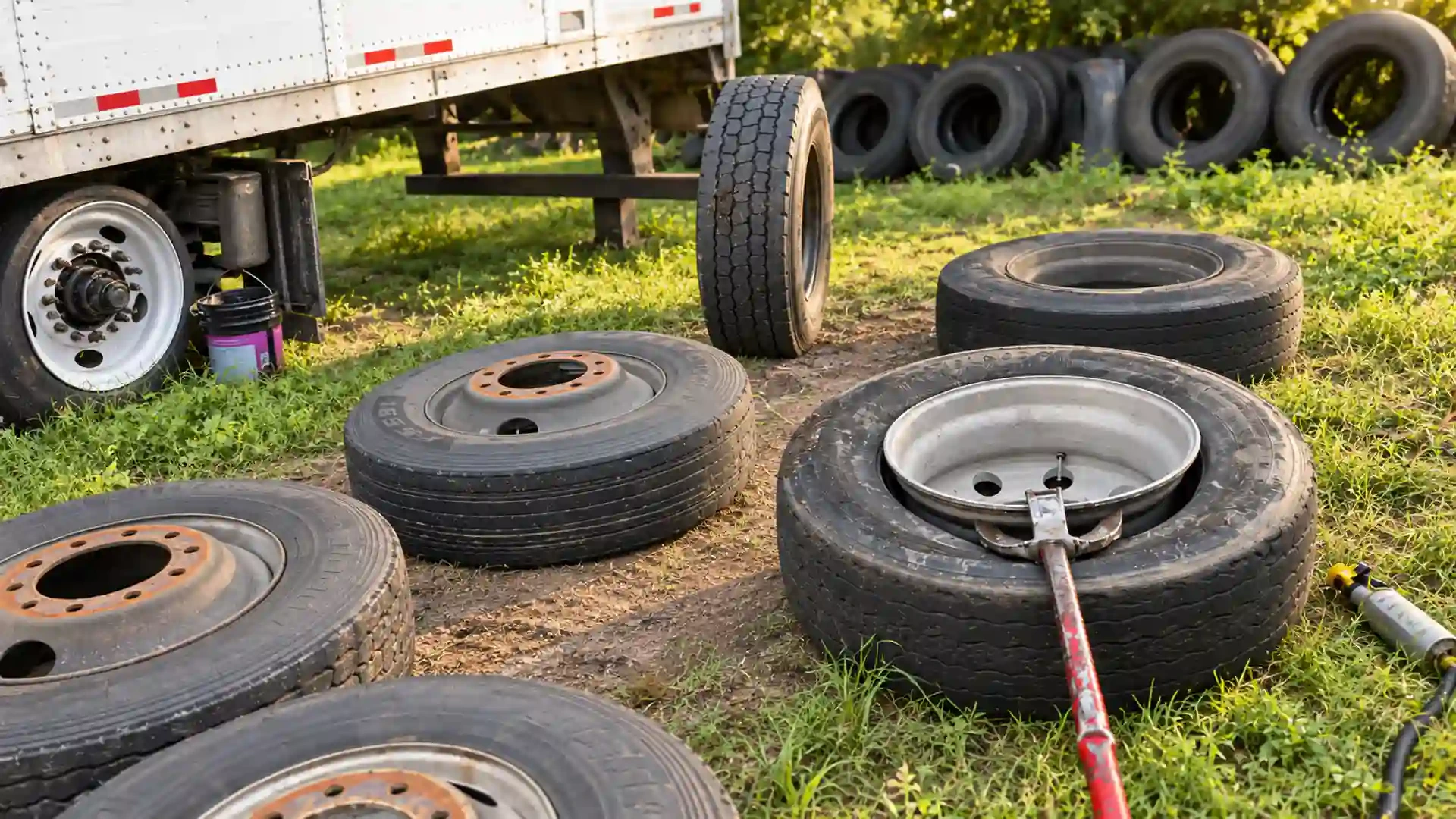
Specialized Truck Services
Commercial truck tire replacement: when to remove a tire from service
Learn when truck tire damage, tread depth, air loss, or irregular wear requires inspection or replacement and what to document before mobile service.
Sep 25, 2026
Specialized Truck Services
Detroit DD15 water pump warning signs: what to document before mobile service
Seeing coolant loss or overheating on a Detroit DD15? Learn what to document before mobile diagnostics and why the water pump should be confirmed, not guessed.
Sep 21, 2026
Specialized Truck Services
EGR-related power loss returns after repair: how to prepare for follow-up diagnostics
If EGR-related power loss returns after repair, document the timeline, codes, operating conditions, and prior work before follow-up mobile diagnostics.
Sep 18, 2026
