A loaded tractor that will not fire at first light is a dispatch problem before it is a parts problem. The driver reports a click, a slow grind, or a normal crank with no combustion, and the load clock starts immediately. A diesel truck won't start for reasons that sound alike from the cab: weak batteries, restricted fuel, an inhibited injection command, or an emissions inducement. Sorting those paths starts with what the driver can see, hear, and record before anyone orders a starter or a tow.
Table of Contents
- Which Symptom Should You Test First?
- Safety and Records to Gather at the Roadside
- Why Can a Diesel Crank and Still Not Fire?
- How Do You Separate Cranking, Fuel and Pressure Faults?
- Can Cold Fuel or a Weak Battery Cause a No-Start in Florida?
- When Does an Emissions Inducement Mimic a Dead Engine?
- Can Mobile Service Handle Your Truck, and When Is an External Facility Needed?
Which Symptom Should You Test First?
At 5:30 a.m., a Lakeland dispatcher hears that a loaded tractor will not start. The driver reports a single click, a slow crank, or normal cranking with no fire. Those observations point to different first checks, but none identifies a failed part by itself.
A precise report helps prioritize roadside work. The American Transportation Research Institute's 2024 operating-cost figure of $90.89 per hour for a fully loaded truck provides context for the cost of downtime. The figure does not measure roadside response time or repair savings.
| Symptom reported | First category to test | Why it stays a starting point |
|---|---|---|
| No crank, single click, or silent starter | Battery, cables, ground path, and starter circuit | Silence does not rule out fuel delivery or an electronic enable fault |
| Engine cranks slowly | Battery capacity under load, cable drop, and starter current | Measure cranking speed against engine rpm before choosing parts |
| Engine cranks at normal speed but does not fire | Start assistance, fuel delivery, and electronic injection enable | Several faults can produce the same sound, so check each system |
| Starts, then dies within seconds | Fuel supply restriction, air in the supply path, and filter condition | Wax or water restriction and electronic shutdown can look alike roadside |
| Cranks normally with a DEF, DPF, or derate message | Aftertreatment and inducement logic | Use the dash message, derate percentage, and DEF level to guide the check |
| Fails after an overnight cold drop, starts after warming | Fuel gelling and battery cold-soak | A truck arriving from a colder route can show this pattern in Florida |
| Intermittent no-start that clears after hours | Do not assign a category from the symptom alone | Review logged data and records before choosing a diagnostic path |
Keep the categories separate. A normal crank with no fire directs attention toward fuel delivery, start assistance, and injection enable. A cold-soak pattern calls for checking battery performance and fuel condition. A DEF, DPF, or derate warning points to an emissions inducement that can restrict operation even when the starter turns normally. Record the symptom and the conditions when it occurred before authorizing parts or transport.
Safety and Records to Gather at the Roadside
Warning devices go out before anyone opens a battery box or connects a scan tool near traffic.
- Stop and secure the truck. Set the brakes and keep people out of the travel lane.
- Place warning devices within 10 minutes. The FMCSA summary of the federal commercial-motor-vehicle rule, which is undated on the planner page, calls for one triangle, flare, or equivalent on the traffic side about 10 feet from the truck toward approaching traffic, a second about 100 feet toward approaching traffic, and a third about 100 feet the other way.
- Keep flares lit. If flares are used, at least one stays lit at each location while the truck is stopped.
- Only then start electrical, fuel, or diagnostic work.

Mark any missing item unknown. Do not guess.
- Dash message and codes: Exact wording and whether codes are active or stored, so the technician does not re-interview the driver.
- Derate percentage and DEF warnings: Level and quality messages decide whether this is an inducement, not a dead starter.
- Last successful regeneration: Time and date show whether a DPF event was overdue.
- Fuel grade and last fueling location: Needed when the truck crossed a colder corridor.
- Temperatures: Overnight low and the temperature at the failure.
- Crank sound: Whether it turns, and whether the sound is a click, a slow crank, or a brisk crank.
- Battery history and prior work orders: Recent replacements change the electrical path.
- Gauge photos: Taken from a safe position, not from the lane.
That packet is the same set described in what to send when requesting mobile truck repair near Tampa or Lakeland. A complete record lets the technician start from evidence.
Why Can a Diesel Crank and Still Not Fire?
At 6 a.m., a truck cranks briskly but does not start. Before ordering parts or arranging a tow, separate a true crank-no-start from an emissions inducement or a battery problem after a cold soak. Record what the driver observed, then test the relevant system.
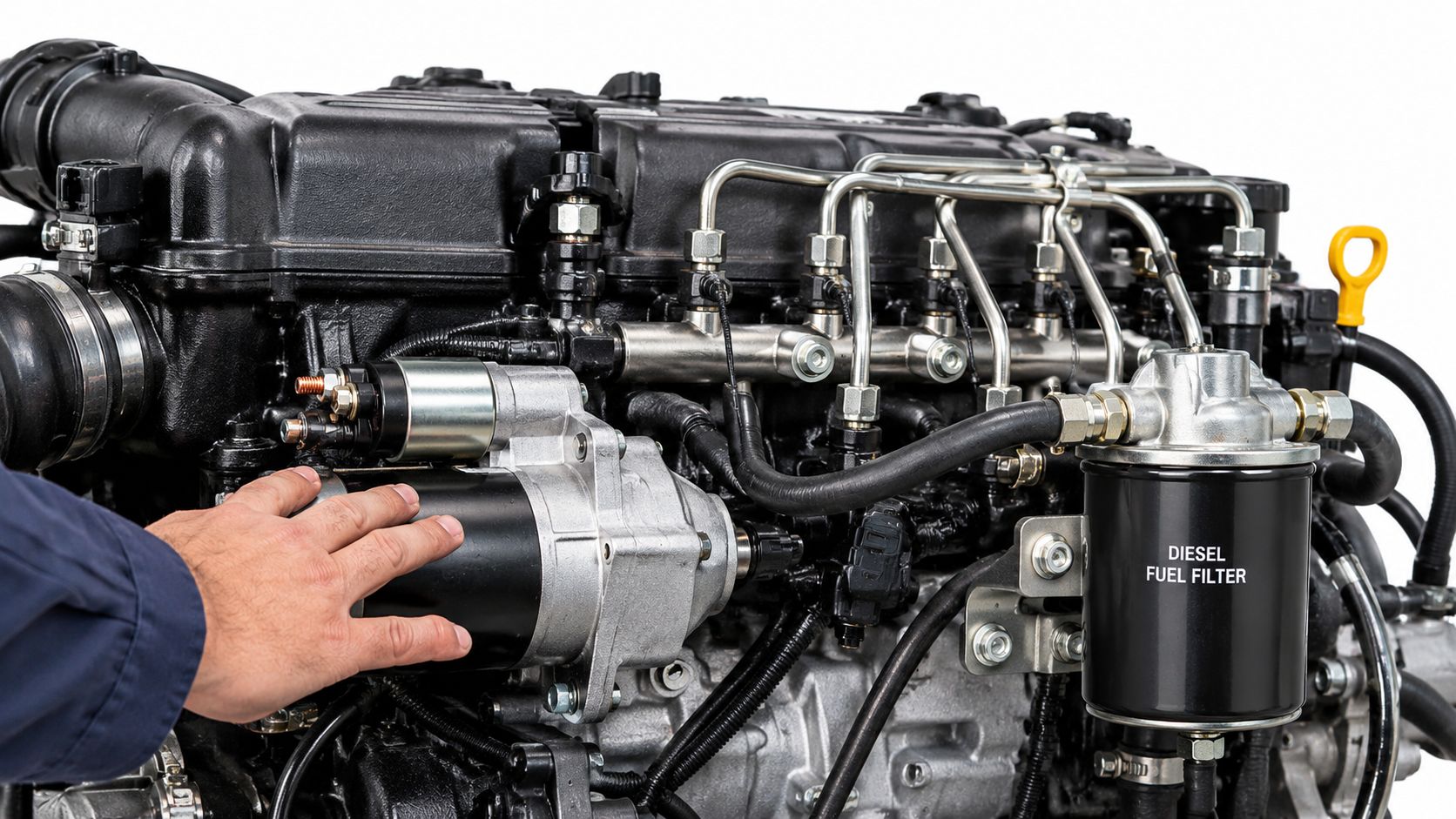
A diesel must meet three conditions to run. Cranking speed must be high enough for the engine to start. Fuel delivery must supply fuel to the high-pressure system. Combustion enablement depends on heat from compression and the engine control module allowing injection.
Diesel fuel is less volatile than gasoline. It ignites when injected into air heated by compression. A cold engine loses heat more quickly, so some engines use glow plugs or intake heaters to support starting. Fuel properties also matter: the diesel fuel technical summary describes cetane number as an indicator of ignition quality. Check the truck's applicable fuel specification before drawing conclusions from a fuel-grade label.
Wax can restrict a filter, and water can freeze, even when the starter and batteries seem healthy. A sensor, pressure, or emissions fault can also prevent the control module from enabling injection.
Listen and record the sound: a click, slow turnover, or steady crank. Note any smoke from the exhaust during cranking and capture the exact dash message. A brisk crank with no visible smoke narrows the observation, but does not identify a failed part. Smoke can help a technician decide which tests to run; its absence alone cannot confirm an injector fault.
Keep the categories separate. A cold-soak battery may turn the engine too slowly, a fuel restriction may prevent adequate delivery, and an emissions inducement may limit operation while displaying a warning. These conditions call for different checks, so record the evidence before authorizing parts or transport.
How Do You Separate Cranking, Fuel and Pressure Faults?
A truck can crank without starting for several different reasons. Before dispatch orders parts or transport, have the driver record cranking behavior and any available scan data. Run checks in order, use short crank bursts, and stop if access is unsafe. Record voltage, engine speed and pressure together so a technician can compare readings against the correct engine specification.
- Log the crank. Record whether the engine turns, how long it cranks, and the exact dashboard message. Note whether the cranking sounds steady or slows.
- Measure under load. Capture battery voltage during cranking and engine rpm from a scan tool. A resting voltage reading cannot show how the batteries and starting circuit perform under load.
- Check cranking speed against the engine specification. If speed is below the applicable minimum, investigate the batteries, starter, cables or mechanical drag before pursuing injection faults. The diagnostic guidance filed with NHTSA gives a reference threshold, but values vary by engine. Confirm the specification for the truck being tested.
- Check fuel pressures after confirming cranking speed. Compare scan-tool readings with the engine's service specification. The cited diagnostic guidance gives fuel-compensation and common-rail reference values. Low readings can prevent injection from enabling, but the correct limits depend on the system.
- Use system-specific procedures. The crank-no-start procedure describes pressure checks for its referenced fuel system. Do not apply those readings to another engine. Confirm the applicable test points and thresholds before interpreting results.
- Treat exhaust smoke as a clue, not a verdict. No visible blue or white smoke during cranking may suggest fuel is not reaching the cylinders. It cannot distinguish a supply restriction from an electronic command that prevents injection.
- Keep crank attempts short. Repeated, extended cranking can overheat the starter and drain the batteries. Record each attempt and its readings instead of continuing to crank without a test plan.
Interpret the readings together. Low cranking speed with voltage dropping quickly directs attention to the starting circuit. Adequate speed with low fuel pressure points toward the supply path, a restricted filter, air ingress, a regulator or a high-pressure pump. Codes alone do not justify replacing injectors or sensors. If the truck ran out of fuel, air in the lines can also prevent starting; see what happens when you run out of diesel.
| Evidence to record | What it helps the technician distinguish |
|---|---|
| Cranking sound, duration and dashboard message | Whether the engine is turning consistently and whether the truck reports a warning or inhibit |
| Battery voltage during cranking and scan-tool rpm | A weak starting circuit or inadequate cranking speed before fuel-system diagnosis |
| Fuel-pressure readings and test conditions | Whether pressure meets the specification for that engine during cranking |
| Exhaust smoke during the attempt | Whether there is a visible combustion clue, while recognizing smoke alone does not identify the cause |
| Recent run-out or fuel-system work | Whether air in the supply path may be contributing to the no-start |
Can Cold Fuel or a Weak Battery Cause a No-Start in Florida?
A truck can arrive from a colder region, sit through a cold front, then crank without starting. In that case, check both fuel temperature and battery performance before ordering parts. A cranking engine does not rule out fuel restriction or a weak battery.
U.S. diesel fuel is specified under ASTM D975, while European diesel commonly follows EN 590. Low-temperature behavior depends on the fuel and its properties. ASTM D2500 measures cloud point, when paraffin crystals begin to form, and ASTM D4539 tests low-temperature flow. Wax crystals can restrict filters and lines enough to starve the injection system while the starter continues turning.
| Condition | Reference point | Practical meaning for a no-start check | Source |
|---|---|---|---|
| Fuel standard | ASTM D975 for U.S. diesel; EN 590 for European diesel | Confirm the fuel grade in the tank and filters | ASTM D975 and EN 590 standards |
| Low-temperature tests | ASTM D2500 cloud point; ASTM D4539 low-temperature flow | Compare fuel test results before replacing filters or electrical parts | ASTM test methods |
| Winter-fuel and anti-gel limits | Set by the vehicle or fuel manufacturer | Check the owner's manual for the truck's make, model, and year | Manufacturer owner's manual |
| Battery capacity at 0 °F | Can fall roughly 30 to 40 percent | Check cranking voltage under load, not open-circuit voltage | Cold-weather battery guidance |
For a truck that ran the previous afternoon, record the overnight conditions, cranking sound, and any available fuel-temperature or restriction readings. A strong-sounding starter does not confirm that fuel is reaching the pump. Wax-restricted filters or lines can prevent delivery, including on a truck operating in Florida after traveling from colder areas.
Battery cold-soak can also reduce available cranking power. The cited guidance reports a roughly 30 to 40 percent capacity drop at 0 °F, while a large diesel still demands high current. Record cranking voltage under load, cable voltage drop, ground-path condition, starter current, and engine rpm. Open-circuit voltage alone can give a misleading picture.
Before replacing electrical parts, check fuel temperature, filter restriction, water, and whether the fuel is seasonally appropriate.
If wax has restricted the system, the truck may need a warmer location or an external facility when the filters and lines cannot be restored safely roadside. Follow the vehicle or fuel manufacturer's winter-fuel and anti-gel limits rather than applying one statewide rule. The winter diesel fuel reference explains cloud point as background; use the truck's owner's manual for vehicle-specific guidance.
When Does an Emissions Inducement Mimic a Dead Engine?
The starter turns at normal speed, but the dash shows an emissions warning and the engine will not run. That pattern points dispatch toward an inducement or aftertreatment fault, not automatically toward a failed battery. The U.S. EPA's diesel exhaust fluid page explains that low DEF or sensor faults can trigger severe speed limits or make a vehicle inoperable. EPA guidance issued in 2025 lets manufacturers modify certain DEF warning, derate, and inducement strategies while remaining within emissions requirements. Strategy still varies by engine, model year, and manufacturer, so there is no universal reset.
A DPF also needs suitable exhaust heat to burn accumulated soot. EPA aftertreatment material distinguishes passive regeneration, which occurs when normal exhaust heat is sufficient, from active regeneration, which adds heat when it is not. A separate EPA technical note states that minimum regeneration frequency is generally once per day or shift. Reported regeneration times range from two to eight hours, depending on filter size, media, and system design.
A truck displays a DPF warning and a 40 percent derate. It cranks strongly, then barely runs. Record the exact dash message, displayed derate percentage, and DEF level before anyone orders parts or arranges transport. Those details help distinguish an emissions inducement from a crank-no-start fault.
Avoid repeatedly clearing codes, which can erase useful diagnostic evidence. Roadside diagnostics may identify a sensor problem, regeneration issue, or restriction, but the repair's location depends on safe access, temperature, available equipment, and vehicle condition. A filter that requires unavailable on-site equipment may need a suitable external facility. Use this DPF warning light and derate preparation guide to organize the information for mobile diagnostics.
Can Mobile Service Handle Your Truck, and When Is an External Facility Needed?
SAAT Repairs Corp works only as mobile Road Services. Technicians come to the truck. There is no customer-facing workshop, so nobody drops a tractor at a SAAT bay.
Roadside work is feasible only when four conditions hold: safe access, a stable place to work, the equipment the fault requires, and a fault that can realistically be finished there. Not every major repair meets that test. Commercial trailer brake, air, electrical, suspension, and structural repairs can be in scope, but location and feasibility stay case by case.
When the job needs equipment or procedures that are not available on site, a suitable external facility is an outside option, not a SAAT location. This article does not describe towing. Any transport has to be confirmed separately. Any arrival window depends on location, traffic, technician availability, and the job. No fixed response time is stated here.
Send the written record from the safety checklist through the English contact section at saatrepairscorp.com so scope can be confirmed before anyone is dispatched.
SAAT Repairs Corp sends mobile technicians to heavy-duty trucks that will not start across Tampa, Lakeland, and nearby Florida corridors, and diagnoses cranking, fuel, and emissions faults at the vehicle when the site is safe. Scope is confirmed from the records you send, and work that cannot be finished roadside is directed to a suitable external facility rather than promised on the shoulder. Visit SAAT Repairs Corp and use the English contact section to submit the dash message, crank description, and fault details before requesting a dispatch.