A semi-truck transmission estimate is useful only when its scope is clear. Compare which portions of the job each quote covers before comparing its total.
The line-item spread carries more weight than any single total. A harness or sensor fault and a contaminated gearset can produce the same shift complaint, then land thousands of dollars apart once labor, software programming, a core charge and time off the route are added. Diagnosis done at the vehicle with scan tools, before parts are ordered, is what separates those two outcomes. SAAT Repairs Corp works that way across the Tampa and Lakeland areas, pricing the fault at the truck's location rather than quoting a rebuild off a symptom description.
Audit the individual lines. A quote that reads cheap on parts can turn expensive after downtime, a missed core return and transport the estimate never listed. Match the symptom to a service category before anyone orders a unit, and the quote you should be holding becomes clear.
Table of Contents
- How much does a semi-truck transmission repair cost?
- What makes a transmission estimate go up or down?
- How does diagnosis set the estimate before parts are ordered?
- Which repair path has the lowest downtime-adjusted cost?
- What do worked transmission repair estimates look like?
- Where can transmission work be done safely?
How much does a semi-truck transmission repair cost?
A Class 8 tractor has no single transmission invoice. Cost follows the service category, and each category carries different parts, labor hours, and truck downtime.
| Service category | How to establish the price | What the price covers |
|---|---|---|
| Routine fluid, filter and inspection | Quote for the specified fluid, filter and inspection work | Fluid replacement, filter work and inspection |
| Moderate internal repair | Written quote after diagnosis establishes the internal repair scope | Gear, clutch-pack, valve-body or bearing work |
| Complete rebuild | Written quote for bench work, parts and testing | Disassembly, replacement of worn parts, reassembly and testing with reuse of serviceable components where possible |
| Remanufactured unit installed | Quote for the matched remanufactured unit and installation | Remanufactured transmission plus removal, installation, fluids and adjustments |
| Complete installed replacement | Quote identifying unit type and all installation-related work | New or remanufactured unit, removal, installation, fluids, adjustments and related parts |
| Diagnostic assessment | Billed as separate time | Fault isolation before a repair path is selected |
The spread creates the audit problem. A shift complaint can come from a sensor fault or a contaminated gearset. The invoice difference is thousands of dollars once programming, core terms, fluids, transport, and days off route are counted. Low parts prices often hide those lines.
Match the complaint to a band
Slipping only after a long grade, with dark fluid. Investigate the symptom and contamination before selecting an internal repair scope. Fluid condition alone does not establish a price or rule out internal damage.
A code with normal fluid and no metal. Hold the rebuild decision. External electrical and air faults belong in diagnostic time, billed as its own line with defined coverage. A code alone does not select a unit.
A unit that will not stay in gear, with debris in the fluid. Price this as a rebuild or installed replacement. Fluid service will not correct mechanical damage, and delay adds contamination to related parts.
Final cost still turns on transmission type and serial number, extent of damage, new versus remanufactured parts, warranty terms, fluids and calibration needs, core return rules, and whether the work can be done safely where the truck sits. Compare written lines, not totals.
What makes a transmission estimate go up or down?
A written estimate should split the job into lines a buyer can check one at a time. Two quotes for the same truck can sit thousands of dollars apart because one bundles diagnosis, programming, a core charge, and towing into a single figure while the other lists them out. The table below is the audit order, and the right-hand column is where the main argument usually sits.
| Line item | What to confirm | Why it changes the total |
|---|---|---|
| Diagnosis | Whether diagnostic time is billed separately and what it covers | Stops a replacement decision based on a code alone |
| Parts | New, remanufactured, or rebuilt, plus the transmission serial number | Unit type changes price and warranty |
| Labor | Estimated hours and the hourly rate applied to them | Hour count is where access and damage show up first |
| Fluids and filters | Fluid type, quantity, and filter changes | Adds cost even when the internal repair is limited |
| Programming and calibration | Software update, parameter changes, and shift relearn | Often required after repair to restore correct shifting |
| Core charge and return | Core condition rules and the return deadline | Changes the net parts cost if the core is late or rejected |
| Transport or towing | Included or excluded, and who arranges it | Adds to the invoice and extends downtime |
| Warranty | Duration, labor coverage, and exclusions | A short warranty can erase a cheap unit price after one repeat failure |
Rank the drivers by what they do to the invoice
Labor hours come first. Twelve hours on an accessible unit and thirty hours on one seized in the frame produce very different invoices before a single gear is priced.
Transmission type is next. The NACFE trucking efficiency transmissions confidence report (December 17, 2014, section 3.2.1) reported a historical upfront-price estimate for new tractors: fully automatic transmissions were expected to cost approximately $3,000 to $11,000 more than automated manual transmissions. That historical purchase-price comparison is not a current transmission repair estimate. An automatic can combine a torque converter, hydraulic circuits, a valve body, clutch packs, solenoids, and control software. An AMT generally automates clutch and gear selection around a manual gearbox.
Access and damage follow. Pulling a heavy unit in a tight frame, or finding a cracked housing, moves the job from an external repair into removal. Parts that do not match the serial number add lead time. Off the invoice, a missed delivery window and a substitute tractor can exceed the parts savings on the unit itself. That is why the cheapest line on the page is often not the cheapest week.
Two lines get skipped most often in that audit. The core charge turns into a penalty when the return deadline passes with the old unit still sitting in the shop, and the programming line tends to appear after the replacement is already bolted in, when there is no room left to negotiate.
Practical rule: When a quote arrives, ask about labor hours and unit type before you argue about the total.
SAAT Repairs Corp offers repair, maintenance, and replacement of manual and automatic transmissions on heavy-duty trucks, including semis and fleet vehicles. Attach four documents to the estimate before authorization: the driver's complaint in the driver's own words, active and inactive fault codes, dated photos of leaks or debris, and the transmission serial number.
How does diagnosis set the estimate before parts are ordered?
A fault code does not prove an internal transmission failure. Depending on the transmission model, technicians may need to check system voltage, harnesses, sensors, air supply, actuators, fluid condition and software parameters before selecting a repair. Use the applicable manufacturer diagnostic procedure for the transmission model and fault.
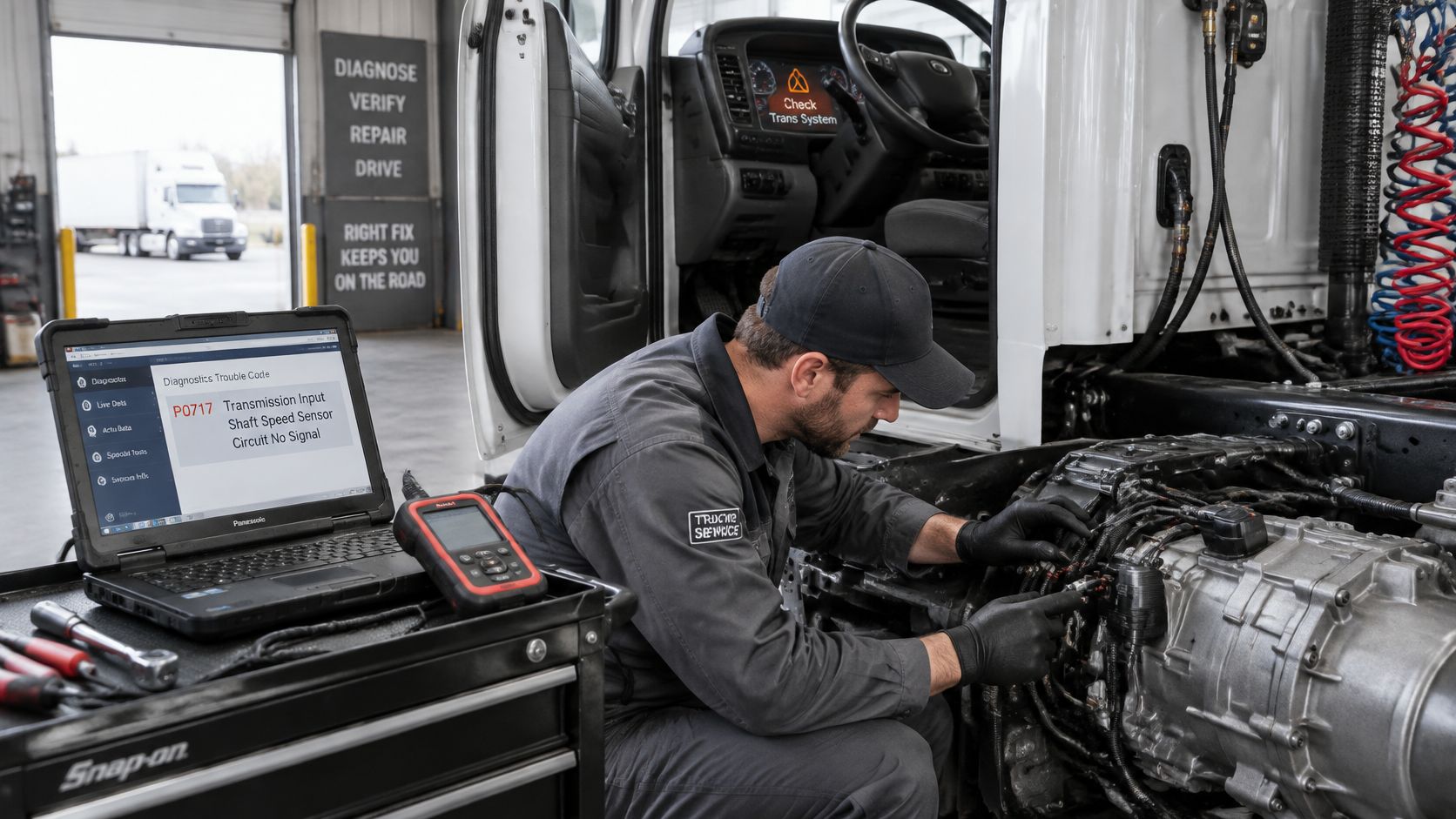
Technicians use diagnostic tools to separate those causes before a unit is ordered. A practical sequence for that work is laid out in semi-truck transmission diagnostics. The order below is the cost-control version of that sequence.
Seven checks before a unit is priced
Record the complaint, the codes, and the conditions. Active and inactive codes plus road speed, grade, and load tell you when the symptom appears. The common mistake is clearing codes before anyone writes them down.
Check battery voltage and grounds. Low system voltage can create shift faults that look internal. Replacing a transmission before a voltage check turns a battery problem into a capital repair.
Inspect connectors, harnesses, and the air supply. Chafed wires and air leaks move actuators without damaging gears. Skipping the harness because a code names a solenoid is a frequent miss.
Check fluid level, color, and contamination. Metal or clutch debris changes the repair scope. A level check that ignores glitter in the fluid underprices the job.
Run commanded actuator and sensor tests. Professional scan tools show whether the control side responds. Guessing from a stored code skips that proof.
Compare the tests with the symptom. If voltage, air, connectors, and clean fluid explain the complaint, an internal fault is not supported. If debris or slip remains, the estimate should move to removal.
After any repair, finish programming or clutch and shift relearn, then record the verification. A unit that shifts on the lift and derates on the route was not finished. Leaving the relearn off the paperwork is how that repeat call starts.
A documented decision, not a code printout, is what gets priced.
That decision is the output: external repair, internal repair, rebuild, or replacement. It is also what tells a fleet whether the truck can be worked where it sits or needs a controlled removal. Major transmission work may not be feasible at the roadside and can require specialized equipment and a secure work setting.
Which repair path has the lowest downtime-adjusted cost?
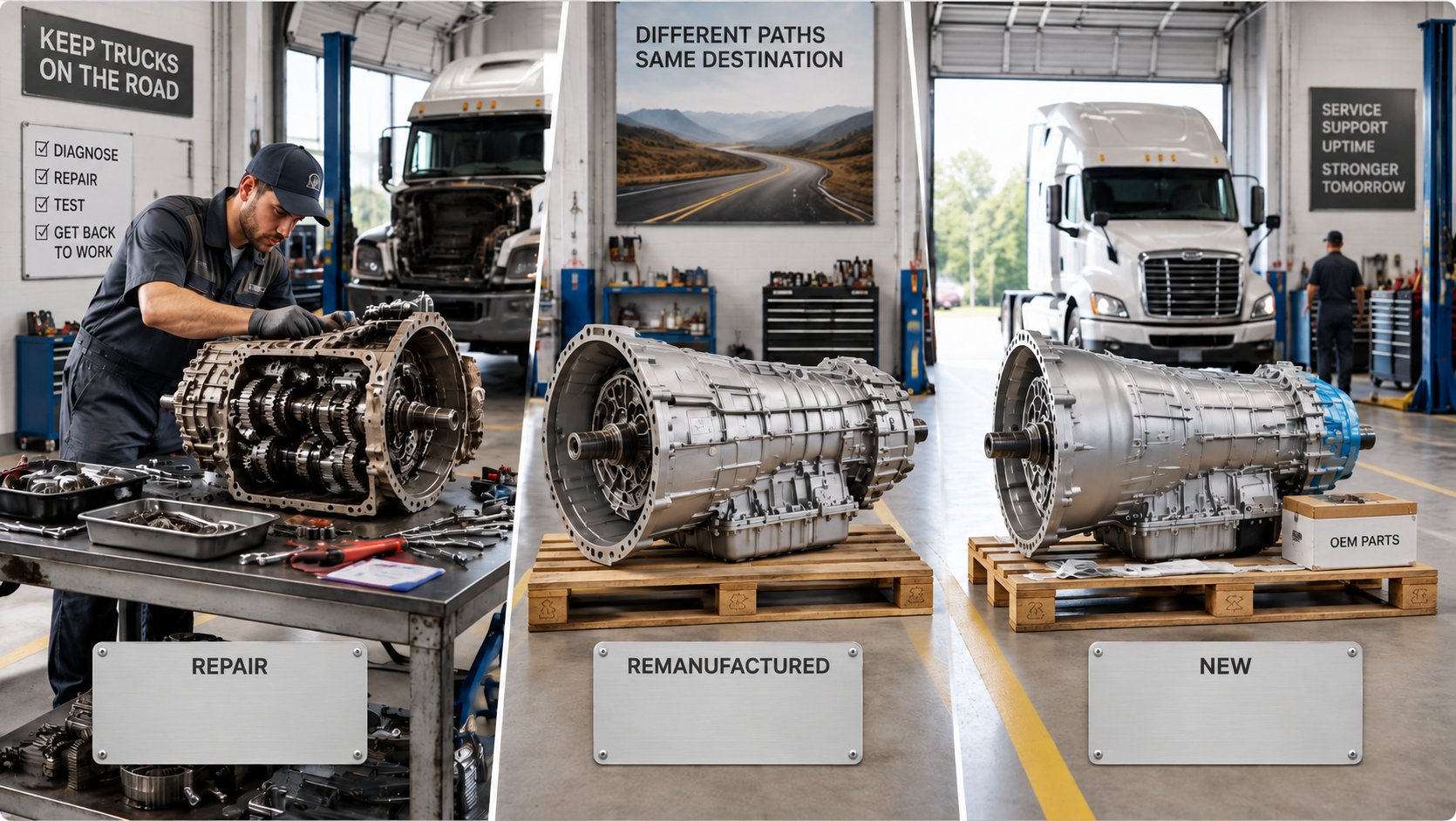
Three paths sit on the table once diagnosis supports internal work. The unit price does not answer which one is cheaper for a given route.
| Repair path | Reported cost reference | Warranty reference | Trade-offs to weigh |
|---|---|---|---|
| New Class 8 replacement | About $6,000–$9,000 for the unit | Confirm the manufacturer warranty terms in writing | Highest unit cost; still needs install, fluid, and calibration |
| Remanufactured replacement | About $3,500–$5,200 for the unit | Commonly 24–36 months, supplier-specific | Core return rules, exclusions, and a match to model and software |
| Rebuild of existing unit | Obtain a written quote for bench work and related parts | Confirm the rebuilder warranty terms in writing | Keeps the original housing; outcome depends on the failure cause |
A mechanical remanufacturing market report estimates new Class 8 transmission replacements at approximately $6,000 to $9,000, against about $3,500 to $5,200 for equivalent remanufactured units, a reported 40% to 50% lifecycle cost difference. The same report describes common remanufactured powertrain warranties in the 24 to 36 month range. Coverage is supplier-specific and may exclude mileage, installation, adjustment, or some failure causes.
The total-cost test
FreightWaves discusses parts-cost pressure, remanufactured sourcing and the need to check warranty documentation. Bench time is only part of vehicle-off-road time. Core return rules, and separate bills for removal, installation, fluid, and calibration, sit outside many advertised unit prices. Obtain bench hours and warranty terms from the written quote for the actual transmission.
A remanufactured assembly can cut off-road time and make warranty coverage more predictable. It does not fix an unresolved clutch, cooling, lubrication, electrical, or driveline cause, and it fails the test if it does not match the transmission model and control software. A rebuild can keep the original housing and limit parts spend, then lose that advantage if the truck sits while hard parts are sourced.
SAAT Repairs Corp can evaluate the vehicle and help identify the repair path. That evaluation is not a promise of a particular remanufactured product, price, or warranty. The side-by-side logic is spelled out further in transmission rebuild versus replace.
Before approval, ask which option minimizes downtime-adjusted cost for this truck and this route, not which line shows the smallest parts price.
What do worked transmission repair estimates look like?
Three hypothetical cases show where the money sits. Treating any total as a market price misses the point. The useful comparison is line by line, because the cheapest invoice often loses once programming, transport, substitute equipment and downtime are added back in.
| Hypothetical case | Diagnosis outcome | Likely repair path | Cost lines to total |
|---|---|---|---|
| Case A, fleet tractor with shift errors | Damaged harness and failed speed sensor | Repair with sensor and connector parts; feasibility assessed on site | Diagnosis, parts, labor hours, programming |
| Case B, owner-operator with clutch wear | Clutch wear and debris in the fluid | Rebuild or remanufactured unit | Removal and installation labor, unit, fluids, relearn |
| Case C, fleet unit with a delivery deadline | Internal failure needing full replacement | Remanufactured unit, with transport only if confirmed | Unit, labor, towing if confirmed, substitute equipment, core return, warranty |
Case A. A fleet tractor on a Tampa delivery loop throws shift errors. Tests show a damaged harness and a failed speed sensor, with clean fluid and no metal. The transmission stays in the truck, so the total is diagnostic time plus connector and sensor parts plus labor for the hours used, plus programming or a relearn if the control software calls for it. Skipping that last line is how the same truck comes back with the same complaint.
Case B. An owner-operator has clutch wear and debris in the fluid. External repairs will not clear the metal. The total adds removal and installation labor at the quoted hourly rate, then either a rebuild or a remanufactured unit, then fluid and a shift relearn. Check a rebuild figure against its own written quote: the unit, the removal and installation hours, and the relearn should each sit on a separate line. A quote that omits any of the three is not comparable to a remanufactured quote that names all of them.
Case C. A fleet unit fails internally with a delivery deadline. The path is a remanufactured unit. Towing or transport goes in only if that move is confirmed for this truck. Substitute equipment for the days the tractor is down belongs in the total, and so does the warranty length with its exclusions, since a second failure outside coverage returns the whole cost to the fleet. The invoice line and the cost of the repair are different numbers. A lower-priced unit only wins if it arrives sooner and stays in service longer.
Add every line from the written estimate. Leave off any line the quote does not name.
The pattern across the three cases is that the diagnosis decides which lines exist at all. Labor hours, parts type and transport then move the total by truck, so those numbers have to come from the reader's own written quote. What stays constant is the audit order: confirm the diagnosis is billed and explained, confirm the labor hours and the hourly rate, then price the lines that scale with downtime, meaning programming, transport, substitute equipment and warranty exposure.
Where can transmission work be done safely?
Mobile work has a hard edge. Diagnostics, electrical checks, sensor and harness repairs, and software programming are often assessable where the truck is parked, if access is safe and the tools for that test are on the truck. Pulling a heavy transmission is different. It can require specialized lifting equipment and a secure work setting, so it is not promised at the roadside.
SAAT Repairs Corp works as an independent mobile road services team and provides service at the vehicle's location. It does not have a workshop open to customers. Technicians attend the truck. Feasibility is judged for each job from safe access, required equipment, and technician availability. When removal needs a suitable external facility, that facility is an option the fleet arranges. It is not a company location. Towing is not assumed unless it is confirmed for that case.
Arrival aims for 45 to 60 minutes in the Tampa and Lakeland areas, depending on location and traffic, and it also depends on technician availability and the job. Customers outside those areas should confirm coverage before booking. What on-site work can include is outlined in on-site truck repair.
Before you authorize, the written estimate should name three things: the feasibility decision, the external option if one is required, and diagnostic time billed on its own line.
SAAT Repairs Corp provides mobile transmission diagnostics, maintenance, repair, and replacement for manual and automatic heavy-duty transmissions at the vehicle location across Tampa, Lakeland, and nearby Florida. A scope review can separate a roadside diagnostic from work that needs an external facility, without treating a published cost band as a fixed quote. Visit SAAT Repairs Corp to request that review of the estimate.