A truck leaves an external facility after an ECM update, the dashboard looks normal, and the driver heads back toward the yard. The fleet manager still has unanswered questions: Which calibration is installed? Were the original fault codes preserved? Did the truck complete its return trip without a derate, warning lamp, or communication problem?
That gap matters because diesel ECM programming changes more than a software label. It can affect fuel control, emissions monitoring, torque limits, aftertreatment behavior, and the records a fleet may need during a roadside inspection, warranty discussion, or future diagnostic event. The flash is only one part of the job. The verification afterward is what tells the fleet whether the truck is ready to return to service.
Table of Contents
- Why a Programmed Truck Still Needs a Fleet Review
- What Diesel ECM Programming Actually Involves
- The Core Items Every Work Order Should Show
- When Mobile Programming Is Realistic and When It Is Not
- Clearing Codes Is Not the Same as Fixing the Cause
- Comparing the Documentation the Driver Gets and the Shop Keeps
- Connecting ECM Records to Compliance and Uptime
Why a Programmed Truck Still Needs a Fleet Review
Consider this hypothetical scenario. A 2022 Cummins X15 receives an approved calibration update at a controlled external facility. The technician reports that the write completed successfully, the engine starts, and the truck leaves under its own power. The driver assumes the job is finished, while the fleet manager still needs evidence that the installed calibration matches the work order and the truck's exact engine configuration.
A completed flash doesn't automatically prove that the correct file was used. It also doesn't prove that injector data, engine rating, transmission configuration, aftertreatment hardware, or fault-monitoring parameters were handled correctly. A proper review connects the programming event to the vehicle identification number, engine serial number, module identity, calibration identifiers, and the reason the update was authorized.
The visible event is only half the work
The ECM controls fuel delivery, injection timing, air handling, torque limits, and emissions-related protection strategies. After programming, the technician should confirm that the module communicates normally and that the new calibration hasn't created a fresh fault, unexpected derate, or mismatch with another control module. The EPA's engine-testing regulations place engine emissions measurement within a standardized compliance framework, which is why a calibration change shouldn't be treated like an unrestricted performance adjustment.
The fleet review should answer four practical questions:
- Was the correct calibration installed? The post-programming identifier should match the approved work order and the exact engine family.
- Were parameters preserved or intentionally changed? Rating, injector, transmission, idle, and aftertreatment settings need a documented reason.
- Did the truck pass a diagnostic check? Active and inactive codes should be reviewed after the write, not merely erased.
- Can the event be reconstructed later? The record should show who performed the work, when it occurred, what tool or authorization was used, and what happened afterward.
Practical rule: A programming receipt proves that money changed hands. It doesn't prove that the truck received the right calibration or that the original fault was corrected.
What a fleet should expect
The driver or dispatcher should receive a concise handoff, while the deeper technical record should enter the fleet's maintenance system. That record protects the operator when a repeat fault appears, a dealer asks about calibration history, or an inspector needs the truck's identity and operating information.
The sections below treat post-service verification as a checklist. The emphasis is not on teaching a roadside operator to flash a module. It is on identifying the evidence that should exist before the truck returns to a demanding route.
What Diesel ECM Programming Actually Involves
Diesel ECM programming developed from the need to control fuel delivery and emissions with greater precision. Early heavy-duty diesel emission rules began in 1968, California introduced on-road heavy-duty standards in 1973, federal standards followed in 1974, and the two systems were harmonized in 1988, as described in this historical engineering analysis of diesel emissions controls.
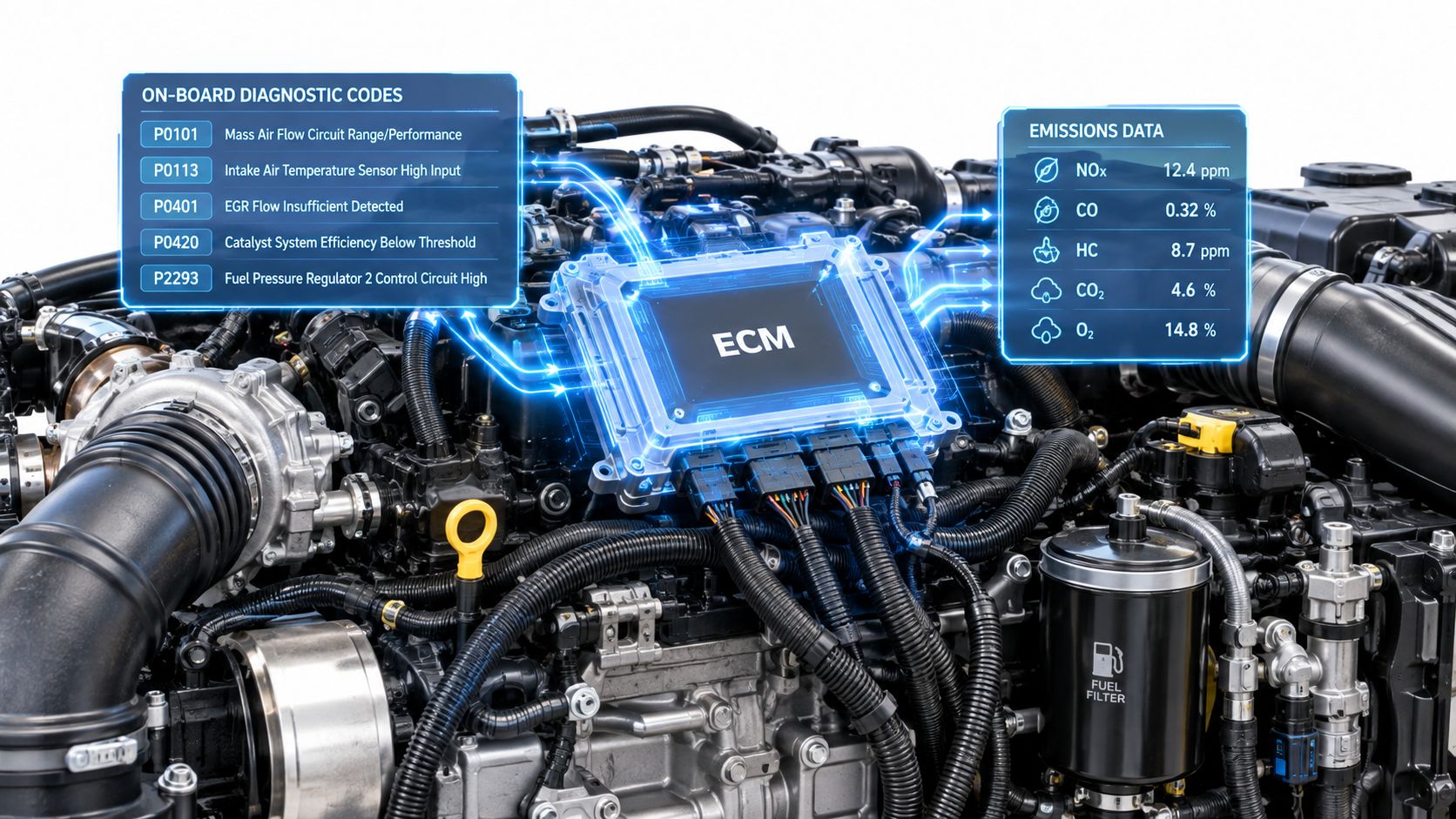
By the mid-1980s, manufacturers had moved from electronic add-ons to fully electronic engine-control systems. Those systems could manage injection timing, injection pressure, fuel metering, and turbocharger control with a speed and precision mechanical systems couldn't match. Later emissions requirements made the software relationship even more important. For model-year 2007 engines, the required particulate-matter limit was 0.01 grams per brake-horsepower-hour, the NOx limit was 0.20 grams per brake-horsepower-hour, and the non-methane hydrocarbon limit was 0.14 grams per brake-horsepower-hour. The 2007 NOx requirement represented a 95% reduction from the earlier 4 grams per brake-horsepower-hour limit in 1998, according to the California Air Resources Board diesel technology report.
The ECM acts like a compliance officer
A useful fleet analogy is to treat the ECM as the truck's compliance officer. The calibration is the rulebook, and programming is the controlled act of issuing a revised rulebook. The ECM uses sensor inputs, combustion conditions, exhaust temperature, differential pressure, and emissions-system status to decide how the engine runs and how it responds to faults.
That makes the following terms important:
- Calibration ID: The identifier that shows which software calibration is installed.
- Parameter set: Vehicle-specific values that configure the engine rating, injectors, transmission relationship, idle behavior, or other supported settings.
- Flash file: The authorized software package written to the module.
- Post-programming verification: The diagnostic and operational checks that confirm the write completed and the truck still behaves correctly.
An OEM-released calibration update is not the same thing as aftermarket tuning. A lawful update must preserve the certified emissions strategy and onboard diagnostics. Software intended to disable or bypass DPF, EGR, SCR, DEF, or diagnostic functions is prohibited tampering, not a legitimate service objective. The EPA's tampering guidance states that an ECM may be altered to undo tampering and return a vehicle to compliance, not to defeat emissions controls.
The programming event should therefore be linked to a clear reason, such as an approved update, a lawful repair, a replacement module, or a compatibility change after component work. A fleet shouldn't accept vague language such as “software adjusted” when the module controls systems that affect emissions, drivability, and protection logic.
The video below provides additional visual context for commercial vehicle diagnostic and programming work.
For a related example of why diagnosis should precede part replacement, fleets can review when a Cascadia with a DD15 needs programming diagnostics before replacing parts.
The Core Items Every Work Order Should Show
A strong programming work order has two sides. The first side records what the technician observed and changed. The second side captures what the driver or dispatcher noticed after the truck returned to operation. Either side alone is incomplete.
The technician's record should begin with the vehicle and module identity, then preserve the pre-write condition before any memory is erased. It should show the original calibration identifier, the new calibration identifier, the flash-file version, the date and time, the power source used during the write, and the diagnostic trouble codes present before and after programming.
The technician's record
The work order should make these items easy to find:
- Identity: VIN, engine serial number, ECM identity, and the relevant engine family.
- Baseline calibration: Pre-programming calibration ID and parameter snapshot where supported.
- Installed software: Post-programming calibration ID and flash-file version.
- Electrical conditions: Power supply or voltage-support method used during the write.
- Diagnostic status: Active and inactive codes before programming, followed by the post-programming scan.
- Authorization: The reason for the update and the approved source of the calibration.
- Linked repairs: Injector replacement, module replacement, wiring repair, sensor work, or aftertreatment repair connected to the event.
The engine serial number matters on platforms that tie calibration downloads to a specific engine. For example, the Cummins service-calibration documentation requires the engine serial number stored in the ECM to match the physical engine data plate, with installation approval for each serial number before a calibration download.
The driver's confirmation
The driver doesn't need to recreate the programming session. The driver does need to report what happened after the truck was released:
- Cold start: Record whether the engine started normally after sitting and whether warning lamps appeared.
- Regeneration status: Note whether a regeneration was pending, active, interrupted, or completed according to the vehicle's operating instructions.
- Dashboard behavior: Report any new check-engine, aftertreatment, transmission, ABS, or communication indicator.
- Return-trip behavior: Record whether the truck showed limp mode, an unexpected torque limit, a new derate, or abnormal response.
- Dispatch timing: Preserve the time the truck left service and the time any new symptom appeared.
| Verification Item | Recorded by Technician | Confirmed by Driver/Dispatcher |
|---|---|---|
| Vehicle and module identity | VIN, engine serial number, ECM identity | Truck number and route assignment match the work order |
| Calibration state | Original and installed calibration IDs | Driver receives the installed calibration summary |
| Diagnostic condition | Codes before and after programming | Any warning lamp or new code reported during operation |
| Electrical support | Power source and programming conditions | No interruption or restart event noticed after release |
| Aftertreatment status | Relevant DPF, SCR, DEF, and sensor data | Regen status and any returning derate documented |
| Operating result | Functional test and parameter review | Cold start and return-trip behavior recorded |
| Service timing | Date and time stamps | Dispatch records when the vehicle returned to service |
A clean work order includes both columns. A credit-card receipt with no calibration history leaves the fleet exposed during a warranty review or roadside inspection because it doesn't show what changed or whether the truck operated normally afterward.
When Mobile Programming Is Realistic and When It Is Not
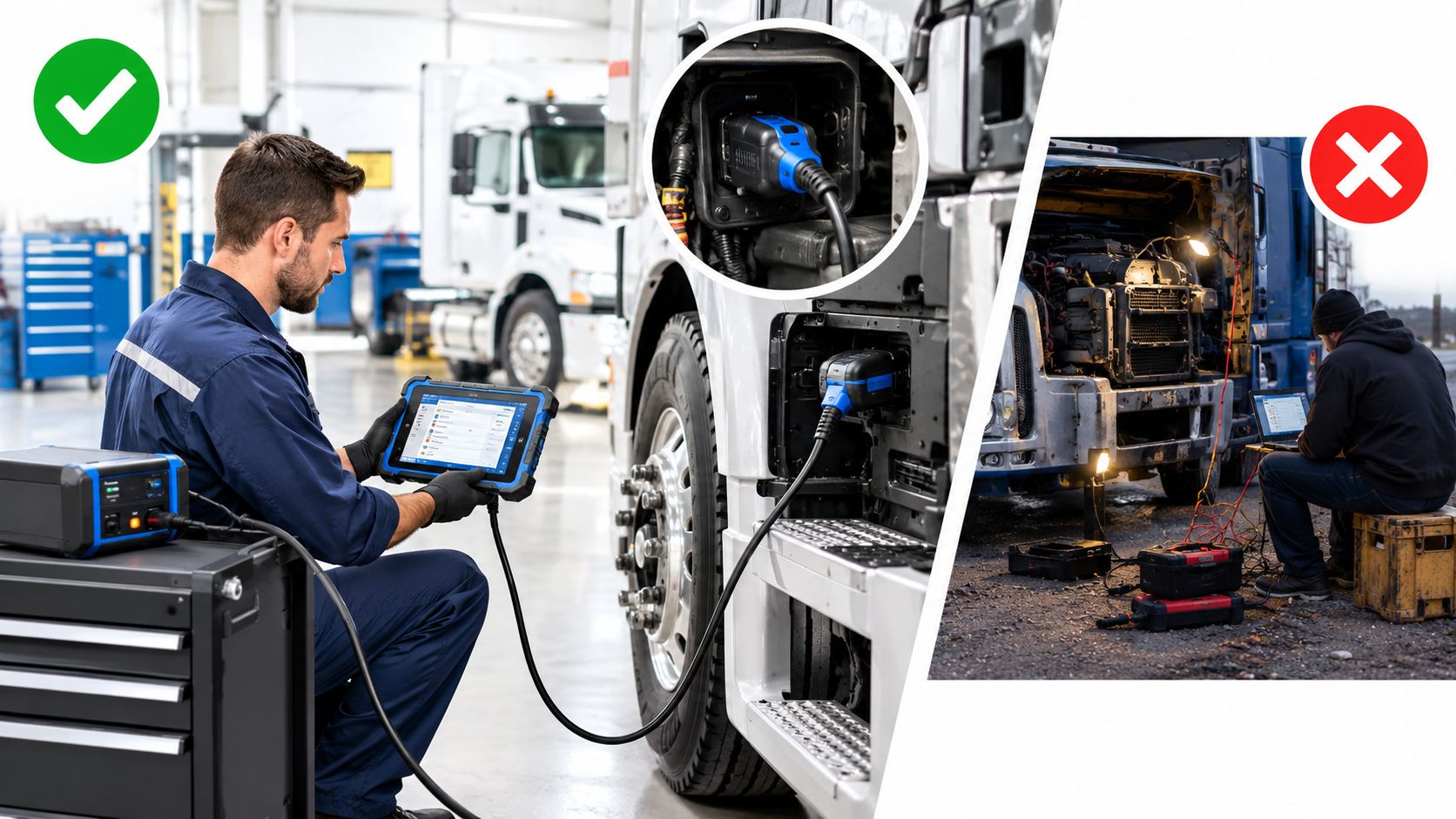
The claim that any ECM can be programmed wherever a truck stops is too broad. Roadside feasibility depends on authorization, stable power, and reliable communication with the correct module. A technician may reach the truck physically and still be unable to perform a lawful write if the required calibration access, security credential, interface, or replacement-module data isn't available.
Authorization is platform-specific
Commercial platforms don't share one universal programming path. Cummins INSITE with the correct feature access, Detroit Diesel DiagnosticLink with the required licensed server access, and Volvo PTT with the appropriate subscription level aren't interchangeable. Basic code reading may be available while calibration writing, advanced logic changes, or security-relevant functions remain restricted.
Training material for heavy-duty service distinguishes basic diagnostics from higher-level feature-code and advanced-logic programming. Some functions require higher access and additional training, while security-related functions may require a PIN or activation. That distinction is why a dispatcher should describe the job accurately before dispatch. “The truck needs a reflash” isn't enough information to establish whether the work can be completed at the vehicle location.
Power and communication decide the risk
A flash write needs uninterrupted electrical support. Heavy-duty batteries alone may not maintain suitable voltage when cab loads, lighting, accessories, and other modules remain active. A voltage drop or communication interruption during a write can leave the module incomplete or inoperative, and indiscriminate power cycling can make recovery harder.
The vehicle network matters too. A diagnostic connector within cable reach doesn't guarantee access to the target module. Some platforms require gateway pass-through, authenticated communication, or a secured remote session. The NHTSA vehicle cybersecurity best-practices document identifies firmware re-flashing as a sensitive operation and emphasizes controlled access, authentication, and authorization.
A mobile technician should promise an assessment of feasibility, not an automatic roadside flash.
Before dispatch, the fleet should provide the VIN, engine and ECM identifiers, active fault codes, recent module replacement information, battery condition, and current derate status. The provider can then determine whether the job is a safe on-site diagnostic or programming event, a limited roadside repair, or a case that needs a suitable external facility with controlled power, network access, and recovery equipment.
Fleets can also review what to prepare before online diagnostics and programming for commercial trucks. The practical question isn't whether mobile service sounds convenient. It is whether the specific truck, module, authorization, power supply, and operating location make the work safe and legitimate.
Clearing Codes Is Not the Same as Fixing the Cause
A dashboard lamp can disappear while the mechanical or emissions fault remains. That distinction becomes clear with a hypothetical DEF derate scenario involving a dosing-system fault and an active aftertreatment diagnostic code.
First, a technician may clear the stored code. That action changes the displayed fault history and may extinguish a lamp temporarily, but it doesn't repair a failed injector, damaged wiring, restricted line, poor fluid delivery, or inaccurate sensor. The inducement logic may return when the ECM sees the same condition again.
Next, an inducement reset may restore a counter or operating state after a confirmed repair. It isn't a substitute for proving that the repair corrected the reason the counter advanced. A calibration revision can also change a threshold or control strategy under an approved update, but it can't restore a physically failed dosing component.
Four actions with different outcomes
| Action | Effect on Lamp | Effect on Inducement Counter | Effect on Root Cause |
|---|---|---|---|
| Fault-code clearing | May turn off a warning temporarily | Doesn't prove the counter is resolved | No physical repair |
| Inducement reset | May restore the operating state after a valid repair | Resets or updates the authorized inducement condition | Doesn't repair failed hardware |
| Calibration revision | May change approved control or diagnostic behavior | May alter how a certified strategy responds | Doesn't fix wiring, dosing, sensors, or restrictions |
| Physical aftertreatment repair | Can remove the condition that triggered the code | Allows a valid reset and verification when required | Addresses the defective component or circuit |
The correct order is diagnostic, not cosmetic. The technician should identify the fault, test the related wiring and sensors, inspect the dosing or aftertreatment components, complete the approved repair, and then perform any required reset or programming. A reset without root-cause testing can return the truck to service briefly while leaving it vulnerable to another derate.
The paperwork should distinguish the action
A fleet should be able to tell whether the service record describes code clearing, an inducement reset, an ECM or ACM calibration revision, or a physical repair. Those are different events with different effects on future troubleshooting and emissions documentation.
EPA policy treats ECU-changing products that defeat emissions controls as potential defeat devices, and federal restrictions apply for the vehicle's entire life, not only during warranty coverage. The EPA enforcement policy on vehicle and engine tampering identifies civil penalties for tampering acts, so a fleet should reject any proposal framed as disabling a required emissions function.
For electrical faults that mimic module failure, Cascadia DD15 electrical diagnostics before programming or module replacement illustrates the importance of testing the cause before condemning the ECM.
Comparing the Documentation the Driver Gets and the Shop Keeps
The paperwork handoff transfers accountability from the technician to the fleet. The driver needs a concise record that can travel with the truck's maintenance file, while the technician's deeper notes need to remain available for warranty, repeat-fault, and compliance questions.
The driver-facing summary should identify the truck, the installed calibration family or part number where applicable, the date and time of service, the technician identifier, and any operating instruction that follows the event. If a regeneration command, idle period, inspection, or return-trip observation is required, the instruction should be written plainly.
Two records serve different users
The shop-internal file should preserve pre-write and post-write parameter snapshots, the programming tool serial number, software subscription level, authorization codes where appropriate, odometer reading, and notes about linked repairs. Confidential credentials need not be distributed to the driver, but the file should state that the required authorization was obtained and identify the service event clearly.
| Record Item | Driver-Facing Summary | Shop-Internal File |
|---|---|---|
| Vehicle identity | Truck number and VIN | VIN, engine serial number, ECM identity, and module details |
| Calibration | Installed calibration family or part number | Pre-write and post-write calibration IDs and parameter snapshots |
| Timing | Service date and time | Full session timestamps and programming outcome |
| Technician | Technician identifier | Technician identity, tool serial number, and authorization record |
| Operating instructions | Regen, idle, inspection, or return-trip instructions | Technical test results and linked repair notes |
| Diagnostic status | Codes requiring driver or dispatcher attention | Complete pre-service and post-service code records |
| Confidential access data | Confirmation that authorized programming was used | Subscription level and authorization details, protected as needed |
| Vehicle status | Release condition and reporting instructions | Odometer, communication status, and module recovery notes |
This split keeps the driver informed without exposing information that doesn't belong in the cab. It also stops the maintenance system from relying on a single invoice as the entire history of a sensitive software event.
The file should survive the next question
A roadside inspector may need vehicle identity, engine hours, speed, or other electronically derived information. A warranty reviewer may focus on calibration history and related component work. An emissions inquiry may require evidence that the installed software preserved the certified strategy. Each reviewer asks a different question, so the fleet record must be searchable rather than scattered across text messages, handwritten notes, and payment receipts.
The driver should leave with enough information to report a problem accurately. The fleet should retain enough information to reconstruct what changed, why it changed, and what the truck did afterward.
Connecting ECM Records to Compliance and Uptime
A truck leaves a roadside programming visit, the warning clears, and dispatch wants it back on the route. The useful question starts afterward: what changed, what was verified, and what evidence supports the release decision? A calibration record earns its place in the fleet file when it connects the module event to the truck's operating history.
That record can help explain why a warning appeared, show whether a later fault followed the programming event, and prevent a repeat repair without reviewing the prior configuration. It should sit with aftertreatment inspection results, maintenance notes, and electronic logging information.
The FMCSA ELD materials state that an engine-synchronization malfunction occurs when the ELD cannot communicate with the vehicle for more than 30 minutes during a 24-hour period. Roadside information can also include ECM-derived values such as vehicle speed, engine hours, RPM, and VIN. Recording the programming time beside any communication fault gives the fleet a practical way to separate a true ELD problem from a network or module event.
Records support different compliance questions
A DPF or aftertreatment inspection requires evidence about the emissions system and the fault that led to service. An invoice can confirm that labor occurred, while leaving the installed calibration, pre-service diagnostic state, and post-service checks undocumented. Those details matter when a later inspection, warranty review, or repeat fault requires the shop to reconstruct the event.
For fleets operating beyond Florida, emissions-test readiness also matters. California's Clean Truck Check requires covered heavy-duty vehicles to undergo emissions testing twice annually, with testing frequency scheduled to rise to four times annually by 2027, according to the California Air Resources Board Clean Truck Check program. The requirement supports organized calibration history, repair records, and diagnostic results. It does not justify changing emissions software outside the vehicle's approved service requirements.
A dependable event log can shorten the next diagnostic process. The technician can see what was installed, which codes were present, and whether the truck returned with a related complaint. Dispatch can use the same record to decide whether the truck can continue, needs a controlled external facility, or requires a different repair. A defensible event log gives the fleet a factual record to stand on when an inspector or warranty reviewer asks what changed.
Before requesting mobile ECM support, the fleet should confirm that the provider assesses on-site feasibility, uses authorized programming access, documents pre- and post-service conditions, and explains when the work must move to a controlled facility. For Tampa, Lakeland, and nearby Florida routes, SAAT Repairs Corp provides mobile Road Services at the vehicle location, including diagnostics and diesel ECM parameter programming when the truck, access conditions, equipment, and job requirements make the work appropriate. Provide the VIN, engine and ECM information, fault codes, location, and current derate status so the service scope can be assessed before dispatch.