Yes, commercial roadside assistance is commonly available around the clock, and some programs include up to $500 in labor and $5,000 in towing to the nearest qualified repair facility. The more useful question for a heavy-duty driver is what that 24/7 promise delivers when a loaded tractor-trailer fails at 2 a.m.
A phone line that answers all night isn't enough. The responder must understand Class 8 equipment, carry the right diagnostic tools, recognize emissions faults, and know whether the truck can be repaired on the shoulder or needs a heavy wrecker and a shop bay.
A dead battery is different from a failed aftertreatment system. A blown air line is different from a damaged steer tire. The wrong response can leave a driver waiting beside the highway while freight, hours of service, delivery commitments, and safety all move in the wrong direction.
Table of Contents
- Is Roadside Assistance 24/7 for Heavy-Duty Trucks
- What a 2 A.M. Breakdown on I-4 Really Looks Like
- How 24/7 Roadside Programs Are Structured
- Light-Duty Help vs Heavy-Duty Recovery
- Services You Can Expect Around the Clock
- Where Roadside Work Stops and the Shop Begins
- How SAAT Repairs Delivers 24/7 Response
- What to Have Ready Before You Call
Is Roadside Assistance 24/7 for Heavy-Duty Trucks
Yes, 24/7 roadside assistance is a standard operating model for commercial trucks in major North American markets. Providers advertise nonstop dispatch for towing, tire service, jump starts, fuel delivery, lockouts, and emergency repairs. One major commercial program describes heavy-truck assistance as available “around the clock,” while another advertises a 24/7/365 call center supported by 65,000+ vetted service providers. Those details show why a genuine nationwide network needs more than a phone number, it needs dispatch coverage and qualified field capacity. See the commercial heavy-truck roadside assistance coverage details for examples of how these programs are structured.
But clock coverage is only the first test. Ask whether the person taking the call can identify a heavy-duty breakdown, whether the assigned technician works on air-brake and trailer systems, and whether the unit carries equipment for the truck's engine and emissions platform.
What “24/7” should include
A useful overnight program has several connected parts:
- Live intake: A person captures the exact location, truck configuration, load status, symptoms, and safety conditions.
- Qualified dispatch: The call goes to a technician or service provider equipped for commercial equipment, not automatically to the nearest passenger-vehicle tow truck.
- Mobile diagnosis: The technician can test voltage, air pressure, fault codes, and basic mechanical conditions at the scene.
- Repair or recovery judgment: The responder knows when a safe roadside repair is possible and when a heavy-duty tow is the only responsible option.
Night work exposes weak programs quickly. Batteries fail, air lines split, tires come apart, and diesel aftertreatment systems trigger derates without waiting for a dealership to open. A truck may need a jump, a tire change, an air-line repair, or a diagnostic reset before it can move safely.
Coverage also depends on geography. A program serving Tampa, Lakeland, Plant City, Brandon, and the I-4 corridor needs technicians and equipment positioned close enough to those freight routes. Availability without proximity, tools, or heavy-duty training is only administrative availability.
What a 2 A.M. Breakdown on I-4 Really Looks Like
At 2 a.m. near Lakeland, a loaded refrigerated trailer starts losing air pressure on I-4. The driver gets the combination onto the shoulder, activates the hazards, sets out warning devices when it's safe, and shuts down the engine. The refrigeration unit still needs attention, the trailer is carrying temperature-sensitive freight, and the driver's delivery schedule has already become a dispatch problem.
The first call should establish three facts quickly: where the truck is, whether it can move, and what failed. The carrier's dispatcher may need to contact the customer, reefer team, fleet manager, and roadside provider at the same time. If the first call center sends a light-duty wrecker because the system only captured “truck breakdown,” valuable time disappears before anyone checks the tractor's weight, air system, or trailer condition.
What the technician checks roadside
A heavy-duty mobile technician can often narrow the problem without moving the truck:
- Air system: Air-brake gauges and a listening inspection can help identify a damaged hose, fitting, valve, or visible leak.
- Electrical supply: A multimeter can separate a dead battery bank from a charging, ground, starter, or wiring fault.
- Engine and emissions faults: A commercial diagnostic laptop can read active codes and identify whether the truck is derated, in a protection mode, or dealing with a sensor or aftertreatment issue.
- Visible mechanical damage: The technician can inspect belts, hoses, connectors, fifth-wheel engagement, and tire condition before deciding whether the unit is safe to roll.
That process doesn't guarantee a roadside repair. A technician may find that a failed component requires a lift, parts unavailable on the truck, controlled emissions work, or a shop-level diagnostic procedure. The value of a capable responder is that the decision comes from evidence rather than guesswork.
Practical rule: Tell dispatch the truck's symptoms, not just “it broke down.” “Air pressure drops while the engine runs” gives a technician a better starting point than “won't move.”
The wrong call can create a chain reaction. A generic tow may deliver the tractor to a yard, but the carrier still needs a heavy-duty technician, a diagnostic plan, and a safe location for the loaded trailer. The clock doesn't stop because the first provider arrived. At 2 a.m., capability decides whether the truck rolls again or enters a longer recovery cycle.
How 24/7 Roadside Programs Are Structured
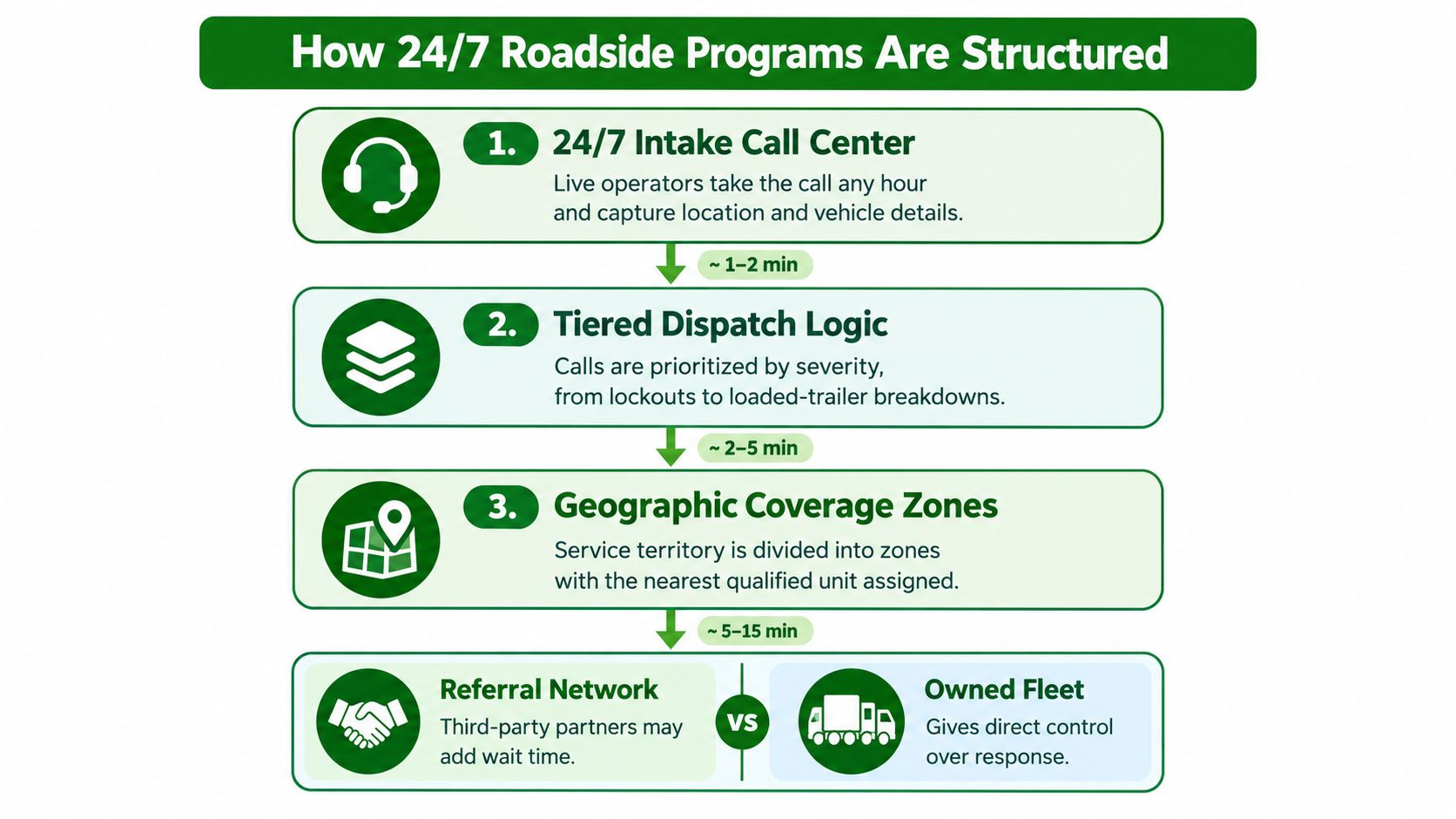
A round-the-clock roadside program usually has four working layers. The driver sees the phone number, but the result depends on what happens after the call connects.
First comes intake. A live agent records the location, vehicle type, symptoms, load, and immediate hazards. Commercial programs then use dispatch logic to rank the request. A loaded tractor-trailer blocking a travel lane requires a different response from a lockout on a parked vehicle.
Next comes provider selection. The program may use an owned service fleet, a contracted network, or a mixture of both. A referral network expands geographic reach, but every handoff can introduce uncertainty about equipment, arrival timing, billing, and heavy-duty qualifications. Direct control can make technical triage clearer, though no single provider has every tool or recovery asset in every corridor.
Coverage terms shape the actual response. A plan may limit roadside labor, define towing distance, exclude certain repairs, or pay only for specific services. A commercial program, for example, may cover up to one hour of labor for a non-accident mechanical or electrical breakdown, according to commercial roadside assistance coverage guidance. That can be enough for a battery or air-line repair, but not for a complex emissions diagnosis or component replacement.
Towing is not the same as repair
A towing-only benefit solves one problem, relocation. It doesn't necessarily solve the fault that stopped the truck. If the provider cannot read commercial fault codes, test the air system, or work on the truck's electrical and aftertreatment systems, the unit may reach a yard without becoming operational.
Emissions failures make that gap more serious. A DPF, EGR, SCR, or related sensor fault may require software-level diagnosis and a controlled repair plan. ABS modules and electronic engine systems also need more than a basic visual inspection. The best dispatch decision is the one that sends the correct capability first, not just the closest vehicle.
Light-Duty Help vs Heavy-Duty Recovery
A passenger-vehicle roadside membership and a commercial truck recovery program may use similar words, but they serve different equipment. A light-duty provider may be well prepared for a car battery, passenger tire, lockout, or short tow. That doesn't mean its truck can safely handle a loaded tractor-trailer or diagnose a modern diesel fault.
| Capability | Light-Duty Plan | Heavy-Duty Recovery |
|---|---|---|
| Vehicle fit | Passenger vehicles and light commercial units | Class 6, Class 7, Class 8 tractors and trailers |
| Tire response | Passenger or light-truck tire tools | Commercial steer, drive, trailer, and specialty tire equipment |
| Electrical work | Jump pack and basic testing | Commercial battery systems, charging circuits, starters, grounds, and wiring |
| Brake and air systems | Limited or unavailable | Air-brake inspection, pressure testing, air-line repair, and recovery judgment |
| Diagnostics | Basic scan capability | Truck-specific engine, transmission, ABS, and aftertreatment diagnostics |
| Recovery equipment | Light-duty tow vehicle | Equipment selected for tractor weight, trailer configuration, and load condition |
| Repair outcome | Often tow-focused | Roadside repair when practical, followed by controlled recovery when necessary |
| Coverage questions | General membership terms | Commercial exclusions, load restrictions, labor limits, and towing terms |
Read the exclusions before the shoulder becomes the office
A policy can say “roadside assistance” and still exclude parts, extended labor, unusual loads, or recovery beyond defined terms. Fleets should check whether the plan addresses loaded trailers, refrigerated equipment, hazardous materials, agricultural equipment, and oversized combinations.
The key question isn't whether a provider can send a truck. It's whether the provider can send the right truck with the right technician. A light-duty wrecker may arrive promptly and still be unable to move the disabled combination safely.
For owner-operators, the practical test is simple. Ask what happens after the first diagnosis, who authorizes a heavy recovery, where the unit goes, and whether the same team can continue the repair after towing. If the answers are vague, the plan may provide transportation without providing a dependable return to service.
Services You Can Expect Around the Clock
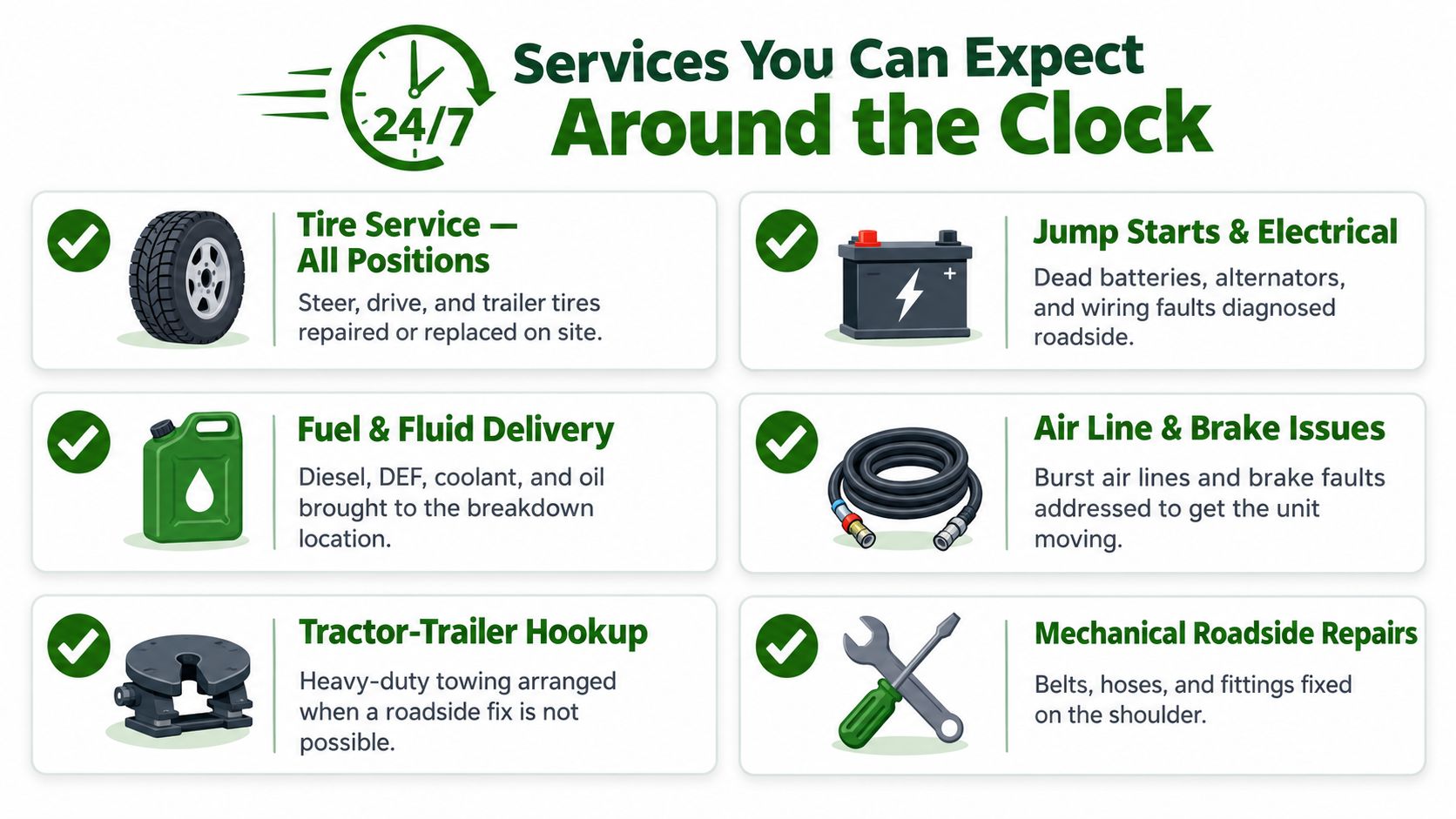
A heavy-duty mobile response should begin with triage and then match the service to the failure. The technician doesn't need to promise that every truck can be repaired beside the highway. The technician does need to arrive prepared to handle common commercial failures safely.
Tire service should cover tractor and trailer positions, including the equipment needed to remove, replace, inflate, and seat commercial tires. A steer-tire problem deserves a different safety assessment from a trailer tire issue, and a super-single requires the correct handling equipment.
Battery and electrical calls require more than a booster pack. The responder should determine whether the problem is a discharged battery bank, a failed alternator, a bad ground, a starter issue, or a wiring fault. A jump can get the engine turning, but it won't fix a charging system that will strand the truck again.
Fuel and fluid delivery can restore a unit stopped by an empty tank or a fluid shortage. Dispatch should confirm whether the truck needs diesel, diesel exhaust fluid, coolant, or another approved fluid, and the provider should account for local fuel-handling requirements.
Diagnosis comes before the fix
Lockouts can involve the cab, storage compartments, or a refrigerated trailer. Air-system calls may involve a burst line, fitting, valve, or pressure-control problem. A technician may also resolve a minor electrical fault, a belt or hose issue, or a fifth-wheel coupling concern without ordering a tow.
Aftertreatment calls need extra care. A scan tool can identify active faults and help determine whether a derate comes from a sensor, wiring, regeneration condition, or failed component. Some programs advertise rapid mobile triage, and one industry overview notes that certain providers report average response times of about 60 minutes and that 95% of shop services can be completed roadside. Those are provider claims described in commercial truck roadside assistance coverage information, not a guarantee for every location or failure.
A forced regeneration or reset may be appropriate in some situations, but a technician must still protect the driver, equipment, and public. The objective is a safe return to service, not a temporary code clear that leaves the underlying fault unresolved.
Where Roadside Work Stops and the Shop Begins
Mobile repair has a useful boundary. A technician can inspect, test, stabilize, and complete certain short repairs at the breakdown location, but a highway shoulder isn't a substitute for a service bay.
Commercial roadside coverage may define a labor threshold, such as up to one hour for a non-accident mechanical or electrical breakdown. That limit helps a provider control the event, but it also tells the driver what to expect. If diagnosis consumes the available labor allowance, the next decision may be a tow, additional authorization, or a shop appointment.
Common reasons to move the truck
A shop is usually the safer destination when the repair requires:
- A lift or heavy fixture: Component access, driveline work, and some suspension or brake repairs need stable equipment and controlled working space.
- Extended brake work: A brake chamber, valve, ABS sensor, or related fault may need more testing and replacement than a shoulder allows.
- Emissions component replacement: DPF, EGR, SCR, dosing, and sensor repairs can involve heat, contamination, software procedures, and compliance concerns.
- Deep electronic history: Intermittent faults may require stored data, wiring validation, parameter checks, and repeated testing that cannot be completed safely beside live traffic.
- A controlled regeneration: A regeneration process creates heat and needs a location that protects people, vehicles, vegetation, and nearby cargo.
The technician should explain the stopping point clearly. “We can't fix it here” is incomplete. The driver needs to know what was tested, which codes or pressures were found, whether the tractor is safe to move, and what recovery equipment the next step requires.
A roadside repair that leaves an unresolved brake or emissions fault can create a second breakdown. Good service isn't measured only by getting the truck moving. It also means refusing an unsafe shortcut when the shop is the correct answer.
How SAAT Repairs Delivers 24/7 Response
SAAT Repairs Corp provides heavy-duty mobile response and in-shop repair for trucks operating through Tampa, Lakeland, and nearby Florida corridors. Its direct dispatch model connects the breakdown with a heavy-duty service process instead of treating a Class 8 failure like a passenger-vehicle call.
That distinction matters during technical triage. The dispatcher needs to establish whether the tractor is loaded or bobtail, whether the trailer can remain connected, whether the truck has air pressure, and whether the dash shows an engine or aftertreatment fault. Those details influence whether a mobile repair unit, a recovery vehicle, or a shop appointment is appropriate.
The mobile and in-shop sides also need to work together. A field technician may identify the fault, make a safe temporary repair, document diagnostic information, and arrange the next step when the repair needs controlled equipment or replacement components. That continuity reduces the risk of repeating the same story to a new provider after the tow.
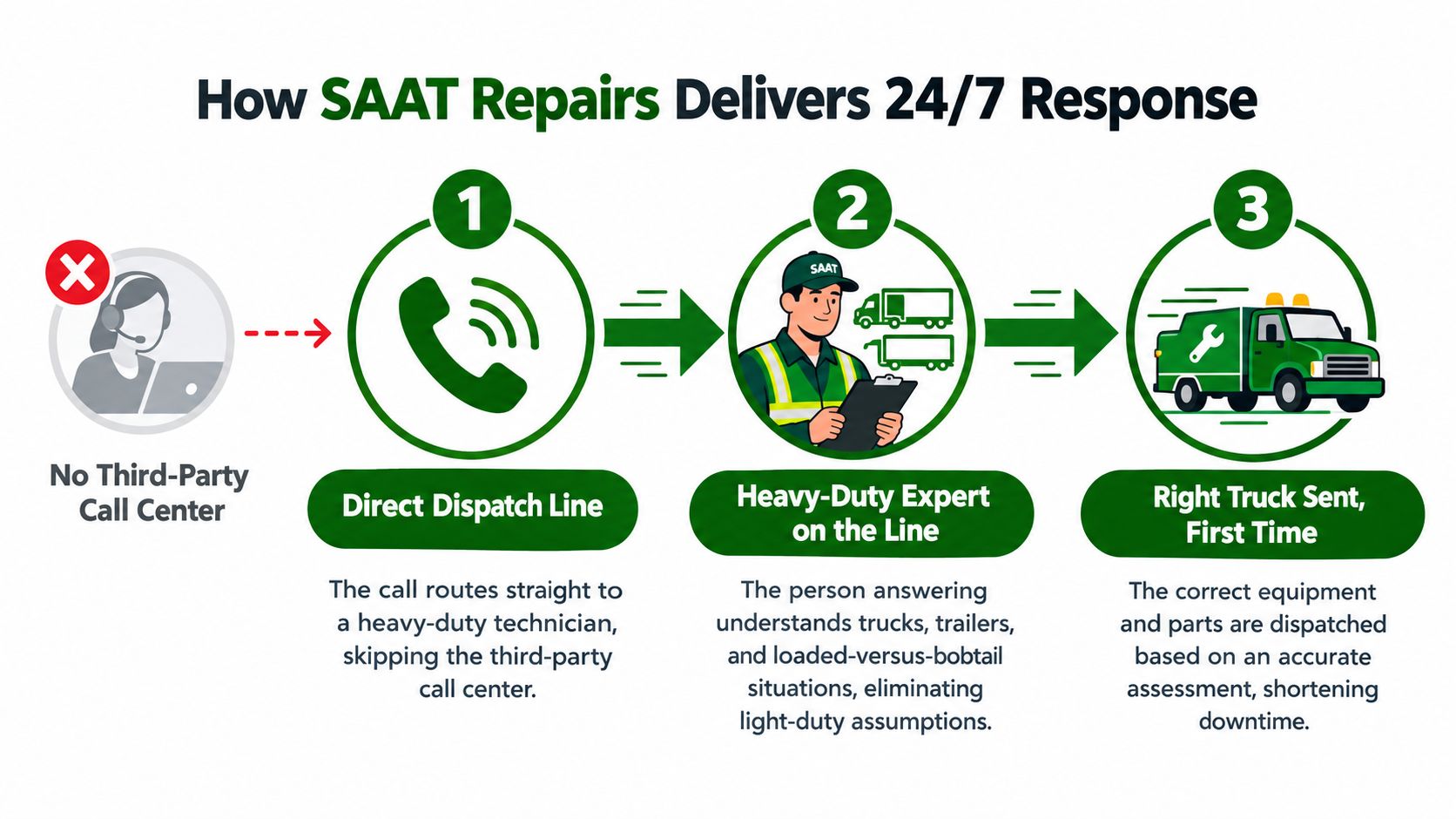
For a fleet manager or owner-operator, the useful question is whether the responder can work across mechanical, electrical, diagnostic, and emissions-related faults. A nonstop response becomes valuable when the person answering can make a sound equipment decision before dispatch.
The SAAT Repairs Corp heavy-duty service team is one local option for coordinating mobile and shop-based truck repair in the Tampa and Lakeland area.
What to Have Ready Before You Call
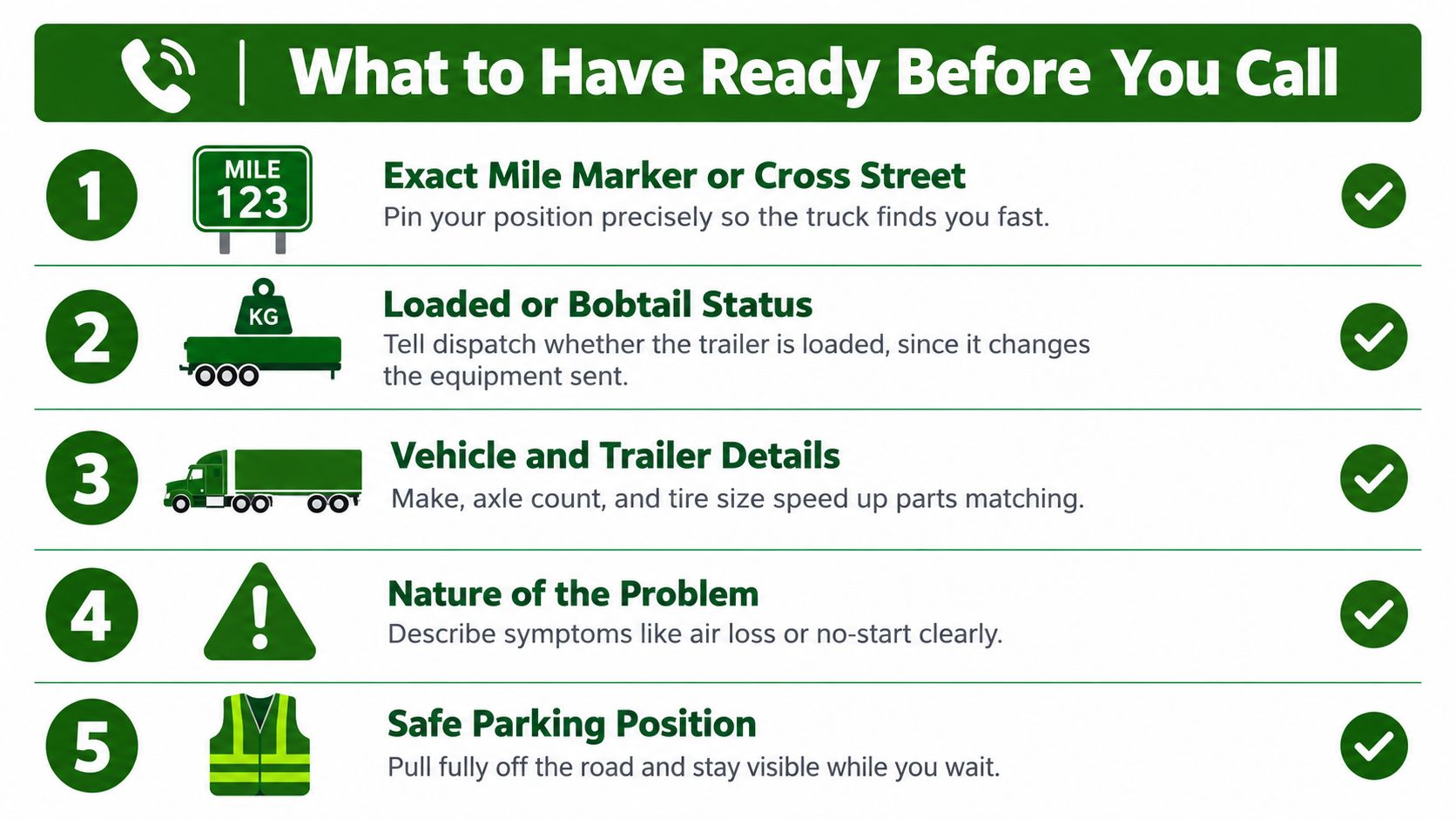
The driver can improve the first dispatch decision by collecting the information a technician needs. Safety comes first. Move as far from active traffic as conditions allow, use hazard lighting, and follow site-specific emergency instructions.
Have these details ready:
- Exact location: Give the mile marker, direction of travel, nearest cross street, exit, or recognizable landmark.
- Load status: Say whether the tractor is loaded, bobtail, hauling a refrigerated trailer, or carrying a restricted load.
- Vehicle information: Provide the unit number, tractor and trailer details, engine family if known, and tire or axle information.
- Failure symptoms: Describe air loss, no-start behavior, smoke, warning lights, derate messages, fluid leaks, tire damage, or electrical symptoms.
- Movement status: Tell dispatch whether the truck can roll under its own power, hold air pressure, and remain safely parked.
- Scene conditions: Report fuel leaks, fire risk, traffic exposure, damaged cargo, or any reason the technician should approach cautiously.
Photograph the dash cluster, visible damage, and fluid on the ground if it's safe to do so. A clear image can help the technician bring a likely connector, hose, tire, or diagnostic tool instead of spending the first part of the response identifying the basic failure.
Keep registration, insurance, and fleet authorization information accessible. If the call becomes a recovery event, those documents may be needed for authorization and site coordination. Drivers who prefer Spanish-language communication can also use the SAAT Repairs Corp Spanish service page when arranging assistance.
For heavy-duty trucks in Tampa, Lakeland, and surrounding Florida corridors, SAAT Repairs Corp offers 24/7 mobile roadside assistance alongside in-shop diagnostics and repair. If your next breakdown involves an air system, tire, electrical fault, emissions issue, or truck that needs safe recovery, contact SAAT Repairs Corp and give the dispatcher the location, load status, and symptoms before the service truck rolls.
Created with Outrank tool