A Freightliner Cascadia with a DD15 engine can show electronic symptoms that are easy to misread. Warning lights, derate messages, communication codes, no-start complaints, repeated sensor faults, or module-related messages can make it look like the truck needs programming or a new module right away.
Sometimes programming is part of the correct repair. Sometimes a module replacement is needed. But those decisions should follow diagnostics, not guessing.
SAAT Repairs Corp provides mobile truck repair, electrical diagnostics, advanced diagnostics, and software programming support for commercial trucks in Tampa, Lakeland, and nearby areas. This guide explains what should be checked before programming or replacing modules on a Cascadia DD15.
Why electrical symptoms can look like programming problems
Modern commercial trucks depend on communication between modules, sensors, wiring, power, ground, and software. When one part of that system is unstable, the symptom can appear as a programming problem even when the root cause is electrical or mechanical.
For example:
Weak batteries can create communication issues.
Poor grounds can cause intermittent faults.
Damaged wiring can interrupt module signals.
A loose connector can create repeated codes.
A previous repair can disturb a harness or electrical connection.
If the truck is programmed or a module is replaced before those conditions are checked, the repair path can become longer and more expensive.
Common complaints that need careful diagnostics
Cascadia DD15 electrical and programming-related complaints can appear in different ways:
No-start or intermittent start condition.
Engine derate.
Warning lights that return after clearing.
Communication fault codes.
Loss of communication with a module.
Repeated sensor codes.
Symptoms after battery, wiring, module, or sensor work.
A truck that runs but does not behave normally after a repair.
These complaints do not prove that programming is required. They show that the truck needs a structured diagnostic approach.
What should be checked first
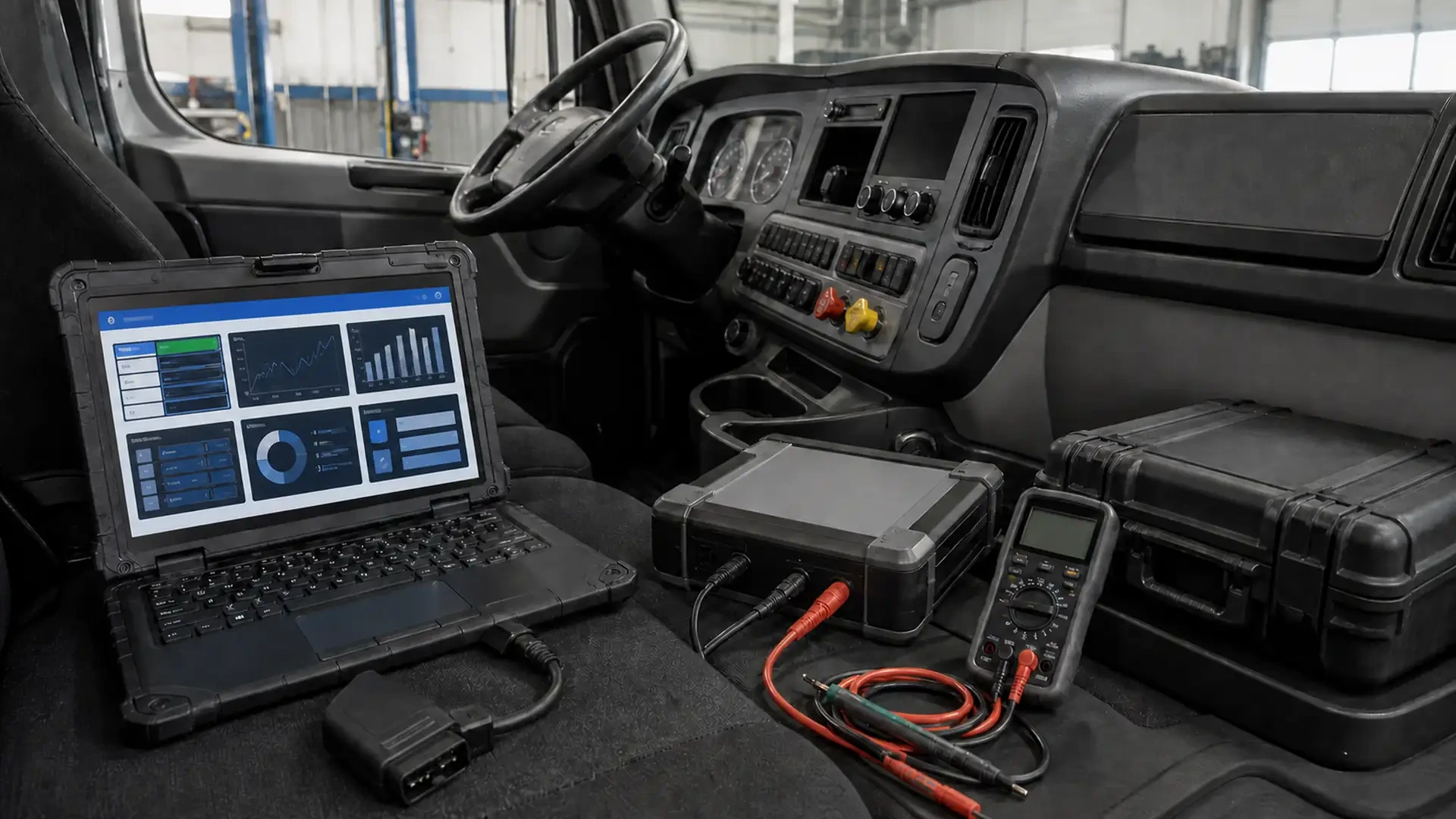
Before programming or replacing a module, several checks can help separate a software need from an electrical or mechanical problem.
Battery voltage and charging condition
Stable voltage matters for diagnostics and programming. Low voltage, weak batteries, loose cables, poor charging, or voltage drops can create symptoms that look like module failure.
During programming, voltage stability becomes even more important. A voltage drop during communication can interrupt the process and create additional problems.
Grounds, connectors, and harness condition
Grounds, connectors, and harnesses should be inspected when the truck has communication faults or intermittent symptoms. Corrosion, damage, loose connections, or disturbed wiring can cause repeated problems.
If the complaint began after recent service, the technician should review the area that was touched first.
Module communication
The technician should confirm whether the correct module is communicating and whether communication is stable. If the diagnostic or programming tool cannot communicate properly, the reason should be investigated before moving forward.
Communication problems may come from power, ground, data lines, connectors, network issues, or the module itself.
Fault codes and operating conditions
Fault codes are useful, but they need context. A code should be reviewed with the symptom, timing, load condition, temperature, recent repairs, and whether the truck derated or stopped.
A code by itself does not always identify the failed part.
Recent repairs or replaced parts
Recent repair history can be one of the strongest clues. If symptoms appeared after battery work, module replacement, sensor service, harness repair, or software work, that information should guide the diagnostic path.
Drivers and fleets should share recent repairs before the technician begins.
When programming may be part of the repair
Programming may be part of the correct service path when diagnostics confirm a software, calibration, configuration, or module-related need. It can also be necessary after certain module replacements or repair procedures.
The important point is that programming should be performed under controlled conditions, with stable voltage, correct identification, and clear service direction.
Programming is not a shortcut around diagnosis. It is a technical step that should support the right repair.
When replacing a module may be premature
Replacing a module may be premature if:
Power and ground have not been checked.
Batteries or charging are weak.
Wiring or connectors have not been inspected.
Communication faults are intermittent.
The issue started after unrelated service.
The same fault returned after previous parts were replaced.
Before authorizing module replacement, fleets should ask whether the root cause has been confirmed or whether the truck still needs further diagnostics.
What fleets should prepare before requesting mobile diagnostics
Before requesting mobile diagnostics or programming support, prepare:
Exact truck location.
Year, make, model, and engine.
VIN if requested.
Unit number.
Driver contact.
Main complaint.
Warning lights or dashboard messages.
Fault code report if available.
Whether the truck starts, runs, derates, or will not communicate.
Recent repairs or parts replaced.
Battery or electrical history.
Photos of dashboard messages or affected areas, if safe.
Clear information helps the service call start with useful context.
Contact SAAT Repairs Corp
If your Cascadia DD15 has electrical symptoms, communication faults, suspected programming needs, or repeated module-related codes, contact SAAT Repairs Corp for mobile diagnostics and truck repair support in Tampa, Lakeland, and nearby areas.
Have the truck location, symptoms, warning messages, and recent repair history ready before calling.
Need mobile diagnostics for a Cascadia DD15 before programming or module replacement? Contact SAAT Repairs Corp in Tampa, Lakeland, or nearby areas and prepare the truck details, symptoms, codes, and recent repair history.