Modern trucks can make repair decisions complicated. A 2022 Freightliner Cascadia with a DD15 engine may show warning lights, derate messages, communication faults, no-start symptoms, or repeated codes. When that happens, it is easy to assume the truck needs a new part or immediate programming.
Sometimes it does. Sometimes it does not.
The better approach is to diagnose first, then decide. Programming, module work, electrical repair, and mechanical repair should all follow evidence from the truck.
SAAT Repairs Corp provides mobile truck repair, advanced diagnostics, and software programming support for commercial trucks in Tampa, Lakeland, and nearby areas.
Programming is not always the first repair
Programming can be part of a correct repair, especially when a module has been replaced, a configuration must be completed, or a software-related step is required after diagnosis.
But programming should not be used as a guess. If the truck has a voltage problem, damaged wiring, weak batteries, bad grounds, a failed sensor, or a mechanical issue, software work may not solve the root cause.
This matters because replacing parts without diagnosis can waste time, and programming without stable conditions can create more problems.
Common situations that may lead to programming
A Cascadia DD15 may need programming or software-related support in situations such as:
Module replacement.
Software configuration after a repair.
Communication issues between systems.
Recurring fault codes after related repairs.
Calibration or setup steps required by the service path.
Diagnostic work that confirms a software or module-related need.
The exact service path depends on the truck, the fault, the module, and the condition of the electrical system.
Warning signs that need deeper diagnostics
Some symptoms should be treated as signs to diagnose carefully before replacing parts:
No-start condition.
Intermittent crank or start issues.
Engine derate.
Warning lights that return after clearing.
Communication codes.
Repeated sensor faults.
Loss of power after recent electrical work.
Problems that started after battery, module, harness, or connector service.
These symptoms do not automatically mean programming is needed. They mean the technician should slow down and inspect the system properly.
What should be checked before replacing parts
Before a driver or fleet spends money on parts, several basic checks can help point the repair in the right direction.
Battery and voltage condition
Electronic systems need stable voltage. Weak batteries, poor charging, voltage drop, or unstable power can create symptoms that look like module or software problems.
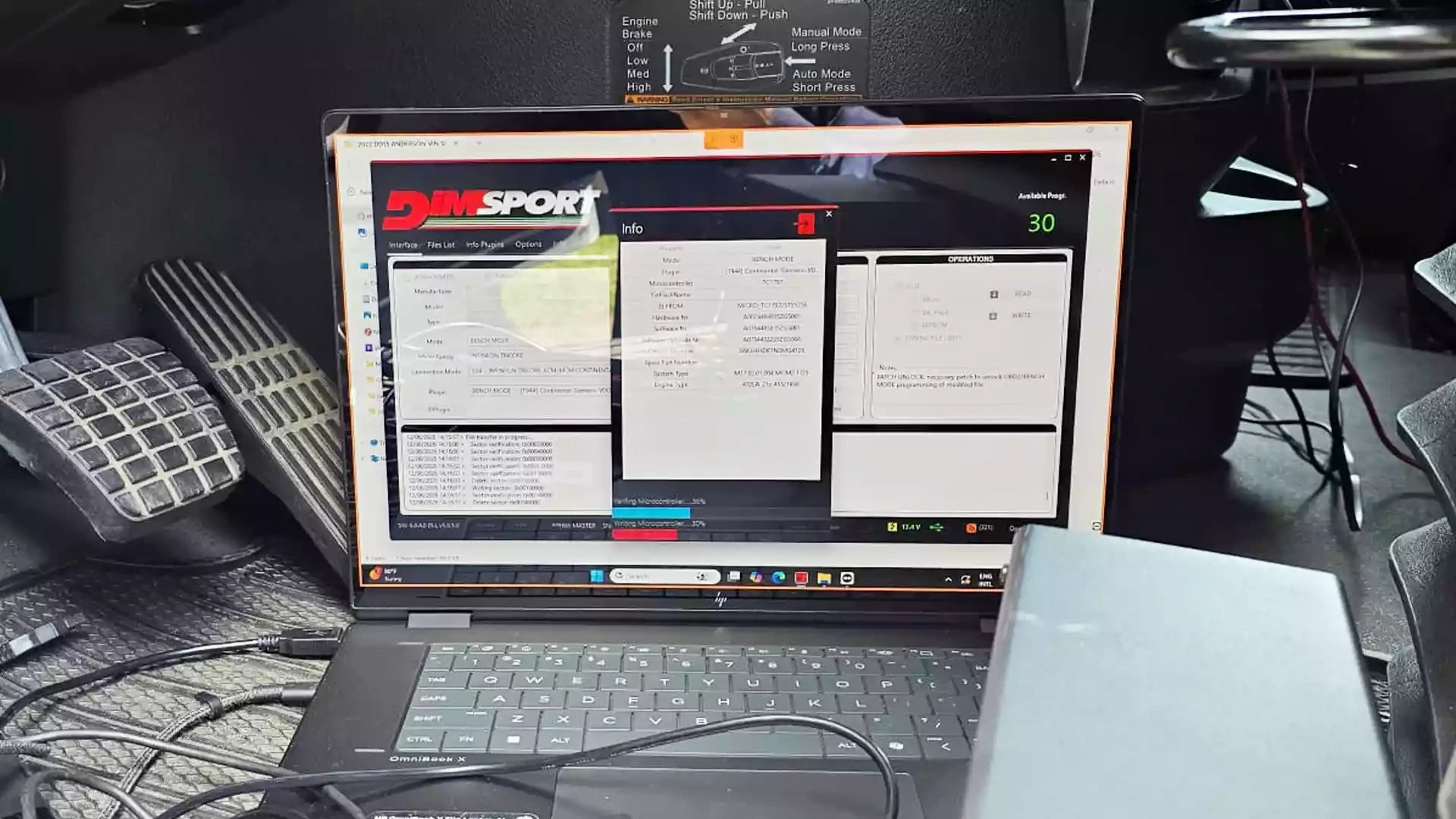
During programming, stable voltage is even more important. The client-provided images show power support equipment near the diagnostic setup, which is a useful reminder that the electrical environment matters.
Wiring, grounds, and connectors
Wiring issues can cause confusing symptoms. A loose connector, corroded terminal, damaged harness, poor ground, or disturbed wiring after a repair can affect communication.
If wiring is the real issue, replacing a module may not solve the problem.
Module communication
The technician should confirm whether the proper module communicates with the diagnostic or programming equipment. If communication is missing or unstable, the reason must be investigated before moving forward.
Communication problems can come from power, ground, data lines, connectors, network issues, or the module itself.
Repair history and recent changes
Recent repair history can provide the best clue. If the issue began after a module replacement, battery work, wiring repair, sensor replacement, or another service, that information should guide the diagnostic path.
Drivers and fleet managers should share these details before the technician begins.
How mobile diagnostics can help
Mobile diagnostics can help evaluate the truck where it is located. That can be useful when the truck is at a yard, delivery location, parking area, or roadside stop and the operator is unsure whether it can move safely.
With the right information and conditions, a mobile technician can inspect symptoms, check communication, review codes, evaluate voltage stability, and decide whether programming is part of the solution.
The goal is not to guess faster. The goal is to make the next decision with better information.
What fleets should document
For fleets, documentation can reduce repeated downtime. Keep track of:
Date and location of the issue.
Driver complaint.
Dashboard messages.
Fault codes if available.
Recent repairs.
Parts already replaced.
Battery or electrical work.
Whether the issue is constant or intermittent.
Photos or videos when safe.
This information helps the technician see patterns and avoid starting from zero.
Why this matters for downtime
Downtime is not only the time spent repairing the truck. It also includes the time spent guessing, moving the unit, waiting for parts that may not be needed, or repeating repairs that do not solve the issue.
For a Cascadia DD15, a careful diagnostic approach can help separate software needs from electrical or mechanical problems. That separation protects time, budget, and route planning.
Contact SAAT Repairs Corp
If your Cascadia DD15 has warning lights, communication issues, derate symptoms, or a suspected programming need, contact SAAT Repairs Corp for mobile diagnostics and truck repair support in Tampa, Lakeland, and nearby areas.
Share the truck location, symptoms, recent repairs, warning messages, and photos if available.