The most common advice about DEF pump failure symptoms is also the most expensive mistake fleet teams make. A warning light appears, a low-pressure code sets, power drops, and someone orders a pump. That sequence treats a symptom as if it were a diagnosis, and it skips the step that matters: finding where in the reductant circuit pressure was lost.
A DEF pump doesn't work alone. It draws fluid through a tank, vent, pickup screen, lines, and fittings, then pushes it toward a dosing valve while sensors report what happened. A failure at any point in that chain can produce the same low-pressure reading at the pump. So the useful question isn't, "Which part should be replaced first?" It's, "What evidence separates a failed pump from a restriction, leak, contaminated fluid, frozen fluid, or wiring fault?" Operators around Tampa and Lakeland who answer that question before ordering parts avoid installing a new pump into the same fault that disabled the old one.
Table of Contents
- DEF Pump Failure Symptoms at a Glance
- Why a DEF Pump Symptom Does Not Prove Pump Failure
- How to Run a Roadside Pressure Check Safely
- What to Document Before Parts Are Ordered
- How Long a DEF Derate Gives and What Mobile Work Covers
- Arrange Mobile DEF Pump Diagnostics Before the Derate Tightens
DEF Pump Failure Symptoms at a Glance
The six signs below tend to arrive in roughly this order. Each one points toward missing or inadequate reductant delivery, not yet toward a specific failed part.
| Symptom | What the Reader Sees | First Check |
|---|---|---|
| Low-pressure code | P20E8 or related low-pressure code | Capture code and freeze-frame data |
| DEF warning and malfunction lamp | DEF warning displayed with the malfunction lamp lit | Record the warning sequence and time of first alert |
| Missing or low DEF dosing | No dosing or inadequate dosing in emissions data | Run a commanded pressure-build test |
| Emissions derate | Speed or torque limit after the warning period | Note time since first warning and current limit |
| Reduced engine power | Power loss tied to the DEF warning | Compare power loss timing with the warning sequence |
| No audible pump operation | Pump is silent during activation | Check activation and power supply, then recheck pump operation |
What Each Sign Actually Means
A failing pump typically presents as a reductant-pressure fault, commonly DTC P20E8 or related low-pressure codes, because it can't build or maintain the pressure the dosing valve requires, according to a manufacturer troubleshooting procedure filed with NHTSA. The same document lists the practical pattern drivers notice, a DEF-system warning, malfunction-indicator lamp, absent or inadequate dosing, reduced power, and an emissions-related speed derate. Read those signs as a sequence. The code and lamp usually come first, dosing data confirms delivery is missing, and the derate follows once the control system has waited long enough.
The audible check sits at the end of the table for a reason. That troubleshooting procedure directs technicians to command a pressure-build test and verify the pump runs audibly for at least five minutes. If it's silent, power, activation, and wiring come before any conclusion about the pump itself. If it runs but pressure still doesn't build, the inlet fitting and its screen get checked before the pump is condemned.
Keep DEF Symptoms Separate From Fuel Symptoms
Drivers sometimes confuse a DEF pump with the diesel high-pressure fuel pump, and the two produce very different patterns. A 2024 National Highway Traffic Safety Administration investigation of a 6.7-liter diesel fuel system listed crank-no-start, long crank or hard start, rough running, reduced power, engine knocking, exhaust smoke, and slowly building fuel-rail pressure as fuel-side symptoms. A DEF fault shows up instead through reductant-pressure codes and the DEF warning sequence. Mixing the two systems sends a technician to the wrong end of the truck.
Record three things immediately, before anyone clears anything. Capture the exact code, the sequence of warnings, and the time the symptom first appeared. Those three facts cost nothing and shape every test that follows.
Why a DEF Pump Symptom Does Not Prove Pump Failure
The replacement-first habit is understandable. A truck is loaded, a delivery window is closing, the dash is showing a DEF warning, and swapping a pump feels like decisive action. But decisiveness without evidence often buys the same breakdown twice.
Consider the circuit as a chain. Fluid sits in the tank, air enters through the vent as fluid leaves, the pickup screen strains what the pump draws, lines and fittings carry it, the pump pressurizes it, and the dosing valve delivers it. A weak link anywhere produces the same low-pressure reading at the pump. The symptom therefore tells a technician where to look in the circuit, not which part broke. That's the distinction most short symptom lists leave out.
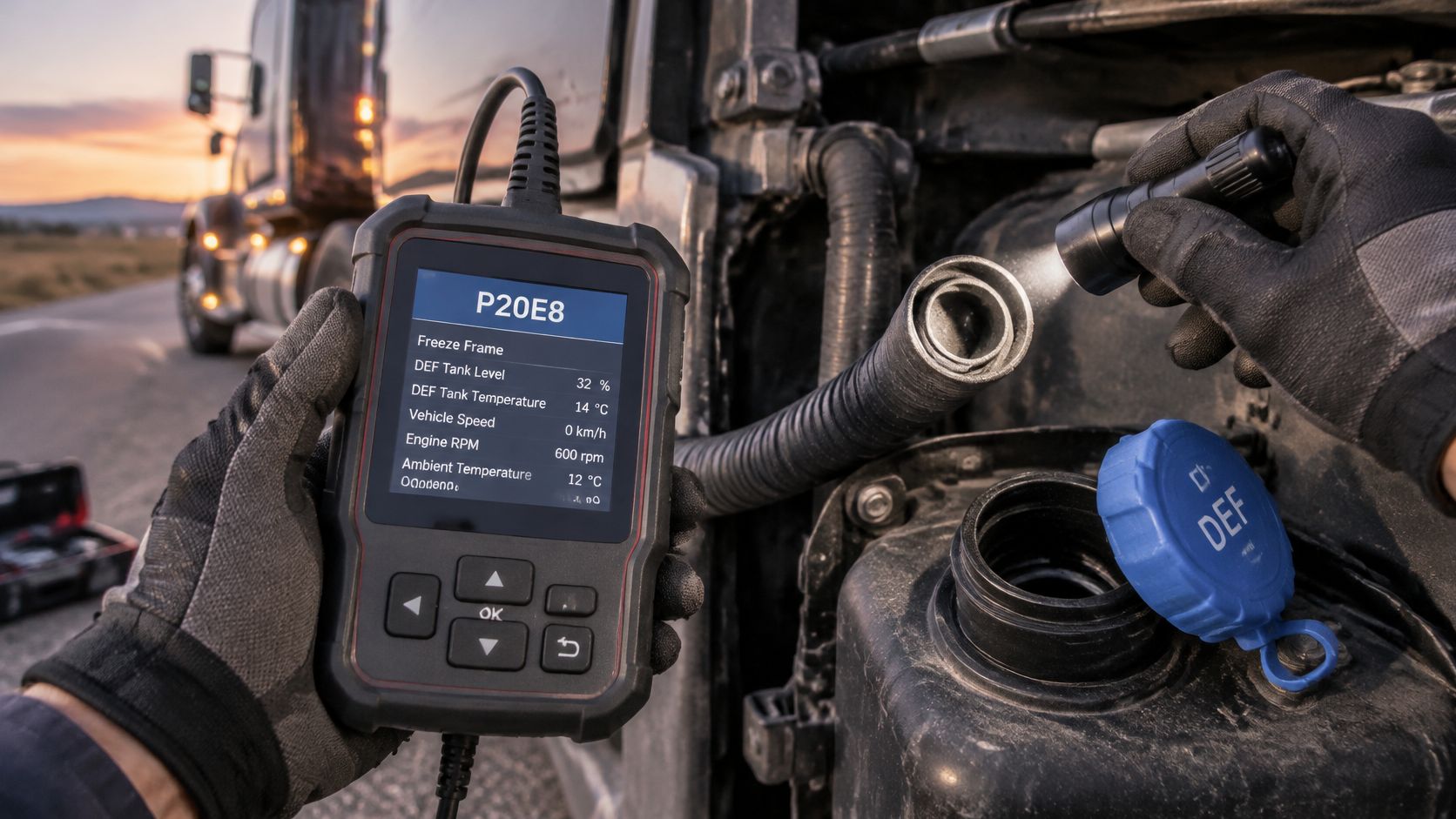
Manufacturer service documentation in a 2019 bulletin filed with NHTSA shows low DEF pressure can also result from a restricted pickup-tube screen, blocked tank vent, restricted pump line or inlet connector, contamination introduced during refilling, an external leak, or a leaking injector. None of those is a pump. Replace the pump while a restriction remains, and the new unit starves the same way the old one appeared to. The truck returns with the same warning, and the fleet has paid for a part plus another round of downtime.
Sorting Causes That Look Identical
| Cause | Pump-Like Symptom | Evidence That Separates It |
|---|---|---|
| Internal pump failure | Low pressure after a pressure-build test | Internal fault codes and no restriction found upstream |
| Clogged pickup screen | Low pressure with the pump running | Restriction found at the inlet fitting and screen |
| Blocked tank vent | Low pressure or a sudden dosing drop | Vent restriction or vacuum at the tank |
| Restricted supply line or connector | Low pressure at the pump | Restriction found at the line or inlet connector |
| External leak | Low pressure with visible fluid | Wet or crystallized residue at fittings and lines |
| Dosing-valve leak | Low pressure with residue near the injector | Leak at the valve rather than at the pump |
| Contaminated DEF | Dosing faults that may show no codes | Fluid sample and timing relative to refilling |
| Frozen or crystallized fluid | Intermittent fault after cold exposure or parking | Crystals present and fault timing matches cold periods |
| Pressure sensor or wiring fault | Pressure reading disagrees with commanded pressure | Harness and sensor checks show the fault |
Read the right-hand column as the actual diagnostic work. Internal pump failure is the one cause that generates specific fault codes for the pump itself, while external leaks and restrictions are found by inspection and pressure testing. Fleets evaluating related aftertreatment signals can compare that logic with how a DPF differential pressure sensor reading is interpreted, where the sensor value likewise describes a condition rather than naming a failed part.
Two Traps That Catch Experienced Teams
The first trap is trusting a clean scan. A Volvo/Mack technical bulletin filed with NHTSA explicitly warns that DEF contamination can exist without accompanying diagnostic trouble codes, so a clear readout shouldn't eliminate contamination when symptoms are present. A truck can dose poorly, warn the driver, and still show no code pointing at fluid quality. Teams that treat "no codes" as "no problem" close the case too early.
The second trap is ignoring timing. Timing is evidence, and it's free.
- Fault right after refilling: That pattern points toward contamination or the filling path, so the fluid and the filler area get attention before the pump does.
- Intermittent fault after parking or cold exposure: That pattern points toward freezing, venting, connectors, or crystallization, because the truck's condition changed while it sat still.
- Fault only under sustained load: That pattern suggests delivery that can't keep up with demand, which makes restrictions and weak supply worth testing.
A symptom names the circuit that is unhappy. Only a test names the part.
What Can Be Settled at the Vehicle
Several checks are safe and useful where the truck sits. A visual inspection for white crystallization, connector and harness checks, scan-tool code capture, and confirmation of commanded versus actual pressure can often be completed at the vehicle. Deeper work, such as controlled testing of a removed component or tank and aftertreatment repairs that need lifting equipment and containment, may not be safe to finish roadside. That's not a failure of mobile diagnosis. A truck can be diagnosed accurately at its location even when the eventual repair belongs somewhere with more room and equipment.
The calm conclusion is this. A warning light, derate, or P20E8 code justifies testing, not a parts order. Fleets that hold that line spend less on pumps they never needed.
How to Run a Roadside Pressure Check Safely
Order matters more than speed here. Each step either protects the next result from being misread or rules out a cheap cause before an expensive one gets blamed. Skipping ahead is how a clogged screen turns into a pump invoice.

Safe access comes before technique. A technician needs stable ground, clearance from traffic, and room to work around the tank and lines without rushing.
The Eight Steps in Order
- Capture every active and stored code with freeze-frame data, and note the time of the first warning. This comes first because clearing codes destroys the sequence. The common slip is resetting the warning to see if it returns, which erases the best evidence available.
- Verify fluid level and check the tank vent for blockage. A pump can't pressurize fluid it can't draw, and a blocked vent lets vacuum build as fluid leaves. Skipping the vent is the classic oversight, because it's small and quiet.
- Inspect the pump, lines, and inlet fitting for leaks and white crystallization. Residue marks where fluid escaped and dried. Photographs taken now are worth more than descriptions written later.
- Check connectors and the harness for damage, then confirm power and ground at the pump. Electrical supply has to be proven before a silent or weak pump means anything. Corrosion, chafing, and loose pins imitate component failure convincingly.
- Activate the pump and confirm it runs audibly for at least five minutes. Listening separates "not commanded or not powered" from "running but not delivering." Those are different faults with different repairs.
- Run the commanded pressure-build test and record the reading. Write down commanded and measured values together. A lone number without its commanded partner can't be interpreted later.
- If pressure still doesn't build, check the inlet fitting and its screen before condemning the pump. This step exists because a restricted inlet starves a healthy pump into looking failed.
- If a newly installed pump fails its test, repeat the leak test after the system sits overnight so a dry filter can re-saturate. Judging a new pump on a dry-filter test can condemn good parts and restart the whole cycle.
Practical rule: Don't cycle the system repeatedly when pressure isn't building. Repeated attempts add heat and confusion, and they don't add information.
Recording the Result So It Stays Useful
Every test should end in one of three recorded outcomes, each with a clear next step.
- Pass: Pressure builds and holds as commanded. The pump is working, so attention moves upstream or downstream to restrictions, leaks, or dosing hardware.
- Fail, with the actual reading: Pressure doesn't reach or hold the commanded value. The recorded numbers, plus where residue or restriction was found, decide whether the fault is internal or external.
- Inconclusive: Access, equipment, temperature, or an unsaturated filter prevented a valid test. The honest next step is a repeat under controlled conditions rather than a guess dressed up as a result.
Some steps need scan tools, command functions, and controlled conditions, so roadside feasibility is case-specific. A technician may complete the early steps at the vehicle and still recommend that controlled retesting happen elsewhere. That boundary protects the diagnosis. A pressure test run badly is worse than one postponed, because a bad number gets quoted for the rest of the repair.
What to Document Before Parts Are Ordered
Good notes turn a roadside guess into a decision someone else can audit. They also protect the fleet when a driver, dispatcher, and technician each hold part of the story. The checklist below takes minutes and prevents the most common ordering errors.
The Minimum Record
- Exact codes and freeze-frame data: Include stored codes, not only active ones, plus the warning sequence and time since the first alert.
- Symptom pattern: State whether the fault followed refueling, appeared on a cold start, showed only under load, or started after parking.
- Ambient temperature and recent fluid stops: Log the temperature and any recent DEF fill or fuel stop, with location if known.
- Photographs before cleaning: Photograph residue, crystals, and leaks first. Cleaning first and describing later removes the evidence.
- Fluid sample when contamination is suspected: Label it with the date, location, and vehicle so it can be tied to the event.
- Every pressure reading: Record commanded and measured values together, and list recent filter, vent, or DEF system work.
Dispatchers sending this information ahead can use the same discipline described in what to send when requesting mobile truck repair near Tampa or Lakeland, because a technician arriving with codes and photos starts testing instead of interviewing.
How Notes Change the Diagnosis
Hypothetical scenario: Truck A shows a low-pressure code shortly after a DEF fill, with crystals visible at the inlet. Its record points toward the fluid or the filling path, so a sample and inlet inspection come first. Truck B in the same fleet has an intermittent fault after cold nights, loose connectors, and no crystals. Its record points toward cold exposure and connectors, so harness checks and venting come first. Both trucks showed similar warnings. The notes sent each one down a different, cheaper path.
Write "unknown" rather than guessing. A record that states what wasn't verified protects the next decision.
That last habit is underrated. A blank filled with a confident guess gets treated as a fact by everyone downstream. An honest unknown invites a test, which is exactly what the situation needs.
How Long a DEF Derate Gives and What Mobile Work Covers
A DEF warning does not identify a failed pump, and the derate countdown does not diagnose the cause. One manufacturer bulletin filed with NHTSA describes a warning that may remain for approximately 80 km (50 mi) after a pressure fault is recorded, before the vehicle is limited to 8 km/h (5 mph). Reduced turbo acceleration may also occur. This is one documented pattern, not a universal schedule.
Possible causes of insufficient DEF dosage include pump leakage, a clogged or damaged filter, blocked ventilation, low fluid, air in the circuit, crystallization inside the pump, a defective pressure sensor, or dosing-valve leakage. These faults can trigger similar warnings, so the code and derate timing alone cannot establish which part needs repair. For context on how these alerts fit into the wider warning picture, see what an emission system problem message means.
| Task | Roadside Feasibility | When an External Facility May Be Needed |
|---|---|---|
| Code capture and scan-tool data review | Often practical when safe access exists | Specialized software or equipment is unavailable at the site |
| Visual check for leaks and crystallization | Often practical | A removed component or fluid sample needs controlled testing |
| Commanded pressure-build test | Case-specific, depending on access and equipment | Repeated tests fail and the component needs testing off the vehicle |
| Inlet screen, line or tank-vent repair | Case-specific | Repair requires a controlled environment or parts that cannot be installed safely at the roadside |
| Pump or dosing-valve replacement | Case-specific | Safe access, parts or time are not available at the roadside |
| Emissions derate reset after repair | Case-specific | Verification requires controlled conditions or additional system checks |
Tank replacement and larger aftertreatment work may require a suitable external facility, such as the fleet's preferred repair facility. That is separate from the derate countdown: a truck approaching the bulletin's 80 km limit should be routed before it reaches the 8 km/h restriction, rather than relying on the remaining distance as a repair window.
Arrange Mobile DEF Pump Diagnostics Before the Derate Tightens
A DEF pump warning is one suspect on a short list. Restricted lines, leaks, contaminated or frozen fluid, and wiring faults can raise the same message, the way a check-engine lamp points at a system and still leaves the failed piece unproven. Call for the test while the truck can still be moved to a safe place to work.
Send the documentation checklist as one packet before anyone is dispatched. That record lets the first hour go to measurements instead of rebuilding the story at the shoulder.
SAAT Repairs Corp operates only as mobile Road Services and has no customer-facing workshop, so the truck is not brought to a SAAT site. Technicians come to the vehicle across Tampa and Lakeland and use diagnostic tools to identify the issue there. Customers outside those immediate areas should contact SAAT Repairs Corp to confirm coverage.
If the stop cannot support the repair, the technician will say so. The next stop is an external facility, not a SAAT location. Any arrival estimate stays conditional on location, traffic, technician availability, and the job, so no fixed time is promised.
Fleet managers and owner-operators with an active warning can contact SAAT with that record already in hand. A clear packet shortens the visit and holds the parts decision until the evidence is in.
When DEF pump failure symptoms put a truck on a derate countdown, SAAT Repairs Corp provides mobile diagnostics at the vehicle location across Tampa, Lakeland, and nearby Florida, testing the circuit before any part is condemned. Share the codes, warning timeline, and photos so the first visit produces evidence instead of guesses. Start through SAAT Repairs Corp and describe where the truck sits and what the dash is showing.