An emission system problem means the engine control module has detected that the parts controlling exhaust pollutants are not performing within expected limits, or that a monitored part reports implausible data. That's the whole answer a driver gets from the dash, and it's not enough to order a part.
Say a dispatcher in Lakeland gets a call from a driver headed toward Tampa. The truck still runs, but an emissions warning is on, power feels soft, and the driver wants to know whether to keep rolling or pull off now. That decision can't come from the warning text alone, because the same message can point to soot load, a sensor, wiring, software, or a dosing fault.
Understanding what does emission system problem mean starts with treating the lamp as a symptom report, not a diagnosis. The sections below walk through what the system includes, how lamp patterns set urgency, which checks come before part replacement, and what to record so a technician can separate a simple regeneration request from a fault that will derate the truck.
Table of Contents
- What an Emission System Problem Actually Means
- Warning Lamp Patterns and First Steps to Take
- Root Causes Behind the Warning
- Operational Impacts, Derates and Compliance Exposure
- Information to Record for the Technician
- Decide Between Roadside Repair and an External Facility
What an Emission System Problem Actually Means
A driver looks down and the dash says "Emission System Problem" or "Exhaust Filter" while the truck is still under load. That line names a monitored system. The lamp is a symptom report from the engine control module, not a part name. The module has seen exhaust control outside expected limits, or a reading that does not add up.
Parts That Can Trigger the Same Warning
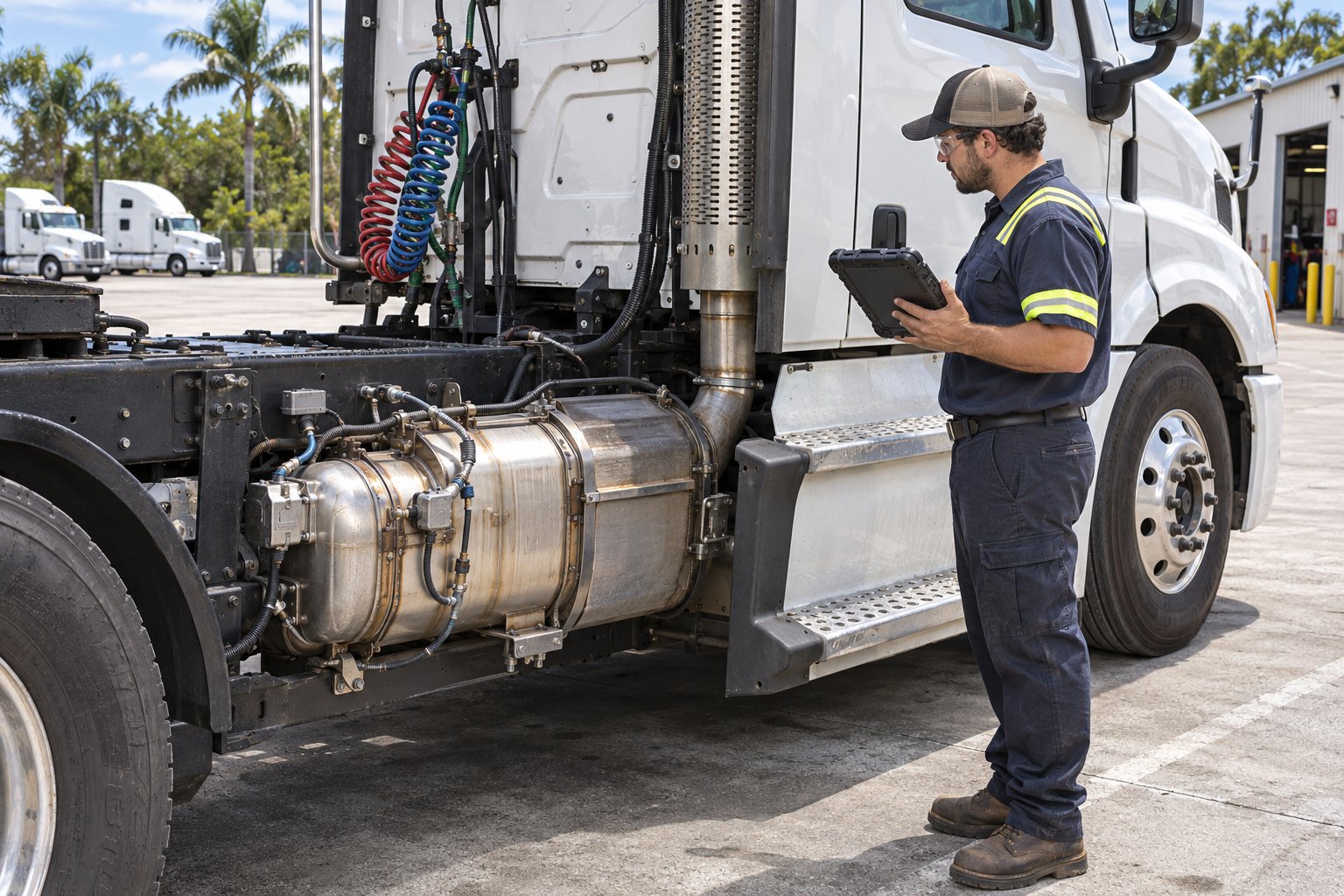
One message sits in front of several layers: exhaust-gas recirculation (EGR), the diesel oxidation catalyst, the diesel particulate filter (DPF), selective catalytic reduction (SCR), DEF dosing, temperature and pressure sensors, NOx sensors, wiring, and engine-control software.
A tripped breaker on a fuse panel can come from the appliance, the wire, or the breaker. An emissions lamp works the same way. Soot load, a bad sensor, a damaged harness, or a software calibration can all light the same warning. The DPF captures particulate matter, or soot. EGR and SCR reduce nitrogen oxides (NOx). Those jobs do not share a repair, even when the dash wording looks alike.
The EPA report on heavy-duty engine standards records a particulate matter limit of 0.10 grams per brake-horsepower-hour beginning with the 1994 model year, then 0.01 g/bhp-hr for the 2007 standards, with NOx phased toward 0.20 g/bhp-hr between 2007 and 2010. Those limits made filters, catalysts, sensors, and dosing controls standard equipment on modern trucks.
What the Warning Can Point To
In practice, the warning can indicate excessive soot loading, failed regeneration, restricted exhaust flow, incorrect DEF dosing, sensor disagreement, an EGR fault, or a software or electrical problem. It can also mean the control module cannot trust a sensor reading, even when the filter itself is fine.
Swapping the DPF first is the wrong repair when the fault is a disagreeing sensor, a wiring problem, or software. The code has to name the subsystem before anyone orders a part.
Practical rule: Note which subsystem the fault code points to before assuming a single cause.
A driver does not need to name the failed part from the cab. The driver does need to keep the exact warning text, the lamp combination, and the symptoms, so diagnosis starts from evidence rather than a guess.
Warning Lamp Patterns and First Steps to Take
Lamp patterns help set urgency. Treat the table below as a starting point, then follow the instructions for the installed engine and vehicle, the exact lamp combination, and the conditions where the truck is operating.
| Lamp pattern | What it may signal | First response |
|---|---|---|
| Solid DPF lamp | The system may be requesting regeneration | Check the engine and vehicle manuals. Continue driving or start a parked regeneration only when those instructions and conditions permit it. |
| Flashing DPF lamp | The request may be more urgent and power may already be limited | Check for accompanying warnings. Follow the unit’s instructions and contact dispatch or service if power is dropping or the warning persists. |
| Flashing DPF lamp with check engine lamp | Some systems call for urgent action and reduce power further | Follow the procedure for the installed engine. If the truck cannot operate safely or the instructions are unclear, stop safely and arrange diagnosis. |
| Red STOP ENGINE warning | The unit is directing the driver to stop | Pull over and shut down as soon as it is safe. Follow the manual and arrange service before resuming operation. |
| DEF or SCR warning | Low fluid, a quality warning, or a dosing or sensor fault | Record the exact warning, DEF level, and any fault codes. Use the manufacturer’s guidance to decide whether replenishment or diagnosis is needed. |
Why the Pattern Matters More Than the Wording
The Cummins driver lamp identification guide applies to the on-highway heavy-duty and midrange engines it covers. It shows how a flashing DPF lamp and an accompanying check-engine lamp can change urgency. For applicable DPF warnings, that guide gives at least 20 minutes at highway speed as one option. Use that instruction only when it applies to the installed engine, the vehicle’s manual allows it, and the truck can operate safely.
Dispatch should record the full lamp combination and any power loss before giving instructions. Follow the installed unit’s guidance for the exact warning. A red STOP ENGINE warning calls for a safe stop and shutdown.
A DEF or SCR warning needs a different first look. A failed sensor can read like an empty DEF tank, so adding fluid won't fix a dosing, quality, wiring, or sensor fault. Check the level, note any quality warning, and read the codes before assuming the tank is the problem.
For more detail on preparing for that diagnostic visit, see the guide to DPF warning lights and derates before mobile diagnostics.
First Steps in Order
Identify the exact warnings and check the manual. Record the lamp combination, fault codes, and power loss. Check regeneration-inhibit status only as directed for that unit.
Check whether the vehicle may continue. Consider driving regeneration only when the manual permits it for the warning shown and the truck can operate safely. With a red STOP ENGINE warning, stop and shut down as soon as it is safe.
Use parked regeneration only when the manufacturer’s procedure allows it. Follow the unit’s requirements for location, clearance from combustibles, and monitoring. If the prerequisites are unclear or cannot be met, arrange diagnosis.
Document a failed or recurring regeneration request. If the warning persists or returns, arrange diagnosis before attempting another regeneration.
Regeneration burns accumulated soot. Ash stays in the filter and can require periodic cleaning under the manufacturer’s maintenance schedule. The EPA technical bulletin on DPF operation and maintenance explains the distinction for retrofit filters. Follow the service schedule for the installed unit.
Regeneration frequency varies with calibration, duty cycle, load, idling, and system condition. Frequency alone does not establish a fault. An incomplete regeneration, a recurring warning, or a returning derate warrants diagnosis. Repeating forced regenerations can mask the underlying problem and stress the filter.
Don't keep forcing regenerations to clear a lamp that keeps returning. A failed sensor or dosing fault won't heal with heat.
SAAT Repairs Corp offers service for diesel particulate filter (DPF) and exhaust gas recirculation (EGR) systems for emissions compliance, but the first need in most cases is still diagnosis at the vehicle location when safe access allows it. Regeneration burns soot. It doesn't remove ash, repair wiring, or correct a sensor that's reporting bad data.
Root Causes Behind the Warning
A DPF lamp is a symptom report, not a finished diagnosis. The same lamp can come from soot load, a pressure sensor, wiring, or a control fault, so swapping the filter first can leave the original problem on the truck and a good filter in the parts pile.
The more misleading cause is bad information about the filter. A truck can set several DPF codes, request regeneration, and lose power even when the DPF is not the part that failed first. Differential-pressure tubes work like a fuel-gauge sender: if the signal path is wrong, the dash reports a problem the part may not have. Cummins technical documentation hosted by NHTSA documents that incorrectly oriented differential-pressure sensor tubes can retain moisture, distort pressure readings, and trigger DPF-related diagnostic codes including 1883, 1921, 1922, 1981, 2639, 3135, and 3168.
Match the Symptom to the First Check
| Symptom | Likely cause | Check before replacing parts |
|---|---|---|
| DPF lamp after short routes or long idling | Soot load outpacing passive regeneration | Confirm exhaust temperature and regeneration history |
| DPF warning with high differential pressure reading | Restricted filter or excess ash | Compare live pressure, sensor plausibility and calculated soot load |
| DPF codes after sensor or tube work | Differential-pressure tubes holding moisture or routed incorrectly | Check tube orientation, wiring and exhaust leaks before replacing the DPF |
| Regeneration fails repeatedly | Low exhaust temperature, injector dosing fault or EGR problem | Read temperature, dosing and EGR data before repeating forced regenerations |
| NOx-related derate | Failed NOx sensor or SCR control fault | Check sensor plausibility and SCR control codes |
| DEF warning with fluid present | Dosing fault, poor DEF quality or DEF sensor fault | Verify fluid quality and dosing data |
Short routes and long idling are the classic soot case. Exhaust stays too cool for passive cleaning, soot builds faster than it burns, and the truck asks for a regeneration. Ash is the slower cousin: it does not burn off in a regeneration and accumulates until the filter needs professional cleaning or replacement.
A high differential pressure reading needs the same kind of cross-check. The number matters, and so does whether the sensor is plausible at key on, at idle, and under load. Technicians compare live differential pressure, calculated soot load, exhaust temperatures, tube routing, wiring integrity, and exhaust leaks before condemning a filter.
Causes Outside the Filter
Repeated regeneration failure often starts upstream of the can. Low exhaust temperature, an injector dosing fault, restricted airflow, or an EGR problem can keep a regeneration from reaching or holding temperature. The checks described for EGR-related power loss before replacing emissions components separate an air-management fault from a failed aftertreatment part.
NOx-related derates follow a different path. A failed NOx sensor or an SCR control fault can make the module cut power because it cannot verify NOx conversion. A DEF warning with fluid still in the tank points toward dosing data, fluid quality, or a DEF sensor rather than an empty tank.
A fault that returns after codes are cleared shows the cause is still present. The useful next step is testing the sensor, tubes, dosing, and EGR data that produced the lamp.
Operational Impacts, Derates and Compliance Exposure
Hypothetical dispatch scenario. A concrete mixer starts a shift with a solid DPF lamp. Later the lamp flashes and the truck loses power. The dispatcher records the warnings and the operator’s observations so a technician can check soot load, sensor data, wiring, and other possible causes before ordering a filter.
A warning, reduced power, and a stop-engine instruction are possible outcomes. Their timing and combinations depend on the engine, calibration, and fault. Dispatch should respond to what the vehicle is reporting now and follow the manufacturer’s instructions. If it cannot operate safely, have the driver pull over safely and arrange assistance.

The EPA guidance on diesel exhaust fluid describes some SCR and DEF strategies that can reduce speed to as little as 5 mph. That figure is an example of a severe restriction on some systems. The actual response depends on the installed system, fault, and software calibration. Record the warning, DEF level, and codes to help distinguish a low-fluid condition from a dosing or sensor problem.
Reported Emission Increases by Failed Component
| Failed component | Reported NOx increase | Reported PM increase |
|---|---|---|
| DPF | 282% | 4,766% |
| SCR system | 304% | No PM figure reported |
| EGR system | 102% | No PM figure reported |
| Turbocharger | 147% | No PM figure reported |
The figures are reported in Table III-7 of CARB’s 2018 heavy-duty emissions warranty staff report, which summarizes emissions increases for individual component malfunctions in engines used in heavy-duty vehicles over 33,000 lb GVWR. CARB based the estimates on certification test data from six engine families. An individual truck’s emissions depend on the component, failure mode, and operating conditions. The dash warning alone cannot establish the size of an emissions increase.
In the hypothetical mixer scenario, dispatch would ask the driver to stop safely if continued operation is unsafe, preserve the fault information, and let the job site know that delivery may be delayed. Arrange external transport when the truck cannot safely move under its own power.
A documented repair trail helps when an inspector later asks why a catalyst or filter stayed in service. The overview of failures that result in out-of-service inspections shows how some of those defects take a truck out of service. If inspection finds a damaged catalyst or a severely restricted filter that cannot be handled safely with roadside equipment, an appropriate external facility is the next step.
Information to Record for the Technician
A driver or dispatcher can capture most of the useful record in a few minutes. The goal is to preserve what the truck reported before anyone clears codes, adds fluid, or starts another regeneration.
Active and inactive fault codes: Photograph or write down every code before clearing anything.
Exact lamp combination: Note whether the DPF lamp is solid or flashing, and whether the check engine or stop-engine lamp is also on.
Time, route, and load: Record where the warning appeared, what the truck was hauling, and whether power dropped.
Derate symptoms: Note the derate percentage if shown, or describe the speed and power loss in plain terms.
Duty cycle before the warning: Include long idling, short routes, stop-and-go work, or steady highway running.
Regeneration attempts: List each attempt, whether it completed, and whether anything interrupted it.
Temperatures and DEF status: Capture exhaust or coolant temperatures if displayed, plus DEF level and any DEF warnings.
Recent work: List recent repairs, sensor replacements, tube work, or software updates.
Dash photographs: Take clear photos of the warning message, lamps, mileage, and engine hours.
Each item narrows the diagnosis. Codes point to a subsystem, lamp pattern sets urgency, duty cycle explains soot load, and recent sensor work raises questions about routing or wiring. SAAT Repairs Corp uses diagnostic tools to identify truck issues, and a complete record lets that testing start with the truck's own history instead of a cleared memory.
A code that returns after a reset points to an unresolved cause. Clearing it first erases the evidence.
A copy-ready dispatch note can stay to one line. Unit, location, lamp pattern, codes, derate status, DEF level, last regeneration result, and safe parking access gives a technician enough to plan the first checks.
Decide Between Roadside Repair and an External Facility
A warm warning on a parked tractor leaves two jobs, not one. Prove the fault where the truck sits, or move the work to a place that has the equipment. Roadside service works like a field test: codes, pressures, and a harness check can happen at the bumper. Ash removal, a cracked substrate, or a catalyst that has to come off the truck is a bench job. A warning that allows diagnosis at the vehicle location does not mean the full repair can be finished there safely.
Feasibility still turns on power loss, safe access, the job itself, available equipment, and technician availability. The lamp pattern you already recorded sets urgency. It does not, by itself, pick the repair site.
| Decision question | What it tells you | Typical next step |
|---|---|---|
| Can the fault be proven with a scan tool, smoke test, or harness check at the truck? | Diagnosis can start where the truck is parked | Mobile diagnostics; order a sensor or connector only after that test fails |
| Does the repair need a part that is not already on the truck? | The wait is for parts, not for more driving | Hold the unit and place the parts order before a return visit |
| Does the DPF need ash removal, substrate work, or off-truck cleaning? | Cleaning equipment and handling do not fit a roadside job | External cleaning or repair facility |
| Is the truck unsafe to move under its own power? | Transport comes before any repair attempt | Arrange transport through an external provider |
A solid case for mobile work is a fault you can prove without pulling the filter. With safe parking and room to work, a technician can read codes, compare temperatures and pressures, and review regeneration history. If a sensor, dosing fault, or EGR issue can be addressed safely on site, that repair can stay at the vehicle. SAAT Repairs Corp offers diagnostics and repair of all truck electrical components, so continuity, connector condition, sensor plausibility, and ground integrity are realistic mobile checks when access is safe. Those tests decide whether a part is required. Ordering a DPF first, before the wiring or software path is ruled out, spends the downtime on the wrong part.
A heavily loaded or damaged filter is the opposite case. Ash removal, severe restriction, a cracked substrate, or a damaged catalyst needs equipment and handling that belong at an external cleaning or repair facility. Plan that move as soon as the tests point there.
If the truck should not be driven, secure it and keep the codes and lamps intact. Arrange the next move through an external provider when transport is required. Restarting and limping toward a shop only adds heat and a deeper derate.
Decision check: Can the truck be reached safely, can the fault be proven with mobile equipment, and can the repair be finished without external cleaning or heavy disassembly?
If any answer is no, line up the external option before a roadside attempt fails. Fleets running Tampa, Lakeland, and nearby Florida corridors should send the dispatch note, the exact location, and the access limits with the request.
If a truck is showing an emission system warning, a returning DPF lamp, or an emissions-related derate, record the codes and lamp pattern, then contact SAAT Repairs Corp through the English contact section for mobile diagnostic help at the vehicle location, subject to safe access. Share the truck's location, fault codes, derate status, DEF warnings, and regeneration history so the first checks match the actual fault, with any arrival estimate based on location, traffic, technician availability, and the job.