Hypothetical Lakeland situation: A loaded tractor stops on a highway shoulder while its delivery window closes. The dispatcher starts arranging a mobile diesel mechanic, but nobody has confirmed whether the service vehicle can park safely or who can authorize the work.
The immediate problem isn't just getting a technician moving. It's making sure the technician can reach the truck, establish a workable repair area, and start an approved job without waiting at a gate or chasing a fleet manager for permission.
Table of Contents
- Yard and Roadside Access to Confirm Before a Lakeland Visit
- Who Approves the Job and What to Record
- Setting Up a Safe Work Zone for the Truck
- Which Repairs Stay On Site and When to Move the Truck
- Three Hypothetical Lakeland Visits and Their Outcomes
- Confirm Access and Approval Before You Dispatch
Yard and Roadside Access to Confirm Before a Lakeland Visit
In that hypothetical shoulder breakdown, the truck's distance from Lakeland doesn't settle whether a mobile visit makes sense. A reachable component still can't be repaired safely if the technician must stand beside moving traffic or park the service vehicle in an exposed position.
The dispatcher should separate permission to enter from permission to work. A gate attendant may admit a service vehicle without having authority to allow jacking, component removal, or an extended repair in a loading area. Both permissions need an identifiable site contact.
Yard and roadside access by location type
| Location type | Access to confirm before dispatch | Feasibility note |
|---|---|---|
| Public shoulder or highway ramp | Lane closure or traffic control, safe stopping space, clear route for the technician vehicle | Case by case; traffic exposure can rule out work |
| Private yard with a gate | Gate code or on-site contact, hours, level parking for the truck and service vehicle | Often workable if the truck can be reached safely; confirm on the day |
| Fenced terminal or depot | Sign-in or escort rules, after-dark lighting, space to position the truck | Case by case; site rules may limit tools or work area |
| Customer lot without level ground | Surface condition, slope, written permission to work on the property | Limited until surface and permission are confirmed |
| Shared commercial lot | Permission from the lot operator, reserved space, plan for other vehicles | Case by case; confirm lot rules and space before dispatch |
A private yard can present access problems too. A trailer backed tightly against a dock may leave no usable space around the affected wheel, while a locked tractor can prevent access to controls needed for diagnosis.
The general pre-call information checklist is separate from this site-access decision. Once the truck's symptoms and identification are available, the dispatcher should concentrate on whether the proposed location supports the visit.
Dispatch gate: Can the technician reach the truck safely? Can the truck be parked and secured? Who is authorized to approve work on site?
A no, or an unanswered question, means dispatch waits until that gap is closed. A delivery deadline doesn't change the physical limits of the location.
Who Approves the Job and What to Record
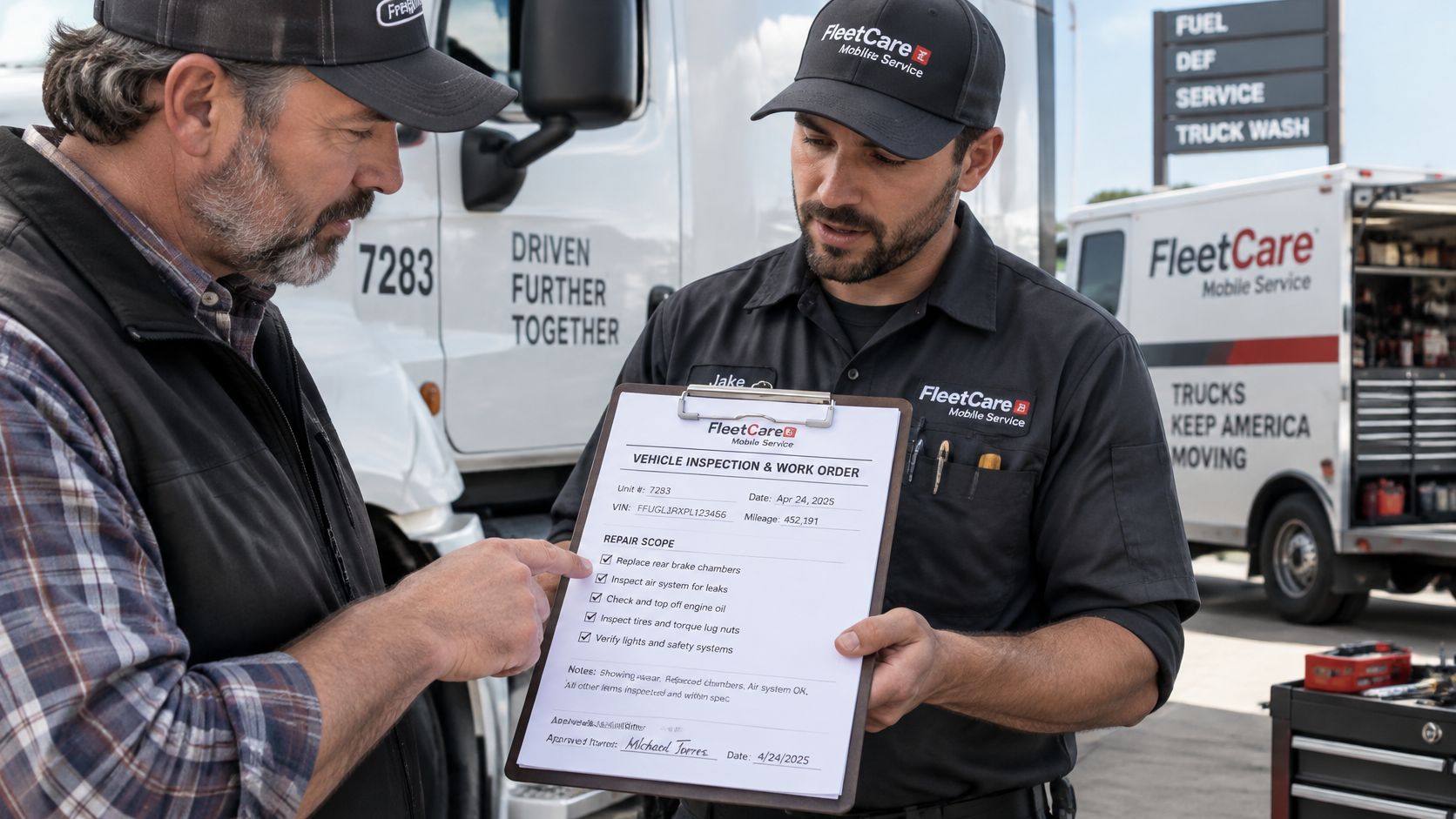
Roadside jobs stall more often over approval than over travel time. The person who reports the breakdown isn't automatically authorized to approve diagnostic time, replacement parts, or additional work discovered during inspection. A technician who starts pulling components without a named approver and a written scope ends up arguing about the invoice afterward.
For applicable driver vehicle inspection reports, 49 CFR Part 396 requires the carrier or its agent to certify that a listed defect was repaired or that repair was unnecessary before the vehicle operates again. Approval to investigate and release back to service are two separate decisions, and they may sit with two different people.
Name the approver and diagnostic limit. Record the fleet contact who can authorize the visit and set a budget cap for diagnosis. Include a backup contact so the technician isn't parked in a yard waiting while the first approver is unreachable.
Record the driver's complaint accurately. Capture the defect in the driver's words, along with the reporting time and location. "Air pressure falling while parked" tells the technician what to test; "brake problem" does not.
Check the truck's operating status. Establish whether an out-of-service notice applies and attach it to the job record. The dispatcher needs the actual restrictions, not a secondhand assumption that the truck can move.
Write the authorized scope. Diagnosis only, a defined temporary repair, and full repair at the vehicle location are three different authorizations. The scope also has to match the site: work that assumes shop equipment can't be approved for an exposed shoulder. Additional findings trigger a new approval rather than expanding the job by default.
Assign completion and release responsibilities. Identify who documents the work and who certifies the applicable defect disposition. Record unresolved items and restrictions instead of treating partial completion as full release.
A cleared warning light isn't a repair record.
The paperwork should connect the complaint to findings, corrective action, and verification. For electronic faults, save relevant codes and test results before clearing them; once the codes are gone, the evidence trail is gone too.
The pre-call truck repair checklist covers the supporting details to send with the request. The authorization record itself should finish with approver name, defect, scope, limits, certifier, and sign-off time.
Setting Up a Safe Work Zone for the Truck
Securing the truck comes before diagnosis. The first assessment is whether the vehicle and surrounding traffic can be controlled well enough for the proposed work, not whether the suspected replacement part is small.
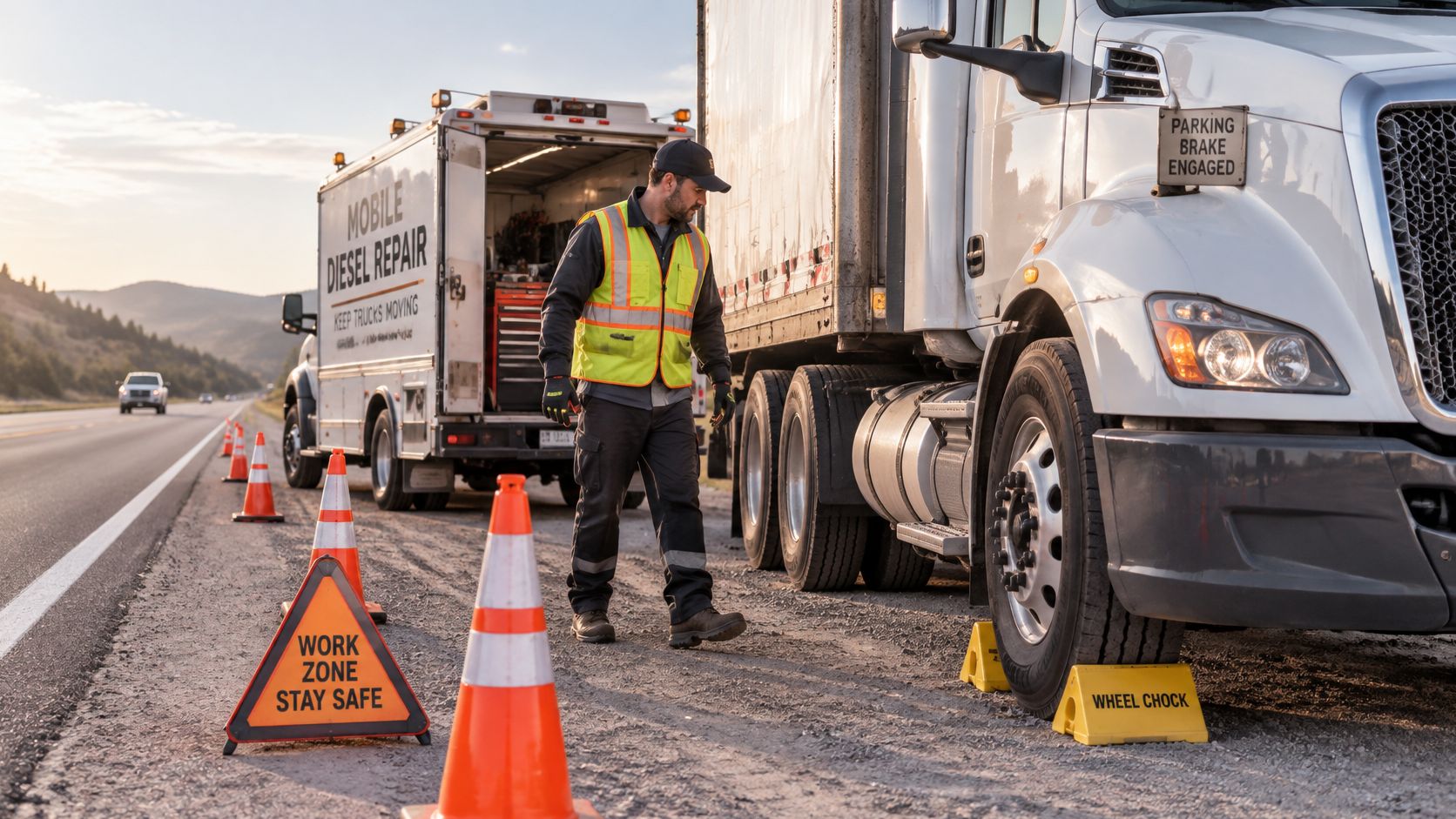
Where lawful and safe, the truck should be positioned clear of the travel lane. Hazard lights and appropriate warning devices help alert approaching drivers, but cones or flares don't make an exposed shoulder safe by themselves. Nobody should enter a live lane to arrange a repair area without appropriate protection.
Establish vehicle stability before component access
Apply the parking brake, chock the wheels as appropriate, and record whether the engine is running, stopped, or required for a controlled test. Brake and air-system work may change how the vehicle is held, so the technician must establish a secure method before releasing pressure or disturbing components.
The site assessment also needs to address the loaded combination. Can the trailer remain coupled during the job? If uncoupling is necessary, can the trailer be supported safely without creating another obstruction?
Firm, level ground matters whenever lifting is proposed. Adequate lighting also matters for identifying damaged wiring, tracing air lines, and keeping tools clear of moving equipment.
If the truck cannot be secured, the repair waits.
Photographs taken from a protected position should show:
- Truck position: The service side, surrounding clearance, and potential service-vehicle parking.
- Lane condition: Nearby traffic exposure, shoulder edges, and obstructions.
- Trailer connection: Coupling position and space around the combination.
- Visible leakage: The apparent source and ground below it, without crawling underneath.
The final work-zone decision remains case-specific. Traffic speed, shoulder width, visibility, and time of day can make the same repair practical in one location and unacceptable in another.
Which Repairs Stay On Site and When to Move the Truck
Diagnosis at the vehicle location doesn't guarantee repair there. The following boundaries describe typical mobile work, not a commitment that every listed task can be completed at a particular shoulder, yard, or terminal.
SAAT Repairs Corp works as an independent mobile road services team at the vehicle's location. Its capabilities include electrical diagnostics, brake and air-system service, DPF and EGR work, transmission support, and truck programming, with each job assessed for safe on-site feasibility.
On-site feasibility by work type
| Work type | Typical roadside feasibility | When an external facility is likely needed |
|---|---|---|
| Fault code reading and electrical diagnostics | Often feasible when power and wiring are reachable | Harness or component work that needs a lift or bench |
| Air leak tests and hose or fitting replacement | Case by case, with the truck secured and pressure controlled | Chamber, valve, or structural work beyond the roadside setup |
| Brake pad, drum, or lining service | Case by case; wheel removal needs safe jacking and firm ground | Extensive component replacement or any defect that cannot be safely corrected |
| DPF or EGR cleaning and reset checks | Case by case, subject to component access and equipment | Removal or off-truck cleaning, or repeated derates after a reset |
| Manual or automatic transmission work | Usually limited to diagnosis and minor service | Teardown, clutch, or internal repair needing a bay |
| Software programming and calibration | Case by case, requiring suitable connectivity, stable battery voltage, and platform support | Programming that needs equipment or connectivity unavailable at the site |
Electrical diagnosis starts with accessible power supplies, grounds, connectors, and wiring. Finding a fault doesn't establish that a damaged harness can be removed safely without lifting or dismantling other assemblies.
Air repairs require controlled pressure and secure vehicle support. Brake friction work adds wheel access, lifting, and component-handling requirements. NHTSA's FMVSS No. 121 test procedure defines an air-brake system as using compressed air to transmit driver control force to the service brake, which is why pressure behavior and leakage deserve attention before focusing only on linings.
The FMCSA inspection record's brake out-of-service criterion identifies defective brakes equaling or exceeding 20% of service brakes as an out-of-service threshold. Inspection records should identify affected axle and wheel positions rather than rely on pedal feel; fewer defective brakes don't automatically establish roadworthiness.
When an external option becomes necessary
Aftertreatment access may permit testing without permitting removal or off-truck cleaning. Transmission teardown usually requires controlled support and workspace. Programming needs suitable power, connectivity, and confirmed platform capability, not merely a laptop beside the truck.
Commercial trailer electrical, suspension, and structural repairs also require a location-specific assessment. Structural damage or unstable suspension components can change how the trailer must be supported before work begins.
The on-site truck repair guide provides additional context for evaluating vehicle-location work. Escalation is appropriate when:
- An out-of-service notice applies: The listed defect controls the release decision.
- The site is unsafe: Traffic exposure or unstable ground prevents the proposed work.
- Required equipment is unavailable: Lifting, bench work, or teardown exceeds the setup.
- Parts aren't on hand: The carrier needs an authorized waiting or external-repair plan.
Under 49 CFR 396.9, an out-of-service vehicle cannot operate until listed defects are satisfactorily repaired. Choosing an external facility doesn't authorize driving it there.
The carrier selects any suitable external facility or tow provider. SAAT has no customer-facing workshop, so a shop-level step is never a SAAT location. The escalation record should state the defect, completed checks, unfinished work, operating restrictions, and reason external support is recommended.
Three Hypothetical Lakeland Visits and Their Outcomes
Gated-yard air leak
A driver reports a tractor slowly losing air overnight in a private Lakeland yard. Before dispatch, the dispatcher secures gate access and written authorization covering diagnosis, with fitting replacement permitted only once the technician confirms the repair scope on site.
The yard surface is level, the technician tests pressure behavior, and a leaking fitting comes up as the fault. Because the approver already defined what could be replaced, the fitting goes in during the same visit rather than waiting on a second authorization call. The record that matters afterward is the post-repair pressure check showing the leak stopped; that reading is what lets the fleet treat the truck as returned to service.
Highway-ramp brake complaint
The dispatcher's call describes a trailer brake problem on a busy ramp. Traffic exposure prevents a protected work area, so exposed wheel-end work never starts at that location.
The carrier arranges a safe response and selects an external option because the site cannot support inspection or repair. The visit produces an inspection record naming the wheel positions checked and the defect still unresolved. The brake complaint stays open with the carrier until corrected, and nothing about the roadside visit closes it.
Depot DPF derate
A tractor at a fenced depot has derated again after repeated resets, and the history matters more than the current warning. With access and diagnosis approved, the technician records differential pressure and operating information; the readings support scheduling off-truck cleaning rather than commanding another reset.
EPA's CRT3 technical guidance explains that passive regeneration needs sufficient exhaust temperature to burn particulate and that regeneration frequency reflects duty cycle, particulate-emission rate, and filter technology. Regeneration doesn't remove noncombustible ash, so repeated derates warrant investigation rather than an assumed reset cure. Here the written scope covers diagnostics only, so the outcome is a scheduled cleaning at an external facility, with the derate documented as open until it happens.
Retain the decision as well as the invoice
FMCSA's Part 396 guidance states that inspection reports are generally retained for 14 months, while maintenance records are retained for one year and six months after the vehicle leaves carrier control.
These outcomes changed with access, findings, and job scope, so each record carries the decision alongside the work performed. A release, hold, or referral needs its reason stated in writing; the invoice captures only the charge.
Confirm Access and Approval Before You Dispatch
The final dispatch decision rests on reach, secure, approve, and the order matters. Reach the site contact first: confirm the gate arrangement, the exact vehicle position, and whether the work area is usable. Secure the work zone next: lighting, clearance, and permission to work where the truck sits. Approve the scope last: name the authorizer and write down the diagnostic or repair limits before the truck rolls. Run the calls in that order and a technician doesn't end up idling outside a locked terminal while an unreachable approver holds up the job.
Capacity makes avoidable delays costly to scheduling. In its 2025 diesel-technician staffing findings, ATRI reported that 65.5% of surveyed diesel-repair shops were understaffed, with an average vacancy rate of 19.3%.
SAAT Repairs Corp primarily serves Tampa, Lakeland, and surrounding Florida regions, with emergency road service available 24 hours a day, 7 days a week. Its 45–60-minute arrival aim in Tampa and Lakeland isn't a fixed promise; timing remains conditional on location, traffic, technician availability, and the job. The commercial roadside service overview supports planning the request, and customers outside the immediate Tampa and Lakeland areas should confirm coverage and applicable hours directly.
SAAT Repairs Corp offers mobile road services at the truck's location, subject to safe access and the requirements of the job. Visit SAAT Repairs Corp and use the English contact section to confirm yard access, the authorized scope, and any site limitations before dispatch.