
A loaded tractor sits in a yard near Tampa or on a shoulder outside Lakeland, the delivery window is still running, and the driver has a warning on the dash and hours ticking down. The dispatcher doesn't need a slogan at that moment. The dispatcher needs a clear answer to three questions. Can the truck move lawfully, can a technician work on it safely where it stopped, and what record will prove what was found? That's where fleet road service starts.
Table of Contents
- What Fleet Road Service Means on a Florida Route
- When Mobile Work Beats Moving the Truck
- What Dispatch and the Technician Should Exchange
- Brake and Air Defects That Stop the Truck
- How a Derate Changes the Roadside Plan
- Downtime Hours That Still Count Against the Driver
- Confirm Coverage Before the Next Breakdown
What Fleet Road Service Means on a Florida Route
Say a regional tractor leaves Tampa before dawn, loops toward Lakeland with a loaded trailer, and stops with low air and a warning lamp lit. The mechanical problem, the driver's remaining hours, and the question of whether the unit may move again all start at the same time. Fleet road service in this setting means a technician comes to the vehicle rather than the fleet bringing the truck to a building.

SAAT Repairs Corp serves individual truck owners, fleet operators, and transportation companies. It offers emergency road service 24 hours a day, 7 days a week, and primarily specializes in heavy-duty trucks, including semi-trucks, commercial vehicles, and fleet vehicles. There's no customer desk or bay to visit, and gasoline commercial vehicles aren't the core offer. That work is a contact-and-confirm exception based on the specifics of the vehicle.
The First Record Sets Up Everything Else
A usable first record names the complaint in the driver's words and the exact location. The full call sheet covering unit identity, cargo status, warnings, and access comes later in this article.
Those details sound basic, but they decide whether a mobile visit is even a sensible option. A driver who says "it loses air when I press the pedal" gives the technician something testable. A driver who says "brakes are bad" gives the technician a category, not a finding. Triage works from the first record, so the quality of that record matters more than the speed of the phone call.
A mobile assessment is a possibility to test, not a promise that every major repair can be finished at the roadside.
Fleet road service, understood this way, is a decision process as much as a repair service. The technician attends the location, checks what can be checked there, and separates a fault that can be handled in place from one that can't. The question that decides the next step is whether an on-site assessment is safer and cheaper than moving the unit, given the access at that spot, the fault type, the driver's remaining hours, and the record the carrier must keep.
When Mobile Work Beats Moving the Truck
The table below is the working tool. Match the live fault to one row, then check access, parts, equipment, and safety at the actual location before anyone promises an outcome.
| Fault pattern | On-site assessment | Move the truck when |
|---|---|---|
| Air leak or brake warning | Component inspection, leak check, and adjustment findings if the shoulder or yard is safe | Extensive disassembly, an unsafe work area, or structural damage |
| Electrical no-crank or charging fault | Scan data, wiring, sensor, alternator, and starter checks at the truck | Harness or component work that cannot be done safely in place |
| DPF or EGR derate | Pressure, hose, temperature, and regeneration-versus-root-cause sorting | Ash removal off the vehicle or an upstream failure beyond roadside scope |
| Repeat derate or software fault | Programming or calibration only if tools, access, and the platform allow it | The update cannot be completed safely at that location |
| Transmission slip, noise, or no shift | Fluid condition and diagnostic assessment | Internal repair or replacement is required |
| Trailer brake, air, suspension, or structure | Case-by-case inspection when access and equipment permit | Major structural, air, or brake work is unsafe or impractical roadside |
A Labeled Hypothetical
Consider a hypothetical regional diesel tractor with a trailer stopped where a technician can reach it safely, out of live traffic, with room to work. Mobile work beats moving the truck in that scenario because diagnosis starts at the fault, and dispatch doesn't lose the truck to a move before anyone knows what's wrong. Change one variable, such as a narrow shoulder with traffic close by, and the same fault may belong at a suitable external facility instead.
That facility is not a SAAT location. SAAT works as an independent mobile road services team and provides service at the vehicle's location, and it does not have a workshop open to customers. Its primary focus is diesel engines, with gasoline-powered commercial vehicles confirmed case by case. The article doesn't assign towing to SAAT, and dispatchers shouldn't assume a mobile provider controls that step.
Why Fast Isn't the Same as Cheaper
A 2025 Trimble-sponsored fleet survey found that only 4% of respondents typically returned vehicles to service within one hour, 40% reported three-to-six-hour delays, and 16% experienced downtime exceeding 24 hours. The same survey found 71.42% of respondents incurred $500 to $2,500 per breakdown, with $1,000 to $2,500 the most common range. Those figures are survey results, not a price list for any one repair.
They do challenge a common assumption, though. A short roadside visit isn't automatically cheaper if it leaves the truck vulnerable to a repeat failure on the next leg. A cheap fix that returns the truck to service with the root cause untouched can cost more across two stops than one correct decision would have cost.
Practical rule: Moving the truck is the better operations decision when access, safety, parts, or repair scope block on-site work, even if the move feels slower.
Walk the rows in order before the dispatch handoff. An air leak wants leak testing and component access. A no-crank wants scan data and electrical checks. A derate wants sorting before action, a transmission complaint wants assessment before anyone talks about internal work, and trailer work depends on whether the structure and brake system can be reached and handled safely. Matching the event to one row turns a vague breakdown call into a decision dispatch can defend.
What Dispatch and the Technician Should Exchange
A driver calls in: the truck died on an exit ramp and will not restart. What dispatch sends in that first call decides whether the visit tests a defined complaint or burns time on basic questions. Failed handoffs go wrong in one of two ways. Too little information arrives, so the technician starts from zero. Or the information arrives in the wrong form: "probably the turbo" is a guess dressed as a diagnosis, and a wrong guess sends the first test down the wrong path.
Before the exchange, a fleet can confirm the basics. SAAT offers emergency road service 24 hours a day, 7 days a week, diesel work is the core offer with gasoline commercial vehicles confirmed case by case, and the provider aims to reach roadside locations within 45 to 60 minutes in the Tampa and Lakeland areas, depending on location and traffic conditions. That window is a planning target; technician availability and job scope still shape actual arrival.

The Numbered Handoff
Treat the exchange as a work order that starts before anyone arrives. Dispatch and the technician coordinate directly on the call, each responsible for half the record.
- Dispatcher confirms the unit and location: Truck and trailer numbers, exactly where the combination sits, and whether a service vehicle can reach it safely.
- Driver reports the symptom: The driver describes what happened without renaming it as a failed part.
- Dispatcher adds context: Loaded or empty status, hours already on the clock, and any prior repair on the same complaint go into the record.
- Technician states test scope: SAAT uses diagnostic tools to identify truck issues, and the technician says what can be tested on site.
- Both sides separate findings: Completed checks stay apart from open recommendations, so nothing looks finished when it isn't.
For fleets, SAAT offers preventative maintenance and rapid response road service, coordinated directly between dispatch and the technician. A fuller list of what to send appears in the guide on what to send when requesting mobile truck repair near Tampa or Lakeland. Dispatchers who send that information up front narrow the first test plan.
Why the First Visit Sometimes Doesn't Close the Fault
Modern diesel faults don't always look like what they are. Emissions faults, sensor failures, wiring problems, and software derates can produce symptoms that feel mechanical to the driver, which is why the driver's words matter more than the driver's theory. The Fullbay 2025 report coverage found 57% of heavy-duty repair shops reported being understaffed in 2025 and technician wages increased by more than 14% on average in 2025. Those are industry figures about constrained repair capacity, separate from any single provider's staffing.
The practical point for dispatch is direct. Scan data, a clear complaint, and first-visit diagnostic accuracy often matter more than the shortest advertised arrival time. A technician who arrives quickly without the right information may still need a second visit, while a well-briefed visit can sort the fault in one stop or identify early that the truck must move.
| Item | Why it matters | What to record |
|---|---|---|
| Location and access | Confirms a service vehicle can reach the unit and work safely | Mile marker, ramp, yard, or gate, plus traffic exposure |
| Complaint in the driver's words | Stops a symptom from being renamed as a part | Low air, pull, derate, no crank, leak, or noise |
| Time stopped | Anchors hours and the recovery plan | Clock time the truck became immobile |
| Lamps or codes already seen | Narrows electrical and emissions tests | Lamp color and any code the dash already showed |
| Combination and cargo | Changes brake, weight, and safety context | Tractor, trailer number, loaded or empty |
| Earlier work on this complaint | Separates a repeat from a new fault | What was repaired and what was checked afterward |
Keep that table as the call sheet. It's the difference between a technician arriving to test a defined complaint and a technician arriving to reconstruct the event from scratch.
Brake and Air Defects That Stop the Truck
A tractor-trailer combination has 10 service brakes, and the driver reports pulling under braking plus a low-air warning. The FMCSA SMS Methodology defines a brakes out-of-service condition when defective brakes equal or exceed 20% of the service brakes on the vehicle or combination. On that combination, two defective brakes meet the threshold.
At 20%, the vehicle is out of service and stays there until the defect is corrected. The truck still rolling under its own power changes nothing about that status. Under FMCSA's roadside inspection rules in 49 CFR 396.9, the driver must deliver the inspection report to the carrier within 24 hours, and the carrier must certify on that report that the violations were corrected within 15 days. Think of the paperwork and the operating restriction as two clocks running on separate tracks: correction comes first, and the certified report follows it.
What to Record Before Anyone Decides
A useful brake record names specifics, not impressions.
- Wheel positions: Which axle and side show the defect, on the tractor or the trailer.
- Defect type: Adjustment problem, audible leak, contaminated lining, or a nonfunctioning component.
- Air behavior: Low-air warnings, pressure build or loss, and pedal feel.
- Combination status: Loaded or empty, and whether the trailer is involved.
- Warning devices: ABS and low-air lamp status at the time of the stop.
The North American Standard Out-of-Service Criteria applied in roadside inspections point inspectors toward missing, loose, contaminated, cracked, or nonfunctioning brake components, audible air leaks, slack-adjuster relationships, and mismatched air-chamber sizes on an axle. The criteria also cover brake adjustment, pushrod travel, ABS and low-air warning devices, and whether the air system holds pressure. A driver describing a live pressure complaint can compare symptoms against commercial truck air pressure problems and when it may be unsafe to continue, which helps separate a system losing air from one that is only slow to build.
SAAT offers inspection, repair, and maintenance of all brake system components, including commercial trailer brake and air work confirmed in scope, delivered at the vehicle's location. Whether the work happens on the shoulder depends on access and the fault itself. A slack-adjuster measurement, a leaking gladhand seal, or a verified pushrod-travel check is a roadside-sized job. Extensive disassembly or a live traffic lane is a different call, and on-site assessment exists precisely to make that call with evidence rather than guesswork.
Field checks support a return-to-service decision. They aren't a field certification that the truck is safe.
If the job needs extensive disassembly or the shoulder is unsafe, the next step is a suitable external facility rather than a promised roadside completion. SAAT works as an independent mobile road services team with no workshop open to customers, so a bay at SAAT is never part of that answer. Documenting affected wheel positions, defect type, adjustment or leak findings, repair parts, and post-repair functional checks gives dispatch and maintenance control an auditable record. That record is what lets the carrier certify correction within the 15-day window without reconstructing the stop afterward.
How a Derate Changes the Roadside Plan
A diesel tractor on Tampa and Lakeland regional runs derates after a string of short trips, and the driver has already decided the DPF is bad. The driver's DPF diagnosis is a hypothesis until the differential-pressure readings confirm it. Treating the guess as fact is how a roadside call burns the driver's window without fixing anything.
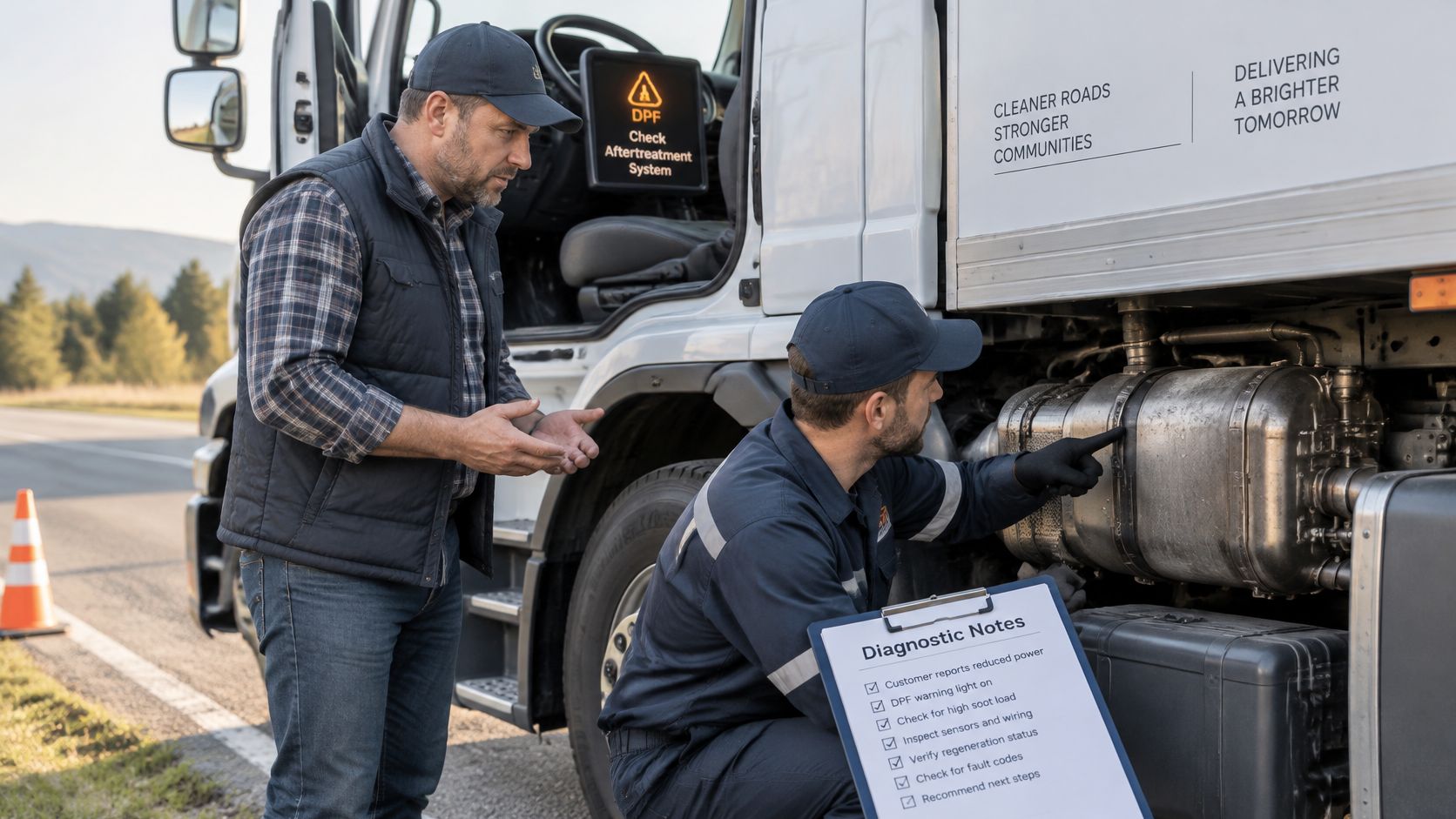
EPA technical guidance on diesel particulate filters explains that regeneration oxidizes trapped particulate matter, while noncombustible ash remains and requires periodic physical cleaning, with cleaning intervals commonly ranging from approximately 6 to 12 months depending on engine-out particulate production and duty cycle. Short-term particulate buildup increases exhaust backpressure and is typically addressed by regeneration, while excessive backpressure requires maintenance and can trigger operator warnings. Regeneration frequency also depends on duty cycle, particulate emission rate, and filter technology, so stop-and-go regional fleets may need intervention sooner than highway tractors.
Sort Before Acting
The on-site sequence comes before any forced regeneration. A derate works like a fever: it tells dispatch something is wrong, and the readings at the truck tell everyone what.
- Verify differential-pressure readings: Confirm the sensor reports something plausible.
- Inspect hoses and wiring: Look for damage that corrupts the pressure signal.
- Confirm temperature behavior: Check whether exhaust temperatures support regeneration.
- Check for excess soot production: Look upstream before blaming the filter.
Regeneration doesn't remove ash. It also doesn't fix failed injectors, a turbocharger problem, an EGR fault, or a bad sensor. Commanding a regeneration without that sorting can consume the driver's remaining window and return the truck to the road with the same fault still active.
Three Outcomes, Three Different Plans
Every derate event sorts into one of three outcomes. The first is soot loading that can be regenerated, which may be handled at the vehicle if conditions allow. The second is filter restriction requiring off-vehicle cleaning, which points toward equipment the roadside can't provide. The third is a root-cause engine or emissions failure, where the filter is reporting a problem rather than causing it.
That sorting is the whole economics of the call. A soot event cleared on the shoulder keeps the truck earning; a restricted filter towed to the wrong destination costs the trip twice. The cheaper plan is the one that identifies which case sits in front of the truck before anyone commits to moving it, then leaves dispatch with the fault codes and findings logged for the carrier's record.
SAAT offers service for DPF and EGR systems for emissions compliance and software programming and updates for trucks. Programming belongs in the plan only when the evidence and safe access support it, not as a default step. Drivers can prepare the right information using the guide on the DPF warning light and derate and what to prepare before mobile diagnostics. Work that needs equipment beyond the site goes to an external facility.
Downtime Hours That Still Count Against the Driver
A repair can finish on time and the driver can still be out of hours when it ends. That arithmetic shapes every recovery plan dispatch builds during a breakdown, because the legal driving window is fixed and only the length of the stop can change.
The FMCSA summary of hours of service regulations caps a property-carrying driver at 11 hours of driving after at least 10 consecutive hours off duty, bars driving beyond the 14th consecutive on-duty hour, stops driving after 60 on-duty hours in seven consecutive days or 70 hours in eight consecutive days, and lets 34 consecutive hours off duty restart the cycle:
| Rule | Limit | Effect of the stop |
|---|---|---|
| Driving time | 11 hours after at least 10 consecutive hours off duty | Waiting does not create extra driving time |
| On-duty window | No driving after the 14th consecutive on-duty hour | Repair waiting stays inside that window |
| Weekly on-duty time | 60 hours in 7 days or 70 hours in 8 days | On-duty repair time counts toward the total |
| Restart | 34 consecutive hours off duty | Not a workaround for finishing a roadside job |
None of these limits pauses for a breakdown. Repair waiting sits inside on-duty time, so a two-hour roadside assessment consumes the same window as two hours of any other on-duty work.
Build the Recovery Plan Around the Clock
The call sheet dispatch built at handoff keeps working while the technician is on site. Updating it with the repair status and the driver's remaining hours prevents a repaired truck from rolling straight into an hours violation, and it forces the harder question early: does the load need a different plan if the job finishes after the window closes?
That question is where the on-site-versus-tow decision gets made. An assessment at the truck tends to be the cheaper answer when it confirms the unit can move within the driver's remaining window, because a tow burns the same hours and still leaves the fault undiagnosed. When the assessment points at a repair the site can't support, the record shows exactly how much driving time the decision consumed.
Detention research makes a related but separate point. The American Transportation Research Institute detention study reported that detention at customer facilities cost the for-hire trucking industry as much as $11.5 billion in lost revenue in 2023, with average detention of 1.4 hours per stop beyond the two hours generally presumed to be active loading or unloading time. That describes customer dwell, not a breakdown invoice, and the two events shouldn't be blended into one number. The figure earns its place only as a reminder that an idle hour carries commercial weight, whether the truck sits at a dock or on a shoulder.
However quickly a diagnosis finishes, the legal driving window closes on the same schedule.
The File That Prevents the Next Call
After a mobile visit, the fleet file should keep the original complaint, the tests performed, the work completed, parts and wheel or component positions, and whatever remains open. That file is what reduces repeat calls, because the next technician starts from evidence instead of a fresh guess. It also makes total cost of ownership visible across stops, since repeat faults show up as patterns rather than isolated invoices.
Preventive maintenance belongs in that same record system as scheduled inspections and documented service intervals. It isn't a claim that every roadside stop can be prevented. Fleets that track complaints, findings, and open recommendations together give dispatch something solid to act on the next time a truck stops, and they stop paying twice to learn the same lesson about the same unit.
Confirm Coverage Before the Next Breakdown
The cheapest time to confirm coverage is before a truck sits still with hours running. A fleet running Tampa, Lakeland, or a nearby Florida corridor can settle the question on a quiet afternoon rather than at night on a shoulder: SAAT primarily serves the Tampa and Lakeland areas and surrounding Florida regions, and customers outside the immediate area should contact SAAT to confirm coverage for a specific route.
When contact happens, the call sheet does the talking. The same fields dispatch already collects for a roadside handoff give the technician a testable starting point, and filling them in ahead of time means the driver only adds a location and a symptom on the day. Sending that record to SAAT Repairs Corp keeps the first conversation factual instead of speculative.
Early confirmation also shortens the decision a breakdown forces on every fleet: whether an on-site assessment is safer and cheaper than moving the unit. If the corridor, the contact path, and the payment method are already settled, dispatch spends the first minutes on the fault rather than on logistics.
Payment fits carrier workflows without special arrangements. SAAT accepts cash, Visa, Mastercard, American Express, and fleet checks. Confirm the method at the same time as coverage, and a night breakdown does not stall on an administrative detail.
Save the documentation list to each unit file before the truck's next stop. The record then travels with the unit, and a future call opens with the truck's history already on file.
When a heavy-duty diesel truck stops in the Tampa to Lakeland corridor, SAAT Repairs Corp provides mobile fleet road service at the vehicle location, including on-site diagnostics and case-by-case assessment of brake, electrical, emissions, and transmission complaints. Fleets can confirm coverage, send the call sheet details, and arrange payment by reaching out through SAAT Repairs Corp before or during the next breakdown.