A dispatcher takes a call at 5:40 on a weekday morning. A tractor pulling a loaded trailer has lost power and stopped on the shoulder of a divided highway. The driver reports a warning chime, two more units are already down for the week, and the load is due before noon. The first decision is how to secure the scene and get the right help to the truck.
The decision in front of that dispatcher isn't whether to repair the truck. It's which repair route fits the situation. A symptom on its own tells you very little, because a warning light on a truck parked in a yard and the same warning light on a truck stopped in a live lane are two completely different jobs.
Fleet maintenance repair planning works when you separate the trigger from the location and check both against a limit before anyone moves. This guide covers the five routes available to commercial fleets, the cost-per-mile numbers that make the decision measurable, and the point at which a mobile job stops being feasible and becomes an external facility job.
Table of Contents
- Which Fleet Maintenance Repair Route Fits Your Truck
- What Do Fleet Maintenance Cost Benchmarks Really Show?
- How Do I Build a Preventive Schedule That Stops Repeat Faults?
- Mobile Repair Limits and When an External Facility Is Needed
- What Should I Do in the First Minutes of a Breakdown?
- How Do I Manage Downtime Before It Costs Too Much?
- How Can I Talk to SAAT Before the Next Breakdown?
Which Fleet Maintenance Repair Route Fits Your Truck
The five routes below differ by trigger, not by preference. A truck due for service on mileage is a scheduling problem. A truck that quits on a ramp is a feasibility problem. Match the trigger to the route first, then test that route against its limit before you commit a technician, a tow or a delivery promise.
| Route | Typical trigger | Where the work happens | Main limit |
|---|---|---|---|
| Preventive inspection and service | Mileage, engine hours or calendar interval | Fleet yard or planned on-site window | Truck must be available on a schedule |
| Scheduled on-site service | Work already listed on a repair order | Vehicle location if access is safe | Parts and tooling must be confirmed in advance |
| Mobile roadside repair | Breakdown, warning light or derate | Where the truck stopped, after a safety check | Scope depends on safe access, parts and equipment |
| External facility repair | Work needs shop equipment, such as off-truck DPF ash cleaning | Suitable external facility, not a SAAT location | Confirm safe transport with the fleet or arrange recovery |
| Tow to external facility | Truck cannot be safely moved or repaired where it stopped | External facility after transport arranged by the fleet | Towing is arranged through a provider of the fleet's choice |
The trigger decides the route, and the limit decides whether that route is feasible today. A scheduled job with no parts on the shelf is not a scheduled job, and a roadside repair on a blind curve with traffic 36 inches away is not a roadside repair.
Before the next call comes in, write down four things in this order.
The symptom in the driver's words. Record the exact warning, any visible fault codes and what changed before the truck stopped. A speed limit or a loss of power alone cannot tell dispatch what failed or whether the vehicle is safe to move.
The road position. Divided highway, undivided highway, shoulder, ramp or travel lane changes both the warning-device layout and whether a technician has room to open a hood and swing a wrench.
Whether the truck can move safely. Follow the vehicle manufacturer's warning instructions and the fleet's breakdown procedure. Keep a unit with a stop-engine warning or an unsafe operating condition out of service. Arrange recovery if the unit cannot be moved safely under its own power.
Parts and tooling on hand. Filters, sensors, airlines, fuses and programming capability determine what can be finished where the truck sits.
Run those four lines, then pick the matching row.
Practical rule: Choose the route by what the location allows, not by what the driver hopes will happen.
What Do Fleet Maintenance Cost Benchmarks Really Show?
The American Transportation Research Institute (ATRI) reported that repair and maintenance averaged $0.202 per truck-mile in 2023, up 3.1% from 2022. Overall marginal operating costs averaged $2.270 per mile. The 2024 ATRI analysis breaks out operating costs by fleet sector and size, which helps put the overall average in context.
In a hypothetical example, a tractor running 100,000 miles at $0.202 per mile would incur about $20,200 in annual repair and maintenance. Use the same cost categories and mileage basis each month to see whether the cost per mile is rising within your own fleet.
The 2025 ATRI update reported that repair and maintenance costs fell in 2024. Use that direction as industry context. Compare trucks within your own fleet by vehicle type, age and duty cycle to see where costs moved and why.
The 2023 ATRI operating-cost report, available as an exhibit in the USDA docket, reported $0.196 per mile for repair and maintenance in 2022. The survey respondents averaged 50,547 miles between breakdowns and performed 59% of maintenance in-house. Use those survey results to frame questions about your own fleet's costs and repair capacity.
| Metric | Reported value or calculation | Year and source | How to use it |
|---|---|---|---|
| Repair and maintenance cost | $0.202 per truck-mile, up 3.1% from 2022 | 2023 data, ATRI 2024 analysis | Compare against your cost trend using the same mileage basis |
| Repair and maintenance trend | Costs declined in 2024 | 2024 data, ATRI 2025 update | Check where your own cost trend moved |
| Miles between qualifying breakdowns | Fleet miles divided by qualifying breakdowns | Your work orders and mileage records | Compare similar trucks and routes using the same event definition |
| Unplanned maintenance stops per truck | Qualifying stops divided by active truck-months | Your dispatch and work-order records | Track changes by route type, vehicle class and age |
| Maintenance share of fleet spending | Maintenance spend divided by total fleet spend | Your fleet ledger for the same period | Keep included costs consistent across periods |
| In-house maintenance share | 59% of maintenance performed in-house | 2022 data, ATRI 2023 report | Review which work needs outside equipment or capacity |
Define a qualifying breakdown before calculating a rate. For example, count each unplanned mechanical stop once, even if it generates several work orders. Keep scheduled service and collision downtime separate. Use the same reporting cutoff, mileage and active-vehicle counts when comparing periods.
Use work orders to rank which systems cause the most lost hours and repeat faults on each route. Pay attention to brakes and air systems, wiring and grounds, lighting, chassis and body hardware, and powertrain where the fleet's records and manufacturer inspection requirements warrant it.
Fleet managers reviewing the wider cost picture can reduce total cost of ownership by tying maintenance spend to resale value and uptime rather than to invoice totals alone.
How Do I Build a Preventive Schedule That Stops Repeat Faults?
A schedule that repeats every interval is not the same as a schedule that prevents repeats. The difference is in what gets written down after each repair. A maintenance coordinator can rebuild the process in a week.
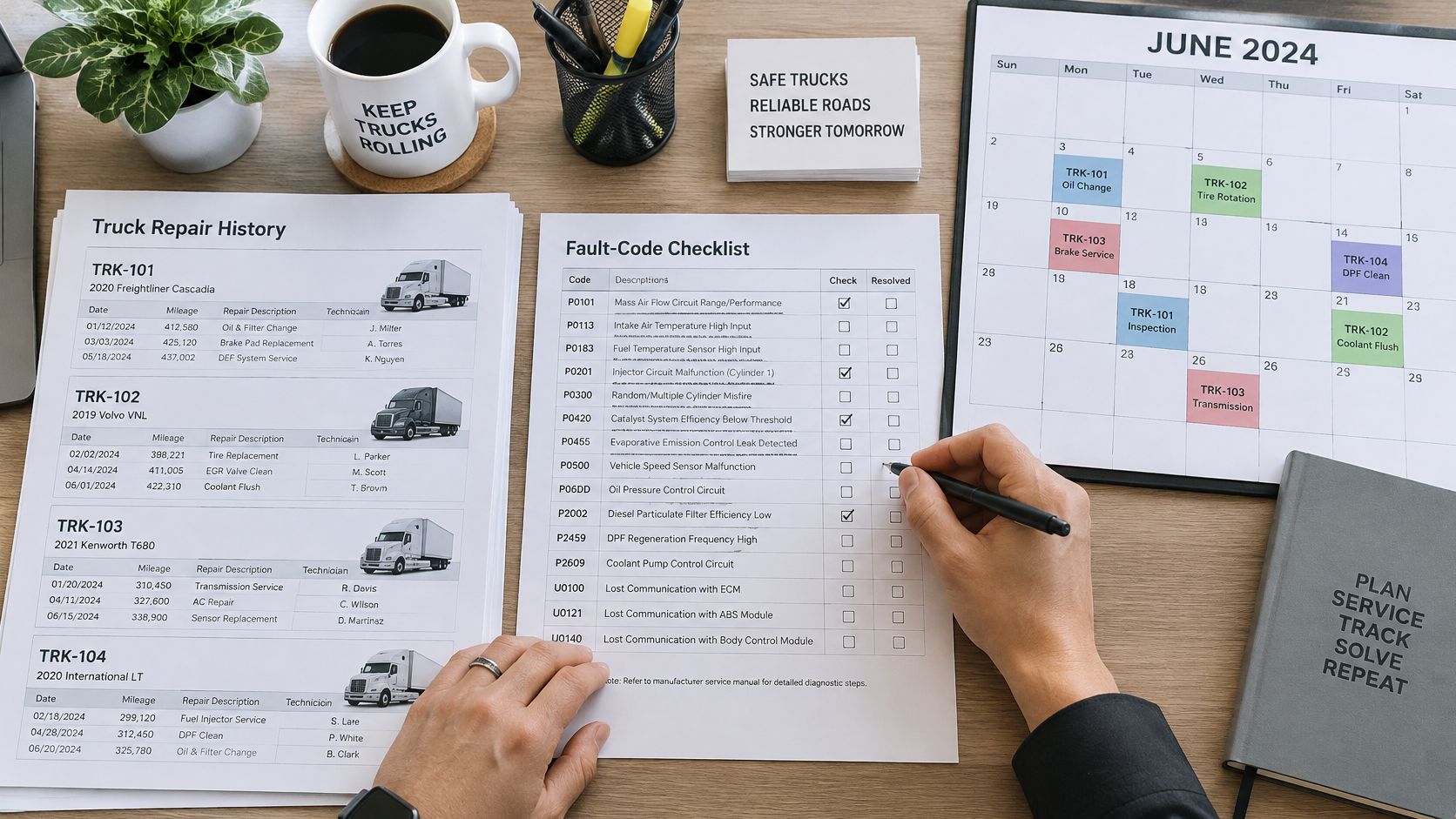
Six Steps That Turn Work Orders Into a Schedule
Pull 12 to 24 months of history for every unit. Export work orders by vehicle, not by shop. Sort by unit number so repeat visits sit on the same page instead of scattered across invoice batches.
Record the technical detail, not the invoice category. For each order capture the fault code, confirmed root cause, failed component, corrective action, operating conditions and time to repair. "Electrical repair, $640" is a receipt. "Chafed harness at the cab-to-engine connector, code set under vibration on rough routes" is a planning input.
Flag repeat failures first. The same component returning inside the same mileage window is the strongest evidence of a planning gap. Two alternators in 40,000 miles on the same truck points at a charging circuit or battery problem, not at an alternator problem.
Set intervals by mileage or engine hours, then add targeted checks. Baseline service runs on mileage or hours, whichever trips first. Add extra inspection points for the systems that have already failed on that route: wiring and grounds, brake chambers and slack adjusters, DPF and EGR behavior, and software configuration.
Inspect before the truck is loaded. Schedule targeted checks ahead of high-risk routes or peak delivery periods. A unit inspected while empty is a cheaper unit to hold than one pulled out of a full load at the dock.
Verify with the manufacturer's specified checks and record what stays open. Save the original codes and relevant data, document the repair verification, and assign an owner and due date to anything unfinished. A qualified technician should perform any required road test only after confirming the vehicle is safe to operate.
What Prediction Can and Cannot Do
Work-order history supports better prioritization, and that's about the ceiling of it. A heavy-vehicle maintenance study using 38,000 work orders over five years tested machine-learning models for predicting failure type and vehicle issues. Gradient-boosted trees produced the strongest reported performance at 68.09% accuracy for one prediction task and 41.24% for issue prediction. Models can rank which trucks deserve a closer look. They can't replace a test plan.
A prediction tells you where to point a flashlight. It doesn't tell you what the wiring looks like when you get there.
The quality of any predictive output rises and falls with input discipline: consistent defect coding, mileage or engine-hour data, repair outcomes and standardized diagnostic descriptions. Poor records produce confident wrong answers and unnecessary parts swapping, which is why human verification and post-repair validation belong in the workflow regardless of what the software says.
Work through the heavy-duty truck preventive maintenance checklist before the next service cycle is set.
Mobile Repair Limits and When an External Facility Is Needed
One rule settles most of these conversations: if the job can't be completed safely at that location with the parts and tools on hand, the plan changes before the truck moves. The table below splits common repairs by where they usually land.
| Repair type | Roadside feasibility | Deciding factor |
|---|---|---|
| DPF or EGR diagnosis and regeneration checks | Case-specific, often assessed on site | Safe access, fault severity and OEM procedure for the installed system |
| Ash cleaning of a removed DPF | Usually needs an external facility | Filter removal and dedicated cleaning equipment |
| Electrical circuit diagnostics | Case-specific, often assessed on site | Access to wiring and available test tools |
| Brake inspection and component service | Case-specific, confirmed by the business owner | Safe work space and parts on hand |
| Transmission repair or replacement | Case-specific, often a planned service | Lift access, parts and equipment |
| Software programming and calibration | Case-specific | Compatibility with the platform and programming tools |
The EPA bulletin on retrofit diesel particulate filters explains the difference between regeneration, which burns accumulated soot, and physical cleaning, which removes the ash left behind. Ash cleaning can require removing the filter and using dedicated equipment. Follow the maintenance plan for the filter installed on the truck.
For example, if a differential-pressure fault triggers a derate, a qualified technician can start by reviewing the codes and live data and checking the sensor circuit and pressure signal. A commanded regeneration or road test is a later decision. The technician must confirm that the warnings, fault and vehicle condition allow the procedure, that the truck meets manufacturer requirements, and that the location and equipment are suitable. If the manufacturer calls for shutdown or movement is unsafe, keep the truck out of service and arrange the appropriate recovery.
SAAT Repairs Corp works as an independent mobile road services team and attends the vehicle location. It has no customer-facing workshop, so any work that needs shop equipment is planned as an external option at a facility that is not a SAAT location. Commercial trailer brake, air, electrical and suspension repairs are confirmed case by case by the business owner, with the work location and feasibility assessed per job rather than assumed from the symptom.
Before dispatch: Confirm safe access, parts availability and tooling for the specific fault, not for the system in general.
Feasibility is a physical question. Gravel shoulders, live lanes, low overhead clearance, a trailer that can't be unloaded, and a fault that needs factory programming can each end a mobile job on their own.
What Should I Do in the First Minutes of a Breakdown?
When a commercial motor vehicle stops on the traveled portion or shoulder of a highway for a reason other than a necessary traffic stop, 49 CFR § 392.22 requires the driver to turn on the hazard flashers immediately and leave them on until the warning devices are placed. The flashers must also be used while the devices are being retrieved.
The rule generally requires placement of the warning devices as soon as possible and within 10 minutes. Refer to § 392.22(b) for the applicable layout and exceptions, including one-way or divided highways, obstructed views and restrictions on flame-producing devices around certain loads. Tell dispatch which road and lane or shoulder the truck occupies.
Keep the fleet's emergency procedure and dispatch contact available to every driver before the trip.
The Sequence After the Truck Stops
Secure the scene. Turn on the hazard flashers immediately where the rule applies and follow the applicable warning-device requirements. Report any travel lane obstruction or immediate danger to emergency services, then update dispatch when safe.
Record symptoms and fault codes in the driver's words. Note which lamps lit, what the dash displayed, and what changed just before the stop. Record or photograph the code only from a safe position.
Decide whether recovery is needed. Follow the manufacturer's warning instructions, fleet procedure and directions from responders. A truck that can still steer or brake may still be unsafe to drive. Keep it out of service if the warning calls for shutdown or safe movement cannot be confirmed.
Run mobile tests only within what the location allows. Diagnostics and repair happen after the access question is settled. Live traffic a few feet from the work area rules out most jobs regardless of the fault.
Escalate early when the job needs parts, programming or shop equipment. Confirm the repair location and how the fleet will arrange safe transport or recovery.
Capacity is the reason to escalate early. The ATRI report on the diesel technician shortage found that 65.5% of surveyed shops reported being understaffed in 2025, with an average of 19.3% of technician positions unfilled. A fast call doesn't guarantee a fast return to service if the destination shop has no bay and no technician.
SAAT Repairs Corp offers emergency road service 24 hours a day, 7 days a week and aims to reach roadside assistance locations within 45 to 60 minutes in the Tampa and Lakeland areas, depending on location and traffic conditions. Any arrival estimate depends on location, traffic, technician availability and the job itself, so treat it as a planning input rather than a promise.
Keep the fleet breakdown response checklist within reach of whoever answers the phone.
How Do I Manage Downtime Before It Costs Too Much?
Downtime cost equals hours or days out of service multiplied by the cost of lost delivery capacity, plus repair and towing spend. Most fleets track the second half of that equation and estimate the first half by feel. The fix is to log the loss as its own line, separate from the invoice.
Suppose a tractor is out for three days on a chassis fault. The repair invoice might be modest. Three days of missed runs, a resequenced route and a delayed customer conversation represent the larger number, and if it never gets written down, the next planning meeting compares a cheap repair against an expensive one with no context.
Log Four Timestamps for Every Event
| Timestamp | What it tells you |
|---|---|
| Time reported | How fast the driver or telematics raised the problem |
| Time diagnosed | Whether the bottleneck is information or access |
| Time repaired | Whether parts and technician time are the constraint |
| Time returned to service | The full gap between a truck going down and earning again |
Time to diagnosis is the number to watch most closely. A unit that sits for six hours while three people guess at a fault has a diagnostic problem, not a parts problem. When diagnosis time exceeds the fleet's own target, that's the trigger to escalate and get the truck in front of someone with the right scan tools and test plan instead of adding another phone call.
Use lost hours and repeat work orders to decide which extra inspections belong in the next service cycle. Continue the manufacturer's required inspections for every system. Recheck the data after a cycle to see whether the targeted inspections are reducing repeat stops.
Unplanned work doesn't just cost more per repair. It removes the choice of when the truck goes down.
Use the first table to choose the repair route once the scene is secure and the problem is understood. For work that requires shop equipment, confirm the external facility and safe transport before moving the truck. If it cannot be driven safely, the fleet can arrange recovery with its chosen provider. Consider a mobile repair when access, parts, tooling and the fault allow the work at the vehicle's location.
How Can I Talk to SAAT Before the Next Breakdown?
SAAT Repairs Corp provides mobile road services, which means technicians attend the vehicle location for diagnostics and repair across Tampa, Lakeland and nearby Florida corridors, subject to safe access, job requirements, parts and technician availability. SAAT does not operate a customer-facing workshop, so any job that needs shop equipment should be planned around an external facility that is not a SAAT location. Fleets running outside the immediate Tampa and Lakeland areas should confirm coverage before a breakdown happens rather than during one.
When contact is made, send the unit number, the symptom in the driver's words, any fault codes, the exact location, the road type, safe-access notes and the delivery timing. That information lets the technician assess feasibility before arrival and reduces the chance of a second visit for a part nobody brought. Any arrival estimate depends on location, traffic, technician availability and the job.
Start the conversation through the English contact section of the SAAT Repairs Corp website, and do it on a quiet morning rather than a broken one.
Planning the route before the phone rings is the whole job. SAAT Repairs Corp provides mobile heavy-duty diagnostics and repair at the vehicle location across Tampa, Lakeland and surrounding Florida corridors, covering electrical faults, brake and air systems, DPF and EGR work, transmission service and software programming, with emergency road service available 24 hours a day, seven days a week. Send the unit number, symptom, fault codes, location and road type through the English contact section so feasibility can be assessed before a technician rolls. Visit SAAT Repairs Corp to start that conversation.