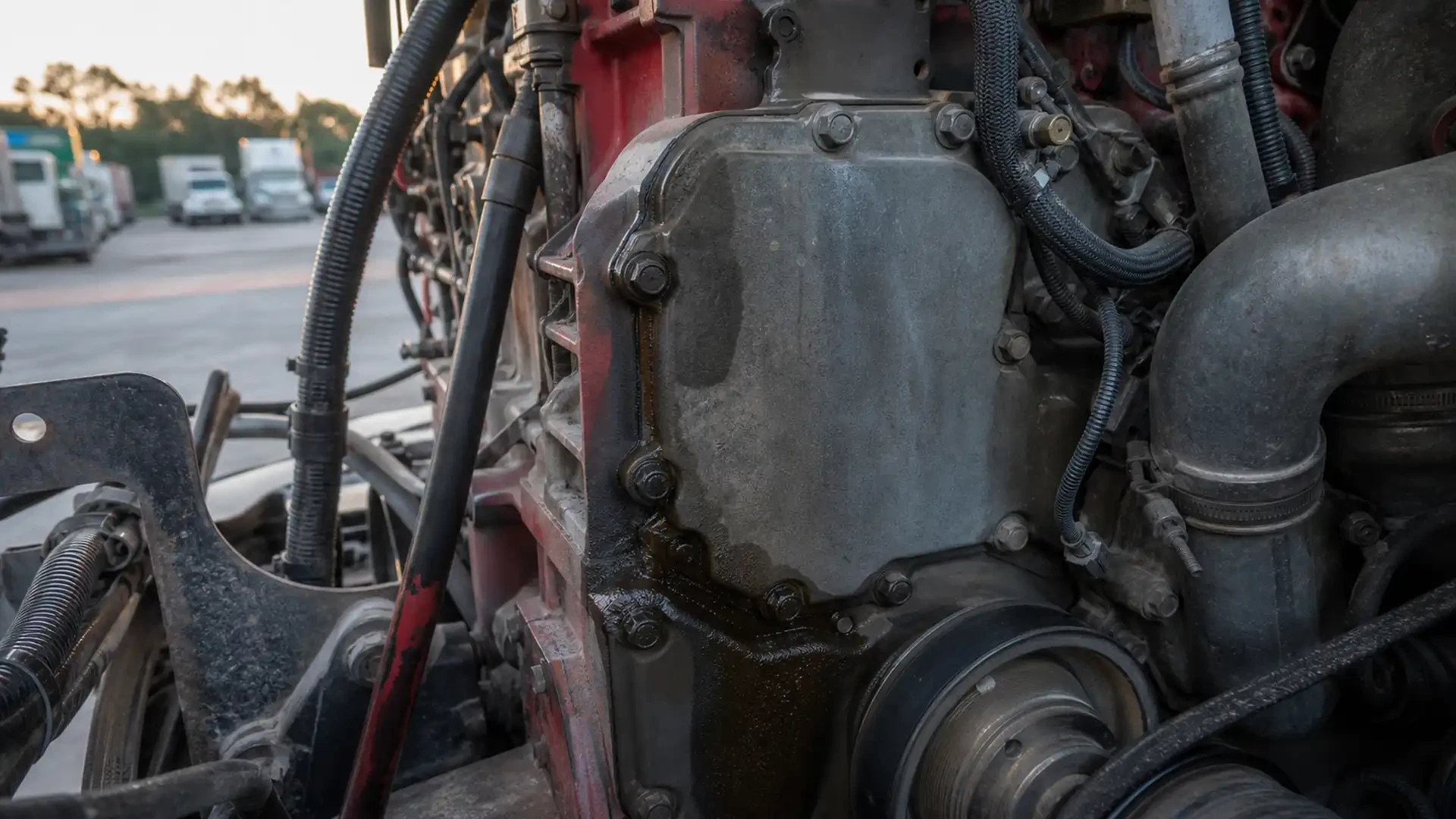
Oil near the front of a Cummins ISX15 can make a front gear housing or cover seem like the obvious source. The visible residue, however, may have traveled from another sealing surface, connection, hose, or engine area before it reached the place where it was noticed.
The most useful first step is to preserve a clear pattern. Record when the oil appeared, where it was seen, whether the level changed, what the truck was doing, and what work was recently completed. That information helps a technician separate the visible location from the likely source before a component or repair is authorized.
SAAT Repairs Corp provides mobile truck repair and advanced diagnostics in Tampa, Lakeland, and nearby Florida areas. Service goes to the commercial truck's location when access and conditions are safe.
Why oil near the front of the engine needs careful identification
Oil can collect on a lower surface or move along a casting, cover, bracket, or frame area. Wind, engine movement, heat, washing, and road debris can also change the visible path.
An observation near the front gear housing does not by itself confirm:
A failed front-cover seal.
A gear-housing gasket problem.
A crankshaft or accessory seal condition.
A loose fastener or damaged sealing surface.
A hose, line, filter, or connection above the area.
An oil-level or pressure problem inside the engine.
A leak that began during the current trip rather than earlier.
The diagnostic question is not only “where is the oil now?” It is also “where could it have started, under what conditions, and what evidence supports that conclusion?”
Patterns worth documenting
The timeline and operating pattern can be more useful than a single photograph.
When the oil first appeared
Record the date, approximate mileage, engine hours if available, and whether the observation happened before departure, after a route, during a stop, or after parking overnight.
Note whether the driver saw a fresh spot, a wet surface, a drip, a spray pattern, or only old residue. If the condition was reported by another person, preserve that description rather than rewriting it from memory.
Where the oil is visible
Photograph the area from a safe position without climbing under an unsupported truck. Include a wider image that shows the engine orientation and a closer image of the visible residue. Record which side, height, or frame area is involved.
Do not wipe or wash the area before the pattern is documented unless a qualified person has a safety or environmental reason to do so. Cleaning can remove information that helps identify the travel path.
How the leak changes after operation
Record whether the oil appears after idling, a loaded route, highway operation, a climb, a warm restart, or extended parking. Note whether the amount seems stable, increases, or cannot be compared because the surfaces were not observed under the same conditions.
Do not run an unsafe truck or create a test drive only to reproduce a leak. The purpose of the timeline is to support a safe review, not to encourage continued operation.
What changed after recent service
List recent work involving the front cover, gear housing, belts, accessories, filters, oil service, hoses, wiring, engine mounts, or nearby components. Include the date, mileage, parts if known, and whether the oil appeared before or after the work.
This timing does not prove that recent work caused the leak. It gives the technician a sequence to consider.
What the driver or fleet should record
Prepare:
Truck number, engine model, mileage, and engine hours if available.
Date and location where the oil was first observed.
Whether the surface is wet, dripping, sprayed, or covered with older residue.
The safest visible description of the source area and travel path.
Oil-level observations made under the fleet's approved process.
Dashboard warnings, low-oil messages, temperature changes, or shutdown events.
Operating conditions when the leak appeared or increased.
Recent oil service, front-cover work, accessory work, or other maintenance.
Whether the truck is parked safely and whether it can move without risk.
Keep photographs, work orders, driver notes, and maintenance records together. A consistent handoff reduces repeated questions and helps avoid a decision based on one incomplete view.
What a diagnostic review may consider
The exact path depends on the engine, visible evidence, operating condition, service information, and approved procedure.
Fluid source and travel path
A technician may inspect the highest visible wet point, nearby surfaces, the direction of travel, and whether residue is fresh or accumulated. The lowest point on the engine is not necessarily the leak source.
Front-cover, gear-housing, and related areas
The review may include the front cover, gear-housing seams, seals, fasteners, access covers, accessory mounting areas, and adjacent surfaces when supported by the evidence. The goal is to identify the source before selecting the repair.
Ventilation, pressure, and engine conditions
Crankcase ventilation, operating temperature, oil level, and engine conditions can influence how a leak appears. These factors should be considered with the approved service information rather than treated as a universal diagnosis.
Seals, fasteners, hoses, and connections
Nearby seals, lines, fittings, filters, and connections can leave oil in the same general area. Their condition, position, and recent service history may help separate one possible source from another.
Oil level and related warnings
Record warnings or oil-level concerns according to the fleet's safe process. A leak accompanied by low oil pressure, a critical warning, unusual engine noise, overheating, or rapid fluid loss requires a more urgent safety decision.
Why cleaning or replacing one part may not close the complaint
Cleaning the surface can make the truck look improved without confirming the source. Replacing a seal or cover from a visual assumption can also leave an upstream leak, pressure issue, damaged surface, or related condition unresolved.
The goal is not to delay a needed repair. It is to connect the observed fluid path, operating pattern, recent work, and diagnostic evidence before authorizing parts.
What not to do at the roadside
Avoid:
Crawling under an unsupported truck or trailer.
Touching hot engine, exhaust, or rotating components.
Opening pressurized systems or removing covers without the correct procedure.
Adding fluid beyond the fleet's approved process.
Washing away residue before documenting the pattern.
Driving an unsafe unit to reproduce the leak.
Assuming a photograph confirms the failed component.
Replacing a seal, cover, or hose from a short description alone.
Use appropriate spill-control practices and follow fleet, environmental, and safety requirements for any fluid leak.
When the truck should remain stopped
Keep the truck safely parked and request assistance if there is rapid or active fluid loss, a low-oil-pressure warning, abnormal engine noise, overheating, smoke, a burning odor, repeated shutdown, or any condition that makes continued operation unsafe.
The driver should follow fleet procedures and applicable roadside requirements. A truck that appears to run normally can still have a condition that needs review before returning to service.
Preparing for mobile Cummins diagnostics
Provide SAAT with:
Exact location and safe-access information.
Truck, engine, year, unit, mileage, and engine-hour details if available.
Photographs taken from safe positions.
The first-observed date and the operating pattern.
Oil-level observations and dashboard warnings.
Recent maintenance, parts, or front-cover work.
Whether the truck is safely parked and able to move.
Contact information for the driver, dispatcher, or maintenance manager.
Mobile diagnostics can help evaluate visible conditions and the available history at the truck's location. The initial inspection determines what can be confirmed and whether the repair can be completed there.
Contact SAAT Repairs Corp
If your Cummins ISX15 shows oil near the front gear housing in Tampa, Lakeland, or a nearby area, contact SAAT Repairs Corp for mobile truck diagnostics and repair planning.
Call +1 414 233 9746 or email [email protected]. Share the location, oil pattern, warnings, recent work, and current safety condition.
Seeing oil near the front of a Cummins ISX15? Document the pattern and contact SAAT Repairs Corp with the truck's location, warnings, recent work, and safe-access details so the next step can be evaluated with better evidence.