EGR-related power loss returns after repair: how to prepare for follow-up diagnostics
Specialized Truck Services
EGR-related power loss returns after repair: how to prepare for follow-up diagnostics
When power loss, an EGR-related message, smoke, or derate returns after a repair, it is tempting to conclude that the same part failed again or that the earlier work did not solve anything. That conclusion may be premature.
The symptom may be related to the original condition, a connected system, an intermittent fault, a verification gap, or a new event. The follow-up process should begin by comparing evidence: what the driver reported, what the technician confirmed, what work was performed, how the truck was verified, and when the current symptom appeared.
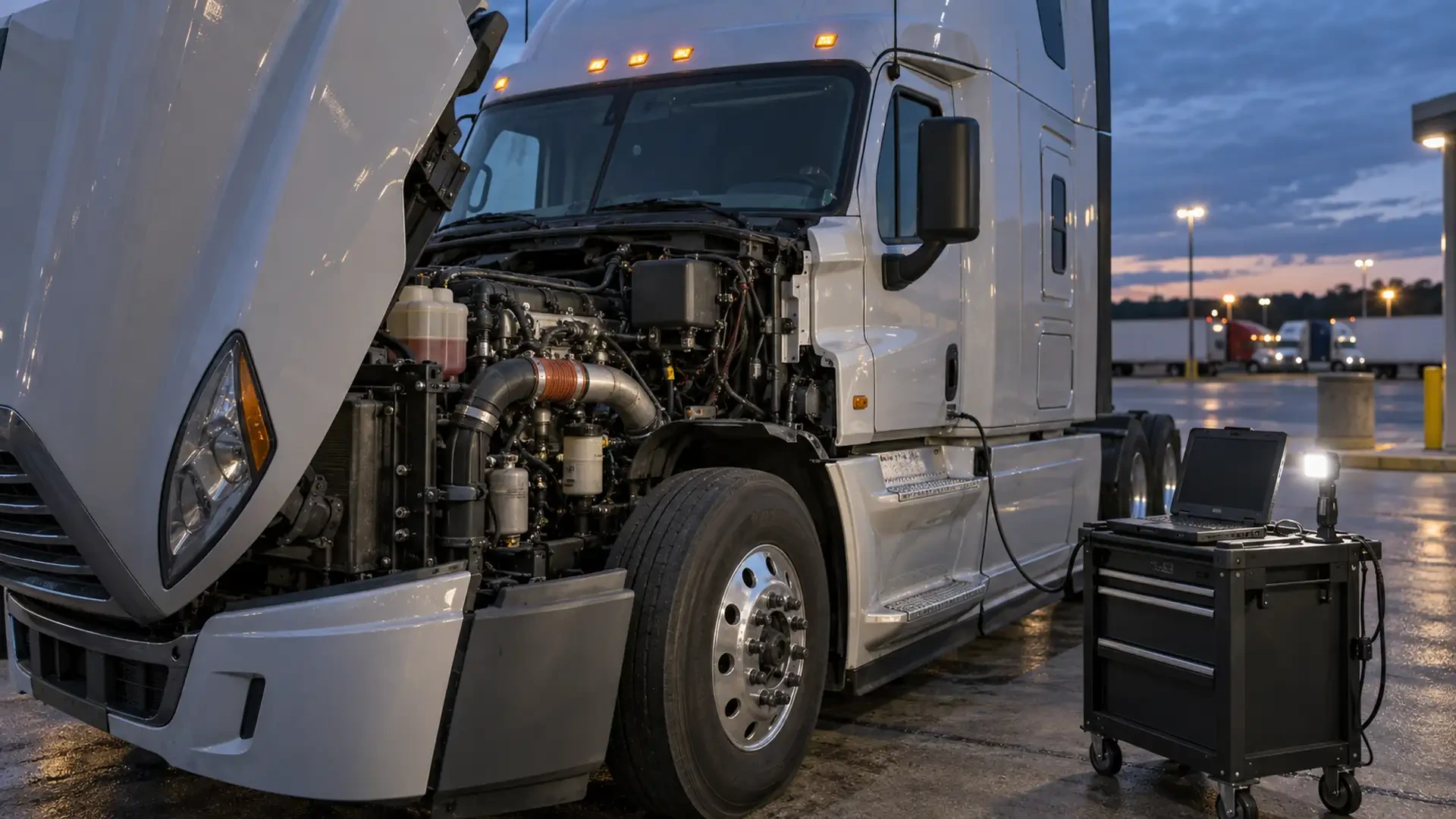
SAAT Repairs Corp provides mobile truck repair, advanced diagnostics, software programming, and DPF/EGR support in Tampa, Lakeland, and nearby Florida areas. Service goes to the truck's location when access and conditions are safe.
A recurring symptom does not explain why it returned
EGR operation interacts with airflow, boost, exhaust conditions, engine load, sensors, wiring, software commands, fuel delivery, DPF loading, and regeneration history. Power loss is therefore a complaint, not a component diagnosis.
Even when an EGR-related condition was confirmed and repaired, the same driver complaint can return under different circumstances. A connector may be intermittent. Another code may become active. A DPF or airflow condition may develop. The truck may only reproduce the symptom under load or after warmup.
The goal is not to defend or reject the earlier repair before testing. It is to give the follow-up technician a clean record that makes comparison possible.
Compare the original complaint with the current condition
Start with the repair order and the driver's first report. If the documentation is incomplete, label missing information as unknown instead of filling the gap with assumptions.
What the driver experienced before repair
Record the earlier pattern:
Power loss at idle, acceleration, cruise, or under load.
Warning lights, messages, and derate level.
Smoke, rough operation, fuel-use change, or abnormal sound.
Whether the problem was constant or intermittent.
Whether it appeared cold, warm, after a restart, or during a regeneration.
What the repair order says was confirmed
Separate the driver's complaint from the technician's findings. The order should identify the condition supported by tests, the codes reviewed, and the evidence behind the repair decision.
An EGR-related code may direct attention to a monitored condition, but the code description alone does not prove that a valve, sensor, cooler, harness, or other named component requires replacement.
What changed after the work
Document whether the truck initially returned to normal operation, whether a warning remained, and how long the improvement lasted. Note any new symptom that did not exist before the repair.
Useful questions include:
Did full power return immediately?
Were warning lights absent at delivery?
Was the truck tested under the condition that originally produced the complaint?
Did the symptom return gradually or suddenly?
Is the current message exactly the same?
Create a recurrence timeline
A timeline can reveal whether the symptom returned before the unit left the service location, after a restart, during the first loaded trip, or after several days of operation.
When the power loss returned
Record the date, approximate time, odometer, engine hours, and distance or operating time since repair. Include any fueling, maintenance, battery work, trailer change, or extended idle period between the repair and recurrence.
Load, temperature, route, and restart pattern
Describe what the truck was doing when power changed. Note whether the engine was cold or at operating temperature, whether the unit was climbing or accelerating, whether it was loaded, and whether cycling the ignition changed the symptom.
These details are evidence of a pattern. They are not instructions to repeat an unsafe condition simply to reproduce the fault.
Codes, messages, smoke, and derate
Preserve the complete code set and dashboard messages before clearing them. Photograph the display when it is safe to do so. Record whether the derate is stable, intermittent, or becoming more restrictive.
Describe smoke by observable color and timing without assuming its cause. Include overheating, coolant loss, oil-pressure warnings, leaks, unusual exhaust heat, or mechanical noise immediately because those conditions can change the safety decision.
Records that help the follow-up diagnostic process
The repair order is the bridge between the first visit and the second. Send it before the appointment when possible.
Parts, procedures, and verification results
Provide:
Confirmed findings from the earlier diagnosis.
Components inspected, repaired, cleaned, adjusted, programmed, or replaced.
Part information when documented.
Test or verification conditions after the work.
Remaining recommendations or limitations.
Technician or service-provider contact information when appropriate.
Avoid a summary that says only “EGR fixed.” That wording does not explain the scope.
DPF and regeneration history
Record DPF warnings, recent regeneration events, incomplete or refused cycles, cleaning history, and changes in soot- or ash-related service information when those records are available. DPF and EGR symptoms can overlap because both interact with engine and exhaust operation.
Airflow, boost, fuel, and electrical history
Include recent turbo, intake, charge-air, exhaust, injector, fuel-filter, battery, alternator, harness, connector, sensor, ground, or software work. Do not list these areas as diagnosed causes; provide them as timeline context.
Why the same symptom may involve a different condition
The electronic control system evaluates many inputs and commands. Two faults can produce similar power-loss behavior, and one condition can influence another. A returned complaint may involve:
An intermittent connection that was not active during the first test.
A related airflow, boost, exhaust, or DPF condition.
A new code or a changed code status.
An operating condition not reproduced during verification.
A repair that corrected one confirmed issue while another remained.
A new failure after the original service.
These are diagnostic possibilities, not conclusions. Testing should determine which, if any, applies.
What not to do before the follow-up visit
Do not clear codes or disconnect batteries simply to remove the warning.
Do not replace the same part again without confirming why.
Do not force regeneration or other procedures outside manufacturer instructions.
Do not unplug, block, delete, tune around, or bypass emissions equipment.
Do not continue driving through a critical warning or unsafe condition.
EPA rules prohibit tampering with emissions controls and defeat devices. Preserve the certified configuration and use manufacturer-appropriate diagnostic and repair information.
When to stop in a safe location
Stop safely and request assistance when the truck has a critical warning, severe or increasing derate, heavy smoke, overheating, abnormal exhaust heat, burning odor, low oil pressure, an active coolant or oil leak, abnormal mechanical noise, repeated shutdown, or any condition that makes the truck unsafe to operate.
The specific dashboard message, manufacturer instructions, road environment, load, and truck behavior matter. This article cannot determine whether a particular unit should continue moving.
Follow-up diagnostic handoff checklist
Send the following information:
Current location and safe-access details.
Truck, engine, unit, odometer, and engine-hour information.
Original complaint and current complaint.
Original and current codes and dashboard messages.
Earlier repair order and verification notes.
Date, time, distance, and operating hours before recurrence.
Current derate and whether the truck can move safely.
Load, route, temperature, restart, and idle pattern.
Recent DPF, EGR, airflow, boost, fuel, electrical, and software work.
Photos or screenshots captured safely.
This handoff can reduce repeated questions and help scope the diagnostic visit. It does not guarantee that the cause or repair can be completed on-site.
Contact SAAT Repairs Corp
If EGR-related power loss, warnings, or derate returned after repair, contact SAAT Repairs Corp for mobile diagnostics in Tampa, Lakeland, and nearby areas. Share the earlier repair order, current codes, recurrence timeline, truck condition, and exact location.
SAAT provides mobile service 24/7. Access, safety, diagnostic findings, parts, equipment, and the confirmed repair scope determine what can be completed at the truck's location.
Did power loss or an EGR-related warning return after repair? Contact SAAT Repairs Corp with the prior work order, current codes, recurrence timeline, derate level, and truck location so the follow-up diagnostic process starts with complete information.
Specialized Truck Services
EGR-related power loss returns after repair: how to prepare for follow-up diagnostics
If EGR-related power loss returns after repair, document the timeline, codes, operating conditions, and prior work before follow-up mobile diagnostics.
Sep 18, 2026
Specialized Truck Services
DPF warning returns after regeneration: what to document before the next diagnostic visit
Did the DPF warning return after regeneration? Learn what drivers and fleets should document before follow-up mobile diagnostics in Tampa or Lakeland.
Sep 14, 2026

Roadside Assistance
Tractor or trailer air-system problem: what to document before mobile diagnostics
Learn what to document when a truck air-system symptom may involve the tractor, trailer, connection, or operating configuration before mobile diagnostics.
Sep 11, 2026
